
ASTA 107 - Glittica
-
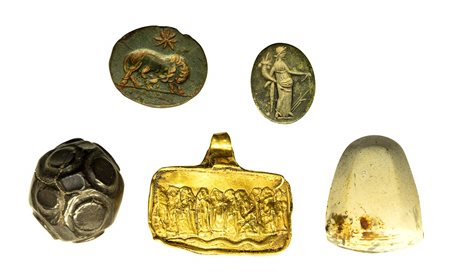
Lotto 253 A group of 5 engraved stones and a gold pendant, roman and near eastern.
1st mill. B.C. to 4th century A.D.
From left to right: An eastern Mediterranean green jasper intaglio with she-wolf feeding. Groundline and star above. An eastern Mediterranean green jasper Fortuna-Tyche. Groundline. An hemispherical hematite sasanian stamped seal (cracks), the base engraved with an enigmatic Zoroastrian symbol. A gold embossed pendant with a group of characters (?). Underneath, a serpent. A neo-babylonian burnt agate seal. Worshiper in front of a temple. Above, crescent moon.
From 11 x 15 mm (bronze inatglio tyche) to 22 x 25 mm (gold pendant).
-
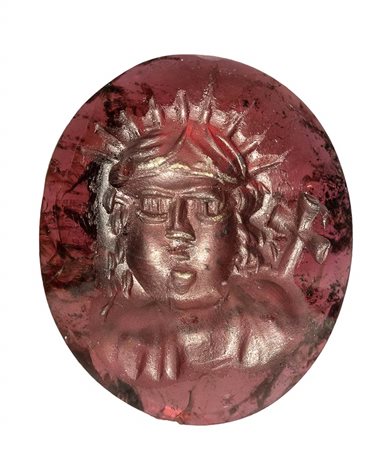
Lotto 254 A late roman garnet intaglio. Radiated bust with a cross.
3rd - 4th century A.D.
Frontal bust with head radiated and draped shoulders. On the right, behind the back, a cross. Slight wear marks.
12 x 14 x 5 mm. -
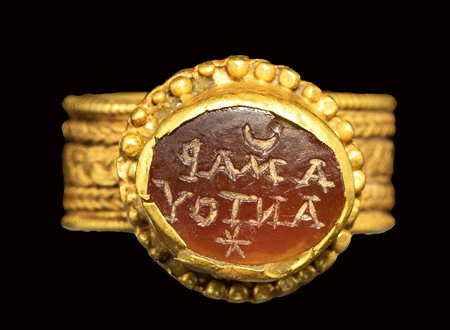
Lotto 255 A late roman gold ring with carnelian intaglio. Inscription with astrological attributes.
4th - 5th century A.D.
The hoop is flat within and rounded without with braided wire and plated wires. On top, a box-setting in button flower-shape set with an oval carnelian intaglio with an inscription in greek letters (probably a name) crescent moon and stars : ΑΜΑΡΑΝΤΟΥ(Amarantou). Intact.
Stone 11 x 12 mm; ring size 17 x 18 mm; H. 30 mm; 7,64 gr.
-
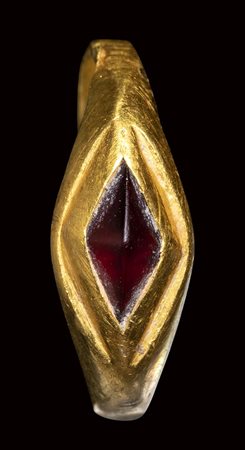
Lotto 256 A roman gold ring set with a sugar loaf garnet.
1st century B.C. - 1st century A.D.
The thin hoop, angular without and flatten within; lozenge shaped convex bezel with sugar loaf garnet inset. Rare.
Parallel: Marshall, F.H., 1968, n°755-756
int diam 16 mm; stone 3x7x3 mm; 2,79 gr. -
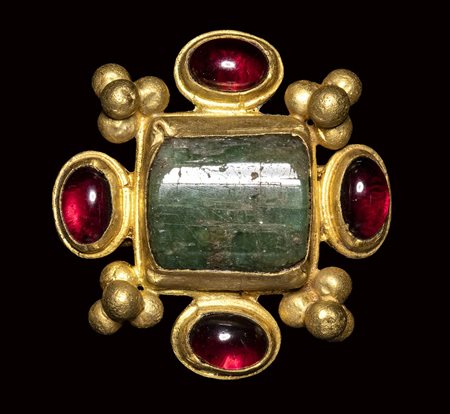
Lotto 257 A late roman gold ring set with emerald and garnets.
4th - 5th century A.D.
Gold ring with five box-settings containing four cabochon garnets, and in the center a large rectangular emerald root. On each angle 4 spherical plain gold beads saldered together. The hoop is rounded and composed of a double grooved gibbon with in the center of two twisted and roped wires covered within by a gold plaque, extending under the rectangular box-setting onto 4 globular ramifications. Very rare.
Parallels: Marshall, F.H., Finger Rings, 1968, pl. XXI-XXII
British Museum, inv. 1981,0201.14
Int diam 20 mm; bezel 24 x 25 mm . 14,43 gr -
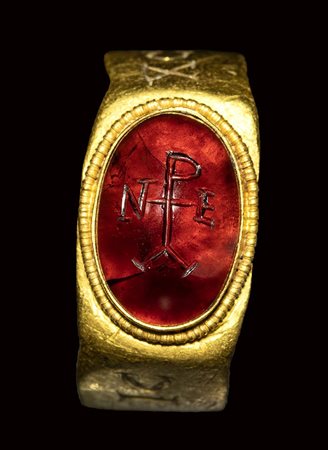
Lotto 258 A byzantine engraved gold ring with garnet cabochon intaglio. Christian monogram.
5th - 6th century A.D.
With sided hoop, flatten within, the shoulders engraved with latin letters « XC » and « IC ».
The oval bezel ornamented with a plaited gold wire and set with a garnet cabochon intaglio with an engraved christian monogram composed of the RHO symbol and two initials « N-E ». Slight cracks on the stone.
Stone 10 x 14 mm; ring size 19 x 22 mm; 11 gr. -
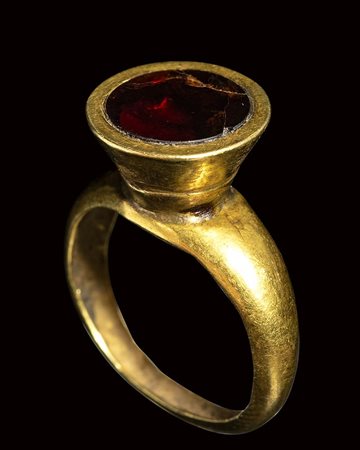
Lotto 259 A byzantine gold ring set with a garnet.
4th - 6th century A.D.
With rounded hoop, flatten within and extending in broader shoulders, high raised conical box-setting. The rounded bezel set with a garnet stone. Slight cracks on the stone. Slight restoration (saldering) on the junction bezel/shoulders.
Stone diam. 11 mm; ring size 17 x 19 mm; 5,67. -
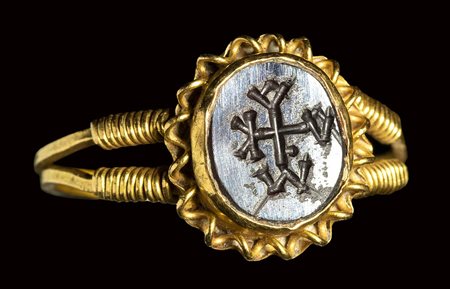
Lotto 260 A late byzantine gold ring set with a garnet intaglio with monogram of a Christian.
4th - 6th century A.D. circa.
With rounded hoop made of a double-ring, the terminals with twisted gold wires. The oval-shaped setting is composed of an embossed hollowed gold sheet adorned with a spiral gold wire and a gold bow containing a garnet intaglio engraved with a cruciform monogram with letters.
Unusual typology.
Stone 8 x 9 mm; ring size 17 x 19 mm; 3,21 gr.
-
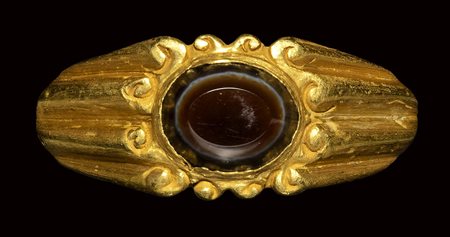
Lotto 261 A late roman gold ring set with an agate.
3rd century A.D.
Kindred type. With rounded hoop without and flatten within, broader angular shoulders, each with grooves, terminating above in volutes. The oval bezel set with a truncated banded agate.
Stone 8 x 10 mm; ring size 16 x 19 mm; 16,95 mm;
-
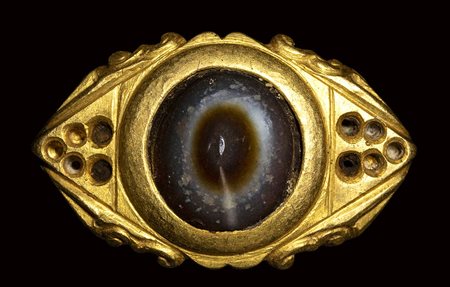
Lotto 262 A late roman openwork gold ring set with an agate.
3rd century A.D.
With losange-shaped bezel,very massive; each side with 5 rounded holes (unfinished foliage pattern work ? ). The sides of the hoop are demented with openwork, the projectile shoulders with volute patterns. Sunk rounded setting containing a truncated banded agate. Rare.
Stone 10 x 11 mm; ring size diam. 20 mm circa; 25,33 gr.
-
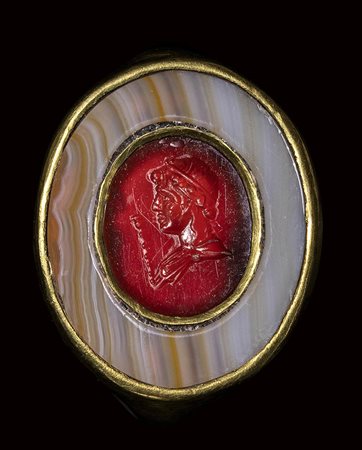
Lotto 263 A roman carnelian intaglio set in a postclassical gold ring with agate inserted into the bezel. Bust of Bacchus with thyrsus.
1st century B.C. - A.D.
The intaglio shows a male bust facing left and characterized by well-detailed features. His hair adorned by a band with graves rendered by globular elements such as his eye. Along his neck, a wavy lock ending on his shoulder covered by a folded mantle, and attached by a fibula. In front of him, a scepter (also rendered by globular elements) ending with a flower, probably a thyrsum. By the judging the realism of the features, this bust might be the representation of a ruler in Bacchus. The intaglio is inserted in an oval box-setting, surrounded by a banded agate insert on a larger box-setting. The hoop is plain and massive. Wear marks. Unusual and rare type.
Int diam 20 mm; bezel 18x22 mm; intaglio 9x11 mm; 15,53 gr.
-
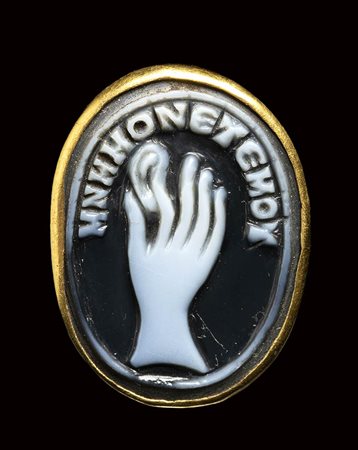
Lotto 264 A late roman two-layered onyx cameo set in a gold ring. Hand pinches earlobe with greek inscription.
3rd - 4th century A.D.
On this cameo, a hand pinches an earlobe between the thumb and forefinger; above a greek inscription— ΜΝΗΜΟΝΕΥΕ ΜΟΥ (Μνμονευε μου) meaning « Remember me ».
In Roman art and literature, the ear-tweaking hand is a common motif, meaning a request for attention. Gems such as this were mementos of love, and were probably given as gifts. The motif of the hand pinching or touching the ear as a stimulus to memory, thought to derive from the writings on natural history by Pliny the Elder, is fairly common in Roman gems, and the Greek inscription translates as 'Remember'. Such inscribed gems were popular, and other mottos such as 'Good Luck', 'Unity', or 'Farewell' also exist.
The gold mounting is with rounded hoop extending on high raised oval bezel containing the cameo. Wear marks on the surface of the ring.
Parallels: Louvre museum, inv. Bj 1296; British museum, inv. 1814,0704.1630; Getty museum, inv. 2001.28.11; Hermitage cat. n. 246, 247, 248, 391
Stone 13 x 19 mm; ring size diam. 15,5 mm; 5,30 gr.