
ASTA 107 - Glittica
-
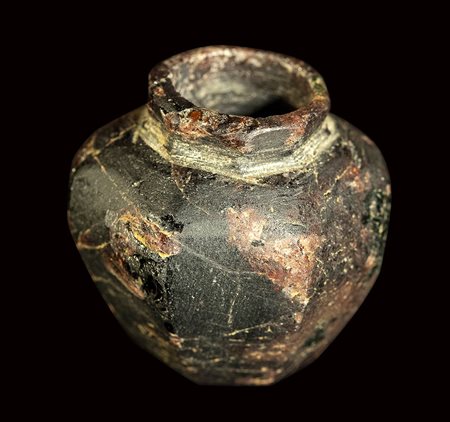
Lotto 241 A roman garnet uguentarium.
1st century B.C. - 1st century A.D.
With faceted belly, and narrowed short neck. Cracks. Wear marks. Rare.
H. 36 mm -
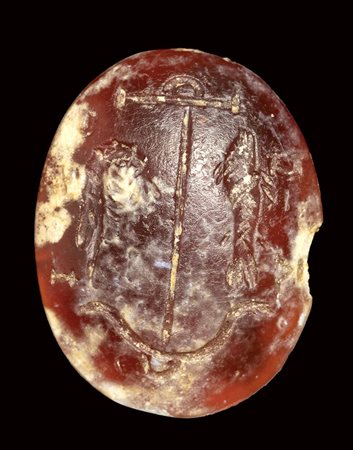
Lotto 242 A late roman carnelian intaglio. Christian emblema.
3rd - 4th century A.D.
The emblem is composed of an anchor and on its sides a fish and a shrimp. Around, a christological inscription (IXT YC). Signs of wear and burns on the surface. small chip on the edge. Parallel: J. Spier, Late Antique and Early Christian Gems, plates 27- 36.
12 x 15 x 4,5 mm. -
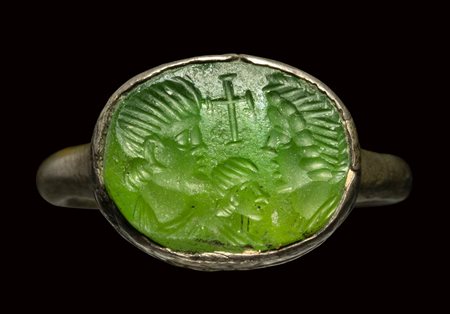
Lotto 243 A Late Roman - Early Christian green glass intaglio, set in a silver ring. Busts of a man, woman and child, with a cross.
4th - 6th century A.D.
On the left: tunicated male portrait; in the center, a small bust of a child; on the right: tunicated bust of a woman, with elaborate hairstyle, with a braid that holds her hair from behind. In the center, a cross. Probably an aristocratic family whose existence is consecrated to the Christian faith. The silver frame is characterized by small dotted decorations with engraved lines. Signs of wear. Parallel : for the typology: J. Spier, Late antique and Early Christian gems, plate 7-11.
Stone 11 x 14 mm; ring size 16 x 19 mm; 7,14 gr. -
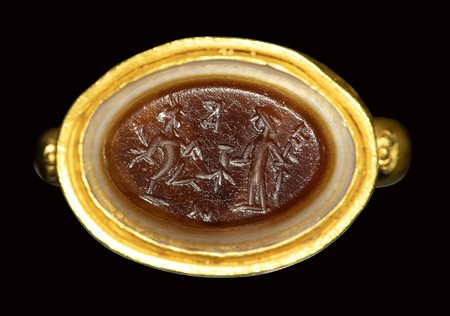
Lotto 244 A rare South Arabian gold ring set with a large banded agate intaglio. Mythological scene.
3rd - 4th century A.D.
South Arabian (Himyarite) ring set with an oval banded agate (brown on white) intaglio. The flat surface of the tapered gem is engraved with the figure of Pan prancing to the right holding a lagobolos(?) in his right hand and the syrinx in the left. He is shown facing a standing figure of Hermes holding a purse of money in his outstretched right hand while a caduceus in his left hand. There are two Sabean letters in the field between the two figures: (M and S'). Very good condition.
Stone 12 x 18 mm; ring size 14 x 19 mm; 11,74 gr. -
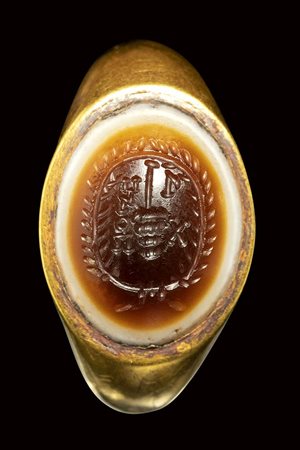
Lotto 245 A large banded agate intaglio set in a Sabean gold ring. Emblema with letters.
1st - 2nd century A.D.
This South Arabian ring is set with an oval banded agate (brown on white) intaglio. The slightly domed surface of the gem shows a central bunch of grapes flanked on the right by four letters (h i ' b) and on the left by two further letters (i t). The whole within a laurel wreath closed with a bow with streamers. Very good condition. Rare.
Stone 15 x 20 mm; ring size 15 x 19 mm; 14,40 gr. -
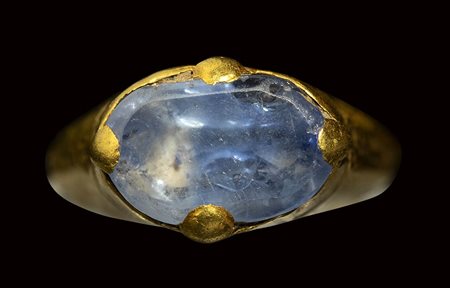
Lotto 246 An islamic gold ring set with a large blue sapphire.
12th century A.D.
This ring made of gold sheet over core with ellipitical bezel. Each shoulders has engraved floral design. The high raised bezel, was one each side decorated with engraved intricates pattern (now partially erased). The large oval bezel supports a blue sapphire held by 4 claws. This style of decoration is a translation of the decorative traditions used on garnements and textiles. Slight chips on the edges of the stone. Nice natural blue color. One side of the bezel has been partial damaged, letting the dark core of the mounting uncovered.
Parallel: for similar ring typology see Wenzel, M., Ornament & Amulet, the Nasser D. Khalili collection, n°189, p.66-67
Stone 8 x 12 mm; ring size 14 x 15 mm circa; 4,45 gr -
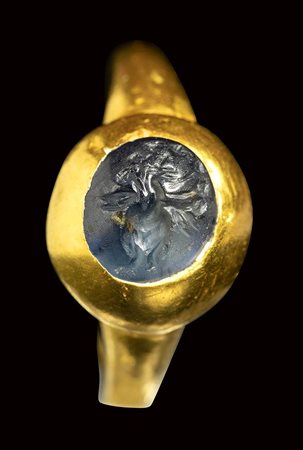
Lotto 247 A late roman blue sapphire intaglio set in a gold ring. Peacock.
4th century A.D.
The intaglio shows a peacock in frontal view, making the wheel, his tail wide open. The ‘eye’ design on his tail is marked by globular elements. His head is surmounted by its typical crowned part. For the ancient Romans and in eastern civilizations such as the Sassanian, like the double-headed eagle, the peacock has been seen in the symbolic forms with mystical and philosophical texts. Peacock is the symbol of decorating, luxury, glory and splendor, life with love, beauty. Reproduced on metal artwork or wall decorations (see Metropolitan Museum of Art, NY, inv.32.150.20). Peacock was also the attribute-animal to the goddess Juno. Rare.
Stone diam. 8 mm; ring size diam 17 mm circa; 8 gr.
-
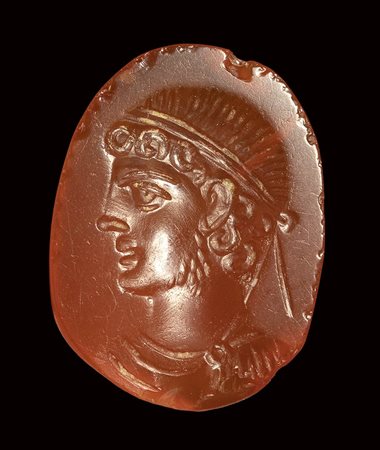
Lotto 248 A very fine Kushan carnelian intaglio. Portrait of a ruler.
1st - early 3rd century A.D.
The young ruler (or prince?) is facing left. He is characterized by hair held by a tenia with curls on the forehead and a slight barbula. Bust covered with a cloak and chlamys. It is closely related to roman gems of the same period. The discussion of the series is to be found inter alia in Callieri, P. Seals and Sealings from the North-West of the Indian Subcontinent and Afghanistan, (4th century B.C. - 11th century A.D.); Local, Indian, Sasanian, Graeco-Persian, Sogdian, Roman. Naples 1997. pp. 259 - 265, pls. 57-64. Parallel: Rahman, A.U. and Falk, H. Seals, Sealings and Tokens from Gandhara. Wiesbaden, 2011. p. 32, no. 01.01.05
12 x 16 x 3,5 mm. -
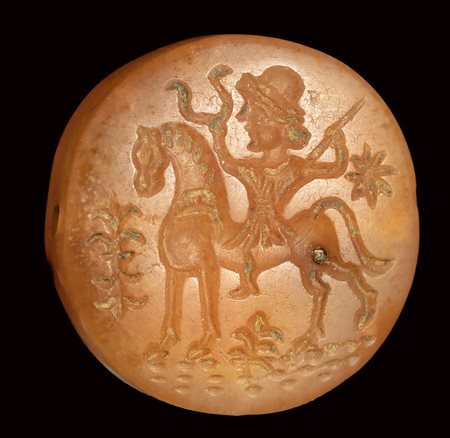
Lotto 249 A rare early islamic carnelian seal intaglio. Horseman holding a tamga (?).
5th - 8th century A.D.
The horseman is facing left, on top of a horse, and holds a tamga (?) with his right and a spear with his left. Below, the ground and vegetation. In the field, a star. Through hole. Slight signs of wear. Parallel: Rahman, A.U. and Falk, H. Seals, Sealings and Tokens from Gandhara. Wiesbaden, 2011. p. 123, no. 09.04.09. Hunnish or early Islamic, For an earlier Sasanian horseman, cf. Gignous, P. Intailles sassanides de la collection Pirouzan. in: Acta Iranica; Hommages et opera Minora, vol. III Monumentum H.S. Nyberg. Leiden, 1975. p. 27 and pl. XIX, fig. 5.5.
Diam 21 mm x 8 mm. -
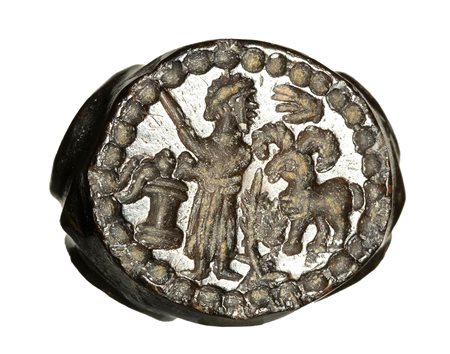
Lotto 250 A christian hematite seal. The Sacrifice of Isaac.
ca. 5th - 7th century A.D.
Abraham stands left, head turned back, holding a knife over Isaac, who lies on an altar; a ram, tied to a tree is behind him; above, the hand of God. Christian from the Sasanian Empire. One of the earliest studies on the subject is Horn, P. and Steindorff, G in: Königliche Museen zu Berlin. Mittheilungen aus dem Orientalischen Sammlungen. vol. IV: Sassanidische Siegelsteine. Berlin, 1891. p. 5, pl. I, no's. 1078 - 1080. (not identified as Sacrifice of Isaac).
Judith Lerner, whose Christian Seals in the Sasanian Period. Istanbul, 1977. illustrated a number of gems as a coherent group on pp. 18 - 26, figs. 24 - 35, identified the subject and showed the Christian link.
A follow-up was published as: Lerner, J. The Sacrifice of Isaac Revisited: Additional Observations on a Theme in Sasanian Glyptik Art. pp. 39 - 57 in Facts and Artefacts; Art in the Islamic World. Festschrift for Jens Kröger on his 65th Birthday. Leiden/Boston, 2007.
Spier, J. Late Antique and Early Christian Gems. Wiesbaden, 2007, no. 803- 829.
A very fine example, once in the Content Collection, may be found in: Lerner, J. Considerations on an Aspect of Jewish Culture under the Sasanians: The Matter of Jewish Sigillography. in: JOAS, 129. 4 (2009, p. 664, fig 1.
An extensive further bibliography about the type and other closely related subjects may be found in J. Spier's: Late Antique and Early Christian Gems. Wiesbaden, 2007, no's 803 - 833, pp. 145 - 148
Bezel 11 x 14 mm; h. 11 mm. -
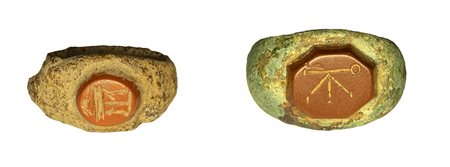
Lotto 251 A group of two late roman bronze rings with red jasper intaglios.
3rd - 4th century A.D.
From left to right: A bronze ring set with a jasper intaglio. Incense burner (?). Ring damaged.
A bronze ring set with an octogonal jasper with Christian monogram.
Stone (monogram) 12 x 14 mm, ring size 16 x 19 mm; Stone (tripod) 9 x 11 mm, ring size 15 x 18 mm. -
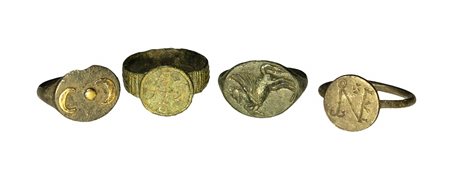
Lotto 252 A group of late roman and late byzantine gilded bronze and silver rings.
4th - 12th century A.D.
From left to right: A bronze ring with round hoop and large oval table with two gilded crescent moon and a solar disc in the center. A bronze ring with rounded bezel and christian monogram.
A bronze ring with rounded hoop and oval bezel with engraved winged-horse (partially gilt).
A silver ring with rounded bezel and Christian monogram.
Pegasus bezel 14 x 19 mm, size 17,5 x 18,5 mm; 2 moons bezel 13 x 18 mm, size 15 x 16 mm circa; silver monogram bezel diam. 13 mm, size 17 x 19 mm; bronze monogram diam 12,5 mm, size 18 x 19 mm.