
ASTA 107 - Glittica
-

Lotto 229 A large eastern roman gnostic hematite intaglio. Anubis with astrological symbols.
3rd century A.D.
The scene depicts the jackal-headed Anubis in armour, standing to left on a crocodile; also to left. Both arms raised and bent in elbow, the left hand holding a whip, right hand a trident. Above Anubis, two eight-pointed stars and a scorpion. Around the figure and in the free field: letters and charakteres including a pentagram and a star. Groundline. Slight chips on the edge of the stone. Traces of deposit inside the engravings. Parallel: The Campbell Bonner Magical gems database, CBd-2575
19x28x3 mm -
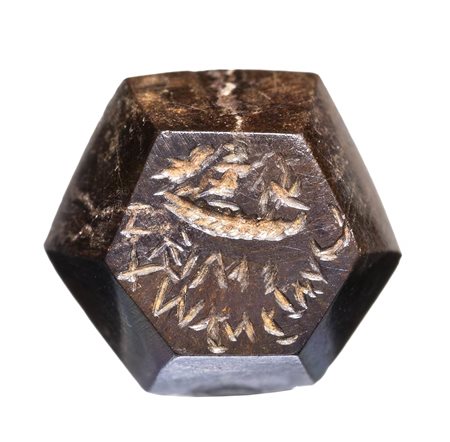
Lotto 230 A roman hexagonal hematite magical intaglio. Figures on a papyrus boat with inscription.
2nd - 3rd century A.D.
The scene shows on top, Harpocrates sitting, to right, in a papyrus boat. Two birds (falcons ?) perch at the prow and stern of the boat. Below, hebrew pseudo-script (?) inscriptions. Rare.
12x11x6 mm -
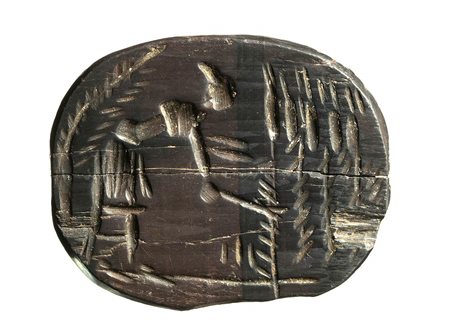
Lotto 231 A roman hematite gnostic intaglio. Reaper- Eagle.
2nd - 3rd century A.D.
A) Reaper wearing high cap and kilt, stooping to right to cut five stalks of grain with a long-handled sickle. Behind him, on the left, a tree.
B) Eagle with widespread wings. Above, the greek letter Ρ.
Longitudinal crack visible on the stone (stone is broken in 2 pieces). A series of hematite intaglios show a reaper leaning forward to cut tall stalks of wheat with his sickle; behind him rises a tree branch. On most of them, we found inscriptions on the reverse, indicating they are amulets against hip pain. This lies in the fact that this type of work presupposes that one does not suffer from the hips. Hematite was a stone appreciated for its ease in breaking, because hematite dust was frequently used in medicine. The breaks of hematite gems can testify to a medical rite in which a part of the stone was pulverized to make a medicine.
Parallel: Mastrocinque, Attilio. Les intailles magiques du département des Monnaies, médailles et antiques. Paris : Bibliothèque nationale de France, 2014, p.169, n°460. Bonner, C.. Studies in magical amulets. 1950, n° 120, p, 272.
21 x 27 x 4 mm.
-
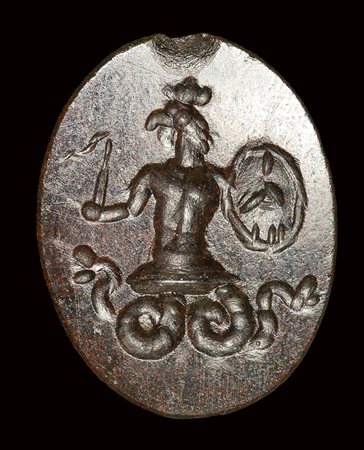
Lotto 232 A roman magical abrasax heliotrope intaglio. Anguipes cock.
2nd - 3rd century A.D.
The hybrid figure is turned on the left. With the right hand he holds the solar whip; the left holds the round shield which is inscribed Ἰάω. On the reverse and on the edge, magical letters. Chip on the top edge and wear marks on both sides. Very nice color of the stone. Parallel : Mastrocinque, Attilio. Les intailles magiques du département des Monnaies, médailles et antiques. Paris : Bibliothèque nationale de France, 2014, p.116, n°303.
11 x 14 x 4 mm. -
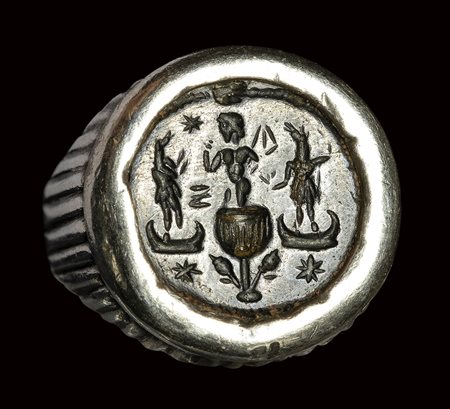
Lotto 233 A roman hematite magical intaglio set on a silver ring. Harpocrates on a lotus flower.
2nd - 3rd century A.D.
A) In the center, Harpocrates as a youth standing naked on a lotus flower (the lower part of the body hidden inside the lotus ?). On each side, Hermanubis, standing toward the young Horus, on a boat and worshipping. Stars and charakteres. All around, an ouroboros.
B) Partially erased inscriptions.
A praxis known from a papyrus (PGM LXI 1-38) specifies that love charms had to be incised with the image of Horus on a lotus flower and the magical name Abraxas (here impossible to confirm the inscription on the reverse). Pieces with the Horus-scheme used as love charms: CBd-533, CBd-534.
Slight crack and restoration.
Stone diam. 15 mm; ring size 19,5 mm circa; 12,34 gr. -
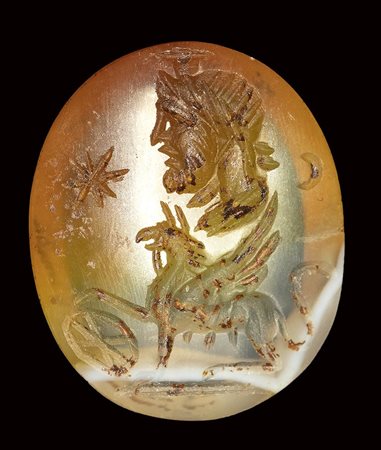
Lotto 234 A roman magical agate intaglio. Nemesis allegory.
2nd century A.D.
Bust of Zeus facing left, above a griffin with wheel. On the sides, a star and a crescent moon. Groundline. Allegorical emblem of revenge (Nemesis) with astrological symbols. Beautiful variety of honey tone agate with a white band near the groundline. Iron traces and slight wear marks.
15 x 18 x 4 mm. -
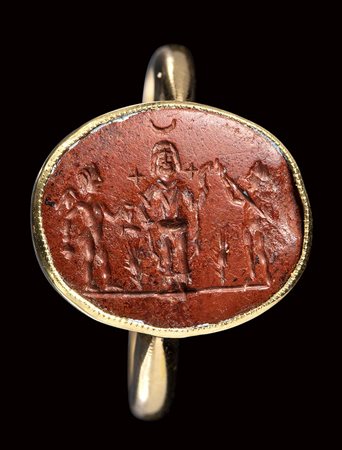
Lotto 235 A roman red jasper magical intaglio set in a gold ring. Votive scene.
2nd - 3rd century A.D.
The intaglio shows a central male in front, wearing a cloak and a sickle surrounded by astral symbol (stars and crescent moon), on each side a winged erotes holding vases (?) and an other young character holding a stick (?). Ear of corns on the ground. Groundline. The central character could be a representation of Kronos. Magical symbolic related to fertility and rebirth.
The 18k gold mounting is with rounded hoop with French mark (eagle head). Rare.
int diam 16 mm; intaglio 11x13mm; 3,41 gr. -
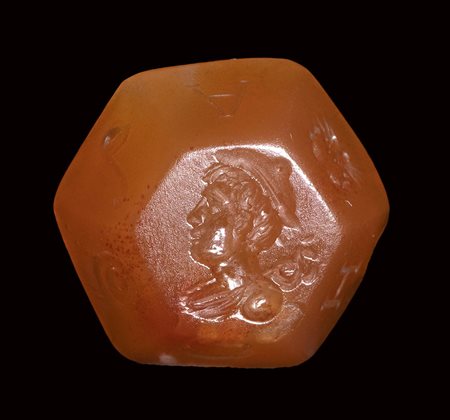
Lotto 236 A roman magical carnelian intaglio. Bust of Mercury/Astrological symbols.
2nd - 3rd century A.D.
The hexagonal stone is engraved on is flat side with a bust of Mercury facing left, wearing petasus and holding on his shoulder a caduceus. The other edge sides engraved with a letter or symbol: A, crab, H, crescent moon, patera (?), simpulum (?). Astrological-magical gem. Rare.
15x16 mm -
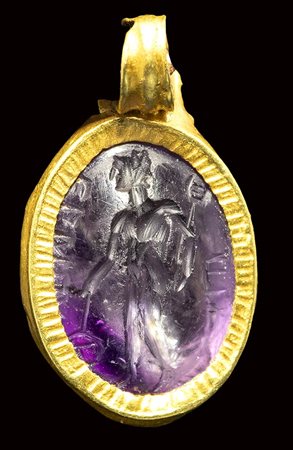
Lotto 237 A roman gold pendant set with a gnostic amethyst intaglio. Mercury with attributes.
2nd - 3rd century A.D.
The gold box-setting with suspension hoop is decorated on the edge with thin engraved lines.
The intaglio is depicting on one side— Standing Mercury, turned left and crowned with stylized little wings. He only wears a cloak, holding the caduceus in one hand and the purse in the other one. On both sides greek letters and charakterês. Magical gems depicting Hermes/Mercury are very rare. The citizens of the Empire who worn rings with the image of this god were numerous. But on magical gems, the figure of Thut was more used.
Stone 0,8 x 10 mm; h. max 16 mm; 1 gr.
-

Lotto 238 A roman lapis lazuli magical intaglio. Gorgona mask with torch.
3rd century A.D.
Slightly three-quarters, almost frontal Gorgona mask. Eyes with engraved iris and winged head with snakes; below, a burning torch. Magical depiction for protective and apotropaic purposes. Rare combination of subject and material. Slight signs of wear.
12x14x3 mm -
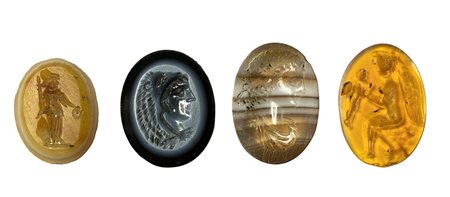
Lotto 239 A group of 4 intaglios. Various subjects.
3rd century A.D.
From left to right: A three-layered agate helmeted Minerva standing, turned right. A nicolo intaglio with portrait of Hercules turned right and wearing the lion skin. A banded agate intaglio with the bust of an hellenistic ruler turned right.
An orange glass impression with a winged Nike and Eros.
Nicolo 12 x 15 x 2 mm; carnelian 11 x 16 x 2 mm; agate 11 x 13 x 2 mm; banded agate 11 x 16 x 2 mm. -

Lotto 240 A roman agate "magical eye" bead.
Early 1st millenium A.D.
The long convex oval stone is a three-layers agate also call « eye bead » since the natural layers of the stone reminds an eye with apotropaic power.
Parallel: for a similar bead see Christie’s NY, December 6th 2007, lot 466
22 x 38 x 13 mm.