
ASTA 107 - Glittica
-
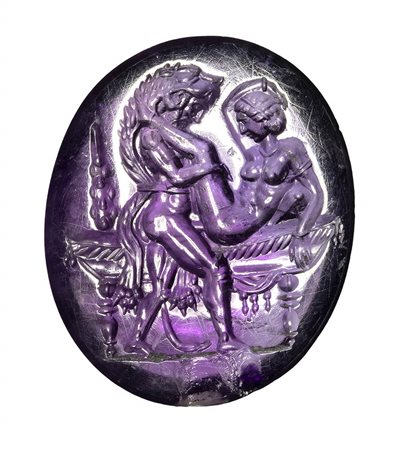
Lotto 217 A large roman amethyst intaglio. Erotic scene.
2nd century A.D.
The man is standing, facing right, and wearing a large leontea that goes from the head down to the calves, covering his back. The woman is semi-reclining on a bed characterized by legs made of ovoid and disc-shaped elements; elegant fringed padding and a pillow make this moment of pure lust beautifully comfortable. Next to the couple, the club of Hercules, a symbol of strength and power. The man grabs her by the legs firmly, showing all his muscles, to penetrate her. The woman raises an arm next to her face, as a sign of satisfaction. The physiognomic features and the hair are referable to the 2nd century A.D., probably to the Antonine era. Chip on the edge below the ground line. Large gem characterized by an extraordinary color. Slight wear marks.
21 x 25 x 0,4 mm. -
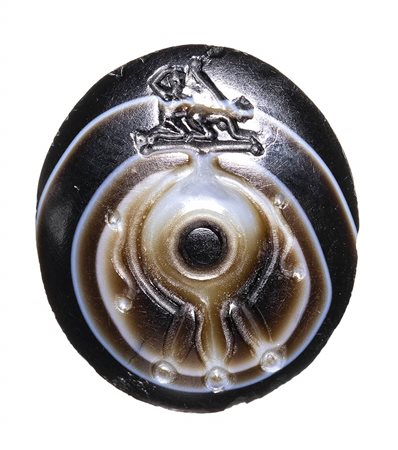
Lotto 218 A roman sardonyx intaglio. Erotic scene on an oil lamp.
Early 1st century A.D.
Tricline oil lamp (three "beaks" or "fires") adorned above the handle ("triangular reflector") by an erotic scene: a young man on his knees is intent on penetrating a kneeling woman from behind ("coitus da tergo"). The type of lamp can be traced back to the Julio-Claudian era. Presence of globular elements. Beautiful variety of banded magical eye sardonyx. Wear marks. Parallels: AGDS n. 232; n. 747. AGKM (Kunst, Wien), vol. II, n. 950.
19x22x6 mm -
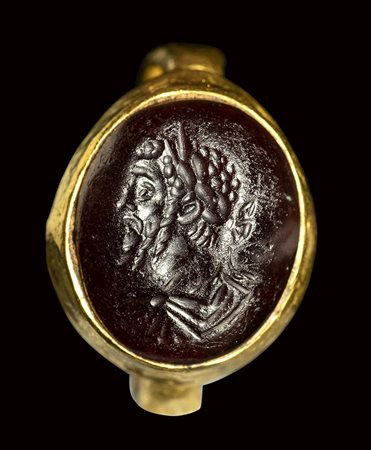
Lotto 219 A roman garnet intaglio set in a gold ring. Bust of Septimius Severus.
2nd century A.D.
Portrait of the emperor Septimius Severus (145-211), facing left. He wears a laurel wreath on his head and a cloak with a chlamys on his shoulders. The typical physiognomy of the face and the anatomical details fit perfectly to his portraits. A sure comparison comes from the coins, but there are some portraits engraved on gems and very similar cameos. This portrait is engraved on a large cabochon, still mounted in its original ancient mount. Signs of wear. Exemplary of great historical importance. Parallel: G.M.A. Richter, The engraved gems of the romans, part two, n. 572 ss.; M-L. Volleinweider, Camées et Intailles. Les portraits romains du Cabinet des médailles, Tome II n. 204 ss.
Stone 13 x 15 mm; ring size 17 x 18 mm; 10,24 gr
-
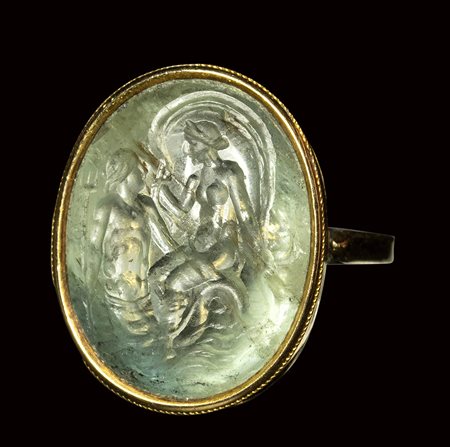
Lotto 220 A rare roman beryl intaglio set in a gold ring. Venus Pelagia on a Triton.
Early 1st century A.D.
A female figure seated on the tail fin of the young, beardless Triton in the middle of the sea represented by incised wavy lines. She is naked except for the drapery covering her legs; she holds the triton’s fin with her right hand, while in the left one she holds a part of a mantle flying over her head. Her hair is braided around the head and tied in a bun at the nape. She wears a diadem. Triton holds the woman by his right hand in the gesture of carrying; as a son of Poseidon, he has a trident in his left. The subject is ancient and was popular in glyptics from the hellenistic period. The diademed female figure can be identified with a marine Venus (Venus Pelagia) rather than with a nereid. This subject is related to the Augustean ideological program and the victory of the battle of Actium by Augustus. Extraordinary testimony engraved on a precious stone of great rarity for ancient times. The gem is biconvex, deep cabochon, set in a 19th century collector’s gold ring. Slight internal cracks due to time, but the gem is solid. Wear marks.
Published: Pawel Golyzniak, Nereid of Venus? The impact of Augustus'"cultural programme" in the private sphere reflected in glyptics, fig. 1; L.P.B. Stefanelli, La Collezione Paoletti, vol. 1, n. 419 (Tomo I).
Stone 15 x 19 mm; ring size 15 x 17 mm; 5,79 gr.
-
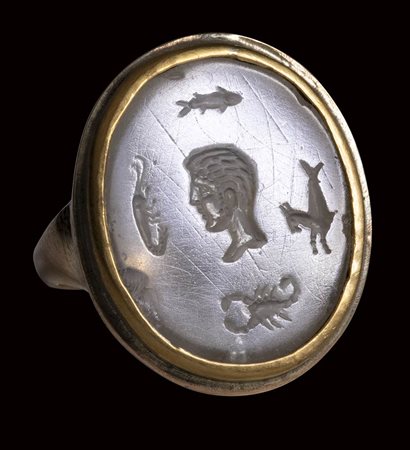
Lotto 221 A large roman rock crystal astrological intaglio set in a gold ring. Portrait of youth with zodiacal and sea animals.
Early 1st century A.D.
Juvenile head in profile facing left. The hair is short, a slight barbula goes down near the ear. The profile is linear, of the Octavian Augustus type. Around the portrait, there are four animals: a fish, a seagoat, a scorpion and a shrimp. These strongly symbolic animals can have, except for the shrimp, an astrological and allegorical meaning, especially the sea capricorn. Some details are engraved with small globular elements. The style is attributable to the end of the Republican age and the beginning of the Augustan period. Interesting allegorical composition. The work is engraved on a large rock crystal. Signs of wear and some light scratches on the surface. Small chips on the edge. The bezel edge is in high carat gold. Parallels: M.L. Volleinweider, Camées et intailles. Les Portraits romains du Cabinet des Médailles, pl. 46. ; M.L. Volleinweider, Die portratgemmen der Romischen Republik, pl. 142 n. 1, 2, 4, 6, ss; pl. 143, 144, ss; 149 n. 15; pl. 151 n. 16 ss. See the coinage. For the subject, a very close intaglio in AGKM (Kunst Museum, Wien) n. 520.
Provenance: UK private collection S.B. London, 1970s, acquired on the London market in 70s. Based on the mounting from a late 19th - early 20th century collection.
Stone 15x18x3 mm; int diam 18 mm; 19x23 mm; 8,15 gr.
-
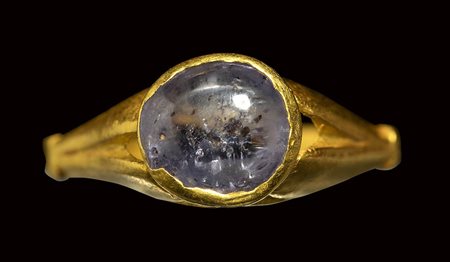
Lotto 222 A late roman gold ring set with a cabochon blue pale sapphire.
3rd - 4th century A.D.
With elliptical hoop , projection below either shoulder ornamented with incised lines. Raised circular bezel with a cabochon blue pale sapphire. Signs of wears and chips on the surface of the stone. Slight missing material on the edge of the box-setting.
Parallel: for similar ring typology see Marshall, F.H., 1968, 976
Stone 10 x 12 mm; ring size 14 x 16 mm; 3,56 gr.
-
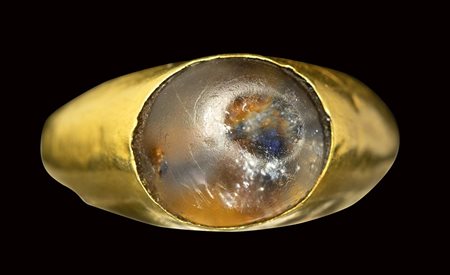
Lotto 223 A roman gold ring set with a translucent sapphire.
2nd - 3rd century A.D.
With massive elliptical hoop, slight flatten within; extending in broader shoulders with raised oval bezel set with a cabochon sapphire stone. Slight signs of wears with slight depression on the surface. Unusual blue and orange shades. Good State of conservation for the mounting.
Stone 6 x 7 mm; ring size 15 x 16 mm; 2,13 gr. -
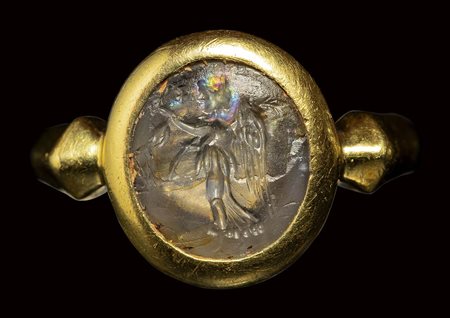
Lotto 224 A rare roman sapphire intaglio set in a gold ring. Nike.
1st - 2nd century A.D.
The intaglio depicts a winged Nike standing and turned left. She holds a palm branch and a laurel wreath in her hands. Slight chips and wear marks on the surface of the stone. The later massive gold mounting with elliptical hoop, flatten within is extending with sided shoulders narrowed toward the junction with the rounded bezel.
Stone 9 x 11 mm; ring size 14 x 16 mm; 7,47 gr. -
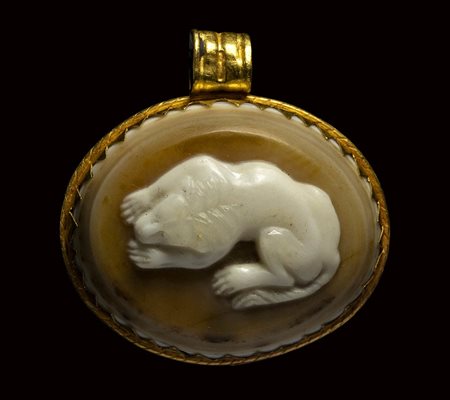
Lotto 225 A large roman agate cameo set in a later gold pendant. Sleeping dog.
2nd - 3rd century A.D.
Sleeping dog reclining to the left, his head resting between his paws. The cameo is carved from a multi-layered agate. The animal is engraved in the white layer with transparencies above a honey-colored background. The stone is mounted in a modern gold revival pendant in the antique style. Parallels: A.P. Kozloff, ed., Animals in Ancient Art From the Leo Mildenberg Collection, Cleveland, 1981, no. 186.; U. Gehrig, ed., Tierbilder aus vier Jahrtausenden, Antiken der Sammlung Mildenberg, Mainz am Rhein, 1983, no. 186.
Stone 27 x 32 mm; mounting 34 x 34 mm; 13,70 gr. -

Lotto 226 A roman heliotrope intaglio. Fight scene with two gladiators.
2nd century A.D.
Two gladiators are facing each other, over a ground line. Both are equipped with similar armament, but with variants. The fighter on the right has an helmet with a closed visor; left arm armed with a curved sword and covered by protection; belt and pelvis protection; greaves and closed shoes. The warrior on the left always has a similar helmet with a closed visor, greaves, belt but has leather belts on his back that hold a breastplate (?); arm armed with a sharp pointed sword with arm protection. The left arm instead holds an ax. His shield is on the ground. His opponent instead protects himself from his violent attack with the shield. The scene is strongly inspired by Roman mosaics. The choice of the dark green heliotrope with vivid red inclusions, to symbolize the blood, the death and the violence of the clash, makes this rare representation very interesting and extraordinary. Parallels: AGKM (Kunst Museum), n. 1701; AGDS Berlin, n. 482. E. Z-Dihel, Die Gemmen und Kameen des Dreikonigenschreines, n. 259 (in heliotrope. The gladiator is described as a "secutor"). AGDM (Munchen) n. 2384. L.P.B. Stefanelli, La Collezione Paoletti, vol. I, n. 560-561 for a very close type (tomo II, cas. 8).
16 x 19 x 2 mm -
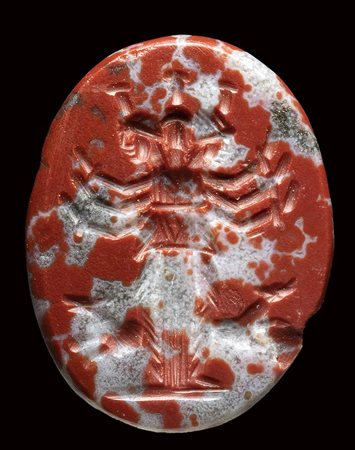
Lotto 227 A rare roman magical mottled chalcedony intaglio. Hecate.
2nd - 3rd century A.D.
Hekate flanked by two dogs. This depiction shows a very rare combination of the goddess with dogs. Her worship was widespread in all the graeco-roman world, especially in the regions of Caria, Lydia, Phrygia and Thrace. For her complex personality and function, referred to both the earthly and celestial scope, the goddess mainly acquires a role of mediator between the world of the living and the world of the dead, intermediary in human events, trivium divinity and protective of roads and crossroads. Especially linked to the infernal sphere, she is a guide for restless spirits and demons from the afterlife; she is represented holding torches in order to dissipate darkness, and followed by a band of dogs. The back of the setting shows a rut on the edge (presumably afterwards it was converted into a talisman pendant). The particular choice of the kind of stone is related to its precise protective effects. Light chippings on the field.
Parallels: Attilio Mastrocinque, Sylloge gemmarum gnosticarum, parte I (Bollettino di numismatica- monografia) IPZS pp. 344-346.
11 x 14 x 3 mm.
-
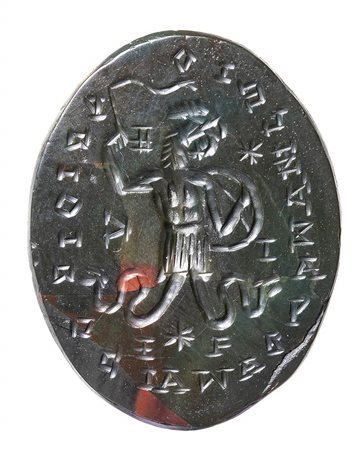
Lotto 228 A large heliotrope roman gnostic intaglio. Anguipes with letters - Helios on a lion with letters.
2nd - 3rd century A.D.
The first side of the stone shows a cock-headed Anguipes in frontal view, his head turned right. He wears a skirt, shield and whip. Around, greek letters, charakteres and inscriptions « ΙΑω - ΑΒΡΑωΑΞ - ΛΕΙΟ - ΡΒΙΟΙΒΟC»….
On the other side, Helios standing right on a lion, holding a whip in his right arm, and his left one upraised.
Around, inscriptions « FΜΟΙ Ι Ι ΡΟF »
On the edge of the stone, inscription « ΑΒΛΑΝΑΝΑΙΟ»
Parallel: A. Mastrocinque, Sylloge Gemmarum Gnostocarum, P.1, 2003, p.296, n° 24
23x29x5 mm