
ASTA 107 - Glittica
-
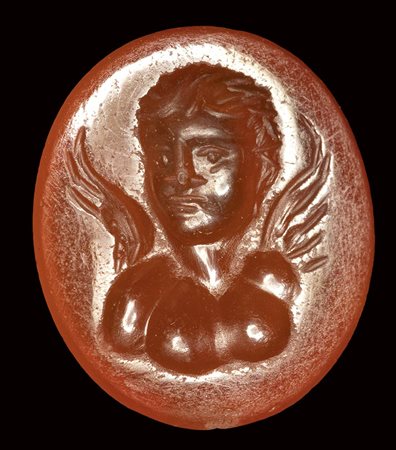
Lotto 193 A roman carnelian intaglio. Bust of Eros.
Late 1st century B.C. - Early 1st century A.D.
The young winged Eros is depicted frontally, with a very light torsion of the bust to the right and of the head to the left. Very fine execution. Use of globular elements (late republican style). Beautiful color of the stone. Slight wear marks.
12 x 13 x 3 mm. -
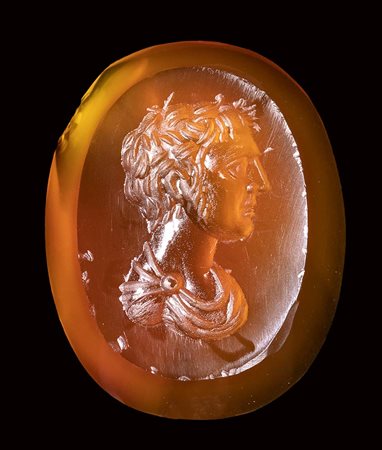
Lotto 194 A fine roman carnelian intaglio. Male bust.
1st - 2nd century A.D.
The male character is facing right and characterized by viril features with a barbula: a strong look, straight nose, semi-opened lips and prominent chin. His face is framed by thick hair composed of short locks and long sideburn. He wears a chlamys attached with a fibula on his left shoulder. Probably a portrait of an official of the military elite. Large size. Slight wear marks.
16x20x4 mm -
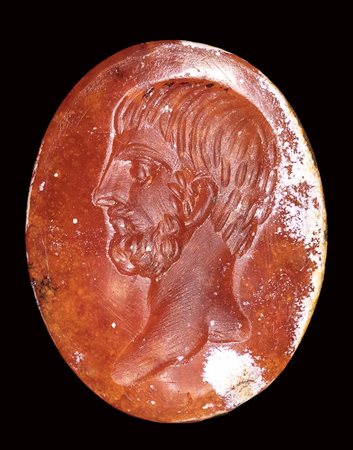
Lotto 195 A roman burnt carnelian intaglio. Male portrait.
2nd century A.D.
The male character is facing left. He is characterized by short hair and trick beard framing his face. Straight nose, and mouth framed by a moustache joining the beard; globular eye. The neck is raised by rendered muscles. Typical features and style referred to the 2nd century A.D. after the imperial Severian dinasty. Fine private portrait. The stone is partially burnt.
12x16x4 mm -
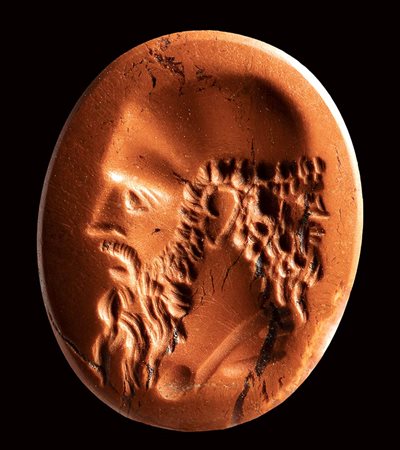
Lotto 196 A roman red jasper intaglio. Bust of a philosopher.
2nd century A.D.
The character is facing left, and is characterized by a partially bald skull, a long beard and thick hair on the nape of the neck where a face can be seen. Interesting subject. Slight wear marks.
12 x 15 x 3,5 mm. -
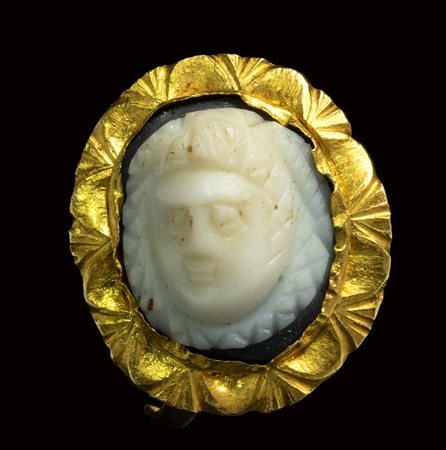
Lotto 197 A roman onyx cameo set in a gold ring. Frontal mask of Medusa.
3rd century A.D.
Typical late roman stylized Medusa mask, with the snakes around the face and the winged head. The shank would appear to be deliberately "split" to make the size adjustable. Slight wear marks.
Stone 10 x 11 mm; mounting 13 x 15; ring size 12 x 13 mm; 2,17 gr. -
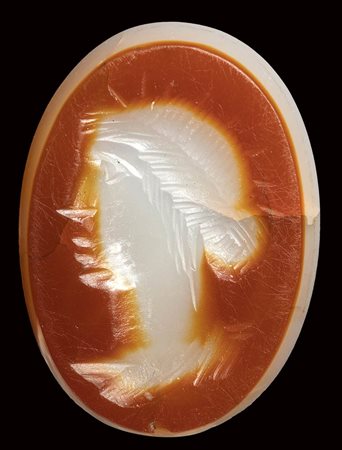
Lotto 198 A roman agate intaglio. Bust of Apollo.
2nd-3rd century A.D.
The divinity is turned to the left, with the radiated head and the draped bust. The intaglio is engraved on a two-layered agate. Small chips on the edge and slight internal cracks.
11 x 16 x 2,5 mm. -
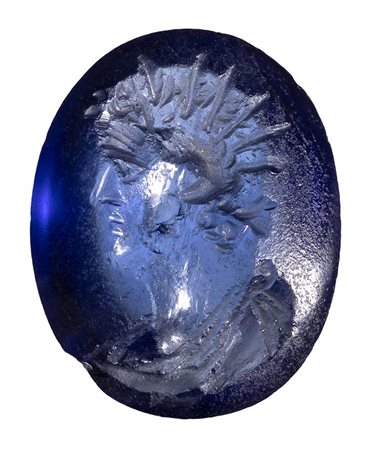
Lotto 199 A roman blue glass intaglio. Portrait of Helios.
2nd century A.D.
Facing left, with his radiated crown. He wears a tunic attached by a fibula. Signs of Wear on the surface of the stone. Beautiful deep blue color.
10x12x3 mm -
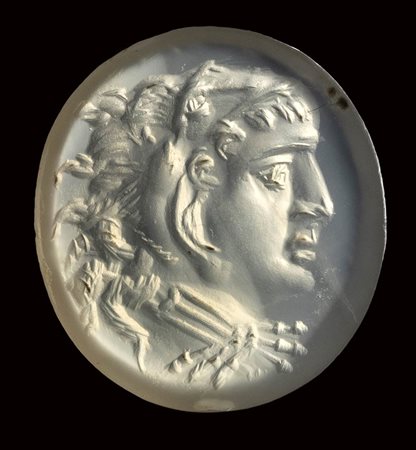
Lotto 200 A roman chalcedony intaglio. Alexander the Great.
1st - 2nd century A.D.
The king of the Macedonians faces right and wears a leontea on his head. The face is in profile and is characterized by its typical features. The carving is done with a certain spontaneity. Beautiful variety of chalcedony. Slight signs of wear.
Parallels: M-L. Wollenweider, Camées et intailles. Les portraits grecs du Cabinet des médailles Tome I. pp. 27 ss.
18 x 20 x 0,4 mm.
-
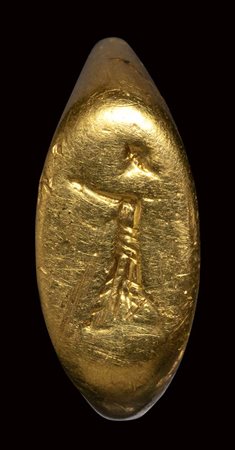
Lotto 201 A roman gold engraved ring. Nike.
1st century A.D.
With elliptical hoop, extending with broader shoulders to an elongated oval engraved bezel. The scene shows a Nike, standing and walking left. Her arms raised. She wears a long dress. Her hair tided back in a bun. Signs of use and wears on the bezel and on the general surface of the mounting.
int diam 15 mm; bezel 7x14 mm; 4,61 gr. -
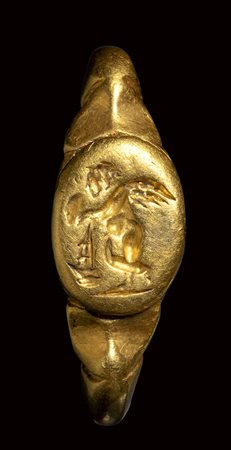
Lotto 202 A late roman engraved gold ring. Funerary Erote.
Late 2nd - 3rd century A.D.
With elliptical hoop, flat within, extending with broader and concave triangular-shaped shoulders, surmounted by an oval bezel engraved with a winged Eros. The character is standing, his body in three-quarters his head turned left. The right leg crossed on the left one. His arms extending, he holds a patera (?) on top of an incense burner. Groundline. Slight wear marks on the surface.
int diam 14 mm; bezel 7x10 mm; 4,67 gr.
-
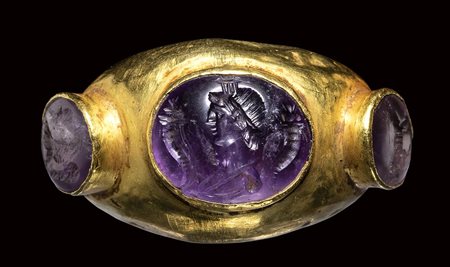
Lotto 203 A large roman gold ring set with three amethyst intaglios. Eagle, Male portrait with cornucopia and a sow.
3rd century A.D.
A large roman gold ring set with three amethyst intaglios. Eagle, Tyche of Antioch bust with cornucopiae and a sow.
Large hollowed hoop expending at the shoulders, on each side above two round raised settings containing amethyst intaglios. In the center, a larger oval raised setting containing a large amethyst intaglio. Intaglios depict respectively; an eagle with wide-spreaded wings, a bust of a Tyche of Antioch facing left and framed by two cornucopiae; a sow facing right. Wear marks and deposits. Rare tipology.
Parallels: Marshall, F.H., 1968, PL. XXI, 851.
int diam 22 mm; intaglios 9x11 mm; 12x16 mm; 9x11 mm; 16,39 gr.
-
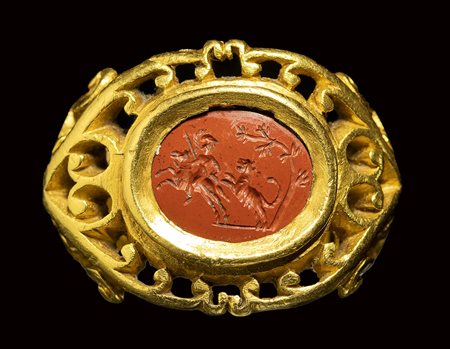
Lotto 204 An important roman openwork gold ring set with a red jasper intaglio. Hunting scene.
2nd - 3rd century A.D.
The gold ring with heavy opus interrasile hoop with stylized openwork scrolling foliate design with broad shoulders, reset with a flat oval stone depicting a hunter mounted on a rearing horse, wearing crested helmet with a spear in his hand, looking back at an attacking lion, which emerges from beneath a bowed tree. Very good condition. Slight wear marks.
Stone 11 x 14 mm ; ring size 18 x 21 mm; 34,05 gr