
ASTA 107 - Glittica
-
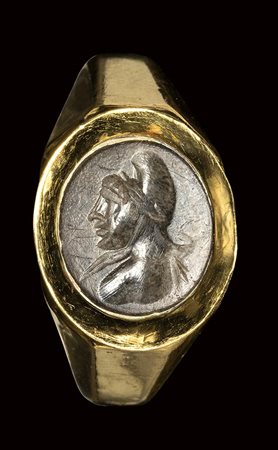
Lotto 181 A roman jasper intaglio set in a modern massive gold ring. Bust of a Phrygian.
2nd century A.D.
The stone depicts a male character turned left. He is characterized by strong features; wide-open eye, straight nose with large nostril and semi-opened mouth. The head is surmounted by a phrygian hat. Probably Ganymede. The massive gold mounting with angular and sided hoop is surmounted by a large oval bezel.
Stone 12 x 14 mm; ring size 18 x 19,5 mm; 21,26 gr. -
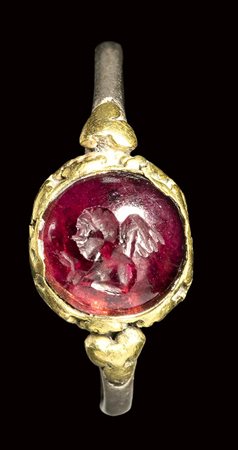
Lotto 182 A late roman bimetallic ring with garnet cabochon intaglio. Eros.
3rd century A.D.
With silver rounded hoop, the shoulders with trefoiled gold beads, and gold rounded bezel set with a garnet cabochon intaglio. The scene depicts a bust of winged eros turned left.
Stone 7 x 8 mm; ring size 16 x 17,5 mm; 2,19 gr. -
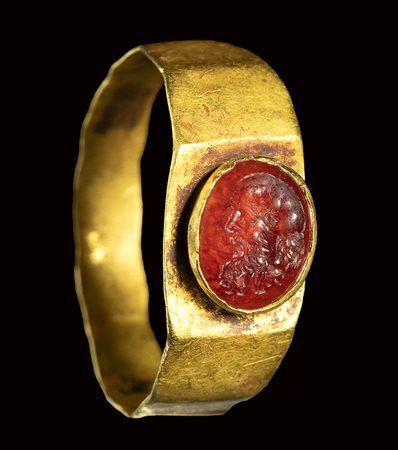
Lotto 183 A roman carnelian intaglio set in a gold ring. Head of a Silenus.
2nd century A.D.
With rounded hoop extending on angular shoulders, the oval box-setting resting on a rectangular plaque and set with a carnelian intaglio. The intaglio depicts the head of a Silenus turned left. The features are characterized by a strong expression, Wide-open eye, raised eyebrow, small large nose and full lips partial covered by a moustache and a very voluminous beard. The shaved skull is framing by wavy hair joining the beard on the back. Nice vivid colour of the stone, and mirror polishing on the engraving.
Stone 7 x 8 mm; ring size 17 x 19 mm; 2,60 gr. -
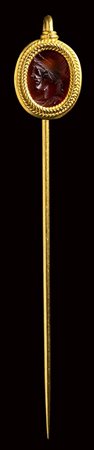
Lotto 184 A roman carnelian intaglio set in a gold stick pin. Apollo.
2nd century A.D.
The intaglio shows the portrait of a male character turned left. He is characterized by young features, wide open eye, straight short nose, semi-opened mouth. He wears a cloak. His hair adorned with a band or tenia. The youthful features and the hair ornament suggest it may be a representation of the god Apollo. Slight wear marks on the surface of the stone. Nice mirror polishing for the engraving. The gold stick pin is composed of a large oval box-setting with three twisted gold wires. Two gold hoops on top of the bezel for the attach of the pin. On the back, open-worked section, with a large oval gold sheet attached to the rest by 8 gold heart-shaped clasps. The style reminds Castellani gold mountings.
intaglio 6x9 mm; overall 10x15 mm; length 70 mm; 3,58 gr. -
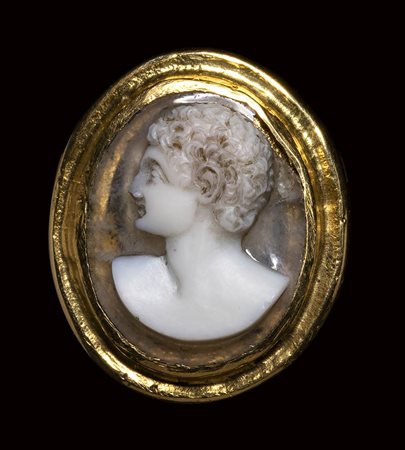
Lotto 185 A roman agate cameo mounted in a gold ring. Male portrait.
2nd century A.D.
The young character is presented in front, his head turned left, with an upraised look. His young features are characterized by short folded hair framing the face with uncovered ear. Aquiline nose (tip of it missing), small full semi-opened lips, with proeminent chin and squared jaw. The gold mounting is composed of a large rounded hoop, flatten within and surmounted by a large oval levelled box-setting. Wear marks.
int diam 20 mm; cameo 15x18x5 mm; 12,05 gr. -
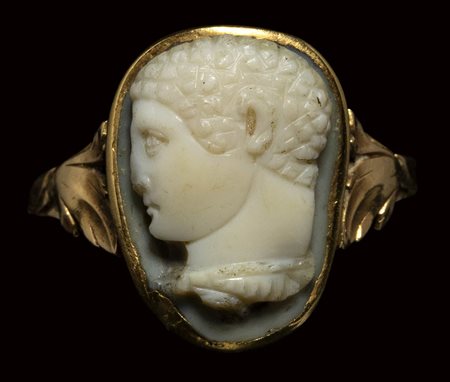
Lotto 186 A fine roman onyx cameo set in a later gold ring. Hercules bust.
2nd - 3rd century A.D.
The hero is facing left, in profile, and is characterized by a curly head and by a large neck, with the leontea wrapped around it. The nose is chipped. The edge was probably reshaped in ancient times. The stone is mounted in a beautiful 18th/19th century chiseled gold ring, with the rod decorated with leaves motifs. Wear marks.
Stone 14 x 19 mm; ring size diam 21 mm; 7,22 gr. -
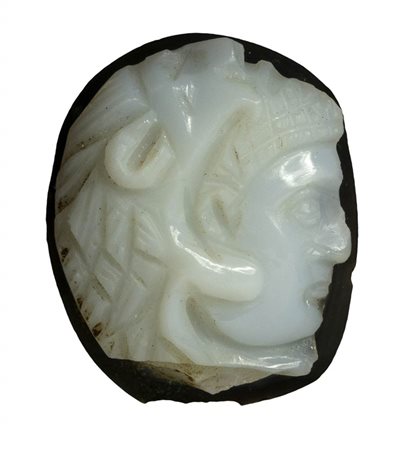
Lotto 187 A roman onyx cameo. Head of Alexander the Great.
3rd century A.D.
The ruler is facing right, with the leontea on his head. Typical iconography of Alexander the Great, after the greek coinage. The cameo is carved in high relief on a two-layered nicolo agate: the portrait in the whitish cerulean part; the background is dark. Small lack at the bottom and chips on the back.
15 x 18 x 10 mm. -
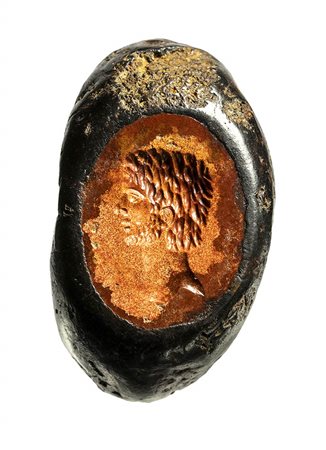
Lotto 188 A roman imperial burnt jasper intaglio set in an iron ring. Male bust.
Late 2nd century A.D.
Beautiful male portrait, facing left, engraved with depth in the stone. The gem has traces of burning and deposits of ferrous oxydes that have penetrated its surface. The stone is still inside its original iron ring, which shows strong corrosion and oxydation. The juvenile portrait is referable to the Severian period, between the period of Pescennio Nigro and Settimio Severo. The fashion of the hair and beard still has influences from the Hadrian and Antonine period, but the stylistic characteristics reveal its belonging more to the end of the second century AD. Fine male portrait, probably a member of the aristocracy in the military elite, near the emperor's family. Rare. Parallel: M-L. Volleinweider, Camées et intailles. Les Portraits romains du Cabinet des médailles. Tome II, p. 115 n. 220, p. 118 n. 225,226 ss.
Stone 13 x 17 mm; ring size 10 x 13 mm circa; mounting 21 x 29 mm circa. 9,74 gr. -
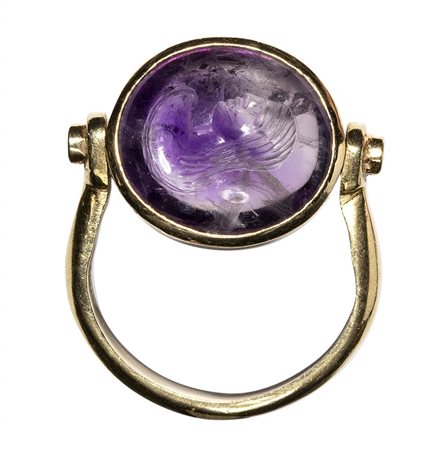
Lotto 189 A roman amethyst intaglio set in a modern gold ring with diamonds. Bust of Nereid.
1st century B.C. - 1st century A.D.
The young figure is turned to the left, and is characterized by a slightly open mouth, rounded chin, long and thick hair. The face, facing in profile, is characterized by delicate features mirror polished. The left shoulder is seen from behind, as in the typical movement of swimming. Use of globulo for the eye. The figure is variously interpreted as Nereid or as Leandro crossing the Dardanelles to reach the lover Ero. By some the subject is interpreted as a marine divinity or Selene. The figure expresses beauty and elegance. Attractive intense color of the stone. Cabochon both side. Slight wear marks. The stone is mounted in a modern gold ring with two diamonds.
Parallels: A. Giuliano, I cammei dalla Collezione Medicea del Museo Archeologico di Firenze, pp. 216-217; L. P. B. Stefanelli, La collezione Paoletti, vol. 1, tomo 2 n. 218, tomo 3 n. 480; Le Gemme Farnese, 1994, p. 122 n. 184 (225); G.M. A. Richter, Engraved gems. Greek, Etruscan and Roman, The Metropolitan Museum of New York, n. 150; J. Boardman, Greek gems and finger rings, n. 1003.
int diam 19 mm; intaglio 14x15 mm; 10,78 gr. -
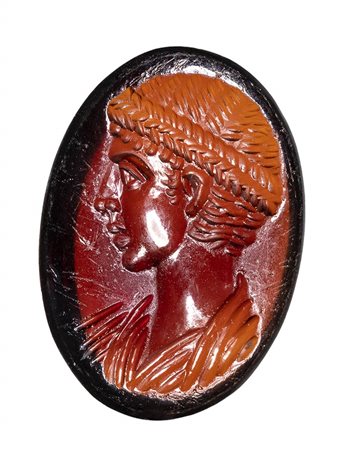
Lotto 190 A fine late roman garnet intaglio. Female bust.
2nd century A.D.
The portrait faces left, and is characterized by a face with youthful features, a draped bust and a refined hairstyle; a large braid surrounds the head in a circular sense, almost forming a diadem that holds the rounded hair. Small locks go down on the forehead and also on the nape of the neck. Although her face is idealized, her youth is emphasized by the sensitive modeling of her smooth, rounded face and high cheekbones. The iconography seems to refer to the 2nd century hairstyle. Probably a portrait of an aristocrat, close to the imperial family. Garnet of extraordinary color and size. Work done with great refinement, mirror polished. Slight wear marks. Parallels: Portrait Head of a Young Woman, A.D. 130/40 Roman Marble; The Art Institute of Chicago, 1960.64, cat. 7.
12x17x3 mm -
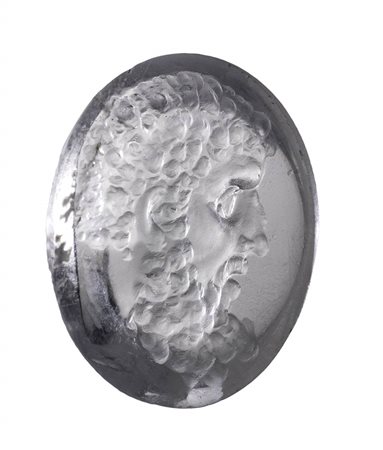
Lotto 191 A fine roman rock crystal intaglio. Head of Hercules.
1st - 2nd century B.C.
The hero is facing right with viril features: thick curly beard and hair framing the face and letting the par uncovered. Eyebrows furrowed, nose wide and straight, and full lips. The style reminds the hellenistic representation of Hercules. Nice engraved polishing and sign of wears on the surface of the stone. Close to the Antonine portraits.
13x14x3 mm
-
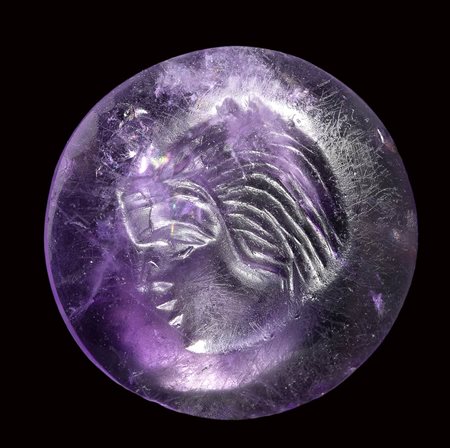
Lotto 192 A fine roman republican amethyst intaglio. Mask.
1st century B.C.
Theatrical mask of a young faun, facing left and placed in the center of the rounded gem. The style, composition and choice of stone refer to the late Republican production. Attractive intense purple color. Slight wear marks.
Diam. 16 mm circa x 3 mm.