
ASTA 107 - Glittica
-
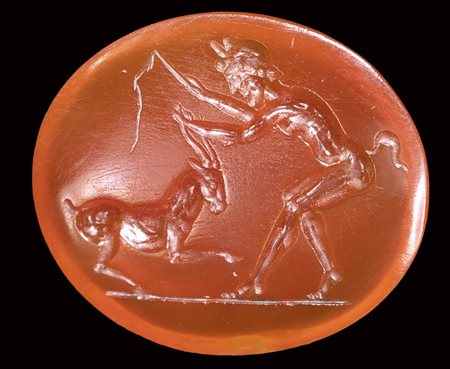
Lotto 157 A roman carnelian intaglio. Faun with goat.
1st century B.C. - 1st century A.D.
The scene shows a bucolic scene with a faun turned left playing with a goat. The mythological character is in flexion, his left leg and arm forward, catching one animal horn, while his other arm holds a branch with a string, in order to excite the goat. Groundline. The anatomical features of both figures and the rendering of volumes with some use of globular elements are well executed. Nice polishing for the engraving, and sign of use on he surface of the stone.
15x17x3 mm -
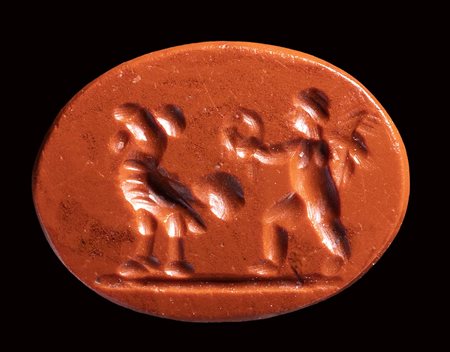
Lotto 158 A roman red jasper intaglio. Winged eros with rooster.
1st - 2nd century A.D.
The scene shows a winged eros standing left toward a rooster and holding a laurel wreath. Groundline.
7x10x2 mm -
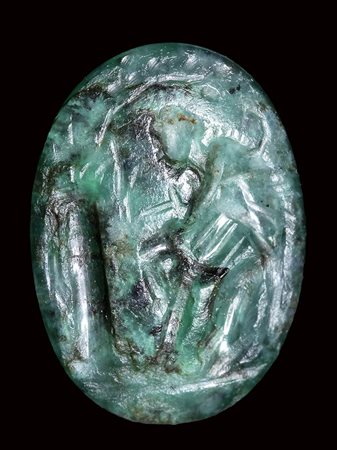
Lotto 159 A roman green chalcedony intaglio. Bucolic scene.
1st- 2nd century A.D.
The scene shows an old male character wearing a large cloak and a stick, seating on a rock in front of a column supporting a vase. Above, branch of fruit. Probably a shepherd in front a votive altar. Groundline.
7x10x2 mm
-
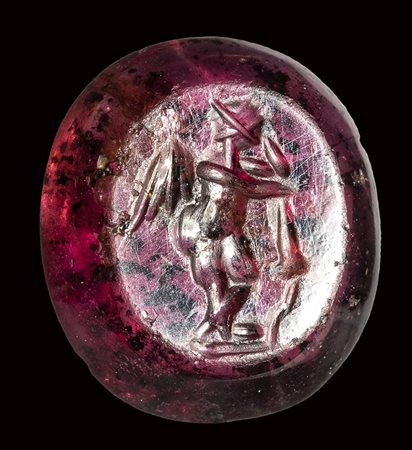
Lotto 160 A roman garnet intaglio. Eros with a torch.
3rd century A.D.
The figure leaning on an overturned torch can be identified both as an erote and as a funerary genius. In fact, the inverted torch symbolizes the sunset of life and the funerary world. Slight wear marks.
11 x 12 x 3 mm. -

Lotto 161 A roman agate intaglio. Fortuna-Tyche.
2nd - 3rd century A.D.
The figure is standing, facing right. With her right hand she holds the cornucopia, with her left the rudder. On the head, a modius. Three-layered agate (magic eye). Slight wear marks with traces of heat.
11 x 14 x 5 mm.
-
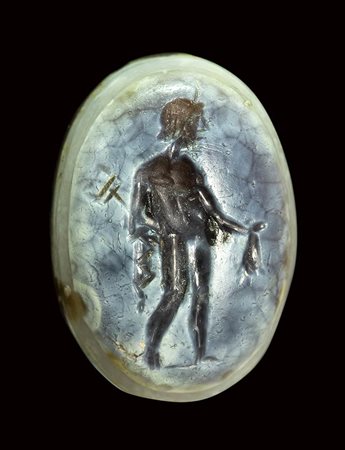
Lotto 162 A roman burnt agate intaglio. Mercury.
2nd century A.D.
The deity faces right. With his left hand he holds the purse with coins, with his right the caduceus. The surface of the stone is slightly burnt.
11 x 15 x 6 mm. -
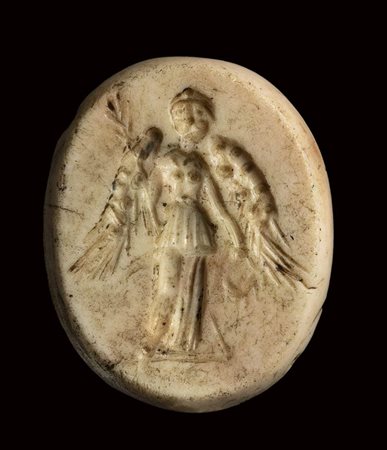
Lotto 163 A roman burnt carnelian intaglio. Victory.
1st century B.C.
The figure is winged, tunicated and depicted frontally. With the right hand she holds a palm branch, with her left a laurel wreath, symbols of victory and triumph. The stone is burnt.
13 x 15 x 2,5 mm. -
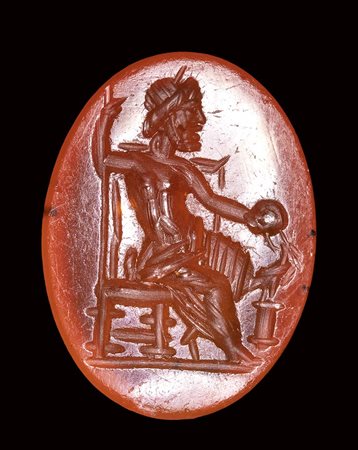
Lotto 164 A roman carnelian intaglio. Seated Zeus.
2nd century A.D.
The god is seated, facing right, holding a scepter in his right hand, and a globe in the left one. At his feet, on a column, an eagle. Groundline. Wear marks.
10x14x3 mm -
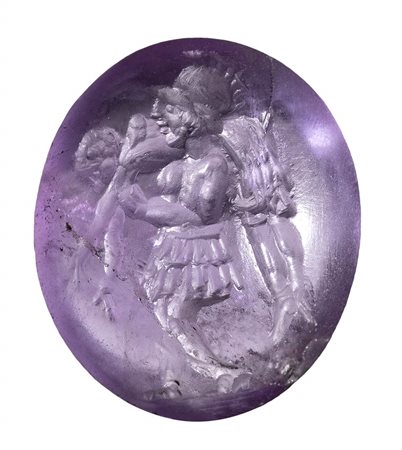
Lotto 165 A roman amethyst intaglio. Two soldiers.
2nd century B.C.
Slightly convex on the engraved side. A standing soldier with crested helmet is carrying the lima body of a dead fellow. Each wears a cuirass over a short chiton. Groundline. Similar gems with same subject referenced and classified as etruscanizing group III by Richter.
Parallel: for a similar depiction see Richter M.A, Catalogue of engraved gems, 2006, pl.XXXIV, 218
14x16x6 mm -
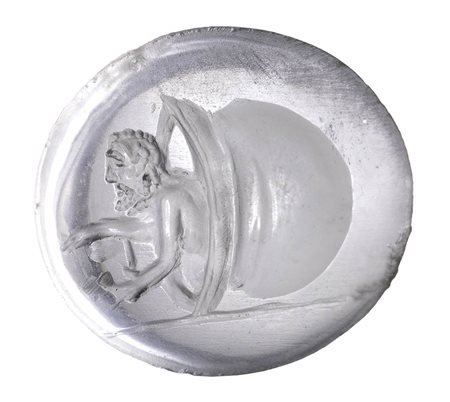
Lotto 166 A roman rock crystal intaglio. Diogenes in his pithos.
1st century B.C.
The old philosopher is shown facing left, the upper part of his body outside from the pithos and holding a papyrus (?). This iconography is linked to the famoust greek philosopher’s lifestyle, far from social conventions and affluence he was renowned for fleeing comfort, sleeping in a simple pithos. Extraordinary work engraved on a very thin gem with the backside slightly cabochon. Parallel: AGDM (Munchen) n. 2757. AGDS Munchen, vol. 2 n. 1007-1008.
13x15x3 mm -

Lotto 167 A roman two-layered agate intaglio. Harpocrates.
2nd - 3rd century A.D.
The figure is standing, to the right. With his right hand he holds the cornucopia, symbol of abundance; the left hand is raised towards the face, in its typical gestures. The effigy, of magical and protective power, is engraved on a large, slightly cabochon two-layered honey agate on a white background. Slight crack at the bottom left.
15x18x6 mm -
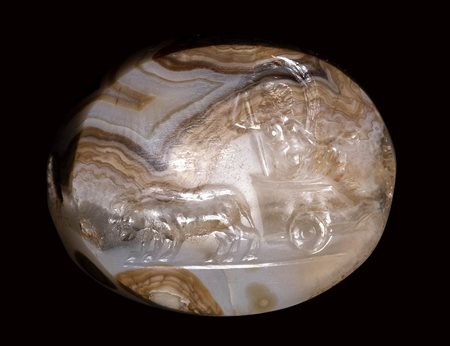
Lotto 168 An eastern roman agate scaraboid engraved seal. The return of Dionysos.
2nd century A.D.
The scene shows Bacchus seated on a chariot pulled by two panthers. Groundline. The god is depicted naked, the lower part of his body covered by a drapery, in his right hand he holds a cup, meanwhile his left hand holds a scepter surmounted by a veil. The style of the depiction suggests that the intaglio is roman, but carved on an more ancient scaraboid seal, probably eastern Greek.
17x21x12 mm