
ASTA 107 - Glittica
-
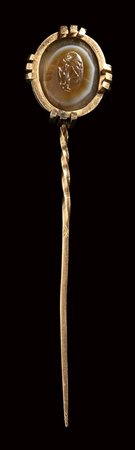
Lotto 145 A roman agate intaglio set in a gold stick pin. Apollo.
2nd - 3rd century A.D.
The divinity is facing right. In his right hand he holds a drapery, a laurel branch in his left; on his shoulder, a quiver. The subject is engraved on a three-layered agate (magic eye). Very good condition.
Stone 11 x 15 mm; H. 70 mm; 5.20 gr. -
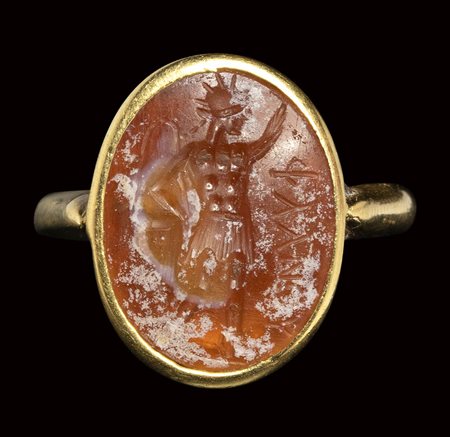
Lotto 146 A roman burnt carnelian intaglio set in a gold ring. Sol Invictus.
2nd - 3rd century A.D.
The god is standing, with his head radiated and with his right hand raised, in the typical pose of the Sol Invictus; with his left hand he holds the solar whip and a drapery. In the field, a greek inscription. Partially burnt surface of the stone.
Stone 13 x 17 mm; ring size 18 mm; 7,12 gr. -
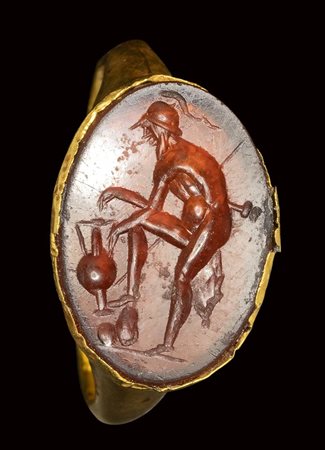
Lotto 147 A roman carnelian intaglio set in a gold ring. Heraclides attempting a draw.
1st century A.D.
The hero is depicted in profile, with his right foot resting on a rock, as he attempts a draw inside an amphora. The Greek warrior is naked, helmeted and armed with a spear and sword. Groundline. The subject is taken from the group of Three Heraclides who attend the draw with the amphora, a mythical episode with complicated events. Wear marks. Ring formed by a hollow sheet of gold. Rare subject.
Parallel: U. Pannuti, Catalogo della collezione glittica vol I, Napoli, Museo Nazionale, n. 147-148.
Stone 10 x 14 mm; ring size diam 16 mm; 1,83 gr.
-
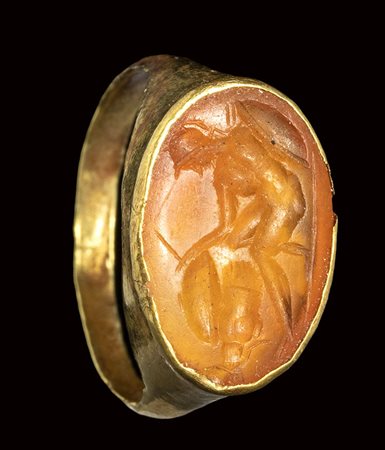
Lotto 148 A roman carnelian intaglio set in an ancient gold ring. Warrior.
1st - 2nd century A.D.
The figure is depicted in a reclined position, on the ground, and leans on a shield with his left arm, while with his right hand he touches another shield on top of an armor, with a shield. Probably a votive representation or of lamentation towards a comrade who died in a military act. The ring is formed of hollow sheet gold. Wear marks and little missing on the bezel edge.
Stone 9 x 13 mm; ring size 14 mm; 1,18 gr.
-
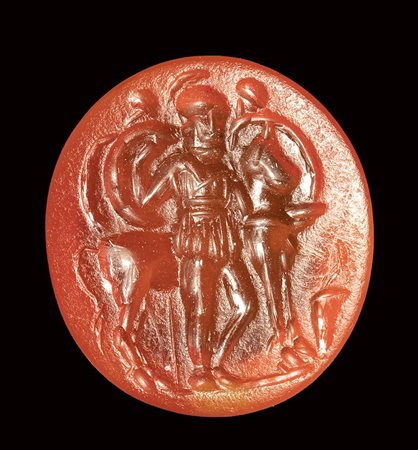
Lotto 149 A rare roman carnelian intaglio. Scene of a sacrifice by Agamemnon.
1st century BC - 1st century AD.
The Achaeons' supreme leader, wearing a helm, is portrayed holding the shield with his left hand, while offering a patera with his right hand, in front of a small altar at his feet. A bull at his side, and others helmets/ shields on the background, in order to symbolize soldiers. The scene can be identified for sure with the sacrifice that Agamemnon made at Aulis before sailing to Troy. Indeed, this rare iconography can be identified in an ancient sardonic intaglio, the which was also displayed by in the collection of Paoletti’s glass paste impressions, and preserved in Philadelphia (University of Pennsyilvania Museum of Archeology and anthropology, inv. 29-128-900, already M. Sommerville collection).
11,5 x 13 x 5 mm. -
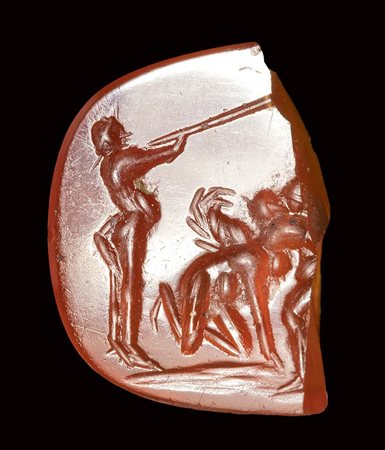
Lotto 150 A roman carnelian fragment of an intaglio. Fighting scene with putti.
2nd century A.D.
In the center, an erote subdues another winged erote to the ground, with a victorious hold for submission; on the left, a referee blows a long trumpet to announce victory. Groundline. Fragmentary stone.
10 x 12 x 3 mm. -
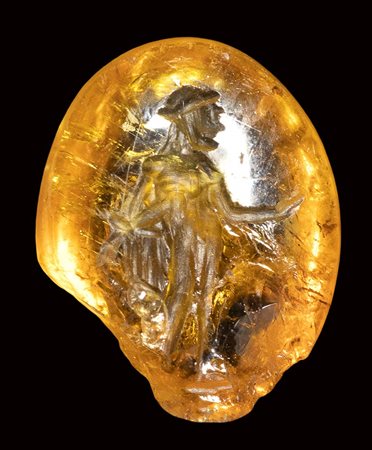
Lotto 151 A rare roman citrine intaglio. Apollo.
2nd century A.D.
This gem has lacks on the edge and chips. However, the young naked figure who appears to be leaning on a tripod (?), could be identified with Apollo. Citrine of extraordinary intense and brilliant color. Rare.
9,5 x 12 x 4 mm. -
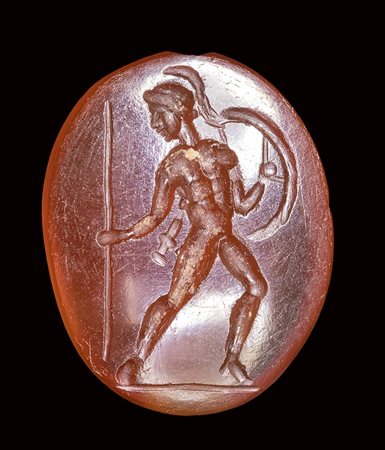
Lotto 152 A roman carnelian intaglio. Warrior.
1st - 2nd century A.D.
The soldier advances to the right, with the frontal torso and the head turned back in profile. The figure is naked and protected by a shield and helmet. With his right hand he holds the spear; the sword is hung with a belt. Groundline. Typical pose inspired by Greek models. Fine quality for the small size of the stone. Slight wear marks.
9x12x3 mm -
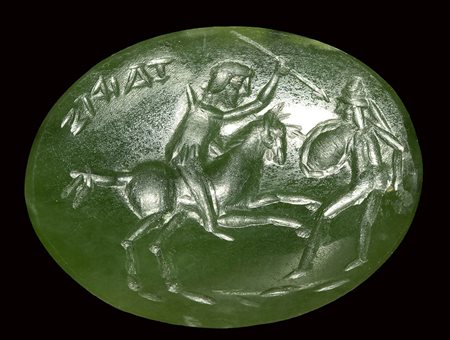
Lotto 153 An eastern roman green chalcedony intaglio. Military fight scene.
2nd - 3rd century A.D.
A soldier on horseback advances against a soldier on the ground (wearing an helmet and holding a shield). The character on horseback raises a spear to kill his enemy and appears to be characterized by a headdress (Leontea?). Greek inscription on the background. Probably Alexander the Great fighting a soldier. Wear marks. Eastern workshop.
17 x 22 x 4 mm. -
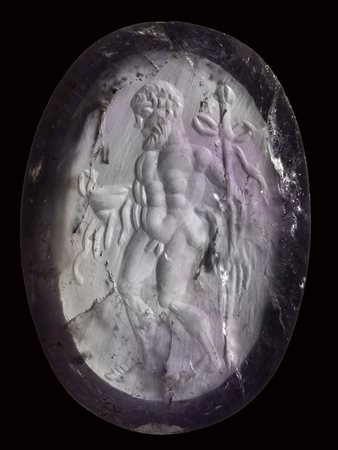
Lotto 154 A large concave roman amethyst intaglio. Silenus.
2nd - 3rd century A.D.
Unusual work, propably from a provincial eastern atelier. A muscular Silenus advances to the left, holding the thyrsus with his left hand and a cup with his right hand. The choice of the amethyst is to be connected to the Dionysiac theme. Large cabochon gem, engraved in the concave inner part. Wear marks.
24 x 34 x 11 mm. -
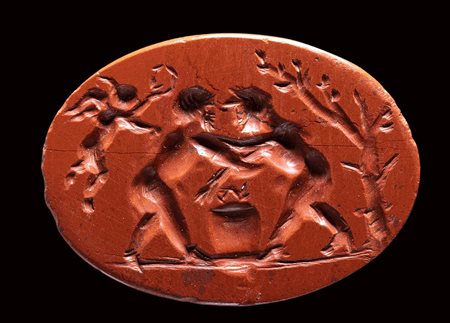
Lotto 155 A roman red jasper intaglio. Fight scene.
2nd - 3rd century A.D.
Two young characters fight in front of an altar. In the background, on the right, a tree; on the left, a winged erote raising a laurel wreath for the next winner. Groundline. Well composed scene. Attractive color of the stone. Slight wear marks.
15x18x3 mm -
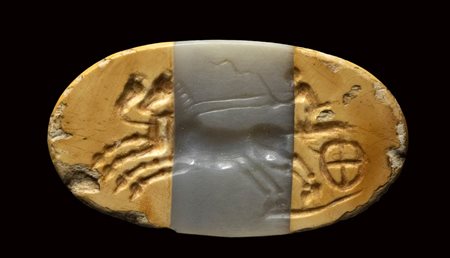
Lotto 156 A roman republican burnt agate intaglio. Biga.
1st century B.C.
Two horses are running to the left, pulling a small chariot driven by a charioteer with a whip. The stone was heated by the fire. Small chips on the edge.
9 x 16 x 2 mm.