
ASTA 107 - Glittica
-
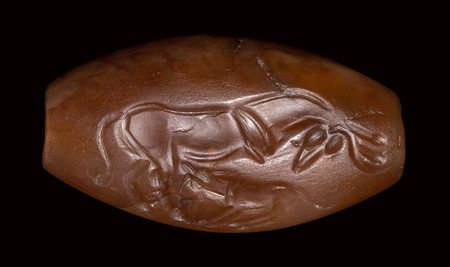
Lotto 1 A greek late minoan agate intaglio seal. A cow nursing a calf.
1450 - 1300 B.C.
An antelope, facing right, suckles her cub. The animal lowers its head in a pose typical of this repertoire. The intaglio is made on a carnelian seal with passing through hole. Stylistic details and execution technique typical and consistent with the minoan glyptic production of the second half of the 2nd millennium. Wear marks. Parallels: M-L. Vollenweider, Catalogue Raisonné des sceaux cylindres et intailles, Musée d'Art et d'Histoire de Gèneve, pl. 74 n. 8-11. AGDS, Band II, Staatliche Museen Preussicher Kulturbesitz Antikenabteilung, Berlin, taf. 10-13.
14x26x13 mm
Provenance: european private collection, acquired in the french market, previously in th UK art market.
-
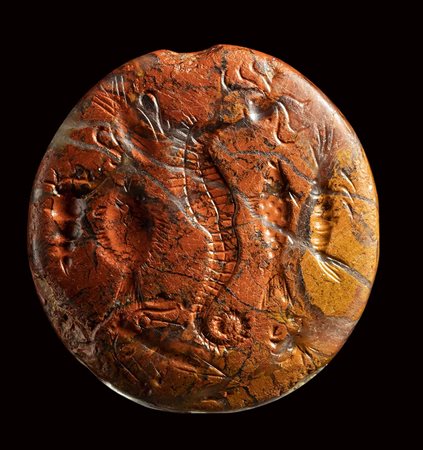
Lotto 2 A fine greek late minoan mottled jasper seal intaglio. Sea creatures.
Late 2nd millenium B.C.
In the center, a hippocampus; on the sides, crustaceans, molluscs and fish, among which it is possible to distinguish a small octopus, a squid, a cuttlefish, a small crab, a shrimp, a shell and two rock fishes. This scene, composed by nine different marine creatures, is of extraordinary rarity, probably a unicum. The composition is well balanced. The engraving style of each animal is referable to the greek Minoan-Mycenaean productions, with the use of the typical circles and globules, and very fine engraved strokes. The animals are depicted with great realism very close to the natural model. The gem seems to enclose the whole living and prosperous marine world, very dear to the Greeks, in a portable seal. This exceptional stone is round in shape with a central hole. The jasper is red with orange and ocher tones, veined with white and transparent; a very rare and beautiful variety. Small chip on the edge. Wear marks. Parallels: for the style and typology of some animals, see J. Boardman, Greek Gems and Finger Rings, n. 75-81; AGDS, Staatliche Museen, Berlin, n. 17; AGDS, Munchen, n. 30-34, 73, 80; AGDS, Hamburg, n. 1-6.
26 x 27 mm x 8,5 mm.
Provenance: english private collection S.B., London, acquired on the London art market in 1969. -
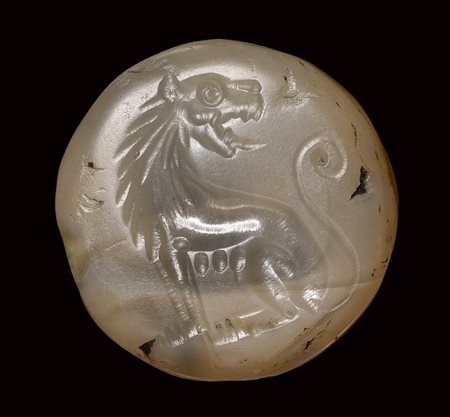
Lotto 3 A greek lentoid chalcedony seal intaglio. Lioness.
Late 2nd millenium B.C. - Early 1st millenium B.C.
The lioness is facing with her body to the left, with her head turned back to the right. The feline opens its mouth showing its teeth and tongue. The eye is engraved with a circle. The tail is raised and ends in a spiral. The stone is drilled with a through hole. Small chips on the surface. Traces of drill in the execution. Wear marks. The intaglio shows stylistic and technical features of late Minoan production (eye, shape of the seal, subject) and an early archaic composition, probably in a transitional phase.
diam 17 mm; width 8 mm
From the collection of Adrien Blanchet (conservateur at the Cabinet des Médailles BNF, Paris).
-
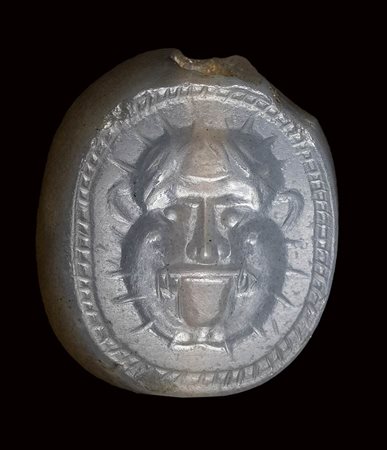
Lotto 4 A rare greek chalcedony seal intaglio. Gorgone.
Late 6th century B.C.- early 5th century B.C.
Frontal Gorgon's mask. The cheeks are full, the eyes globular, the mouth wide open in his grimace, with the tongue and sharp teeth. The hair is slightly streaked, parted in the center; the ears are protruding. Around the head there are sharp points, (probably to symbolize snakes?). Dotted frame. The subject, of strong apotropaic power, is engraved on a chalcedony scarab. Through hole. Signs of wear and lacks on the edge. Interesting work, performed in the typical style and technique of the late 6th century- early 5th century B.C. Rare. Parallels: G.M.A. Richter, Catalogue of Engraved Gems, The Metropolitan Museum of Art, New York, p. 14 n. 49; J. Boardman, GGFR, pl. 289 (Carnelian scarab, carinated, Gorgoneion); Getty n. 81.AN.76.3.
14x16x8 mm
Provenance: old french collection 1990s, than UK private collection. -
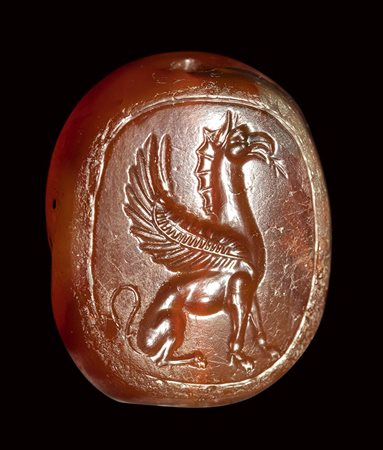
Lotto 5 An early classical greek carnelian scaraboid intaglio. A seated griffin.
5th century B.C.
The creature is seated, facing right. Its sharp beak holds small leaves, and its wings are spread out. Around, linear engraved frame. The scarab is characterized by a pointed shape in the back. Through hole. Wear marks. The engraving technique, the iconography and the executive style are typical of the beginning of the Classical Era. Use of globular elements. Intaglio of great beauty and rarity. Parallels: J. Boardman, Greek Gems and Finger Rings, p. 289 n. 491 (Munich).
15 x 18 x h.13 mm.
Provenance: english private collection S.B., London, acquired on the London art market in 1969. -
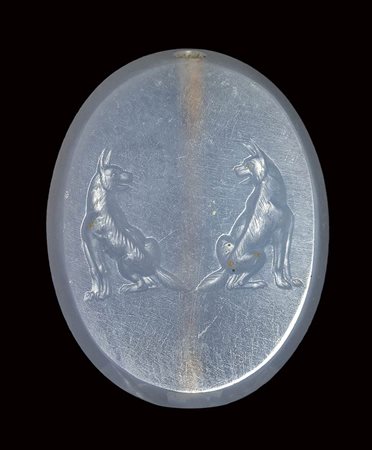
Lotto 6 A fine late classical greek blue chalcedony scaraboid seal. Two molossian dogs.
5th century B.C.
Two dogs, presented symmetrically on the right and left of the scene. Looking at each other, with their faces in profile, but their bodies are turned away, towards the outside of the edge. The bodies are represented of three-quarters seen from the back, with great technical and artistic virtuosity. Use of globular elements and very fine engraved features, typical of the best greek production of this period. These dogs, with an almost leonine body, are to be identified with the famous Molossi dogs (also known as the Molossian hound, Epirus mastiff. The Molossus were famous throughout the ancient world for their size and ferocity and were frequently mentioned in ancient literature). The back of the stone is convex. Pierced through hole. Second half of the 5th century B.C. circa. Beautiful color of the stone and large size. Very fine condition. Intact. Slight wear marks. Rare. Parallels: J. Boardman, Greek Gems and Finger Rings, p. 292 n. 576 (Blue chalcedony scaraboid from Cyprus, a lioness; J. Boardman, Intaglios and Rings, Greek Etruscan and Eastern from a private collection, p. 98 n. 92 Blue chalcedony seal, scaraboid, a seated hyena, striped, greek style of Graeco-persian gems).
22 x 29 x 12 mm.
Provenance: the seal is described in a letter dated 1971 to B. & G. H., London.
-
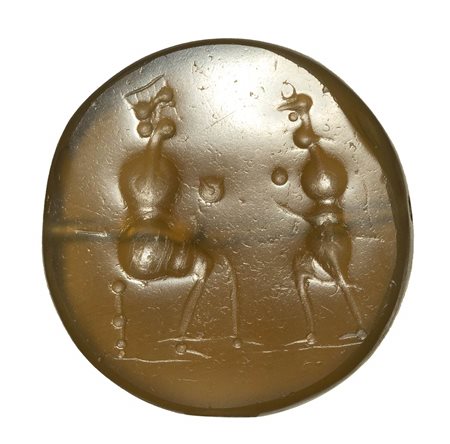
Lotto 7 A graeco-persian agate seal. Scene with two characters.
4th century B.C.
A female figure with a headdress, presumably a Persian woman of royal rank, is seated on a throne and receives an offer from a young male character. Thin groundline. Use of engraved globular elements of both large and small dimensions, and small incised sections. Attractivehoney tone. Light signs of wear. Through hole. Rare. The specimen is referable to the "Bern Group", identified and described by J. Boardman, in: Greek Gems & Finger Rings, New York, 1972, pp. 320 ff., Tav. 960 - 972; P. Callieri, Seals and Sealings from the North-West of the Indian Subcontinent and Afghanistan, Naples 1997. pp. 84 -90, tav. 12-3; Beazley Archive, Gem Database, Bern Group (Seated Persian woman with a flower. Cambridge. Pale red all-stone ring. 22mm. GGFR pl. 966). M. Henig, Classical Gems, The Fitzwilliam Museum, Cambridge, p. 43 n. 71.
Diam. 25 mm circa x 10 mm.
Provenance: UK private collection D.C. -
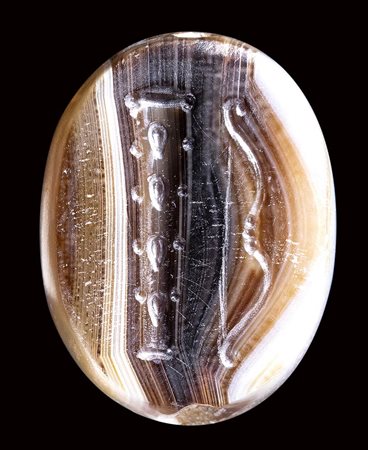
Lotto 8 A rare greek banded agate scaraboid engraved seal. Club and bow.
4th century B.C.
On the left a club; on the right a bow. Emblem referable to Hercules. Interesting variety of sardonyx agate, in which the engraver has artistically followed the curvilinear movement of the bands for the curve of the bow. Wear marks. Through hole. Rare. Parallel: J. Boardman, GGFR, n. 732 ("Leningrad, from Chersonesos. Gold..Bow and club. Gaidukevich and Maximova, Antichnie Gorod 440, pl. I.2).
16x23x6 mm
Provenance: UK private collection 80's. -
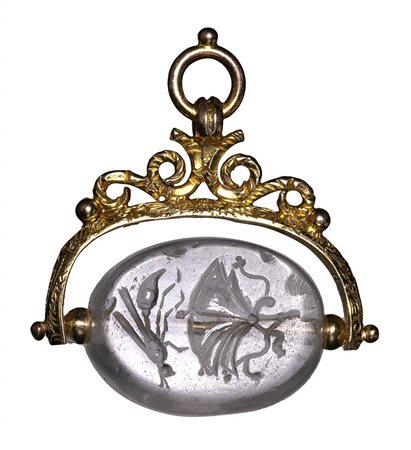
Lotto 9 A rare greek classical rock crystal scaraboid engraved seal set in a gold swivel mounting. Wasp on a flower.
5th - 4th century B.C.
A wasp flies to the left; below a flower, identifiable with a rose. Rare scene characterized by great naturalism and engraving mastery, typically classical Greek. The details of the insect and the flower are engraved with great refinement, very fine lines or small globules. Signs of wear and small chips. Through hole. The scarab is mounted in a swivel and chiseled collector's gold seal, dating from the 19th century. Of great rarity. Parallel: J. Boardman, GGFR, n. 505 for the insect; n. 703, 783 for the flower, a rose, engraved in a silver seal ring (see also the greek coinage). For a similar composition, but later, see AGKM (Kunst, Wien), vol. II, n. 903, and the Cornell University plaster database, n. 185.
Stone 15x20x8 mm; High with seal 33 mm; 6,36 gr.
Provenance: english private collection S.B., London, acquired on the London art market in 1969.
-
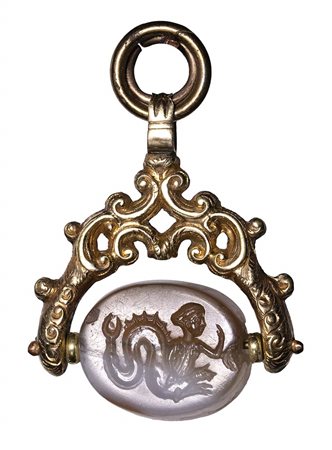
Lotto 10 A greek classical banded agate scaraboid engraved seal set in a gold swivel mounting. Scylla.
Second half of the 5th century B.C.
Scylla, in profile to the left. She is human down to the waist, and than has the body and tail of a fish at the back, and the forepart of a dog in front. The human part is shown wearing a stylized sakkos and a chiton. Wear marks and chip on the edge. Beautiful honey tone of the banded agate, with a white part symbolizing the waves of the sea. The scarab is mounted in a swivel and chiseled collector's gold seal, dating from the 19th century. Rare. Parallel: G. M.A. Richter, Engraved gems of the greeks and etruscans. A history of greek art in miniature, n. 363- 364; AGDS, Berlin n. 157; J. Boardman, GGFR, n. 453; BNF database, Cabinet des Médailles, inv. Luynes.264: "Scylla à droite, coiffée d’un kécryphale, a le buste d'une femme couvert d’une courte tunique, un protomé de chien sous le ventre et une queue de poisson. Elle tend la main gauche en avant. Intaille en cristal de roche. vers 460 av JC. Chez Homère, Circé met Ulysse en garde contre la terrible aboyeuse, monstre aux douze pattes et six têtes de chien avec trois rangées de dents. Elle est traditionnellement décrite avec un torse de femme ceint de chiens aboyants, réduits ici, par les dimensions miniatures de l’œuvre, à une seule tête". See also the greek coinage for the pose of the left arm.
Stone 15x18x8 mm; High with seal 40 mm; 8,65 gr.
Provenance: english private collection S.B., London, acquired on the London art market in 1969.
-
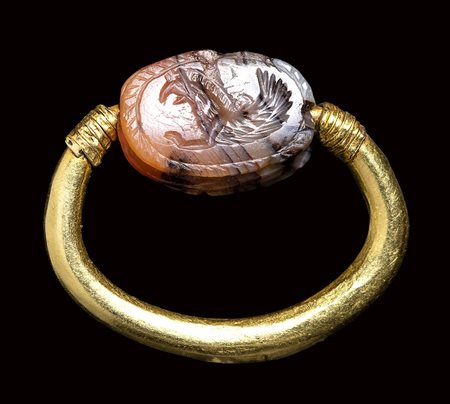
Lotto 11 A Greek archaic agate scarab seal set in a swivel gold ring. Griffin.
6th century B.C.
Swivel gold ring with massive elliptical hoop ending on the shoulders with twisted gold wires passing lenghtwise through the scarab with engraved design. Forepart of a winged griffin, facing left. Hatched frame. Small chip on the edge. Wear marks. Interesting variety of agate. From Epidauros. Rare.
Parallel: J. Boardman, Archaic Greek Gems, p. 66 n. 130 Munich, A 1369.
seal 10x14x6 mm; int diam 19 mm; 6,58 gr.
Provenance: acquired in the european antiquarian market late 1990s.
-
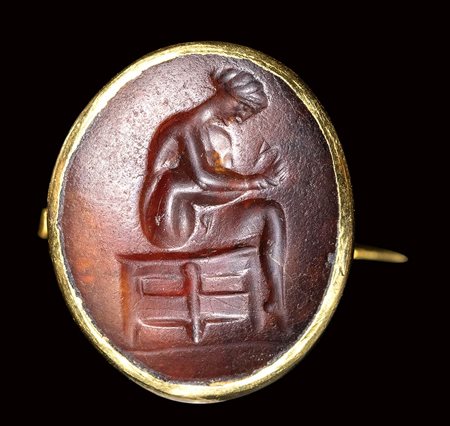
Lotto 12 A fine greek agate intaglio set in a gold brooch. Scene of Toilette.
5th century B.C.
The female figure faces right, sitting on a stool. The head is in profile, the body in three-quarters, in an unusual pose. The right leg is in fact raised and the foot rests on the thigh of the left leg. The left arm, in the foreground, holds the raised foot by the ankle, while with the right hand (hidden) he makes an unidentifiable gesture. The figure is taking care of his foot (with a tool that can be seen?), Cleaning herself, or observing herself. Her eye is turned towards this action. In this posture, the woman spreads her legs showing her pubis. The female figure intent on carrying out intimate actions (washing her hair, undressing, placing her dress on a column) is typical of a certain greek repertoire of the classical era. The type of stool, and the pose itself, is consistent with classical greek glyptic, as is her hairstyle with gathered hair. The stylistic (anatomical), compositional and technical details all correspond to this period referable to the 5th century BC. However, this subject with this pose is apparently of the greatest rarity. The stone is partially burnt on the back, showing small lacks on the surface behind. Signs of wear. The gem is mounted in a 19th century gold brooch. Parallel: J. Boardman, GGFR, 1970, n. 550, 637, 858 and 859 for intimate female scenes (hair washing, undressing); 636 for the stool (from Sparta); n. 682 for the pose.
intaglio 14x16 mm; brooch 15x18x4 mm; 3,91 gr.
Provenance: private collection acquired on the French market from a 19th century collection based on the mounting; previously ancient private collection.