
Auction 86 - Glyptics and Ancient Jewelry
-

Lotto 289 A neoclassical agate cameo. Bust of Maecenas.
End of 18th century - Beginning of 19th century
28 x 40 x 11 mm
The bust portrait of the so called "Maecenas" (Caius Cilnius Maecenas) is facing right. Large stone engraved in high relief, close to "Head of Maecenas" from the Marlborough Collection (Carnelian intaglio, Boston, Museum of Fine Arts: 99.112). -
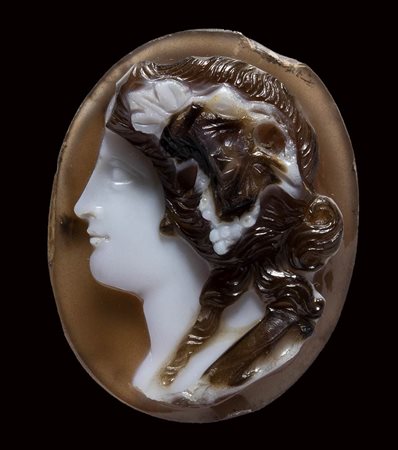
Lotto 290 A neoclassical agate cameo. Bust of a Bacchante.
End of 18th century - Beginning of 19th century
20 x 25 x 6 mm
This fine portrait of a Bacchante is characterized by the typical thick hair adorned with leaves and bunches of grapes. The depiction could be identified also with Dionysos. Attractive use of the layers of the stone. Slight chipping on the edge. -
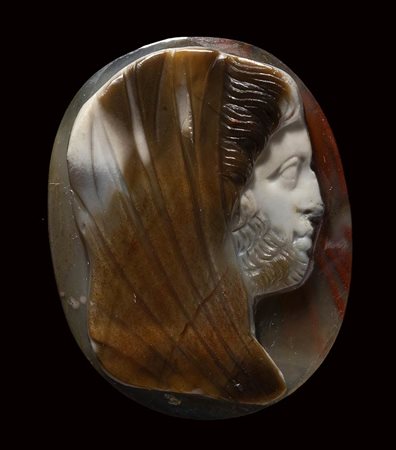
Lotto 291 A neoclassical agate cameo. Bust of a veiled man.
End of 18th century - Beginning of 19th century
16 x 21 x 3 mm
The bearded character is probably the representation of Saturn. The cameo has an unusual concave rather than convex relief, to follow the colored layers and veins of the agate. Attractive colors of the stone. -
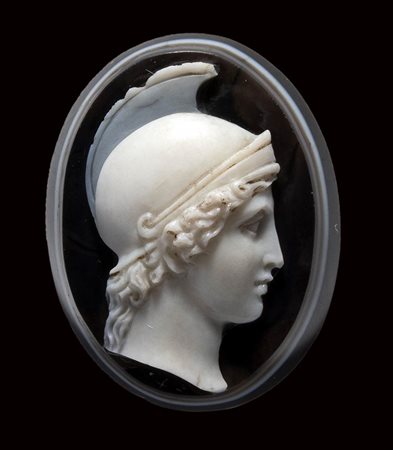
Lotto 292 A fine neoclassical agate cameo. Bust of Athena.
Mid of the 19th century circa.
16 x 20 x 8 mm
The helmated deity is facing right. On the reverse of the stone, an engraved handwritten inscription: “N. 4 - Negroni - 670”. Fine work executed on an attractive six-layers agate. Mirror polishing. Slight chipping on the helmet crest. -
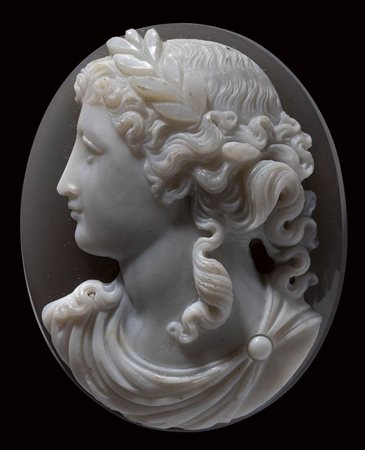
Lotto 293 A neoclassical french two-layers agate cameo. Bust of Apollo.
19th century
37 x 46 x 17 mm
The young god is turned to the left, and is characterized by the draped bust and the head crowned with laurel. The hair is thick and elegantly sculpted with sinuous braids that fall on the neck and shoulder. Work carried out in high relief.
French private collection 80's. Than, UK private collection G. C. , London. -
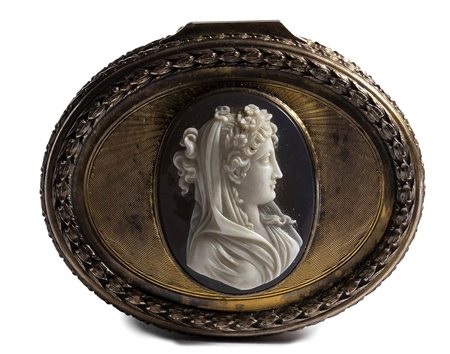
Lotto 294 A large two-layers agate cameo set in a Victorian gilded massive silver snuff box. Veiled bust of Flora.
19th century
Cameo : 32 x 42 mm
Box : 63 x 77 x 37 mm
The female bust is turned to the right side. The figure is characterized by thick hair adorned with a flowers wreath. The head is veiled and the bust is draped. The stone is set in a fine boxe finely engraved, adorned with a garland frame on the edge. Very fine condition. Octagonal mark: Helmeted head of Minerva (1st title), facing right. French manufacture since 1838. -
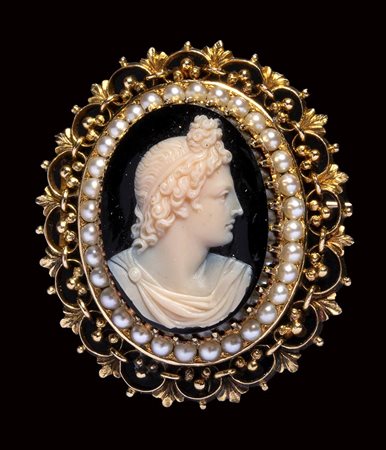
Lotto 295 A neoclassical onyx cameo set in a gold brooch with pearls. Bust of Apollo.
Second half of 19th century
Cameo : 16 x 22 mm
15,0 g
The young god, identifiable with the Apollo Belvedere model, faces right and is wearing a tunique with chlamys. Beautiful victorian gold brooch with pearls.
This prototype has been widely copied and reproduced also on cameos, inspired by the famous statue of the Vatican. For example, the cameo engraved by Saulini in the parure of the Metropoliotan Museum (inv..40.20.55a–c). A very fine exemple of this type comes from the production on Nathaniel Marchant.
Parallels: Catalogue of One Hundred Impressions from Gems engraved by Nathaniel Marchant, J.Edwards, London, 1792, pg. 10, no. XIV, for a listing of a sardonyx intaglio of the Apollo Belvedere, commissioned by the politician J. Cox Hippisley, 1st Baronet (1746-1825). Seidmann, Nathaniel Marchant, Gem Engraver, 1739-1816, The Walpole Society,LIII, 1987, pg.41-2, no.11, mentions that this design of the Apollo Belvedere was particularly popular, and Marchant carved several intaglios of it. -
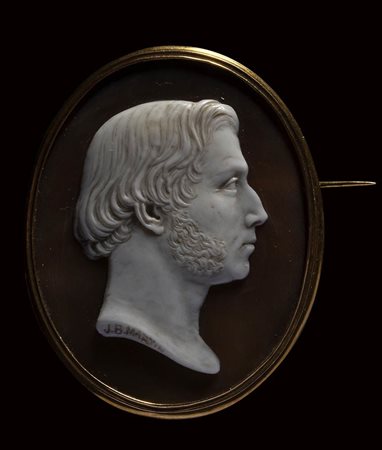
Lotto 296 A 18K gold brooch set with a shell cameo signed JB Martin. Male portrait.
19th century
Cameo : 40 x 50 mm
11,13 gr
The bust portrait, characterized by long and thick hair and beard that ends before the chin, is turned to the right. Private portrait to identify, signed J.B. Martin. -
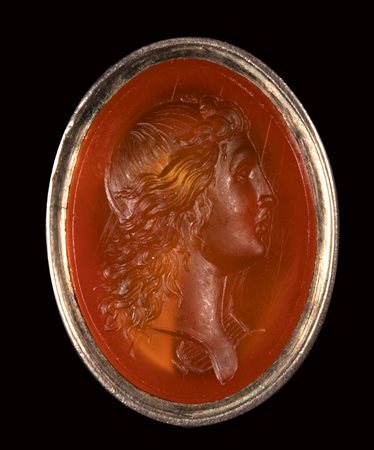
Lotto 297 A neoclassical carnelian intaglio mounted on a seal. Bust of Apollo with lyre.
19th century
Intaglio : 14 x 20 mm
4,34 gr
The young god is facing right. He is characterized by thick and long hair that partially covers the neck. A small lyre appears behind the bust, as an allegory of the arts, poetry and music. Fine work well engraved. Subject inspired by french neoclassical models. Attractive color of the stone. Wear marks on the seal. -
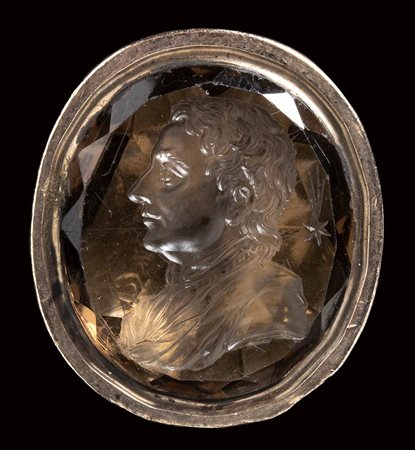
Lotto 298 A quartz fumé intaglio set in a metal seal mounting. Portrait of Isaac Newton.
18th century
intaglio: 20 x 23 mm ; 16.74 gr
Bust of Sir Isaac Newton, bareheaded and wearing a contemporary dress, facing left; a star behind his head. Sir I. Newton (1643-1727) was a favourite subject for English seals and engraved by talented artists as Christopher Seaton, Cave, Wray and Burch. This beautiful work is set in a metal mounting as seal. Attractive brightness of the quartz, faceted on the edge.Very fine condition.
Parallels: M. Henig, Classical gems. Ancient and modern intaglios and cameos in the Fitzwilliam Museum. Cambridge, p. 308 n. 644. -
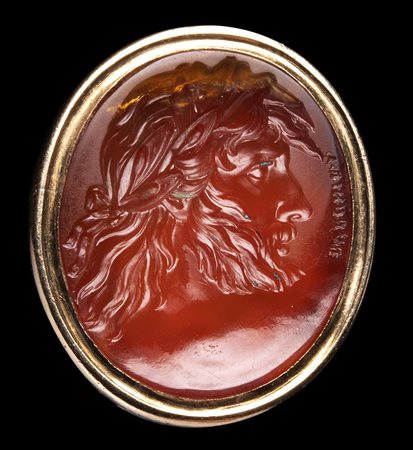
Lotto 299 A fine carnelian intaglio seal engraved by Edward Burch. Zeus wearing a laurel wreath.
Early 19th century
intaglio : 18 x 21 mm; 19, 22 gr
Zeus is facing right and characterized by a thick beard and finely engraved thick hair, with a laurel wreath on the head. The profile is characterized by a protruding nose and a semi-opened mouth. In the foreground, the right shoulder is raised, showing the musculature.
This beautiful intaglio is signed BURCH R.A.: opus of Edward Burch (1730-1814) from Royal Academy. The artist is considered one of the England’s greatest gem-engravers. This stone is mounted as an early 19th century seal engraved with a border of shells, the handle modelled as a stylised lyre composed of foliate scrolls. A very fine intaglio executed with great skill. Light crack on the stone. Extremely fine mirror polishing.
Parallels: G. Seidmann, The diversity of Edward Burch, pp. 17-26 in Le gemme incise nel Settecento e Ottocento. Continuità della tradizione classica, 1998. -
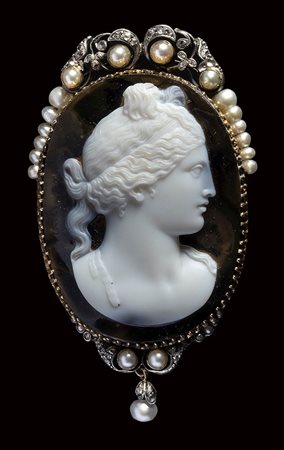
Lotto 300 A neoclassical gold, diamonds and pearls brooch set with an agate cameo signed Pestrini.
Early 19th century
Cameo : 21 x 42 mm
23,74 gr
This fine two-layers agate cameo depicts a female bust in profile, facing right, inspired by the graeco- roman statuary models (probably a Venus).
The stone is signed PESTRINl. Possibly by Clemente Pestrini (Italian, active first half of the 19th century). ca.1810-1820. The brooch is characterized by a split pearl, single and rose-cut diamonds, glazed reverse. Mirror polishing. French assay marks -
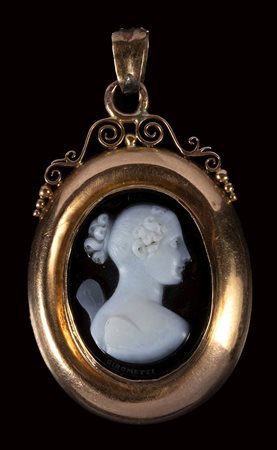
Lotto 301 A neoclassical two-layers agate cameo mounted on a gold pendant. Bust of Psyche. Signed Girometti.
19th century
Cameo : 17 x 23 mm
8,76 gr
Bust of Psyche, facing right, signed GIROMETTI (Giuseppe Girometti, 1780-1851). The stone is mounted on an elegant gold pendant with openable back, fitted with a glass (cracked). Delicate work inspired by the canovian marbles.
Published: Michel Duschamp, "Nouveaux inédits de G. Girometti et de L. Michelini (XV)". Bulletin de la Société Francaise de Numismatique 52.5, May 1997, pp. 83-88, fig. 2.
From the collection of Michel Duchamp (1922-2011) -
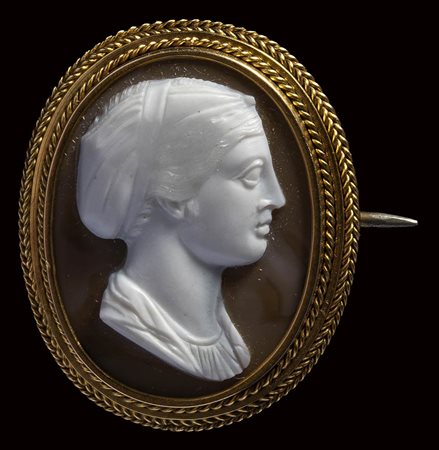
Lotto 302 A neoclassical two-layers agate cameo mounted on a gold brooch. Sapho.
19th century
Cameo : 18 x 24 mm
5,72 g
The greek poetess, facing right, is charachetrized by a draped bust and by hair elegantly gathered in the sakkos.
The cameo is set in a fine gold brooch with a filigree border.
Published: D. Scarisbrick, The Art of Gem Engraving From Alexander the Great to Napoleon III, Fukuoka 2008, p. 242, p. 360. EXHIBITED: Hakone, Open-Air Museum and Fukuoka, City Museum, The art of gem engraving from Alexander the Great to Napoleon III, 2008, no. 308
From the collection of Raphael Esmerian (1903-1976). -
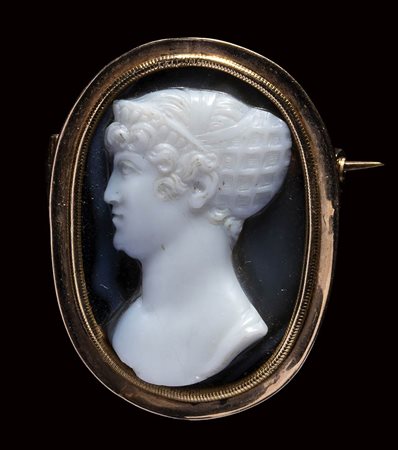
Lotto 303 A late Georgian gold brooch set with an onyx cameo portrait by Berini. Bust of a noblewoman.
End of 18th century - Beginning of 19th century
Cameo : 22 x 27 mm
5,39 g
Portrait of a noblewoman from the napoleonic period, facing left, signed BERINI (Antonio Berini, 1770-1861) along the neck profile. The portrait bust is characterized by a greek profile, a small mouth and an elaborate hairdo, an can be identified with a member of the Royal Family from the Bourbons (see Effigy of Maria Luisa di Borbone-Parma, Queen Consort of Spain, 1751-1819; Maria Luisa di Borbone, Queen of Etruria and Duchess of Lucca, 1782-1824). The front adorned with a diadem, and two bands on the top, while, on the back, the haidress in a bun net, following the style of the ancient heads. Refined work, soft in the anatomical volumes and careful in the physiognomic research, with a certain expressive elegance. -
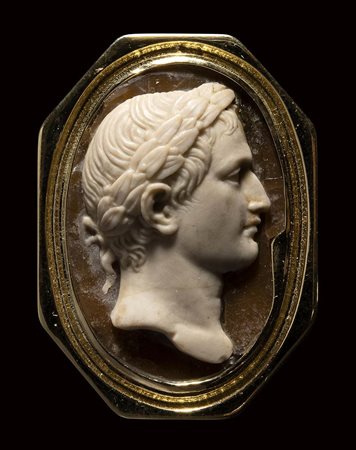
Lotto 304 A fine neoclassical agate cameo set in modern gold ring. Bust of Napoleon Bonaparte as Emperor.
Early 19th century.
Cameo: 20 x 30 mm ; 22.76 gr
The portrait is facing right, with the bust not draped. A refined laurel wreath with berries is engraved on the thick, finely wavy hair. The face presents the typical physiognomic features of the emperor Bonaparte, taking as parallel the contemporary portraits made for the medals or some cameos engraved by famous artists. The portrait is carved on an ivory-colored layer, over a brownish background showing cracks and small breaks on the edge. The cameo is mounted in a beautiful modern ring with an elongated octagonal bezel, of generous size.
Parallels: O.M. Dalton, Catalogue of the engraved gems of the post classical periods, British Museum, n. 396 (ex Blacas collection, probably by Rega); M Duschamp, "Antonio Berini un des grandes graveurs italiens du XIXe siècle et le haut relief", Cahiers Numismatiques 169, Sept. 2006, pp. 47-59, fig. 22.
European private collection. -
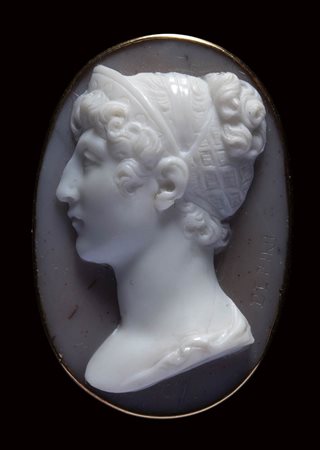
Lotto 305 A neoclassical two-layers agate cameo mounted on a gold brooch, signed Berini. Bust of Caroline Murat.
19th century
Cameo: 22 x 33 mm
8,30 g
This beautiful female portrait bust depicts Caroline Murat (1782-1839), facing left. The thick hair held on the front by adiadem, and by one band on the top, while, on the back, it’s tightened by an accessory of a net-like texture, following the style of the ancient heads. The two-layers stone is engraved in high relief with great skill for the anatomycal details and features of the private portrait. This portrait is characterized by interesting physiognomic features close to the natural model rather than idealized as in the official medals. Caroline Murat became Queen of Naples in 1808.
Published: Michel Duchamp, "Antonio Berini un des grandes graveurs italiens du XIXe siècle et le haut relief, Cahiers Numismatiques 169, Sept. 2006, pp. 47-59, fig. 12.
From the collection of Michel Duchamp (1922-2011) -
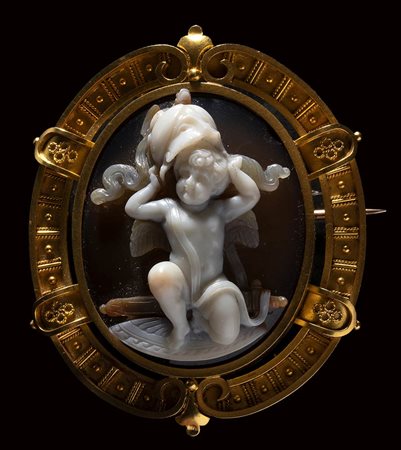
Lotto 306 A very fine agate cameo by G.A. Girardet, set in a gold brooch. Eros with a Panoplia.
19th century
cameo: 30 x 35 mm ; 29.38 gr
Giorgio Antonio Girardet was born in Rome the 2nd July 1829 to Anthony John, and Clotilde Pochon.
He then undertook the art of engraving at Bonfiglio Zaccagnini, engraver of the Mint under Pius IX, and subsequently he began to carve hard stones at the atelier of engravers Antonio Odelli and Tommaso Saulini. The collaboration, started through Odelli, with the famous goldsmiths Castellani was long and fruitful. Among the works commissioned by them, and which are often identifiable because they are marked by the artist’s signature (as well as by the engraving of the double «C» on the bottom layer of the stone).
He also had a good reputation as portrait engraver: in 1874 in fact the G. is reported as «graveur de camées, spécialiste de portraits» in via Margutta, n. 53 B. In the cameos iconographic repertoire of G. (signed usually ”G.A Girardet F.”), which belonged to a now limited group of hardstones engravers still active in Rome in the second half of the 19th century, such as Tommaso Saulini, Antonio Odelli , Pietro Girometti, Giovanni Liberotti, Giovanni Dies, Paolo Neri, Carlo Civilotti, are often present, in addition to mythological subjects and motifs taken from the ancient, motifs taken from the works of modern sculptors such as Bertel Thorvaldsen.
This beautiful two-layers agate cameo, signed G.A. GIRARDET, is carved with great skill and elegance in a very high-relief. Cupid, represented frontally, is wearing the helmet of Mars, too large for his tender curly-headed boy. Love plays with the weapons of the god of war. Love is preparing himself for a new love battle. The small erote holds with his arms the heavy crested helmet with, masterfully sculpted almost in the round with undercut. Cupid turns his head slightly to the left and maintains a serene and smiling air despite the effort. The figure is above the shield and rests a knee pointed on the ground as a support. Behind him, the sword, which binds to itself with the bandage attached to the scabbard. This image is highly emblematic, of great impact and beauty, engraved with skill. Slight chipping over the helmet, otherwise perfect condition. The stone is mounted in a splendid gold frame, referable to the Castellani atelier with spherical or interwoven decorations, delicately arranged in a radial pattern.
Parallels: Fondo Castellani, Bi-blioteca, b. 201/9; Relazione di G.A. Girardet (incisore in pietre dure) letta all'assemblea generale del 25 genn. 1874, Roma 1874; Mostra di Roma nell'Ottocento (catal.), Roma 1932, p. 154; E. Kris, Catalogue of the Milton Weil Collection in the Metropolitan Museum of arts, Wien 1932, n. 21, tav. XXXIX; G. Umani, in Numismatica, IX-XI (1943-45), p. 65; A. Jandolo, Antiquaria, Milano 1947, pp. 190-193; R. Righetti, Incisori di gemme e cammei in Roma, Roma s.d. (ma 1952), pp. 63, 85; L. Pirzio Biroli Stefanelli, Cammei per casa Savoia: i ritratti di G.A. G., in Strenna dei romanisti, LVIII (1997), pp. 509-516; Id., Del cammeo e dell'incisione in pietre dure e tenere nella Roma del XIX secolo, in Arte e artigianato nella Roma di Belli.Atti… Fondazione Marco Besso, Roma 1998, p. 24; L. Forrer, A Biographical Dictionary of medaillists…, II, London 1904, p. 272; VII, ibid. 1923, p. 163; G.C. Bulgari, Argentieri, gemmari e orafi d'Italia, I, 1, Roma 1958, p. 547. Et Alia.
European private collection. Formerly from the collection of R.E. (1903-1976). -
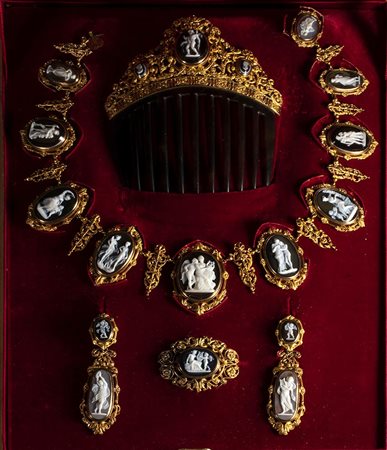
Lotto 307 A very fine french gold parure with agate cameos. Mythological figures.
1840 (circa)
Cameo (earring) min : 12 x 15 mm
Cameo (earring) max : 14 x 34 mm
Cameo (brooch) : 19 x 24 mm
Cameo (comb) min : 8 x 11 mm
Cameo (comb) max : 19 x 23 mm
Cameo (necklace) min : 13 x 17 mm
Cameo (necklace) max : 25 x 32 mm
Necklace lenght : 44 cm
170 g
Various mythological subjects.
Necklace: a dancer, Venus and Mars from Canova, Venus and Cupid in the act of playing with the bow (after Saulini), Diana huntress with a female figure, Eros with a Muse, Cupid and Psyche, Venus and Cupid in the act of making garlands, Venus and Adonis, a dancer, a dancing figure inspired by Herculaneum frescos.
Brooch: Cupid with a Muse; Earrings: cipid with the quiver - a dancer/cupid with the lyre- a Muse (Erato).
Diadem: a drunken silenus with tyrsus.
All these cameos are finely engraved on two-layers agates of different sizes. All these mytological subjets are inspired by the classical and the neoclassical repertoire, and in particular from works of famous engravers and sculptors. The very fine 18K gold mountings are masterfully chiseled with branches, acanthus leaves and flowers motifs. Small repair with tin on the brooch. Gold marks on the earrings mountings: Head of Ram turned to left, (Paris, 1819-1838, 18K).The lot is sold in its original wooden boxe (red velvet inside) with an old label “Collier de camées d’or fin grammes (?) 137. Fournisseur du roy rou (rue) Favart”, and another label with numbers. Very fine condition.
European private collection 80's -
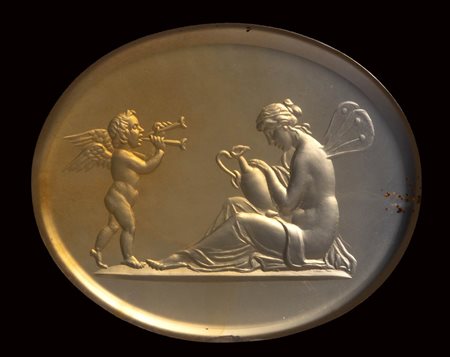
Lotto 308 A neoclassical agate intaglio. Eros and Psyche.
19th century
20 x 24 x 3 mm
The young girl is seated on the ground, looking slightly downwards in contemplation, and in the act of holding a jug. Her delicate body is characterized by butterfly wings on the bare back, while the legs are draped. Eros advances in front of her playing the double flute. The scene was engraved with similar compositional and stylistic characteristics by Pichler (signed carnelian intaglio, Vienna Kunsthistorisches Museum, Legate Timoni n.171; sardonic intaglio, by Giovanni Pichler, Vienna, Kunst, inv. XII. 424). This composition typically reflects the neoclassical taste and it is inspired by a drawing by Angelica Kaufman after a copy from the ancient (fresco). The work is characterized by great executive finesse. Attractive honey shade of stone.
Parallel: L.P. P. Stefanelli, La collezione Paoletti, vol. 2, p. 54 n. 331; p. 72 n. 536.
U.K. private collection, London. -
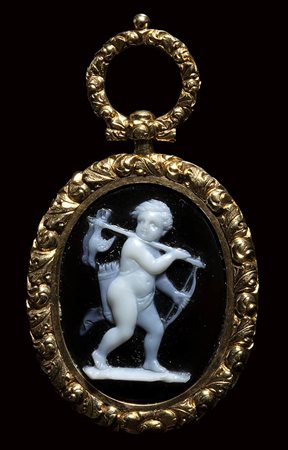
Lotto 309 A fine neoclassical onyx cameo set in a chiseled gold pendant. Cupid hunter.
End of 18th century - Beginning of 19th century.
cameo: 19 x 25 mm ; 8.43 gr
The erote advances to the right, turning his elegant head engraved in three-quarters. With the right hand he holds a stick where two prey (birds) are hung; with his left hand he holds the bow and carries the quiver tied to the bust. Groundline. This mythological subject is inspired from the ancient classical models, then spread in a more graceful key by the neocalssical artists and, above all, by the Wedgwood manufactory. The cameo is mounted on a finely chiseled gold pendant. Very fine condition.
European private collection. -
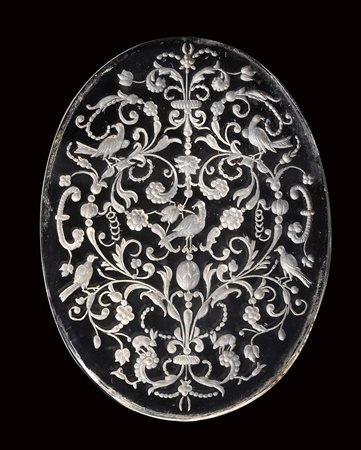
Lotto 310 A large post renaissance rock crystal intaglio. Grottesca.
17-18th century circa
55 x 72 x 5 mm
A large plant divides into two main branches, evolving into volutes and curvilinear terminals, sometimes performed with globular elements as a variation. Among this intricate vegetation of decorative taste on the model of painted grotesques, there are animals, including: two rabbits at the bottom; in the middle three birds, one of which flanked by an insect; above, two other birds. The intaglio was engraved on a large stone of extraordinary transparency and purity, leaving the details so finely etched satin. The piece probably adorned a metal casket on the Renaissance model. To be identified.
European private collection -
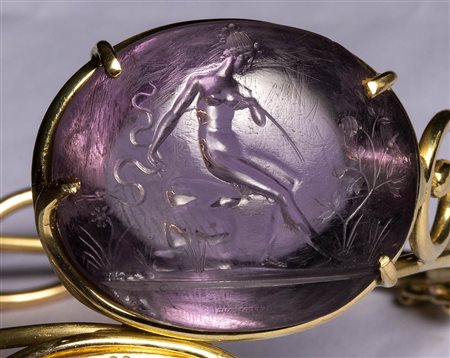
Lotto 311 An amethyst Poniatowski intaglio set on a modern gold bracelet with gold impression.
Early 19th century
intaglio : 22 x 28 x 10 mm
Diam (bracelet) : 60 mm
47 g
Heavy gold bracelet set with a fine Poniatowski intaglio: “Nature seated with a serpent in her hand”, signed Pyrgoteles (ΠΥΡΓΟΤΕΛΕΣ). The stone is flanked by a gold piece engraved with the same subject, adorning the jewel. Attractive color of the stone. Slight wear marks.
Parallels: Catalogue des pierres graves antiques de S.A. le Prince Stanislas Poniatowski ([1830?]-1833): II.157
Christie's, London: 1839-2023
Prendeville, J.: Explanatory catalogue of the proof-impressions of the antique gems possessed by the late Prince Poniatowski and now in the possession of John Tyrrell, Esq. (1841): 311.
European private collection. -
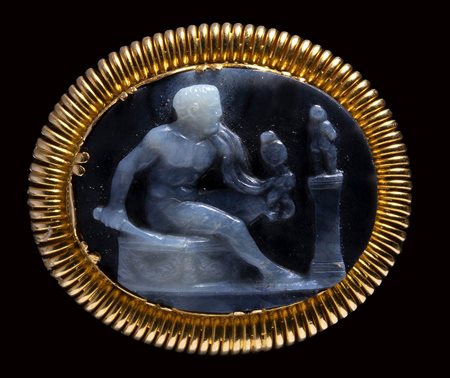
Lotto 312 A neoclassical agate cameo mounted on a modern gold ring. Diomede with the Palladium.
19th century A.D.
Cameo : 19 x 23 mm
Ring : 19 x 18 mm
14,0 g
Son of Tydeus and Deipile, he was one of the main Achaean heroes of the war of the Epigoni and of the Trojan war. Author of the theft of the sacred Palladio, he is shown here in one of his most famous poses. Diomedes is seated on an altar adorned with garlands. With the right hand he holds the sword, with the left the Palladio (the arm is wrapped in a drapery). In front of him, a pillar with an idol on it. Groundline. The scene, highly emblematic and elegantly composed, is performed with refinement and great skill; of particular beauty is the way in which the transparency of the stone changes with respect to the highest or lowest relief of the figure. The stone is set in a beautiful gold ring. Very fine condition.
Parallels: Jean-Marc Moret, Les pierres gravées antiques représentant le rapt du Palladion, 1997 for a complete study of the subject.
U.K private collection, London. -
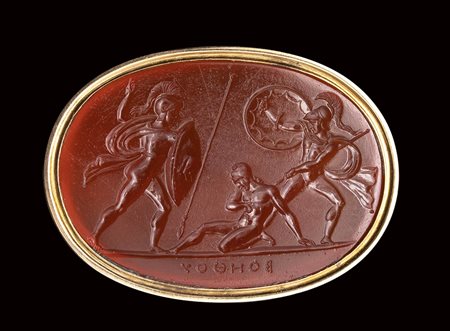
Lotto 313 A fine neoclassic Poniatowski carnelian intaglio mounted on a gold ring. Achilles having killed Pilidorus, attacked by Hector.
19th century A.D.
Intaglio : 20 x 30 mm
Ring : 26 x 17 mm
7,89 g
The intense fighting scene refers to an episode of the Trojan War. The brave Achilles, after killing Polidoro by hitting him with his spear, is attacked by Hector, who faces him without fear. The bodies are naked, sculpted in their youthful beauty, with the muscles tense in combat. Only helmet and shield protect them; the rising drapery is purely ornamental, a neoclassical signature of this splendid stone, mounted in its original ring commissioned by the Polish prince for his legendary collection. The intaglio is signed with greek letters under the groundline: ΒΟΗΘΟΥ (Boethos). Very fine condition.
Parallels: Beazley Archive; Catalogue des pierres graves antiques de S.A. le Prince Stanislas Poniatowski ([1830?]-1833): V.168; Christie's, London: 1839-1159. G. Vangelli de Cresci, Ad Minima Ad Maxima. La raccolta di impronte e matrici di gemme incise e medaglie. Museo dell'Antica zecca di Lucca.
U.K private collection, London. -
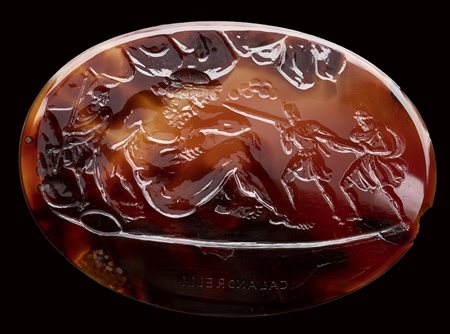
Lotto 314 A very fine neoclassical agate intaglio signed Calandrelli.
Ulysses and his companions blinding the eye of Polyphemus.
1820-1830 circa
42 x 59 x 4 mm
This remarkable large agate intaglio, signed below CALANDRELLI, depicts the famous scene in which
Ulysses and his companions are ready to blind the cyclops in his cave, after falling asleep for drinking wine. On the right Ulysses, recognizable by his typical headdress, pushes the base of the long inflamed wooden pole, directed towards the eye of Polyphemus, helped by his companion; wearing an helmet and a cloack covering an armor. A third character is instead behind the monstrous cyclops, to monitor the action, armed with a spear and always dressed with helmet, armor and cloak. The cyclops, who occupies the most prominent central position, is intoxicated and seated on the ground, with his head bowed over his left arm, resting on the raised knee, as a sign of yielding to sleep; instead his right arm is abandoned towards the ground, near the emptied cup. The scene is set inside the cave, with masterfully rendered rocks.
The same delicacy is used to make the smoke coming out of the tip of the bursting pole.The scene is set according to a well-balanced structure and studied by the artist, as evidenced by one of his drawings (Berlin) which undoubtedly constitutes the faithful preparatory model for this gem: the correspondance between the preparatory drawing and the agate carving it is in fact very strong, almost total, except for some aesthetic variations (as often happened during the execution phase).There is a second variant of the same scene, always attributed to Calandrelli but signed in Greek as Demophilos (ΔΕΜΟΦΙΛΟΣ ΕΠΟΙΕΙ), made for the Prince Poniatowski. The attribution of the drawing to Calandrelli is certain; the attribution to Calandrelli for the Poniatowski intaglio (currently missing and testified by the plaster cast ) may not be so sure.
The style of the intaglio signed Demophilos (propabably Calandrelli ?) appears in fact different, far inferior in skill and style, with anatomical details often artistically weak and the proportions of the characters not always respected.
The agate intaglio signed by the artist, reveals in fact an extraordinary engraving quality completely different, with a masterly rendering of the anatomical details and the expressive physiognomy of the figures very faithful to the drawing. Every detail is mirror-polished with great skill. A very rare and extraordinary agate variety was used to represent this mythological episode: the agate in fact presents very fine variety of colors from red, yellow to brown tones with shades and spots, as if to symbolize the cave, the smoke and the violence of the scene. The stone has slight signs of wear, small cracks and a chipping on the edge, probably caused by removing the stone from its original setting.
A Grand Tour Era plaster cast impression, taken from this work, has been identified in a private collection. Unpublished.
Parallels: Catalogue des pierres graves antiques de S.A. le Prince Stanislas Poniatowski ([1830?]-1833): VI.30
Christie's, London: 1839-538
Prendeville, J.: Explanatory catalogue of the proof-impressions of the antique gems possessed by the late Prince Poniatowski and now in the possession of John Tyrrell, Esq. (1841): 1014
Calandrelli drawing, Antikensammlung Berlin: A.IV.4
Lord Monson
Christie's, London: June 9, 1851, lot 101
Samuel Sharp
Sotheby's, London: 5 April 1883: lot 91
Platz-Horster,G.: L'antica maniera. Zeichnungen und Gemmen des Giovanni Calandrelli in der Antikensammlung Berlin (2005): P.81 G. Vangelli de Cresci, For the Poniatowki collection: A Minima Ad Maxima, La raccolta di impronte ematrici di gemme incise e medaglie, Museo dell'Antica Zecca di Lucca.
U.K., private collection 80's, London. -
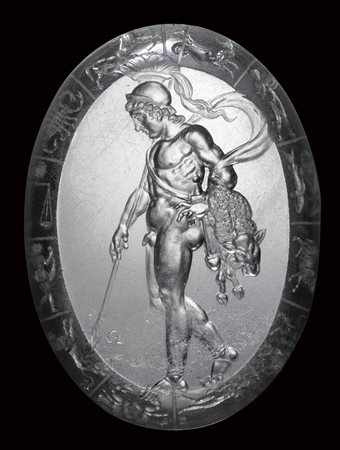
Lotto 315 An extraordinary neoclassical rock crystal intaglio. Jason and zodiac signs.
1820-1830 circa
30 x 42 x 6 mm
Jason, son of the king of Iolco, Aeson, and husband of the sorceress Medea, was at the head of the Argonauts expedition, aimed at the conquest of the golden fleece. Wanting to regain the throne of Iolco usurped from his father Eson by his stepbrother Pelias, Jason will have to go to conquer the Golden Fleece, the skin of the golden ram located in Colchis from King Aetas, at the head of a group of heroes, the Argonauts, who form the crew of the ship Argo. Thanks to Medea, daughter of Eeta, he succeed in his quest and, after many adventures characterizing the whole trip, he will return to Iolco. In this extraordinary rock crystal intaglio, the hero is represented in all his youthful strength and beauty with the attributes of success.
The character is facing left, with the helmeted head in profile and with the chest slightly twisted in three-quarters. The gaze downwards, is contemplative, the left hand resting on the side, while the right holding a spear, the tip pointing downwards. The left leg supports the vigorous body, while the right elegantly lifting the heel. The body is muscular, sculpted with meticulous anatomical details, with great technical skill. On the chest appears the sword sheath leather band, while the feet are protected by sandals whose very thin sole can be seen under the feet. The left arm also carries the mythical fur of the Golden Fleece, emblem of his great enterprise; a flap of cloak rises behind the back, blown by the wind, according to a typical neoclassical iconography. The figure of Jason, perfectly centered in the field of the stone, dominates in all its heroic splendor, in a powerful sculptural pose of classical inspiration, and at the same time intimate and delicate.
A strong allegorical and astrological meaning is present in this precious gem, showing the 12 zodiacal signs masterfully engraved on the edge of the back of the stone. The extraordinary stylistic rendering of the zodiac symbols is emphasized by their executive perfection despite the narrow and complicated space to engrave, since the edge is inclined. Despite of its thickness, the transparency of the stone makes possible the perception of all signs engraved on the back, creating an effect of passing and overlapping of both scenes, united in a single great astral allegory. The celestial signs accompany Jason in his mythical triumph, after many difficulties and fights. His effigy appears thus protected by the gods and the planets, from the beginning to eternity, as revealed by the letters alpha and omega, the seal of this scene.
The compositional structure of the standing (or seated) figure surrounded by the zodiac is known and attested since ancient times also in the glyptic, in rare and valuable specimens; however the stylistic and executive details seem to advance the dating of this gem to the neoclassical Era.
U. Pannuti, La collezione glittica. Museo Archeologico Nazionale di Napoli, vol. 2, p. 164 n. 130 (Apollo-Helios with the zodiac, ancient roman carnelian intaglio); J. Kagan, O. Neverov, 500 pierres gravées du Cabinet de Duc d'Orléans, p. 67 n. 57/29 (16th century carnelian intaglio); p. 145 n. 273/91, p. 165 n. 335/153. L.P.B. Stefanelli, La collezione Paoletti, vol. 1, tomo I n. 125; n. 197; tomo 4 n. 48 and 228; vol. 2: tomo 5 n. 395 (copy of L. Pichler after the famous carnelian intaglio of Paris, Bibliothèque Nationale, Cabinet des Méedailles) and n. 424; tomo 8 n. 288.
U.K., private collection, acquired from M-G., 70's, London. -
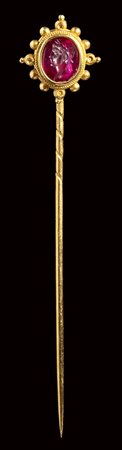
Lotto 316 A fine postclassical ruby intaglio set in a gold stick pin. Bust of a Julio-Claudian emperor.
18th-19th century
Intaglio : 6 x 7,5 mm
Pin : 64 mm
2,50 gr
The laureated emperor, identifiable probably to Augustus or Tiberius, is facing left. This precious intaglio is mounted on a fine gold stick pin characterized by a refined frame worked by spherical elements. Very fine condition. Attractive color of the stone. Rare. -
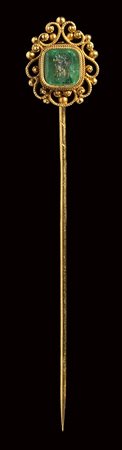
Lotto 317 A postclassical emerald intaglio set in a gold stick pin. Bust of Hercules.
19th century
Intaglio : 8 x 8 mm
Pin : 70 mm
2,80 gr
The hero is facing left, with short hair and the club on the shoulder. This precious intaglio is mounted on a fine gold stick pin characterized by a refined frame worked by intertwined and spherical elements. Very fine condition. -
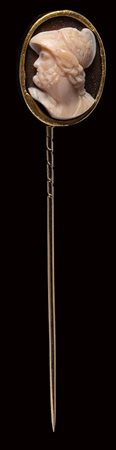
Lotto 318 A neoclassical agate cameo set in a gold stick pin. Ajax.
19th century
Cameo : 15 x 20 mm
Pin : 75 mm
7, 53 g
The bearded hero is wearing the corinthian helmet, facing left with the head in profile and the front bust. The work reproduces a popular and recurring model in neoclassical production, inspired by statuary models. High relief. Fine condition. -
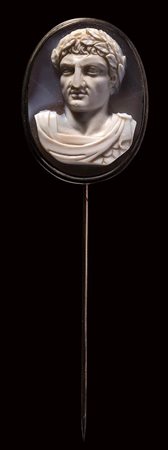
Lotto 319 A modern agate cameo set in a metal stick pin. Bust of an emperor.
18th-19th century
Cameo : 28 x 37 mm
Pin : 92 mm
The effigy of the Roman emperor is carved in high relief, almost frontally, with the face turned slightly three-quarters to the left. Laurel wreath on the head and bust draped with chlamys and armor. Work carried out with marked engravings that well highlight the anatomical volumes of the character, inspired by an ancient model. Fine condition. -

Lotto 320 A modern amethyst intaglio set in a gold stick pin. Female head.
19th century
Intaglio : 8 x 10 mm
Pin : 75 mm
3,0 g
A post classical female head, facing left. Fine gold frame formed by spherical and intertwined elements. Fine condition. -
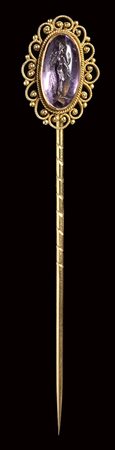
Lotto 321 A modern amethyst intaglio set in a gold stick pin. Winged female figure.
19th century
Intaglio : 7 x 13 mm
Pin : 73 mm
3,59 g
The standing allegorical figure is facing right, holding a branch. This precious intaglio is mounted on a fine gold stick pin characterized by a refined frame worked by intertwined and spherical elements. Very fine condition. -
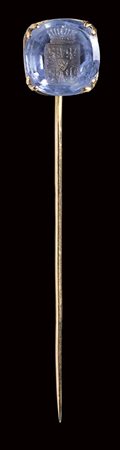
Lotto 322 A modern topaz seal intaglio mounted in a metal stick pin. Coat of arms.
19th century
Intaglio : 12 x 12 mm
Pin : 68 mm
4,34 g
Heraldic coat of arms composed of an ornated shield surmounted by a crown with nine points. To be identified. Attractive color of the stone. Slight wear marks. -
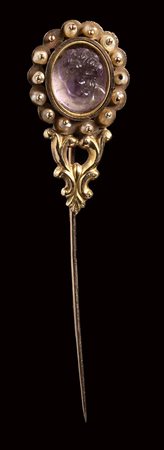
Lotto 323 A postclassical amethyst cameo set in a gold stick pin with pearls. Bust of Cupid.
18th-19th century
Cameo : 10 x 13 mm
Pin : 62 mm
2,93 g
The young head is turned slightly in three-quarters to the right side, engraved in high relief. Fine work. Mirror polished. The stone is mounted on a fine gold Georgian stick pin characterized by a refined frame with pierced pearls (one missing). Very fine condition. -
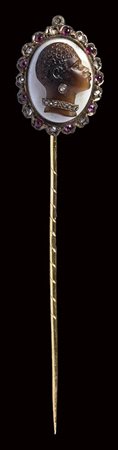
Lotto 324 A fine victorian agate cameo set in a gold stick pin with precious stones. Moor's head.
19th century
Cameo : 11 x 14 mm
Pin : 70 mm
4,0 g
The head is turned to the right and embellished with an earring and a collar made of diamonds masterfully set on the small agate cameo. Rubies and diamonds are set in the frame surrounding the portrait. Very fine condition. -
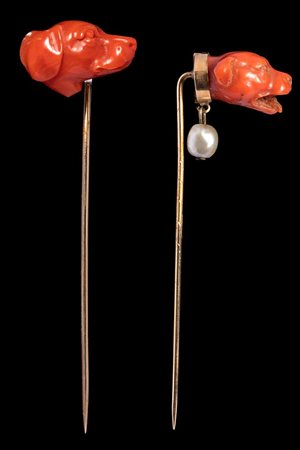
Lotto 325 A lot of two Victorian coral cameo head of dog set in gold stick pin.
19th century
H : 70 mm
8,22 g
These two fine microsculptures depict two different dogs heads, one with a closed-mouth and the other with an opened mouth. The latter is set at the stick pin with a gold band edge that reproduces his collar and a pearl as pendant. Very fine condition. -
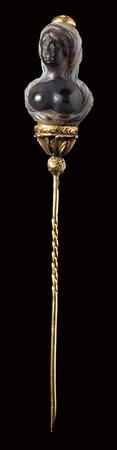
Lotto 326 A banded agate female bust set in a gold stick pin.
18th century
H. 95 mm 8.36 gr
The figure is characterized by a veiled head, partially draped torso with large exposed breasts. The bust is finely sculpted, emphasizing in the best way the beauty of this banded agate, engraving the body in the dark part and the drapery in the light part of the stone. The nose is damaged. This microsculpture is set in an elegant mounting adorned with plant motif, finely chiseled. -
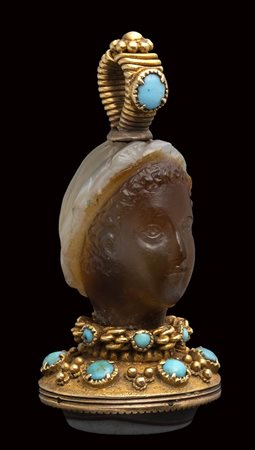
Lotto 327 A fine banded agate seal set in a gold mounting with turquoise. Female head.
18th century
H. 41 mm 15.73 gr
The handle of this beautiful fob seal is formed by a microsculpture in a brown and white banded agate with honey tones and depicting a woman’s head with a headdress. The gold frame with small turquoise set is finely worked with various ornaments. An elegant collar made up of stones and intertwined golden chain elements goes around the neck of the figure. Below, an agate intaglio (set to make the seals) depicting a bearded helmeted head of Mars. Refined piece in excellent condition. -
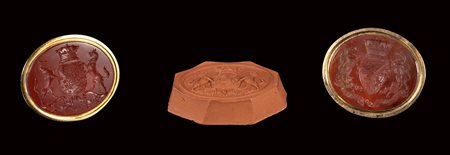
Lotto 328 Two fine carnelian intaglios mounted as seals. Coat of Arms of the 1st Earl of Lucan.
18th century
Intaglio : 23 x 28 mm
H: (seal) : 27 mm/ 43 mm
15,28 g /17,24 g
The lot consists of two large carnelian carvings representing the same heraldic coat of arms referable to Sir Charles Bingham (1735-1799), 1st Earl of Lucan, High Sheriff of county Mayo - M.P. as Baron Lucan of Castlebar. The two coat of arms have small variations (shape of the shield, crown and ribbon). One mounted in a typical seal frame with elongated handle; the other mounted as a ring. Complete set very rare. Perfect conditions. Sold in an elegant red leather boxe, including the cast impression of the depiction. -
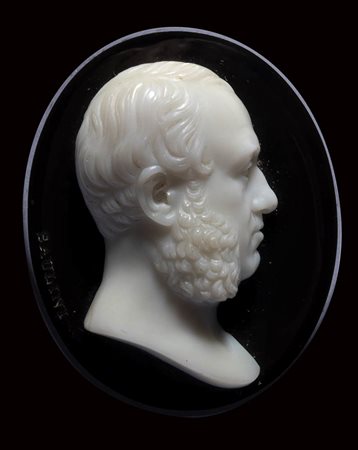
Lotto 329 A neoclassical onyx cameo signed Saulini. Bearded gentleman.
19th century
30 x 37 x 11 mm
A fine high relief private portrait of a breardered victorian gentleman, facing right, signed SAULINI (probably Luigi Saulini, 1819-1883). Working in Rome. Son of Tommaso Saulini, continued the family studio after his father death specialising in portraiture for which both men were renowned. Recorded in Murray's Guide to Rome for 1853 at 8 Via della Croce. By 1867 the studio had moved to 96 Via Babuino.
Tommaso e Luigi Saulini, incisori.... ; British Museum database inv. 1978,1002.1162 -
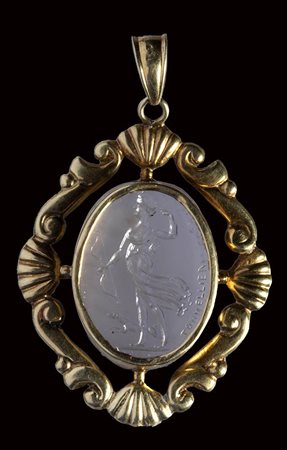
Lotto 330 A chalcedony intaglio signed Tonnellier, set in a gold 14K pendant. Diana hunting.
End of 19th century
Intaglio : 12 x 15 mm
2,0 g
The deity wears an elegant fitted tunic and faces left. The huntress is in the act of looking for an arrow to shoot with a bow. At her feet, a running dog. Groundline.
Georges Tonnelier (1858 - 1937), whose name is sometimes spelled «Tonnellier», was the student in Paris of A. Millet and Charles Gauthier. First destined for statuary, he began engraver of gems quite late, around the age of twenty-seven, under the auspices of master Jules-Clement Chaplain. He was an engraver constantly praised by fans and critics of this art at the end of the 19th century: his intaglios were masterpieces where “precision does not exclude grace”, and considered to be «one of the most ardent renovators of his art» (see among others the magazines Art & Décoration, vol. 6, 1899, and La Revue de l’Art, vol. 30).
Ernest Babelon, the famous curator of Cabinet des Médailles, found him «astonishing fruitfulness and the energy of a blacksmith». He describes him as one of the four modern artists with «neat and elegant works» admired in the last exhibitions of the late nineteenth century (see Engraving in fine stones. Cameos and intaglios, Paris, Librairies-Imprimies unifies, p. 315; and also the long passage he devotes to his works in his History of engraving on gems in France, Paris, Société de propagation of art books, 1902, pp. 243-245). Works of Tonnelier are in the Walters Art Museum in Baltimore (inv. 42.99) and in the Metropolitan Museum (Cameo Appearances catalog, p. 50, n ° 109-110).
European private collection. -
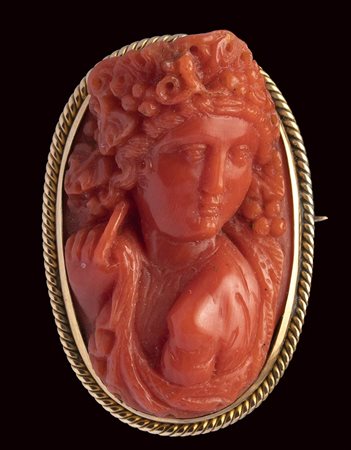
Lotto 331 A fine Victorian coral cameo set in a gold brooch. Bacchante.
19th century
Cameo : 21 x 25 mm
brooch : 58 mm
15, 14 g
The female figure presents the torso almost in profile facing left, placing the left shoulder uncovered in the foreground. With her left hand she holds the drapery that partially covers it, turning her head back to the right in three-quarters. The thick hair is decorated with bunches and grape leaves. Fine work in high relief. Very good condition. -
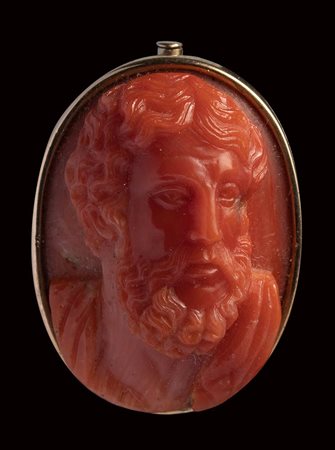
Lotto 332 A fine neoclassical coral cameo set in a metal brooch. Bust of a bearded philosopher.
19th century
Cameo : 23 x 32 x 16 mm
12,65 g
Philosopher bust in high-relief, with a frontal draped bust and the face turned slightly three-quarters to the right. The figure is characterized by a thick hair and a thick beard, physiognomic features inspired by classical statuary. Very good condition. -
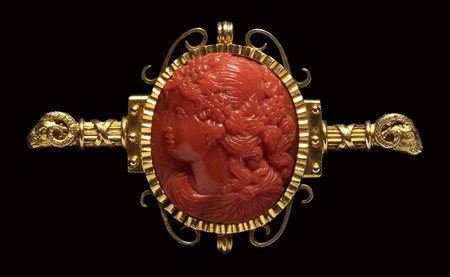
Lotto 333 A fine Victorian coral cameo set in a gold brooch. Bacchante.
19th century
Cameo : 26 x 39 x 18 mm
15,55 g
The figure is turned to the left, with the draped bust and the thick hair adorned with bunches and grape leaves. The cameo is mounted in an elegant gold brooch characterized by two protruding side parts (bundle of rods tied by ribbons), each ending with a ram head. Very fine condition. -
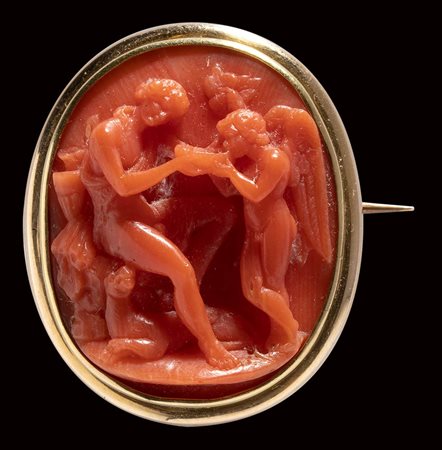
Lotto 334 A fine red coral neoclassical cameo set in a gold brooch. Bacchus and Cupid.
19th century
23 x 28 x 8 mm
10,04 g
A fine neoclassical scene inspired by the relief «Amore e Bacco» (1810, 1824) of Bertel Thorvaldsen (1770-1844). The young god is seated on the rocks on the left side, facing right, giving a cup to quench the thirst of an erote (winged genio). At his feet, a panther. Very fine work, well composed and executed in high relief. Mirror polishing. Perfect condition. -
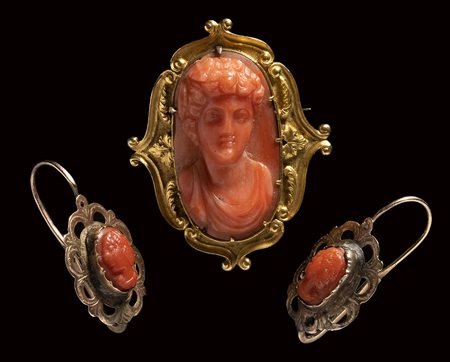
Lotto 335 A Victorian red coral cameo set in a gold brooch with two small coral cameo set in earrings.
19th century
Cameo brooch : 20 x 34 x 9 mm
11,88 g
Draped bust of a young male, engraved in high relief, set in a beautiful gold mounting decorated with chiseled leafs.
Two small female portraits for the earrings. Good condition. -
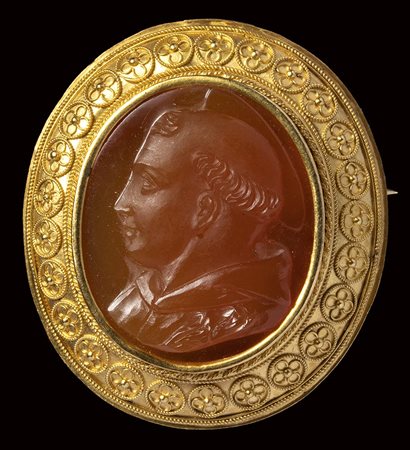
Lotto 336 A carnelian cameo mounted in a gold brooch. Bust of a Saint Anthony of Padua.
19th century
Cameo : 24 x 29 mm
12,40 g
The saint is turned to the left, wears his typical robe and nimbus on his head. The cameo, finely engraved on a vivid red carnelian, is mounted in an elegant gold brooch adorned with stylized floral patterns on the frame. Very fine condition.