
Auction 86 - Glyptics and Ancient Jewelry
-
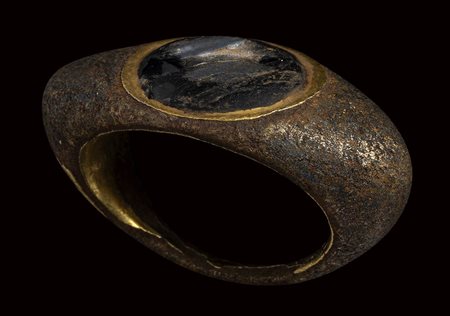
Lotto 241 A large late roman gilted bronze ring set with a glass paste.
1st century B.C.
Glass : 13 x 15 mm
ring : 21 x 16 mm
17,36 g
Oval hoop, convex without, concave within. It broadens out widely at the head. The bezel is in the form of a raised gold hollow disk soldered to the head of the ring, with a glass.
Parallel: Antiken Gemmen in Deutschen Sammlungen, Band. IV, T.36, n°236, inv. K 1349
U.K private collection -
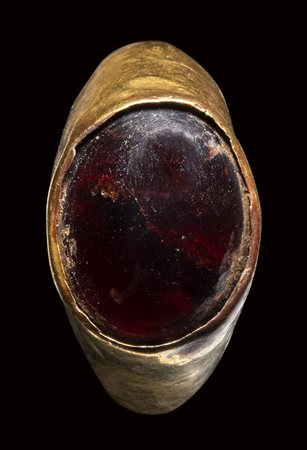
Lotto 242 A graeco-roman gold ring set with a garnet cabochon.
2nd B.C. - 2nd century A.D.
Stone : 9 x 12 mm
Ring : 15,5 x 15 mm
3,29 g
Hollow hoop rounded with large ending and oval bezel set with a nice oval cabochon garnet.
Parallel: Marshall, F.H., Finger rings, 1968, p. 121, n°725
U.K private collection, London. -
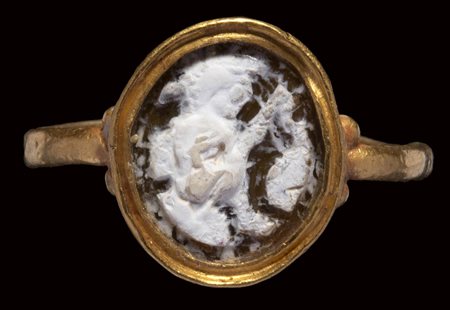
Lotto 243 A roman burnt agate cameo mounted in a gold ring. Mythological scene.
3rd century A.D.
Cameo : 10 x 12 mm
ring diam : 21 x 19 mm
5,48 g
The surface of the cameo is partially damaged by the ancient burns, which partly "baked" the stone. Scene to identify. The cameo is mounted in an ancient ring decorated with four spheres between the bezel and the smooth annular rod. Wear marks.
U.K private collection, London. -
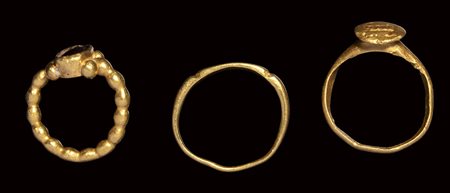
Lotto 244 A lot of three roman gold finger rings.
2nd – 3rd century A.D.
Diam : 13,5 mm / 11 mm / 14 mm
7,64 g
From left to right ;
- Hoop composed of a serie of gold spheres ending with two laterals ones and a almond-shapes bezel set with a garnet.
- A gold plain hoop rounded within and without, the bezel marked by two vertical engraved lines.
- Hoop rounded within and without, enlarged at the ends with a circular engraved bezel.
U.K private collection -
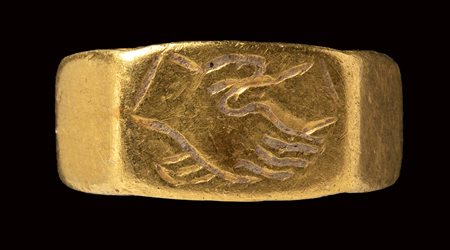
Lotto 245 A roman gold engraved child ring. Dextrarum Junctio.
3rd – 4th century A.D.
Diam : 13 x 11 mm
3,29 g
Flat hoop, broad and polygonal. Long bezel with engravd design representing two hands clasping.
Parallel: Marshall, F.H., 1968, Catalogue of finger rings, p. 189, n° 1199
U.K private collection -
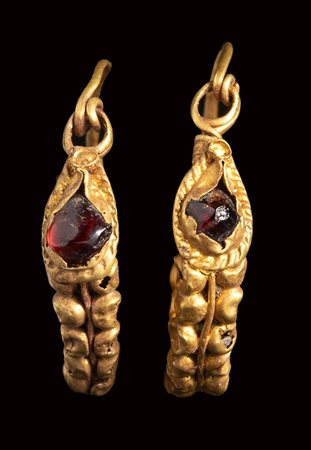
Lotto 246 A roman pair of gold earring with garnets.
1st century B.C. - 1st century A.D.
H : 22 mm
3,02 g
Pair of crescent-shape earrings, each hoop composed with two rows of spherical elements ending with a gold ovoid setting with a cabochon garnet.
Little damages on some spherical beads.
Parallel: Metropolitan Museum of Art, NY, inv. 1995.85.3-7.
U.K private collection -
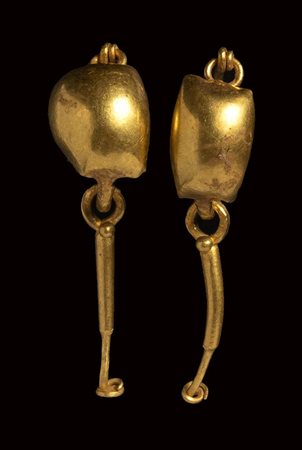
Lotto 247 A roman pair of gold earring with discs and pendants.
2nd century A.D.
H : 32 mm circa
4,24 g
Hoop with discoid plaque, loop beneath with breloque and granule, ending in spirals.
U.K private collection -
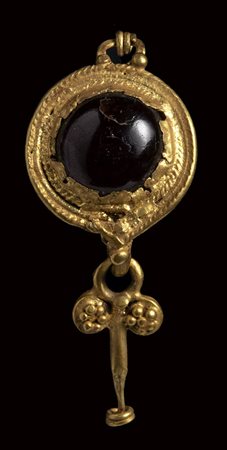
Lotto 248 A roman gold and garnet earring with disc and pendant.
2nd century A.D.
H : 28 mm
2,43 g
Hoop with discoid plaque and granule above. The disc set with a garnet cabochon, loop beneath with breloque fromed as a loop and granulated lobes. Wire beneath.
Small crack on the garnet.
U.K private collection -
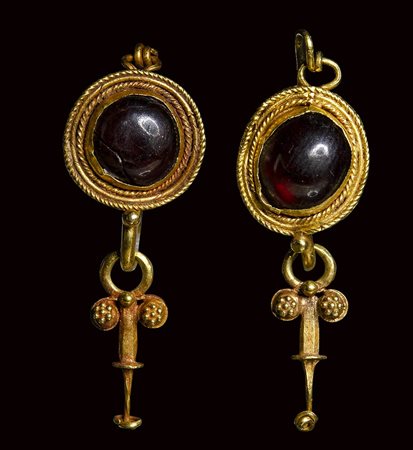
Lotto 249 A pair of roman gold earrings set with garnets.
2nd - 3rd century A.D.
H: 39 mm ; 5,32 gr.
Each earring set with garnet cabochon (one damaged) in a gold disc box decorated with twisted gold wires. Supension rings intertwined with a gold twisted pendeloque and granulation. At the terminals, suspension hoops and hooks.
Monte-Carlo private collection, Mr. P.L, 1982 -
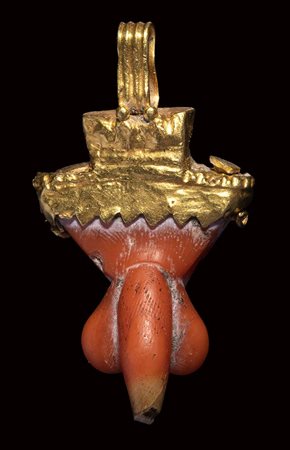
Lotto 250 A gold and coral roman apotropaic phallic pendant.
1st century B.C. – 1st century A.D.
21 x 37 mm
5,59 g
The coral sculpted phallus, naturalistically modeled is set in a clip made with soldered gold plaques ending with a large hoop.
This pendant was worn as an apotropaic amulet.
U.K private collection, London. -
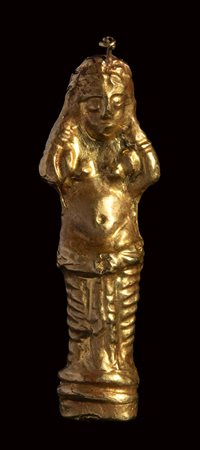
Lotto 251 A romano-egyptian gold amulet. Aphrodite
1st - 2nd century A.D.
H : 40 mm
3,45 g
Composing with two embossed layers of gold, this hollow figure represents the goddess with a naked bust, the lower part of the body covered by a folded drapery. She standing on a rounded base.
Her arms, touching her hair, she wears bracelets.
Suspension loop on her back. This figure was worn as a pendant.
Parallel: Marshall, F.H., Catalogue of Jewellery, p. 360, n° 3011, 3012
U.K private collection, London. -
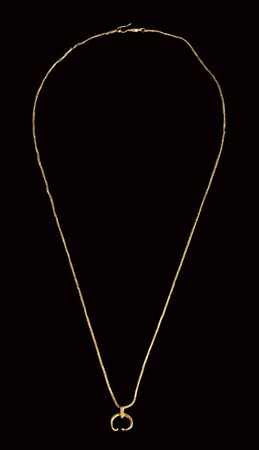
Lotto 252
A roman gold necklace with a moon crescent pendant (lunula).
1st century A.D.
L: 255 mm
5,05 g
Gold necklace composed of a chain of plated wire ending in a hook-shaped clasp. The crescent pendant is attached to the chain with a solid gold loop. Very fine condition.
Parallels :
Marshall, F.H., Jewellery, p.314, n° 2720
U.K private collection -
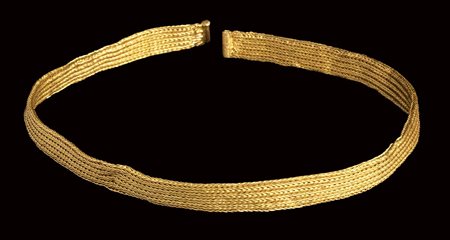
Lotto 253 A roman gold bracelet.
1st century A.D.
L : 200 mm
9,90 g
Consisting of a band of six plated strands ending in a clasp with cylindrical form.
Exceptional state of conservation. This model is inspired by the classical greek jewellery.
Parallel: Marshall, F.H., Jewellery, p.314, n°2719
U.K private collection -
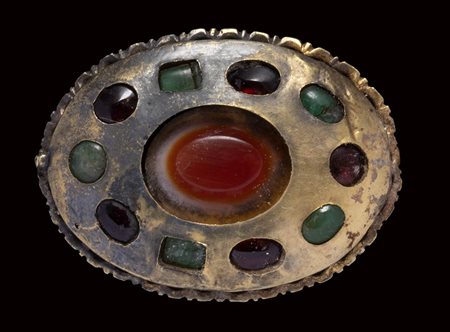
Lotto 254 A late roman large gold brooch set with an agate, garnets and emeralds
4th - 5th century A.D.
33 x 44 mm
15,49 g
The structure of the jewel is in oval-shape, with a hollow and slightly convex body. In the center there is a three-layered agate (which has fallen into the brooch over time and moves slightly in the frame). Around it, five oval garnets and five oval/rectangular emeralds. The brooch is characterized by a finely chiseled frame. The back of the brooch is characterized by a heart-shaped relief ornament. The large-sized jewel is in good general condition, with patina and sediment deposits. Slight damage. Intact.
U.K private collection, London. -
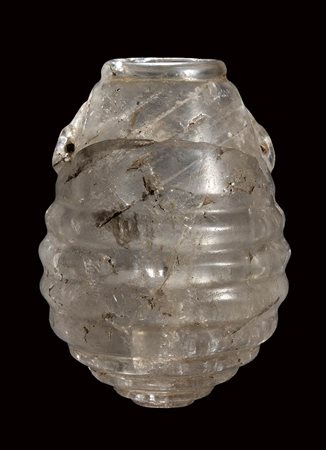
Lotto 255 A roman rock crystal amphoriskos.
1st century B.C.
H_ 54 mm
Diam max : 39 mm
With a piriform-shape, short neck and a rounded rim. The shoulders with twin pierced lug handle. The belly with 7 relief discs. Probably an unguentarium. Cracking and wear marks. Patina deposit. Very rare specimen.
U.K. private collection 1985. Formerly in Arthur Sambon (1867-1947) collection. -
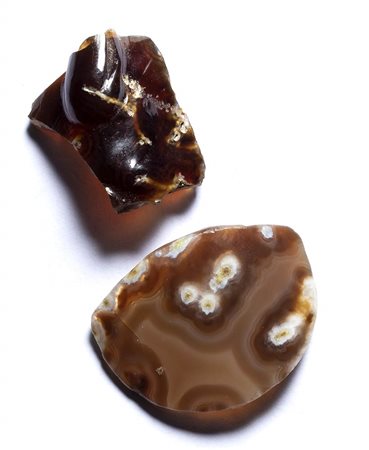
Lotto 256 Two fragments of roman murrina vasa.
1st century B.C. - 2nd century A.D.
22 x 28 mm
18 x 22 mm
The two fragments of cupped vase come from two different artefacts carved in two different beautiful sardonyx varieties.
A fragment has a smooth mirror-polished surface, convex and of fairly uniform thickness, with the presence of typical nodules. The other piece has a cameo carved surface, of uneven thickness and probably decorated with figures. Two precious examples of disappeared artifacts, already from the time of the Romans considered particularly precious and of great luxury. Rare.
Parallel: D. Del Bufalo, Murrina Vasa. A luxury of imperial Rome, 2016.
U.K. private collection -
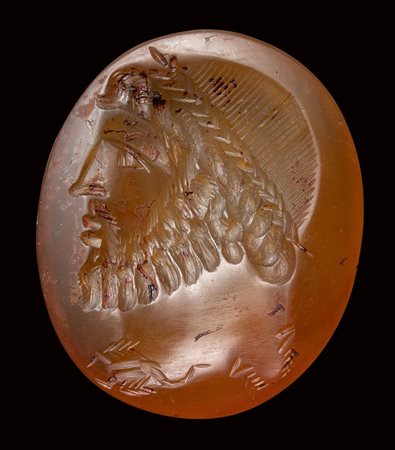
Lotto 257 A large eastern roman carnelian intaglio. Bearded male bust with astrological symbols.
1st - 3rd century A.D.
24 x 29 x 12 mm
The character faces left and is characterized by a thick beard, finely engraved hair with a laurel wreath. The bust ends in front with a scorpion, and behind with a crab, both zodiac symbols. The large stone is characterized by small deposits and traces of iron even inside the carving. Probably a middle-eastern workshop. Very rare astrological iconography.
U.K private collection, London. -
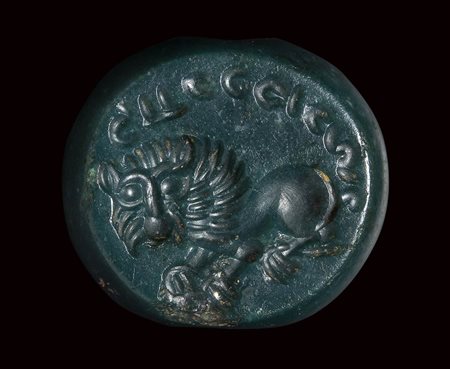
Lotto 258 A sasanian green jasper stamp-seal. Lion and inscriptions.
5th century A.D.
12 x 14 x 11 mm
Ellipsoid shaped stamp-seal with high domed back and hole lenghtwise. On the flat base, a lion running on the left, the head in front. On top, pahlavi inscription "'ys'gzy(?)" For a similar example : MET, NY, inv.81.6.288
Chips on the edge.
Parallel: Brunner, Christoph, Sasanian Stamp Seals in the Metropolitan Museum of Art, p.96
U.K private collection -
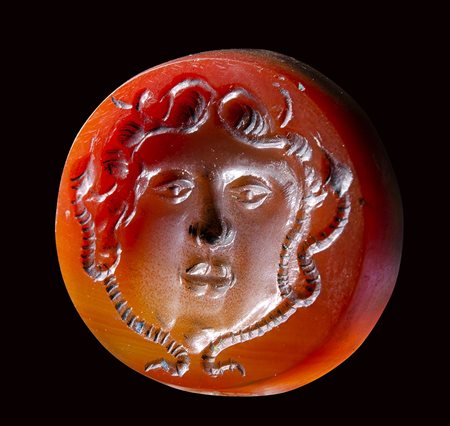
Lotto 259 A large early medieval agate intaglio. Medusa mask.
12th-13th century
24 x 26 x 5 mm
The thick stone is engraved with a Medusa mask characterized by a rounded face with plain chicks, full lips, and a straight little nose. The eyes are framed by heavy lids and the pupils are marked by a globular element. The forehead is surmonted by some curly short locks and snakes surrounding the face until the chin. This unusual stone is characterized by certain stylistic, iconographic and executive details that place it in the glyptic production referable to the court of Frederick II Hohenstaufen. The cameo production is better known, while the intaglio production is still little known and rare. The frontal face of this Medusa certainly emulates the classical models of the Greek-Roman Era, but reveals its evolution through the models of late antiquity with new stylistic features belonging to the early medieval age. The shape, the choice of this variety of agate (slight burnt on the back side) and the type of polishing seem to confirm this dating and the geographical area of its production (southern italian ateliers). The choice of a mythological subject inspired by classical antiquity is in line with the Federician cultural project, always maintaining its apotropaic meaning. The stone was mounted probably in a pendant.
Parallels for the glyptics production of the Federican Court: Aa.Vv. La Glittica Santarelli ai Musei Capitolini, pp. 215 ss with references to Antonio Giuliano researches.
European private collection 80's -
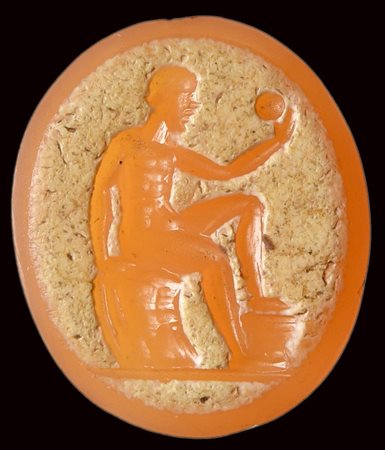
Lotto 260 A postclassical agate intaglio. Seated male figure with a globe.
18th - 19th century
10 x 13 x 3 mm
The character is seated on a rock and rests his left foot on a base on the ground; with his left hand he raises a globe. Groundline. Wear marks. Postclassical work. -
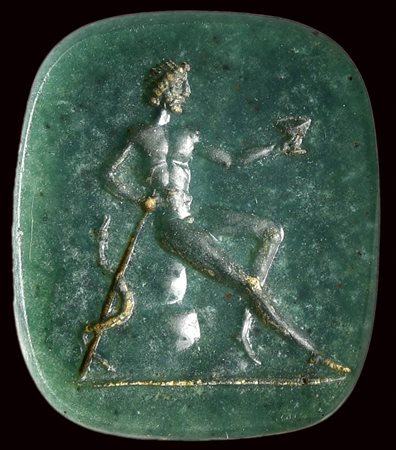
Lotto 261 A postclassical crysoprase intaglio. Asclepius.
18th-19th century
10 x 12 x 2,5 mm
The naked deity is seated on the rocks, holding a cup and the scepter with entertwined snake. Groundline. Attractive color of the stone. Postclassical work. -
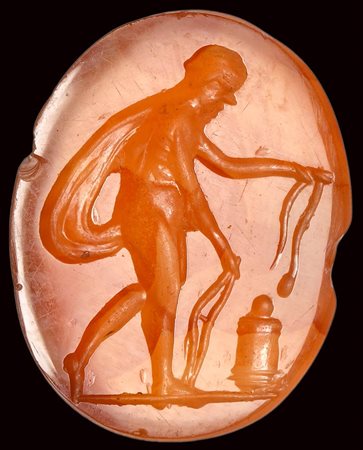
Lotto 262 A post classical agate intaglio. Sacrifice scene.
17th - 18th century
13 x 16 x 3 mm
An old male character with a cloak is in the act of making a sacrifice over a small altar. With both hands he holds offerings. Groundline. Attractive variety of stone. Wear marks. Light chipping on the edge. Postclassical work. -
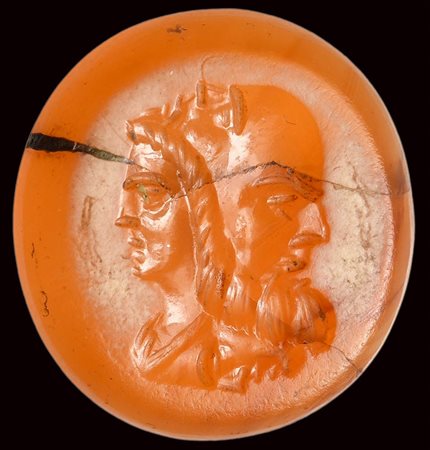
Lotto 263 A postclassical agate intaglio. Gryllos.
18th - 19th century
14 x 16 x 4 mm
The hybrid creature is composed by: mask of an elder Silenus conjoined with a young draped bust; two others male masks are conjoined to the apotropaic depiction. The stone, characterized by a slightly burnt surface, is broken and recomposed in the upper part, and has a crack at the bottom. Wear marks. Postclassical work. -
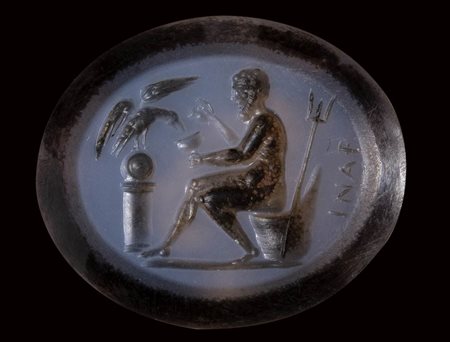
Lotto 264 A postclassical agate-nicolo intaglio. Hades.
18th - 19th century
15 x 18 x 3 mm
The ruler of the Inferos is seated on the throne, facing left, in the act of pouring a drink and quenching a crow's thirst on a column ending in a globe. A trident is leaning against the throne. Behind, the inscription INAP. Groundline. Wear marks. -
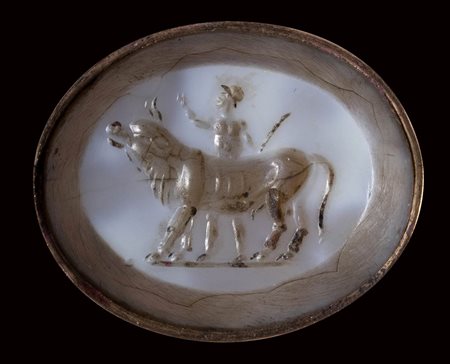
Lotto 265 A postclassical agate-nicolo intaglio. Male figure with a bull.
18th - 19th century
16 x 20 x 4 mm
In the foreground a bull, facing left. Behind the mighty animal, a standing male character with headdress and a stick, in the act of raising his right arm upwards. Groundline. Metal frame. Wear marks. -
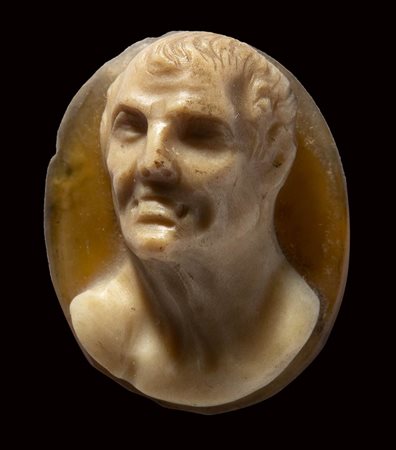
Lotto 266 A postclassical agate cameo. Bust of Seneca.
17th - 18th century
13 x 16 x 8 mm
The philosopher is depicted with the head in three-quarters in slight torsion with the bust. The unusual portrait is engraved in very high relief and characterized by naturalistic anatomical details and great espressiveness. The portrait expresses the signs of the age and suffering of the famous roman character. Wear marks. -
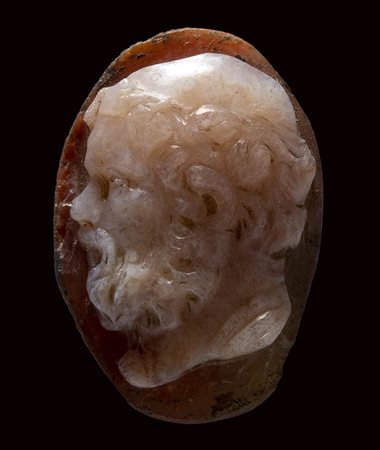
Lotto 267 A postclcassical agate cameo. Bust of Silenus.
16th - 17th century
11 x 16 x 6,5 mm
The bearded character is turned to the left, wearing the ivy crown. Wear marks and chippings on the edge. Probably an ancient cameo slightly reworked in postclassical times. -
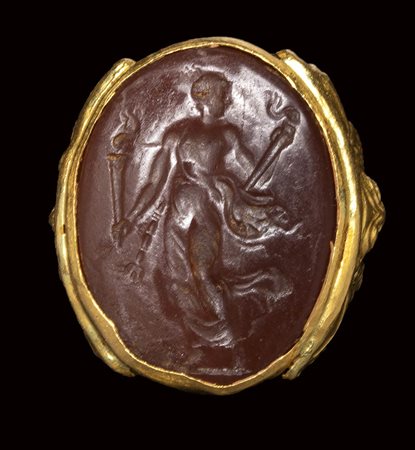
Lotto 268 A postclassical carnelian intaglio set in a gold revival ring. Female figure with torch.
Probably 19th century (?)
intaglio: 20 x 26 mm ; ring: diam. 18 mm ; 17.78 gr
The female figure advances to the left, turning her head in profile backwards to the right. She wears a tunic that adheres to the body for the wind, which also raises a veil. With both hands she holds burning torches. Allegorical subject (perhaps referred to Diana Lucifera), probably executed in the post classical era. Signs of wear. The gem is mounted in an Etruscan style setting, adorned with two gorgona masks chiseled on the triangular shoulders of the ring. Fine condition. -
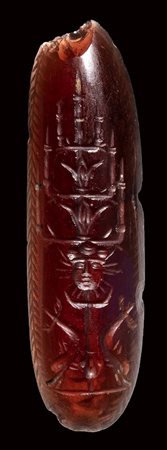
Lotto 269 A post-renaissance magical garnet amulet. Candelabrum with inscriptions.
17th century
9 x 33 x 4 mm
On the convex surface, a candelabrum with grotesque head; 6 lateral branches and a principal larger branch decorated with lily flowers. Beneath the base, on each side, a dolphin, head down. Groundline.
On the reverse, greek inscriptions (retrograde): Α ΚΙΡΙΑς ΛΓΡΙΠΕΙΝΑΣ: Long live Agripine ! On the right, a palm branch.The inscription is surrounded by a branch border. Chip on top of the amulet and small chips on the edge (lower part). Rare.
U.K private collection, London. -
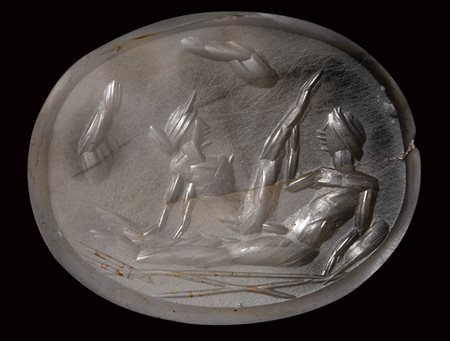
Lotto 270 A postclassical agate intaglio. Erotic scene.
16th - 19th century (?).
18 x 22 x 3 mm
The scene is composed of a man and a woman depicted during a sexual act: the male figure is partially lying down, with his legs stretched out and his torso raised against an arm; with the other arm he holds and raises the legs of the female
figure who is above him to receive a penetration. The two characters look at each other during the act, over a stylized bed with crossed engraved signs. Above, two large phallic symbols, allegory of the carnal act. Scene inspired by Pompeian frescoes and spintriae (erotic tesserae). Slight cracking. Signs of wear. Probably postclassical.
U.K private collection, London. -
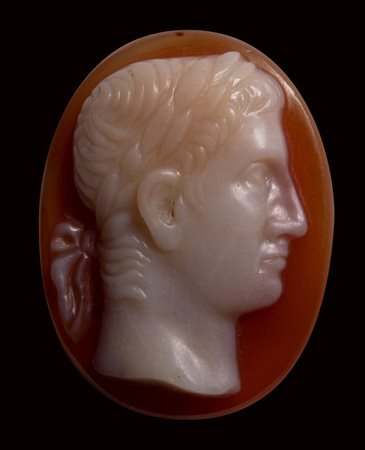
Lotto 271 A postclassical agate cameo. Bust of a Julio-Claudian emperor.
16th-18th century
14 x 18 x 4 mm
The emperor is facing right, with the laurel wreath on the head. The portrait, probably referable to Caligula, is inspired by ancient models. Wear marks. -
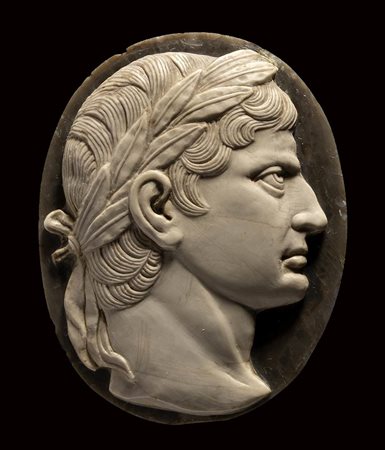
Lotto 272 An unusual large renaissance agate cameo. Portrait of Augustus.
16th century
45 x 57 x 10 mm
Imperial portraiture of this size and typology is rare. The cameo was made on a large two-layered agate, composed of a brown background with caramel tones, and a light ivory-colored layer with grayish tones. The piece shows traces of wear and slight heat cracks (especially in the back) as if it was a late antique specimen (reworked in the post-classical era ?). However, the marked engraving style of this unusual piece can be related to the Renaissance era: the hair is finely chiseled with fine and parallel lines, the leaves of the laurel wreath have a delicately wavy surface, the pupil is engraved with a drilled iris, the slightly wrinkled forehead and the mouth closed in an expression of power and strength. The portrait, facing right, can be identified with the effigy of Emperor Augustus.
European private collection 80's -
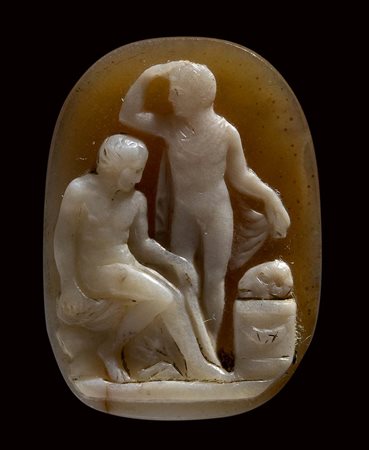
Lotto 273 A fine renaissance agate cameo. Sacrifice scene.
16th century
16 x 23 x 4 mm
The scene is composed of two male characters in front of a small votive altar. On the left, a naked male figure, sitting on the rocks covered by a drapery; with his left hand he holds a stick pointed towards the ground, with his right hand he holds a drapery. His legs are spread starting from the knee while the head is facing down towards the altar. On top of it, decorated with a small garland after the ancient roman prototypes, a goat’s head. The other naked male figure wears a cloak on the shoulders. The right arm raised toward his head turned left, in the opposite direction from the scene; with the left hand he holds a flap of the cloak. Groundline. Probably inspired by a mythological episode, the detailed scene is well composed with balance and elegance. The fine anatomical details are engraved with skill and the characters’ poses can be easily related to Renaissance models.
European private collection 80's -
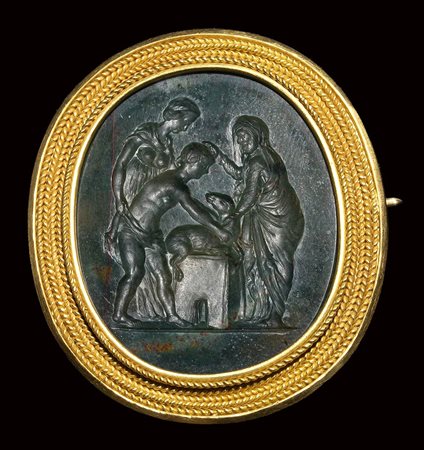
Lotto 274 A rare green jasper renaissance intaglio mounted on a gold brooch. Scene of initiation for Lupercalia.
16th century
intaglio: 28 x 35 mm 23.90 gr
The scene depicts a young Luperque presenting himself to the Priest of the God Faunus, holding the sheep, prepared to serve the sacrifice on the altar. Meanwhile, the Priest is initiating to the Mysteries, putting his left hand on the young man's forehead. Behing him, a young roman lady is assisting to the ceremony, waiting the Luperque initiation, then to be hit by him to become fertile. Groundline.
The iconography, as well as the composition refers to a high sense of execution and knowledge toward the Lupercalia traditions and rituals.
As described in Chabouillet, 1750 :
"UN jeune Luperque fe préfente devant le Prêtre du Dieu Pan, il embrafle le Bélier, qui , defliné à fervir de victime, va être égorgé fur l’autel où on le voit étendu ; & pendant ce tems-là le Prêtre l’ini- tie aux Myftères, en lui mettant la main fur le front. Une Dame Ro maine affite à cette cérémonie , & femble attendre le moment où le Luperque armé d’une courroie , doit la frapper pour la rendre fécon-de. Cette Gravure , dont la compofition , ainfi que l’exécution peuvent être données aux plus grands Maîtres de l’Antiquité eft furtout, recommandable par le fujet, & en ce quelle ajoute des particularités à ce que nous fçavions déjà concernant la cérémonie des Lupercales."
A similar exemple is conserved at Le Cabinet des Médailles, Paris, inv. 58.2348
Chabouillet, Anatole. Catalogue général et raisonné des camées et pierres gravées de la Bibliothèque impériale. Paris : 1858, n°2348.
Mariette, Pierre-Jean. Traité des Pierres gravées. Paris : 1750, t.II, pl.LXIV.
European private collection. -
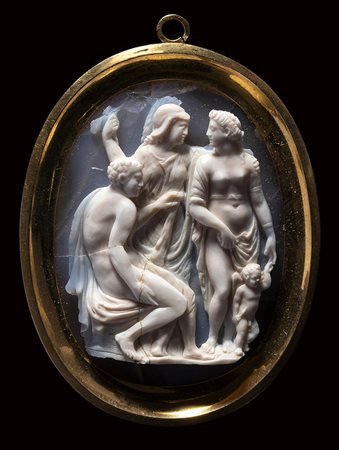
Lotto 275 A gold pendant set with a large oval two-layers agate cameo set in a golden frame. The choice of Hercules between Virtue and Vice .
16th century
Cameo : 36 x 47 mm
27,90 g
The scene, The Choice of Hercules, is taken from classical mythology. The seated figure of Hercules chooses between Virtue and Vice, here personified by the two goddesses Minerva (with a helmet) and Venus with Eros.
A very close parallel is an oval bronze plaquette (Victoria and Albert Museum inv. A.479-1910) with naked figure of Hercules seated draped in a lion's skin at the left and holding his club. In front of him stand Minerva, helmeted and holding a spear and an olive branch, and Venus, leading Cupid by the hand (inscription: INSTAR).
Probably cast from a mould made of a rock crystal or hardstone carving by Valerio Belli.
There is also a version in the British Museum which is signed by Valerio Belli. Related hardstone cameo versions exist in Berlin and Naples. The seated figure of Hercules is a reference to one of Michelangelo's slaves in the Sistine chapel. The style is that of the gem-engraver Valerio Belli (around 1468-1546), who worked for two successive popes. Almost all of his bronze plaquettes are cast from his intaglios in rock crystal or hardstone. In this case, however, no rock crystal original has yet been identified.
The bronzes would have been cast from a plaster or brass mould made from the original hardstone engraving.
This large agate cameo, probably made for a gilted metal casket, is mounted in a gold frame and it is cracked in 4 pieces.
The piece is masterfully carved in high relief.
The lot is sold in an elegant boxe which includes a solid silver cast impression of this beautiful cameo.
Parallels: H. Burns, M. Collareta, D. Gasparotto, Valerio Belli vicentino. 1468 c. - 1546, p. 65 n. 18, cat. 124; Victoria and Albert Museum Database: inv. A.479-1910
European private collection. -
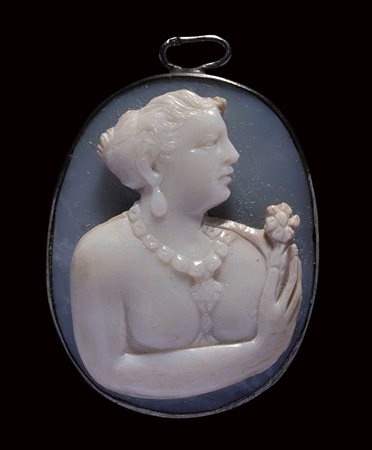
Lotto 276 A renaissance agate cameo. Female bust
16th century A.D.
30 x 38 x 9 mm
The figure is turned to the right, with the torso almost frontal and the head in profile. With her right hand she holds a flower, her breasts are uncovered and a precious necklace with a floral pendant rests in the middle. The lady has her hair gathered and wears a teardrop earring. The cameo is engraved in well polished high relief. The figure carved in the ivory white layer is well distinguished from the cerulean blue background, typical of this Renaissance production. The attributes that characterize this elegant figure (flower, jewelry) refer to beauty, vanity and love. The stone is mounted in a nicely toned silver pendant.
U.K private collection, London. -
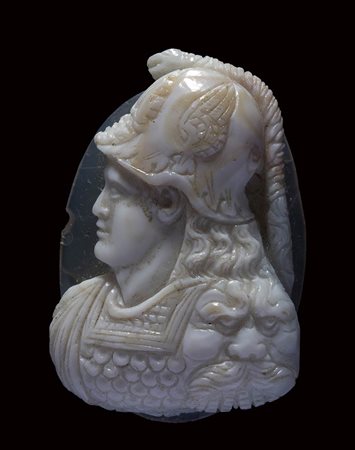
Lotto 277 A renaissance agate cameo. Mars.
16th century A.D.
23 x 34 x 12 mm
Bust of Mars wearing an armor- corselet (egys); a mask on her winged helmet with a feather crest; an expressive grotesque head as epaulette. The character is facing left. This fine cameo is engraved in high relief in the typical renaissance taste. Slight chips and wear marks on the edge.
Parallels: Story-Maskelyne, M.H.: The Marlborough Gems (1870): no. 88
Boardman, J., Scarisbrick, D., Wagner C., Zwierlein-Diehl, E: The Marlborough Gems (2009): no. 320; Le gemme Medici al Museo degli Argenti (Palazzo Pitti), p. 197 n. 107
U.K private collection, London. -
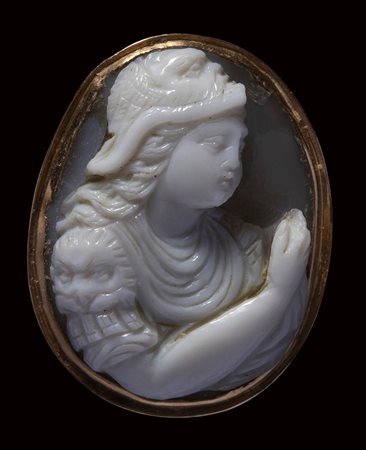
Lotto 278 A renaissance agate cameo mounted on a modern gold ring. Athena
16th century A.D.
Cameo : 17 x 22 mm
Ring : 19 x 16 mm
6,12 g
The goddess is wearing an armor with a cloack; a mask on her helmet; an expressive grotesque - lion head as epaulette. The character is facing right, with a raised arm and with the face turned in three quarter. This fine cameo is engraved in high relief in the typical renaissance taste. Slight chips, cracks and wear marks on the edge. The stone is set in a gold ring.
U.K. private collection, London. -
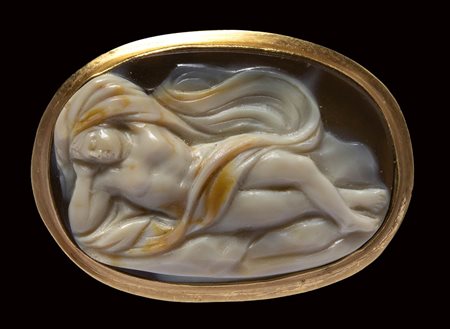
Lotto 279 A renaissance agate cameo mounted on a modern gold ring. Ariadne.
16th - 17th century A.D.
Cameo : 16 x 20 mm
Ring : 17 x 17 mm
9,32 g
The naked sleeping figure is lying to the left above the rocks, with the head turned slightly downwards, supported by his right arm. The eyes are still closed, the legs crossed and the left arm raised in a sign of rest. The figure can be identified with the sleeping Ariadne. In this cameo the figure is elegantly draped with a fold rising in the air and partially cover the figure in his intimate sleep. The scene seems to have been inspired by a relief or a statuary model. The sculptural rendering, the articulated pose of the figure and the peculiar drapery, the executive refinement are all elements that lead this work to the workshop of Alessandro Masnago (active in Milan in c. 1560-1620). The stone is mounted in a gold ring. Very fine condition.
Parallels : Le Gemme dei Medici al Museo degli Argenti. Cammei e Intagli nelle collezioni del Palazzo Pitti, p. 188, n°81-82
U.K private collection, London. -
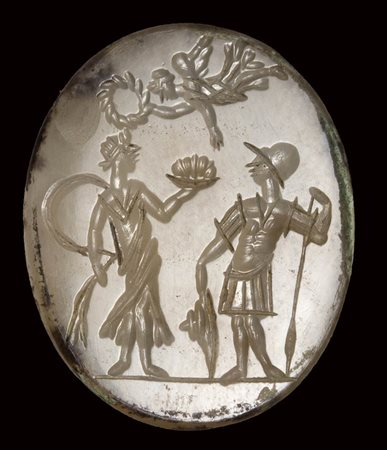
Lotto 280 A late renaissance agate intaglio. Allegorical scene.
17th century
19 x 23 x 5 mm
On the left, a draped female figure in the act of offering a tray with offerings; on the right, an helmeted warrior with spear and shield. Above, a winged victory in the act of crowning the offerer with a laurel wreath. Ground line. Allegorical scene. North Italy-Cisalpine atelier.
Parallel: Le gemme dei Medici al Museo degli Argenti. Cammei e intagli nelle collezioni di Palazzo Pitti, pp. 375 ss.
U.K private collection -
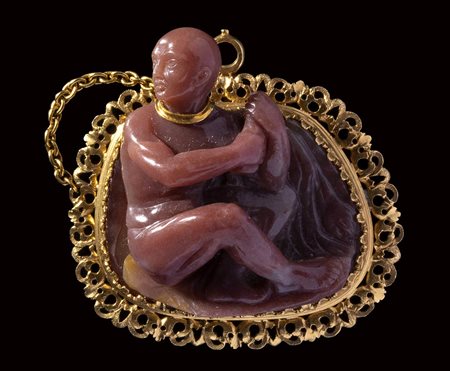
Lotto 281 A very fine high relief rose chalcedony cameo, attribuited to Giovanni Ambrogio Miseroni.
A captive - "The Slave of Love".
End of 16th century A.D.
Cameo : 34 x 37 x 20 mm
25 g
This extremely refined and beautiful jewel is extraordinary for the quality of its composition and execution. Masterfully carved, it represents a chained captive (his bald head indicating that he is of Oriental origin, probably Ottoman or North African). This masterpiece is very close with works by the celebrated hardstone carver Giovanni Ambrogio Miseroni, who worked alongside his brother, the Imperial stone-cutter Ottavio Miseroni. The choice of the stone, the quality of the mirror polishing technique, the facial and the anatomical features of the figure (incised eyes), the composition are all important elements to compare with Miseroni’s works as the Statuette of a Reclining Venus with Cupid in the Kunsthistorisches Museum, Vienna (inv. no. KK 1730). The way the figures emerge from the stone, flanked by flowing drapery, is similar to the present cameo. The gold mount and chain resemble those from a small scent flask from the same circle. The iconography of the shackled prisoner is evident both in Classical and in Renaissance art. Compare, for example, with Giulio Romano’s Chained prisoners, also shackled at the neckfrom the Palazzo Te in Mantua (circa 1527-1528). However this jewel seems to have a meaning that goes beyond technical virtuosity, fashion for certain subjects or political allegory. An allegory rather referred to carnal love.
Perhaps a pledge of love, an intimate message of vigorous passion to wear as a gift and as a bond, unique in its beauty and preciousness.
Parallels: P. Rainer, Splendour and Power: Imperial Treasures from Vienna, exh. cat. Wiener Kunstkammer, Vienna; Schmuckmuseum Pforzheim; Kunstmuseum of Sachsen-Anhalt, Halle; The Fitzwilliam Museum, Cambridge, 2011, pp. 198-203, nos 56-57; D. Scarisbrick, Portrait Jewels, London, 2011, p.33
U.K. private collection, London. The lot was sold at Sotheby's and described as "with a paper note inscribed The Slave in rose agate out of the Wertheimer collection, possibly a reference to Emile Wertheimer Collection of Renaissance Jewels sold Sotheby's London 13 July 1953". -
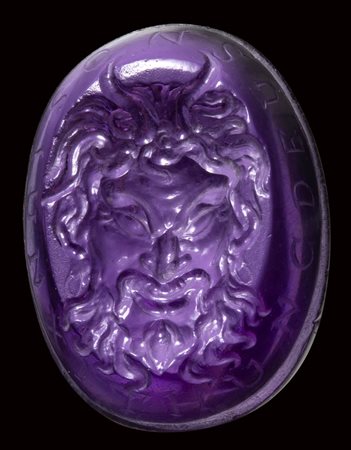
Lotto 282 A fine renaissance amethyst intaglio. Mask of Pan with motto
16th century A.D.
15 x 20 x 7 mm
This impressive frontal effigy of Pan is engraved with a very deep excavation on an amethyst stone of a particularly vivid and bright color. The facial features are typical ones inspired by ancient models (cf. The "Rubens vase", agate, 4th century A.D., Walters Museum inv. 42.562, and the mask of pan sculpted in ancient marble statues and reliefs) but the Michelangelo style seems unequivocal present and particularly strong here. The face is characterized by the typical somatic features of Pan, masterfully engraved with great art and technical skill, with an almost three-dimensional high relief effect. The anatomical details are rendered in an almost virtuosic way, with particular attention to the folds of the face due to the corrugated and almost diabolical expression of the character. The nose is curved, the almond-shaped eyes bent under the corrugated orbital arch, the mouth slightly open in a lascivious smile, the goat horns stand out from the thick hair, the long and finely chiseled beard. Portrait almost alive in its expressiveness. All the details are extremely mirror polished. Around the mask, on the edge: latin motto " HUNC DEUS NOS IUNXIT " ("this god united us"). This inscription, referring to the engraved subject, seems to allude as a pledge of love and passion: this emblem of carnal and feral love, of sexual impetus, unites who gave and who received this erotic seal.
U.K., private collection 70's, London. -
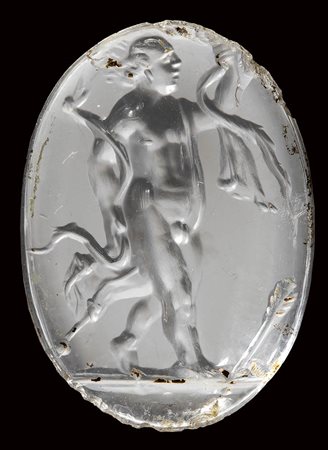
Lotto 283 A postclassical rock crystal intaglio. Allegorical male figure.
17-18th century circa
13 x 18 x 2 mm
A naked male character advances to the right, in the act of holding two snakes (?) with drapes; below, near his feet, an arrow. Groundline. Allegorical scene, to be identified. The stone is particularly thin and of an extraordinary purity and luminosity so as to be able to observe the incision even from the slightly convex back. Slight wear marks. -
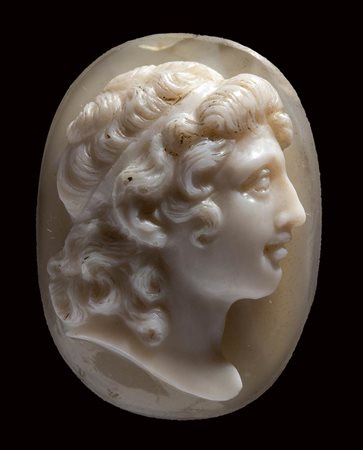
Lotto 284 A neoclassical agate cameo. Bust of Alexander the Great.
End of 18th century - Beginning of 19th century
16 x 21 x 7 mm
The young ruler is turned to the right, and characterized by thick hair held by a band. This beautiful specimen, inspired by the hellenistic models, approaches the works of famous neoclassical engravers such as Pichler and Cerbara for stylistic beauty and executive finesse. -
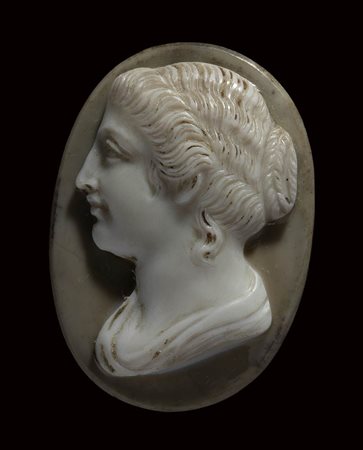
Lotto 285 A neoclassical agate cameo. Female bust.
End of 18th century - Beginning of 19th century
16 x 22 x 6 mm
The draped bust is turned to the left, and characterized by finely engraved gathered hair, inspired by the imperial portraits of the Roman Age. Work with executive finesse. -
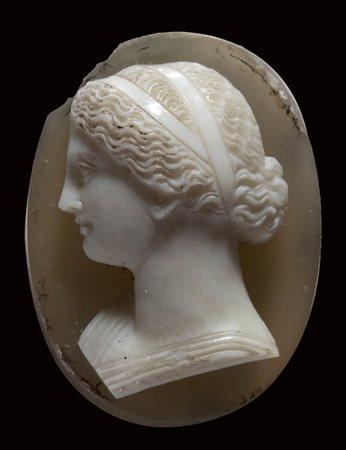
Lotto 286 A neoclassical agate cameo. Bust of a Niobid.
End of 18th century - Beginning of 19th century
16 x 21 x 9 mm
Draped female bust, facing left. The figure is characterized by a hair gathered from two bands. The subject is inspired by a famous marble sculpture (Uffizi, Florence) and it was executed by N. Marchant for a sardonyx intaglio. Small chip on the edge. -
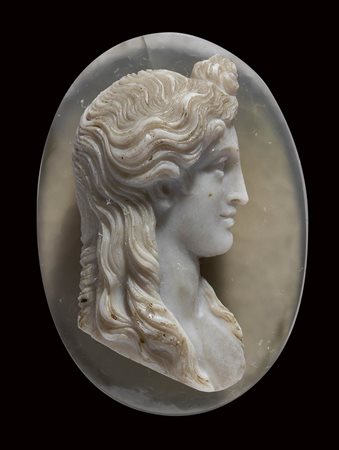
Lotto 287 A neoclassical agate cameo. Bust of Isis.
19th century
26 x 37 x 14 mm
The goddess is facing right, and characterized by thick hair gathered over her forehead aforming a Basileion; three long locks fall from the neck to the shoulder. Beautiful work engraved in high relief. -
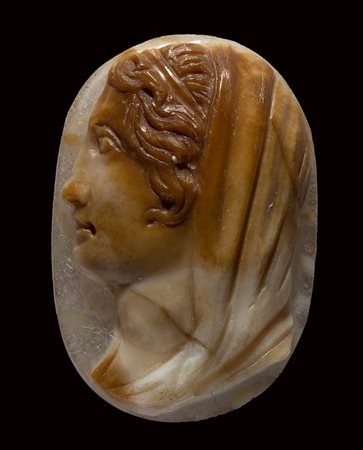
Lotto 288 A neoclassical agate cameo. Bust of a veiled matron.
End of 18th century - Beginning of 19th century
14 x 20 x 6 mm
The female bust is facing left. The figure is characterized by thick hair held by a diadem, under the veil. Interesting stone variety. Slight crack probably due to heat.