
Auction 86 - Glyptics and Ancient Jewelry
-
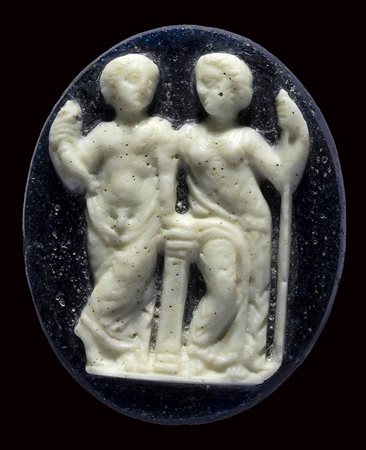
Lotto 193 A large roman blue and white glass cameo. Bacchus and Ariadne
2nd-3rd century A.D.
34 x 42 x 6,5 mm
On the dark blue background, the two figures are standing, engraved on the white layer. They are looking at each other, a little column between them. Ariadne is holding a stick with her left hand, her right arm hidden beside the bust of Bacchus.Her right leg bent is in relief, meanwhile the rendering of the left one well held is more flat, creating a sense of volume. The wine god, is holding a rhyton in his right hand, meanwhile his left hand rests on the column. Legs crossed, with the left on top, also in relief. Very fine condition. Rare.
U.K. private collection, London. -
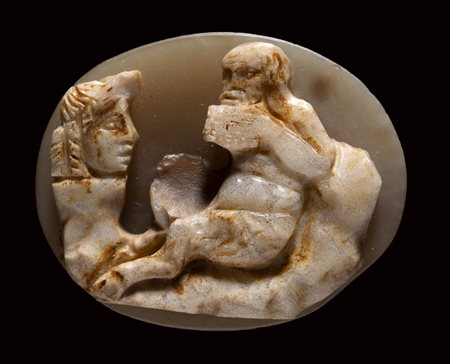
Lotto 194 A roman agate cameo. Satyr and mask.
1st - 3rd century A.D.
20 x 25 x 7 mm
The bucolic scene is well composed and is skillfully carved in high relief on an agate characterized by delicate nuances. On the right side, a satyr sitting on the ground with his back resting on the rocks, in the act of playing the syrinx; in front of him, on the left side, a theatrical mask placed on a rock. The satyr's right thigh (in the background) is chipped. The scene seems inspired by a marble relief. Traces of iron patina. The representation is part of the repertoire of bucolic scenes with references to theater and the musical arts, without excluding allegorical allusions. Rare type.
U.K. private collection, London. -
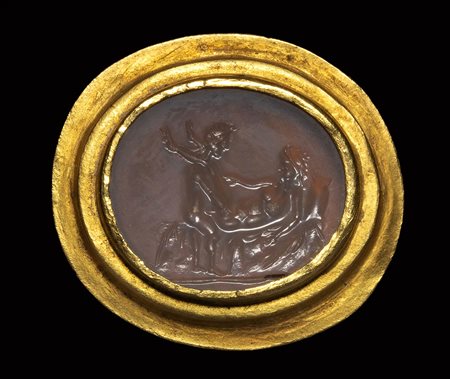
Lotto 195 A roman chalcedony intaglio set in an ancient gold ring. Erotic scene.
2nd - 3rd century A.D.
intaglio : 13 x 17 mm
ring : 21 x 20 mm
13,38 g
Erotic scene, the woman is lying on the bed, her neck resting on a large pillow, meanwhile the man is entering, standing and turned toward her. Groundline. This depiction is referred to the “spintria”, these roman tesserae with various erotic compositions.
Attractive color of the stone. Set on a massive hoop, rounded without, flatten within and broadening upwards. The bezel composed of two bands of gold rising one above the other.
U.K private collection, London. -
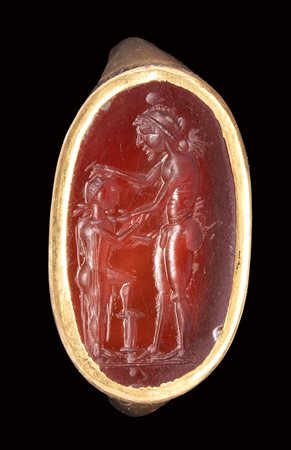
Lotto 196 A roman carnelian intaglio set ina modern gold ring. Homoerotic "paiderastia" scene.
2nd - 3rd century A.D.
intaglio : 9 x 17 mm
ring : 18 x 16 mm
7,86 g
A young boy is depicted in an intimate moment of initiation into the greek paiderastia. The young figure wears a collar and a thin robe that glimpses his shapely naked body (veil) and is faced with an adult male figure, with a diademate head and a naked body. The man brings his hands to the boy's head, who puts his hand up to touch his attributes while keeping his left leg raised above a small altar. Groundline. Probable scene of initiation to homoerotic paideia; the scene seems inspired by the repertoire of Greek black-figured vascular painting. Very rare subject on gems. The ring seems to have a repair in the attack between the rod and the bezel. Wear marks.
U.K private collection 90's -
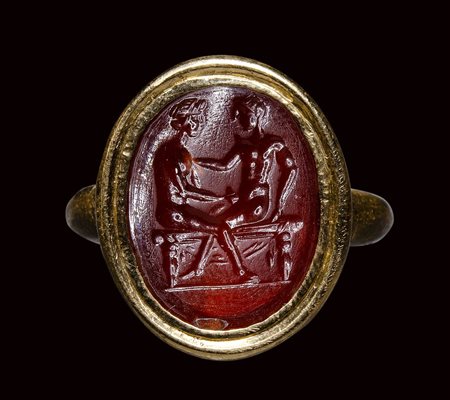
Lotto 197 A roman carnelian intaglio mounted in a modern gold ring. Erotic scene.
2nd century A.D.
stone: 1,4 x 1,8 mm ring diam: 20 mm 12,76 gr.
With a wide hoop rounded without and flatten within surmonted by a large rounded bezel set with a large carnelian intaglio. The scene depicts a man and a woman seated on a bed in front of each other in an act of masturbation. Groundline. The scene is strongly inspired by the depictions of sexual acts coined on the spintriae: the characteristic posture, the style of the figures and of the bed, the composition and the attitudes of the characters. Spintria (plural, spintriae), or more correctly erotic tessera, was the name of a particular category of Roman token, generally used for payments within a brothel. On it, usually, heterosexual erotic scenes are depicted. However, this intaglio is not a copy of spintria as mastrurbation scenes of this type do not seem to recur in the usual repertoire. Another source of inspiration are the frescoes of Pompeii and the terracotta oil lamps.The deep red color of the stone well emphasizes the strong erotic charge of the representation, and presents a small natural inclusion in a nodule exactly on the breast of the female figure, perhaps referable to an intimate auspicious and apotropaic meaning on the health of the owner of the gem. Mirror polishing inside the figures. Wear marks and a minor crack on the edge. Rare.
Parallels: C. Johns, Sex or Symbol. Erotic images of Greece and Rome; T. V. (1973) 'The Spintriae as a Historical Source', The Numismatic Chronicle 13, pp. 52 – 63; A. Campana, A. (2009) 'Le spintriae: tessere Romane con raffigurazione erotiche', La Donna Romana: Immagini E Vita Quotidiana Atti de Convegno. Astina, 7 Marzo 2009. pp. 43 – 96; Jacobelli, L. (2000) Spintriae e ritratti Giulio-Claudii. Bd. 1. Spintriae e scene diverse. L'impianto iconografico. Centro Culturale Numismatico Milanese, Milano; Simonetta, B & Riva R. (1981) Le tessere erotiche romane (spintriae). Quando ed a che scopo sono state coniate. Chiesa, Lugano; Duggan, E. (2016) "Stranger Games: The Life and Times of the spintriae". For a roman cameo with an erotic scene (couple on a bed intituled"spintria"), see U: Pannuti, La Collezione di Glittica, Museo Archeologico Nazionale di Napoli, p. 224 n. 189
U.K., private collection 80's. -
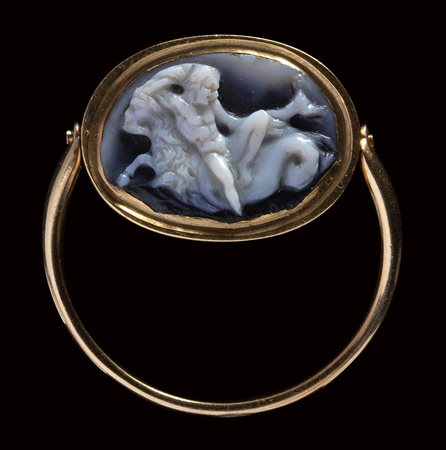
Lotto 198 An roman agate cameo mounted on a modern gold ring. A youth on a seagoat.
2nd - 3rd century A.D.
Cameo : 12 x 18 mm
Ring : 23 x 19 mm
5,60 g
A naked youth riding a capricorn (goat-fish). He claps one of the creature's horns and is fishing with a rod, which curves as it catches a small fish. He is sitting on a hide with a serrated edge. An interesting parallel, very similar, is a refined sardonyx cameo from the Beverly collection (Alnick castle), dated 30 BC and identified as the young Octavian Augustus (whose zodiac sign was Capricorn) in the allegory of the victory of the naval battle of Actium (31 BC). The victory was in fact celebrated on the cameos. However, the figure also seems close to the models of the satyr-pan, as in this case, whose marked features of the face and youthful musculature seem to express. The cameo, mounted in a swivel gold ring, has damaged edges and the figure is missing a foot. The piece clearly shows signs of ancient wear and an ancient execution with marked and spontaneous engraver lines, certainly inspired by a precise model as for the Beverly cameo. Well composed scene. Interesting iconography. Rare.
Parallels: D. Scasbrick, C. Wagner, J. Boardman, The Beverly Collection of gems at Alnick Castle, p. 11 n. 6.
U.K private collection, London -
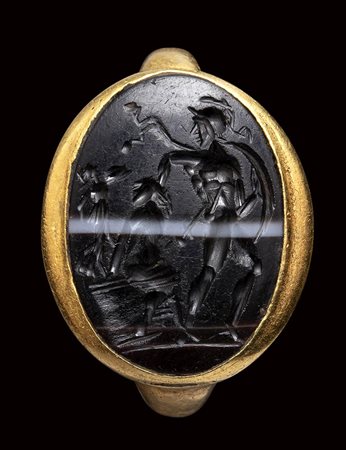
Lotto 199 A roman banded agate intaglio set in a gold ring. Ajax with Cassandra.
2nd-3rd century A.D.
Intaglio : 11 x 16 mm
Ring : 16 x 13 mm
3,56 g
She has fled to the altar and is near to embracing the palladion. Ajax stands beside her in the act of take Kassandra by the hair and holding his shield in the left arm (the sword stuck in his side?). Kassandra is shown in back view, with head and limbs turned in profile; a himation covers the lower part of her body. Ajax, shown in front view, is nude and wears an helmet. The statue of Athena has a girded peplos, with aegis, a helmet and shield, and brandishes her spear. Groundline. Slight wear marks. The stone is set in an ancient gold ring. Very fine condition. Rare.
Parallels: G.M.A. Richter, The engraved gems of the greeks, etruscans and romans, part II, p. 65 n. 300 (British Museum, sard intaglio, from the Blacas collection 445, Walters Cat. No. 1942).
U.K. private collection, London. Ex Schweizer Privatsammlung seit ca. 1930 -
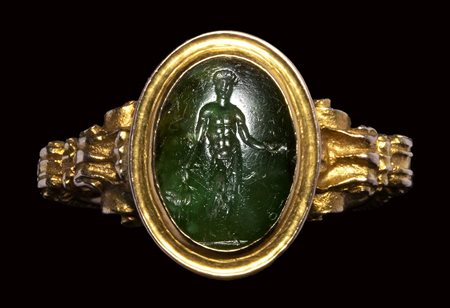
Lotto 200 An early Victorian gold ring, set with a roman intaglio in chromian chalcedony. Bonus Eventus.
intaglio: 1st century A.D. Mounting: 19th century
intaglio : 8 x 12 mm
Diam (ring) : 18 x 19 mm
5, 68 g
The standing and nude figure is holding ears of corn with the right hand and a phiale with the left. Allegorical and votive depiction referred to the abundance and good luck. Slight wear marks. This fine roman green chromium chalcedony is set in an early victorian gold ring, finely chiseled, with a bezel later inscibed: "In memory of William Manson - Ob 19 June ae 1852". Manson was an auctioneer, who joined the firm Christie's in 1831 as partner (at the death of James Christie Jr.) and was replaced by his brother Edward after is death. Very fine condition.
European private collection. -
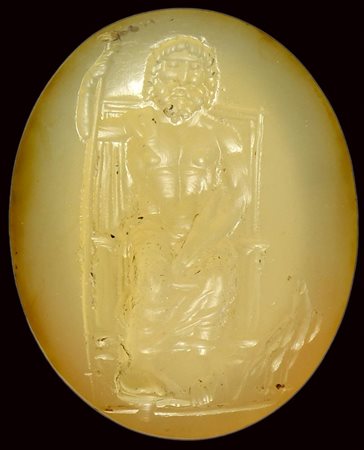
Lotto 201 A very fine roman chacedony intaglio. Zeus enthroned with the eagle.
1st century B.C. - 1st century A.D.
11 x 13 x 5 mm
Zeus is seated on his throne, holding the scepter on his right hand and lightning with the left. The god is characterized by voluminous hair and beard, a muscular body, with the naked torso, and wearing a drapery marked by pleats in relief revealing the framework of his knees and feet. On the left, at his feet, the eagle looking toward him. Groundline. The subject is probably inspired by a sculpture. Very fine execution of the muscular rendering, with an impressive high relief effect, almost three-dimensional. Beautiful work engraved on a fine chalcedony double convex stone with honey tone. Slight wear marks.
Parallels :
Thorvaldsens museum, Copenhague, inv. 189. Cabinet des Médailles, Paris, inv.58.1420.G.M.A. Richter, Catalogue of engraved gem. Greek, etruscan and roman. The Metropolitan Museum of New York, n. 256. Antiken Gemmen in Deutschen Sammlungen, Band I, Staatliche Munzsammlung Munchen, n. 2448.
U.K private collection -
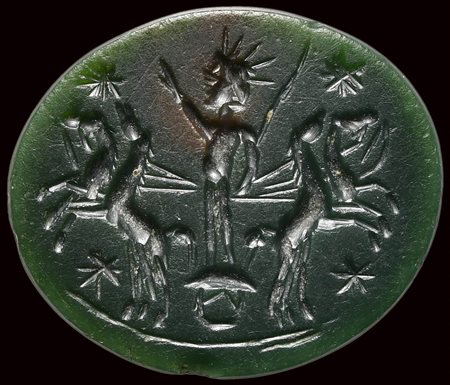
Lotto 202 A roman green jasper astrological intaglio. Helios with solar quadriga.
2nd - 3rd century A.D.
13 x 16 x 3 mm
In the middle of the scene, the standing god is over the chariot, wearing the radiated crown and holding the solar whip/ the bridles with the left hand, rising the right. On his left and right side, the horses. Four stars. Groundline. Fine astrological depiction, well composed. Slight wear marks.
U.K., private collection 70's, in the same family since then. -
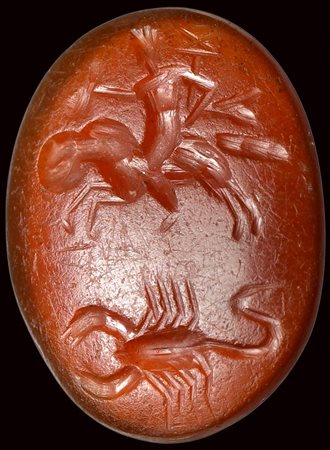
Lotto 203 A roman carnelian intaglio. Mercury on the ram with a scorpion.
2nd - 3rd century A.D.
12 x 15 x 3 mm
The magical and astrological depiction is formed by: on top, Mercury riding a ram and holding a caduceus with the left hand, the purse witht the right; on the lower part, a scorpion. Attractive color of the stone. Wear marks. Rare.
U.K. private collection -
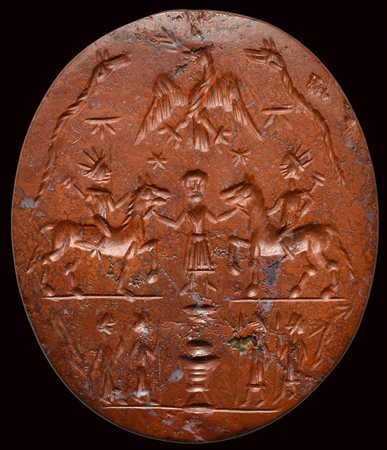
Lotto 204 A large roman magical red jasper intaglio. Allegorical scene referring to the Danubian mystery cults.
2nd-3rd century A.D.
23 x 27 x 3 mm
In some gems and lead plates we find the representation of a goddess standing between the two Dioscuri on horseback. Evenly identifying this character is not simple or certain. According to Chapouthier's interpretation it can be assimilated with the goddess Hekate-Elena; according to Delatte and Derchain it is Nemesis-Hekate; according to Barb, a representation of the mystery cult of Balkan origin. These lead plates derive mainly from the Danubian area. In this jasper intaglio, it is not entirely clear the identification of the central character with tunic and cloak, in the act of spreading his arms; certainly next to it there are two riders with a radiated crown (dioscuri). Above, two stars and above an eagle holding a laurel branch and two snakes in its beak. Below, in the center, a container (crater) and on the sides of the characters armed with spears. In the reverse side of the gem, a crater surmounted by a star, above a vessel and another star; on both sides, two large snakes twisted with two sticks and two arches. Above, crescent moon. Slight wear marks. Very rare.
Parallels: Chapouthier 1935, n. 69, p. 77; fig. 56, p. 287 ss. DELATTE, DERCHAIN, Les Intailles magiques, p. 193 ss, n. 259-260; D. Tudor, Corpus monumentorum religionis Equitum Danuvinorum, II, 1967, n. 228. A. Mastrocinque, Sylloge gemmarum gnosticarum, pp. 354-355.
European private collection. -
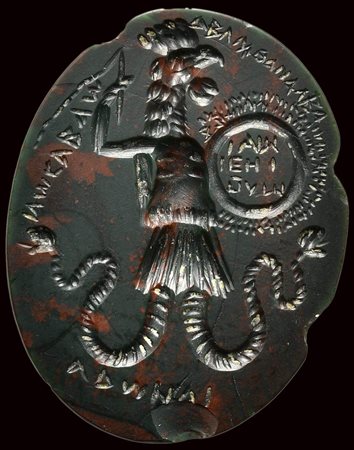
Lotto 205 A fine roman green and red jasper magical intaglio. Anguipes with inscriptions.
2nd - 3rd century A.D.
15 x 19 x 2 mm
Frontal view of a cock-headed Anguipes in armour with snakes legs, head to right. Right hand raised high, bent in elbow and holding the solar whip meanwhile the left is holding a round shield. Inside the shield, 3 inscribed lined :
IAW
IEHI
OYω
We distinguish the name of the Jewish god : Ἰάω (Iaô)
Around the shield, two circular inscribed lines.
On the left, IAWCABAω -> Iaô Sabaoth (Lord of Armies).
Under the legs, ADωNAI -> Adonaî.
On top, on the right of the cock head, a palindrome ΑΒΛΑΝΑΘΑΝΑΛΒΑ̣ -> Ablanathanalba.
On the reverse, 3 inscribed lines :
OYXCΠΓA
CPAHΛIAHΛ --> we can reed Prasraêl or Prosoraiêl
MEIXAHΛ --> Michaêl
On the edge, two inscribed lines on each part.
Chips and little missings on the edge. Very fine detailed execution. Rare. Attractive vivid color of the stone.
See parallels :
A. Mastrocinque, Les intailles magiques du département des Monnaies, Médailles et Antiques, n° 292
Michel, 2001, pl.26, n°181
Henig, Martin, 1975, BAR Supp., pl.15, n°251
A. Mastrocinque, Sylloge Gemarum Gnosticarum, P.I pp.269-297
U.K., private collection 70's, in the same family since then. -
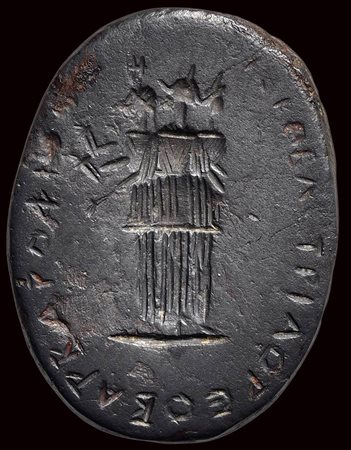
Lotto 206 A roman hematite magical intaglio. The Three Graces-Hecate.
2nd - 3rd century A.D..
11,5 x 15 x 2 mm
The Three Moirai (Graces) standing in a group, the arms in movement. Groundline. Inscription around the edge (partially erased), (...)OBΛ TPIAOPEOBAPBAPCAI (...).
Following Plato's cosmogony, the Goddess Ananke and the Three Fates were spinning the central spindle of the cosmos (Mastrocinque 2002a, p.174-187).
Traces of iron and slight wear of marks. Rare.
Parallels :
Metropolitan Museum of Art. 1894. Handbook No. 9: Collections of Engraved Gems. no. 56, p. 40, New York: The Metropolitan Museum of Art.
Bonner, Campbell. 1950. Studies in Magical Amulets, Chiefly Graeco-Egyptian, University of Michigan Studies, Humanistic Series, Vol. 49. no. 61, p. 263, pl. 3, Ann Arbor: University of Michigan Press.
U.K., private collection 70's, in the same family since then. -
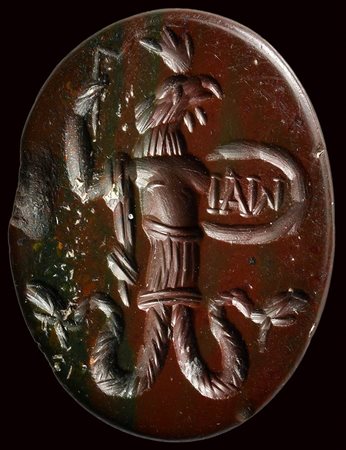
Lotto 207 A roman red jasper with dark green inclusions magical intaglio. Anguipes cock.
2nd - 3rd century A.D.
13,5 x 18 x 3 mm
The hybrid figure is turned on the right. The right hand raised high and holding the solar whip, left hand holding the round shield which is inscribed Ἰάω. On the reverse, two inscribed lines ABPACAZ - CABAωθ (Abraxas, Sabaoth).
Chip on the left edge and wear marks on both sides. Very nice color of the stone.
Parallels : Mastrocinque, Attilio. Les intailles magiques du département des Monnaies, médailles et antiques.Paris : Bibliothèque nationale de France, 2014, p.116, n°303.
U.K., private collection 70's, in the same family since then. -
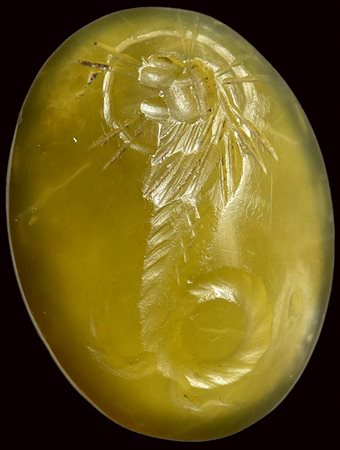
Lotto 208 A roman chalcedony magical intaglio. Chnoubis.
2nd - 3rd century A.D.
11 x 14,5 x 5 mm
Chnoubis with lion radiated head turned on the left is opening his mouth. On the reverse, 4 lines inscribed and charakteres. Rare.
Parallels: Mastrocinque, Attilio. SGG.I, pp.248-260
U.K., private collection 70's, in the same family since then. -

Lotto 209 A large roman astrological chalcedony intaglio. The Gemini decan, Pephisothet.
2nd - 3rd century A.D.
17 x 20 x 12 mm
The male figure is standing on a lotus flower, naked, in a contrapposto posture, the head turned on the right. On his left hand he holds thunderbolts, meanwhile upraising his right arm (partially missing) over his head . At his feet, on each side, lion and sheep with inscriptions over their head. Under the lotus flower, inscriptions. On the reverse, 5 inscribed lines. The lotus, the lion and the ram (here the sheep) composed the egyptian triad “serpouth moui sro” representing the three forms of the Sun during the day. A similar gem conserved at the J. Paul Getty Museum was interpreted as the Gemini decan (cf. Mastrocinque, n°469).The category of gems representing the decans has been underestimated. The decans are the thirty-six deities who presided over the thirty-six sectors of the zodiac (each sector governing ten degrees), at the rate of three decans for each of the twelve zodiac signs. They have been known in Mesopotamia and Egypt since the most ancient times. They were said to provide specific diseases and govern particular organs of the human body. That’s why we used some of them for health protection. Some lacks and chips on the edge. Nice dimensions of the stone.
Mastrocinque, Attilio. Les intailles magiques du département des Monnaies, médailles et antiques. Paris : Bibliothèque nationale de France, 2014, p.172, n°469. Delatte, Armand, Derchain, Philippe. Les intailles magiques gréco-égyptiennes, Bibliothèque nationale, Cabinet des Médailles et Antiques. Paris : 1964, n°45.
Delaporte, Louis. Cachets orientaux de la collection de Luynes. Paris : 1928, p.64.
U.K., private collection 70's, in the same family since then. -
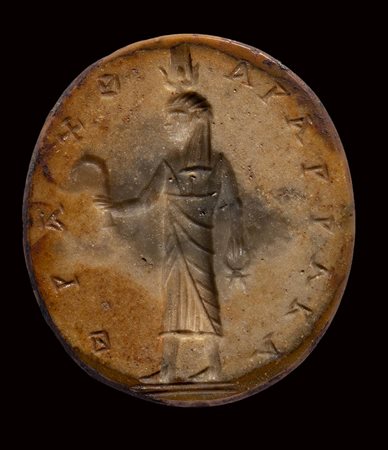
Lotto 210 A large roman magical agate intaglio. Isiac divinity and inscriptions.
1st - 3rd century A.D.
24 x 27 x 4 mm
The isiac divinity is faced to the left, wearing a long dress, holding in her right hand a short curved knife, and in her left an instrument. She wears the atef crown with horns, feathers and disc. Around, inscriptions from right to left :
APAPPABA
θPAXθ
On the reverse, inscriptions in" triangle shape":
AAAAAAA
EEEEEE
HHHHH
IIII
OOO
VV
W
U.K., private collection 70's, in the same family since then. -
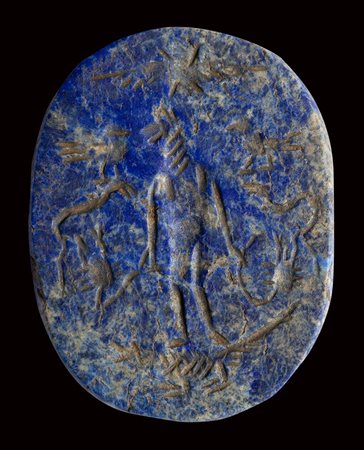
Lotto 211 A large roman magical lapis lazuli intaglio. Anubis.
2nd - 3rd century A.D.
26 x 34 x 4 mm
The god is standing on a crocodile, turned to the left and wearing a short dress.
Above the winged solar disk. On either side of the god, birds and snakes. He holds a scorpion in each of his hands.
On the reverse, inscription:
NθM
ONOC
KONY
This type of magical gem was used to protect against disease. Wear marks. Rare.
U.K., private collection 70's, in the same family since then. -
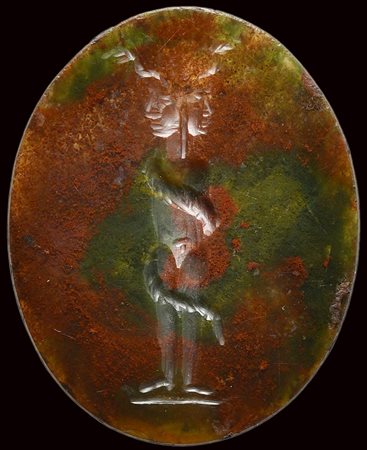
Lotto 212 An unusual roman magical agate intaglio with red and green inclusions. Zodiacal representation of Gemini.
2nd - 3rd century A.D.
15 x 19 x 2 mm
The scene depicts a naked male figure, with two heads, and a snake wrapped around his body, whose double head covering the polymorphic figure. Each of the heads looks in a opposite direction, one on the left, the other on the right. Groundline.
This representation reminds the egyptian zodiac for Gemini sign, which has for animal the snake (Mastrocinque, 2014) and describes by Teucros the Babylonian.
In the PGM III. 275-81, the Moon on Gemini is the time says for bounding spells (which can be symbolized by the snake wrapped around the two faces body).
Traces on the iron mounting on the backside.
Rare representation. Very nice variety of stone for this large and unusual amulet.
Bibliography :
Betz, The Greek magical papyri in translation, 1992, p.26
Mastrocinque, Les intailles magiques du départements des Monnaies, Médailles et Antiques, 2014
U.K. private collection -
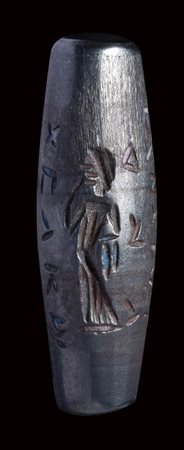
Lotto 213 A roman hematite magical fusiform amulet. Feminine figure with inscriptions.
2nd - 3rd century A.D.
H : 24 mm
The cylindrical shaped amulet is engraved with a principal feminine figure, dressed with a long dress and hat, turned on the left, her right arm bent and right index to her mouth, meanwhile, she holds her tight with the left arm. Groundline.
Around, seven lines of greek inscriptions.
Parallels : A. Mastrocinque, SGG I, p.399, tav. 21
U.K private collection, London. -
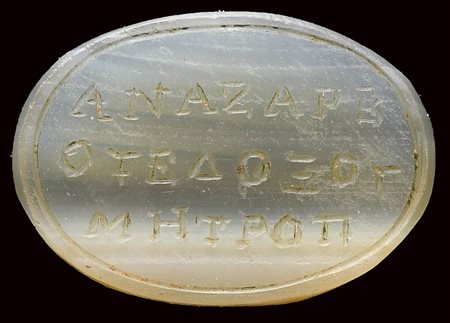
Lotto 214 A roman chalcedony magical intaglio. Inscriptions.
2nd - 3rd century A.D.
8 x 11 x 2 mm
Oval-shaped stone. Inside a circle, 3 lines inscribed :
ANAZAPB
OYEDOΞOY
MHTPOΠ
Slight wear marks. Rare.
Parallels: Mastrocinque, Attilio. Sylloge Gemmarum gnosticarum, p.I, pp.421-448
U.K., private collection 70's, in the same family since then. -
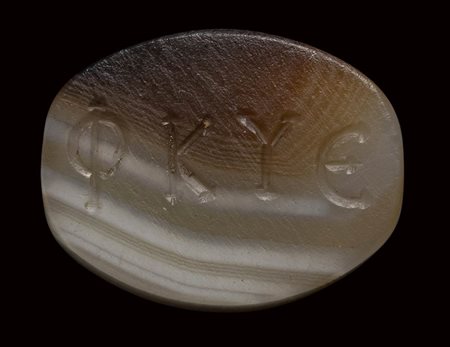
Lotto 215 A graeco-roman agate engraved seal. Ear of corn and inscriptions.
1st century B.C. - 1st century A.D.
11 x 14 x 7 mm
The scaraboid shaped seal is engraved on both side. On the convex side, an ear of corn turned on the left between two greek inscriptions :
ΑΤΔΠΧΙ
ΝΚΗΕΥ
On the reverse, a greek inscriptions :
ΦΚΥΕ
Attractive colors of the stone. Rare.
U.K., private collection 70's, in the same family since then. -
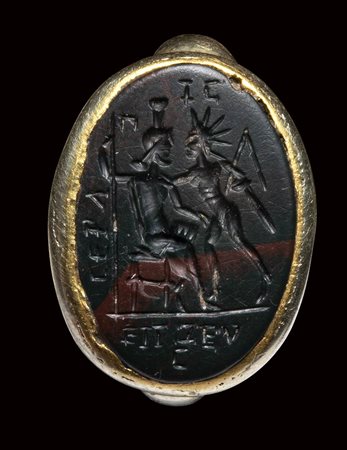
Lotto 216 A roman magical green and red jasper intaglio set in an ancient electrum ring. Serapis and Helios with magical inscriptions.
2nd - 3rd century A.D.
Intaglio : 14 x 20 mm
Ring : 19 x 15 mm
9,15 g
The solar god is standing, naked, holding the solar wip and the radiated crown, turned on the left torward the Serapis. The seated god is facing Helios, and wearing with crown with the modius. He holds the scepter with his bended right arm. Groundline.
Clockwise, on the edge, greek inscriptions engraved : CΕΓΑΠΙC -> Serapis
Under the groundline, greek inscriptions.
The mounting is an electrum ring, with a rounded hoop without, flatten within and a large oval bezel.
U.K private collection, London. -
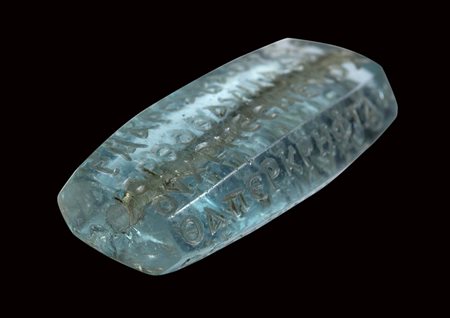
Lotto 217 A rare roman beryl hexagonal prism magical amulet.
2nd - 3rd century A.D.
16 x 32 x 8,5 mm
The magical faceted amulet is engraved with various inscribed lines. On the two larger faces :
ΒΑλΧΑμΧΗΒPΑΟ -> Bachaxi
YΕCΤΑΔωΝΑΙΕP -> Aδωναιε, Adonaî
ΙμωΘΑΓΙΑΔYΝΑ -> Iaô, ἁγία (saint)
ΡμΑΡCΑΒΑΟYΦΘ -> Cαβαωθ, Sabaôth
ΟΠΘΟΘΑYμΑΘΑμ -> Θŵθ, name of the egyptian god Thot and palindrome μΑΘΑμ
ΟYΧΠΗΕCμΕΝΟΧ
On the 4 edges :
μΙCΒΟΗΘΕΙμΟΙ -> we can read the expression εìς βοηθει, “Lord, help me!", we find the same inscription on a round hematite gem, coll. Seyrig, AA.Seyrig. 63
CΑΒΑωΘΟYΕΔΗω -> we read the two names of the lord Sabaôth, Yahvé
ΘΑΠΕΡΚΡΗΦΤΑω -> name of Râ, and the last letter of hebrew alphabet
ΡΒΔωΤΟΛΕΟΡω
This amulet can be attached to the group of rock crystal, amethyst, beryl, chalcedony stones using as magic tools for magicians and wizard. According to Lactantius Placidus, in Statii "Thebaida" commentum, IV.516, the magicians possessed "sphragids quas putant Dei nomina continere" (seals which the magicians believe to contain the names of God).
The unusual and rare aspect of this amulet lies not only in its polygonal structure but also in its function which differs from the other gnostic gems. The choice of a six-sided structure can also refers to the importance and power of various numbers in magic, the 6 being a multiple of 3, a particularly important number.
Large stone dimension and high quality of execution. Perforated lengthwise. Excellent state of conservation. Extremely rare.
Parallels: Kelsey Museum, inv. 0000.02.6134
Michel, 2001, p.338, n°587
Bibliography :
Mastrocinque, SGG I, p. 5
U.K., private collection 70's, in the same family since then. -
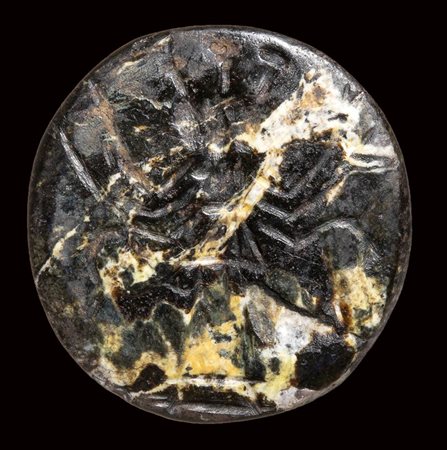
Lotto 218 A roman black jasper magical intaglio. Hecate.
2nd - 3rd century A.D.
16 x 16 x 4 mm
The lentoid shaped intaglio is engraved with the figure of the three-headed goddess Hecate.
Her arms rising in a gesture of praying or putting a spell on. Groundline. Slightly butn stone. Wear marks. Traces of the iron setting on the backside.
U.K. private collection -
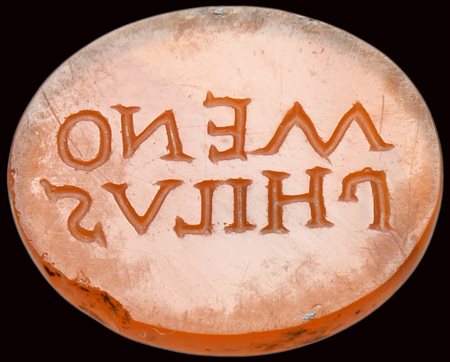
Lotto 219 A roman carnelian intaglio. Inscriptions.
1st century B.C. - 1st century A.D.
10 x 11 x 1 mm
Inscription on two lines (correctly readible on the impression): MENO-PHILVS ("Menophilus"). Personal name referable to the owner of the intaglio. Attractive vivid color of the stone.
U.K., private collection -
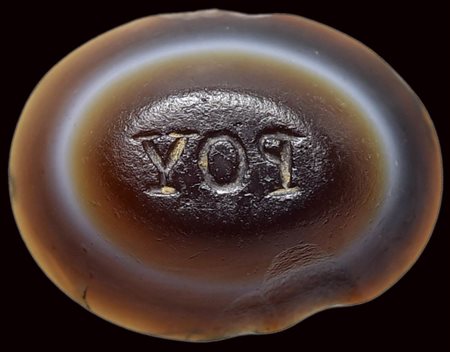
Lotto 220 A roman agate intaglio. Inscription.
2nd - 3rd century A.D..
8 x 11 x 4,5 mm
Truncated shape bezel. Three greek letters: POY. Wear marks. Chipping on the edge.
U.K private collection -
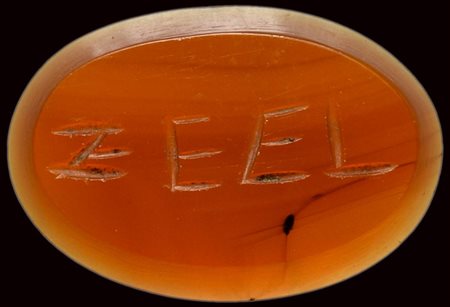
Lotto 221 A roman carnelian intaglio. Inscription.
2nd - 3rd century A.D.
7 x 10 x 2 mm
Four letters: ZEEL. Attractive color of the stone.
U.K private collection -
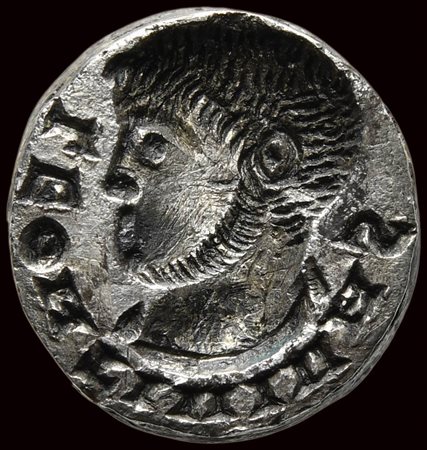
Lotto 222 A rare roman silver engraved seal. Male portrait.
End of the 3rd- Beginning of the 4th century A.D.
Diam. 10 x 4 mm 2,64 grs
The head is facing left, surrounded by the inscription LEONTI-VIVAS. The effigy is characterized by a short hairflow and a drawn beard, both referable to the imperial models of the late 3rd century A.D. (Massimino Daia, Costanzo Cloro, Massenzio). The inscription contains an auspicious meaning to Leontius. This seal was probably mounted into a ring, traces of which are still on the reverse. Excellent preservation.
Parallels: Alföldi, M.R. - 1950 - Aranykincselet Brigetioból a III. Század végéröl, vol. 48-49, pp. 5-9.
European private collection. -
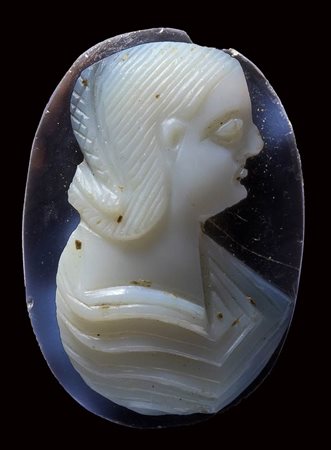
Lotto 223 A late roman onyx cameo. Female bust.
3rd century A.D.
16 x 22 x 9 mm
The effigy is in profile to the right. The hair forms a striped mass, which falls down on the neck in a braid and arching ("helmfrisur" hairdo). The ear is uncovered; the neck is elongated, the eye prominent. The bust is draped, the folds of the tunic are engraved with angular pleats. Probably a private portrait. The bust is sculpted in high relief with undercut from the background. Slight chip on the edge. Fine condition.
Parallel: M. Henig, H. Molesworth, The Complete Content Cameos, pp. 58-64.
U.K private collection, London. -
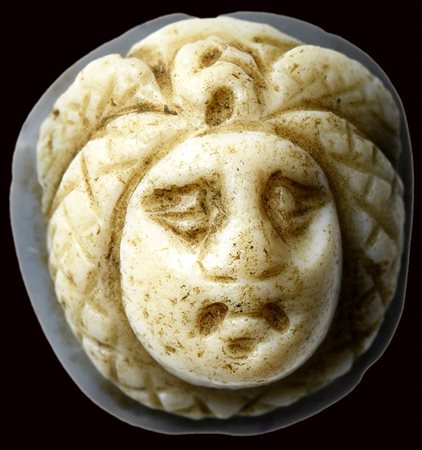
Lotto 224 A roman onyx cameo. Medusa head.
2nd - 3rd century A.D.
12 x 12 x 9 mm
The face is in three-quarters, executed in high relief. Above, on the head, the wings. Subject of an apotropaic and protective value. Wear marks.
Parallels: M. Henig, The Content Cameos, pp. 88-92; M. Henig, H. Molesworth, The Complete Content Cameos, pp. 183-192 ("Gorgoneia").
European private collection 80's -
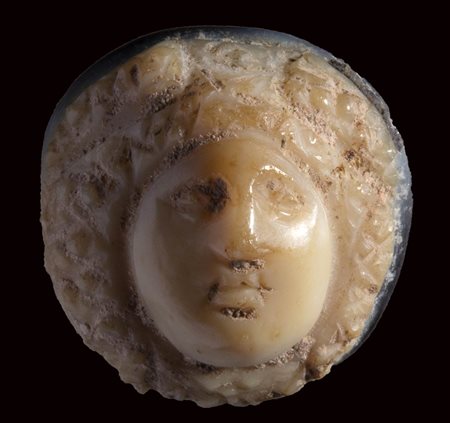
Lotto 225 A late roman onyx cameo. Medusa mask.
2nd - 3rd century A.D.
15 x 16 x 11 mm
Frontal head of Medusa executed in high relief. Above, on the head, the wings. Subject of apotropaic and protective value. Slight wear marks.
Parallels: M. Henig, The Content Cameos, pp. 88-92; M. Henig, H. Molesworth, The Complete Content Cameos, pp. 183-192 ("Gorgoneia").
U.K. private collection, London. -
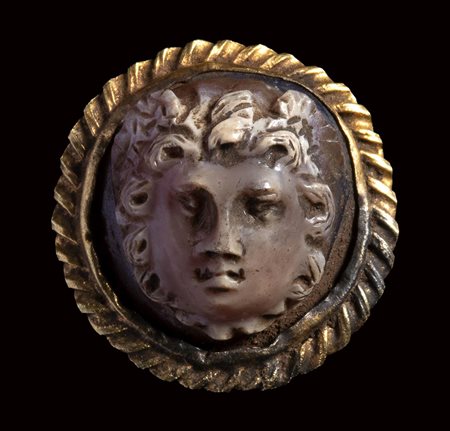
Lotto 226 A roman agate cameo mounted in an ancient gold brooch. Medusa mask.
2nd - 3rd century A.D.
Cameo : 17 x 17 x 18 mm
4,25 g
The front facing winged head of Medusa is depicted as a rounded face with thick hair. The stone, slightly burnt on the surface, was cutted in very high relief and mounted in a gold brooch. Wear marks. Intact specimen, rare in this fine condition.
Parallels: M. Henig, H. Molesworth, The Complete Content Cameos, pp. 183-192.
U.K private collection -
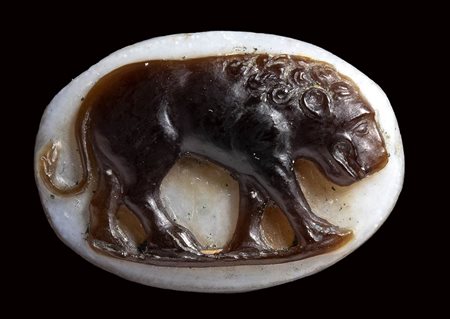
Lotto 227 A fine late Roman sardonyx cameo. Lion.
3rd-4th century AD.
13 x 19 x 6 mm
The mighty animal, symbol of strength and power, is represented in profile facing right. The mouth is half-open, a massive body; the tail is sinuous with the end facing upwards. The groundline and the figure are honey-brown in color, the bottom is white with brown shades on the edges. Empire. Work inspired by the classic late Hellenistic and Roman models of the early imperial period.
Parallels: sardonyx cameo of the National Archelogical Museum of Naples (inv. No. 25969/136), almost the same in type. Slight signs of wear. For comparison: U. Pannuti, The glyptic collection. National Archaeological Museum of Naples, vol. 2, pp. 273-274.
European private collection. -
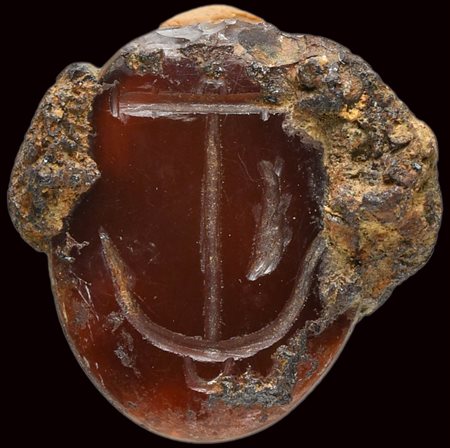
Lotto 228 A late roman carnelian intaglio. Christological emblem.
3rd - 4th century A.D.
13 x 12,5 x 4 mm
The emblem is composed by an anchor and a fish. Traces of the iron ring mounting. Allegory of salvation and hope. Deep red color of the stone. Rare.
U.K private collection -
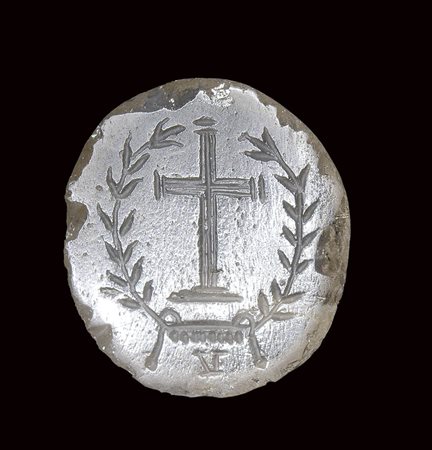
Lotto 229 A rare early byzantine rutilated quartz intaglio. Cross.
6th century A.D.
17 x 19 x 4,5 mm
A cross is surrounded by a laurel wreath, and under the letter V (probably for VOT). The cross is engraved with very thin lines that round its perimeter; the wreath, intricately engraved with pointed leaves, is tied by two ribbons that hang elegantly downwards in the style of coins. Some gems with the depiction of the cross date back to the 5th century, also surrounded by a laurel wreath, very close to the style of the late imperial and early byzantine coinage (Heraclius, with Heraclius Constantine, 610-641. Solidus, Rev. VICTORIA AVGG A / CONOB Cross potent on base and two steps). Crosses as the central subject of the gem therefore appear from the 5th century on carnelian and garnet, in the sixth and seventh century generally on rock crystal, and on Sasanian Christian gems. The rarity and interest of this specimen is also increased by the mineral type of the gem (rutilated quartz, with thin golden thread-like inclusions, similar to rays) and by the large size. Wear marks, abrasions and slight cracks inside the stone.
U.K., private collection 80's. -
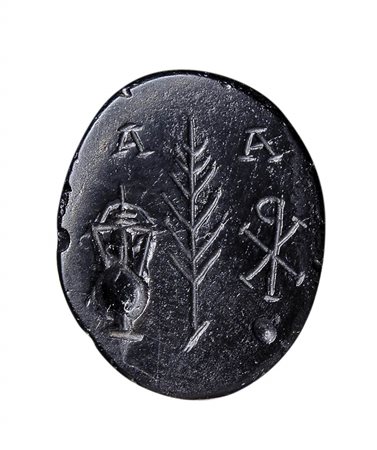
Lotto 230 A late roman black agate intaglio. Martyrium Emblema.
4th-5th century A.D.
14 x 17 x 4 mm.
The gem is engraved on both sides. On the front: a christogram, a palm of victory and martyrdom, a vase (probably a jug). On the back: an anchor with two fish. The gem is characterized by Christological emblems referable to the production of workshops of late Roman antiquity. The black stone is characterized by widespread wear marks over the entire surface. Rare and interesting specimen.
Parallels: J. Spier, Late Antique and Early Christian Gems, Plate 23 Cat. No. 166, plate 33 n. 261-264, pl. 51 n. 434.
U.K., private collection 80's. -
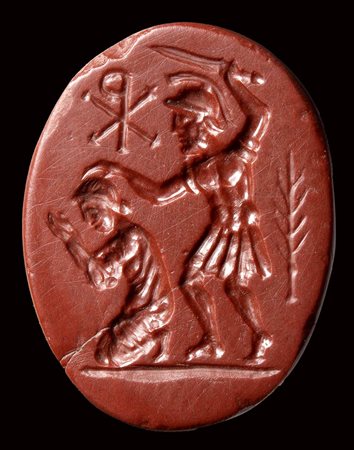
Lotto 231 A late roman red jasper intaglio. Martyrum scene with chi-rho.
3rd-4th century A.D.
15 x 19 x 4 mm
A pagan Roman soldier is in the act of decapitating a female character identifiable with a christian believer. The figure is kneeling on the ground to the left, with her hands folded in a sign of prayer, and she is wearing a long tunic and her hair is gathered. Behind him, a mighty helmeted, bearded and armored soldier. This rests his right hand on the martyr's head, on which the Christogram appears above; with his left hand he raises a sword (gladio) to decapitate. A palm frond in the background, to symbolize the martyrdom and triumph of the resurrection over death. Groundline. Highly symbolic scene, referring to the martyrs of the Christian religion at the time of the Roman Empire. Intaglio executed with skill. Attractive vivid red color of the stone. Wear marks. Slight chipping on the edge. Slight surface cracking of the stone (the stone is whole and does not show any breakages). Rare.
Parallels: Metropolitan Museum of Art Database inv. 81.6.311; King, Charles William. The Johnston Collection of Engraved Gems in the Grand Hall. Hand-book, Vol. no. 9. New York: The Metropolitan Museum of Art, 1881. no. 62, p. 5, 4001/03/2020 Corneille, Pierre, and Paul Allard. "Les procès des Martyrs." In Polyeucte, martyr: Tragedie Chrétienne en Cinq Actes. Tours: Mame, 1889. p. 158. Cabrol, Fernand, Henri Leclercq, and Henri Irénée Marrou. Dictionnaire d'Archéologie Chrétienne et de Liturgie. Vol. 1-15. Paris, 1907-1953. p. 430, fig. 78.
U.K., private collection 70's, London. -
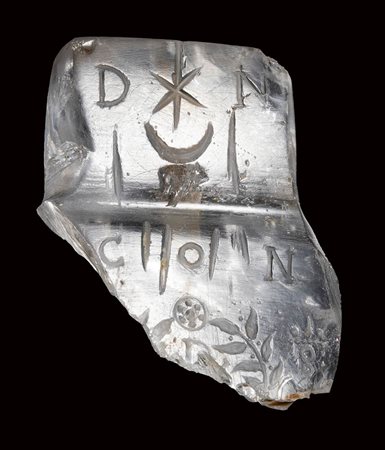
Lotto 232 A late roman rock crystal fragment of a bulla. Constantinian inscriptions with emblema.
4th century A.D.
22 x 28 x 8 mm
On the front of this fragmentary bulla, a crescent moon with a star flanked by the letters D-N is visible at the top. Below, the inscription C-O-N (identifiable with DN CONSTANTIVS PF AVG ) and below: laurel wreath that converges towards a floral corolla; alongside, military insignia and at the center of the crown there must have been the Christogram, as can be seen from the engraved details still visible. This depiction and the inscription are identifiable in some monetary specimens of the Constantinian Era. The precious pendant, carved in a rock crystal of extraordinary transparency and brightness, has a through hole for vertical fastening, signs of wear and residues encrusted in the marks. Rare.
U.K., private collection 70's. -
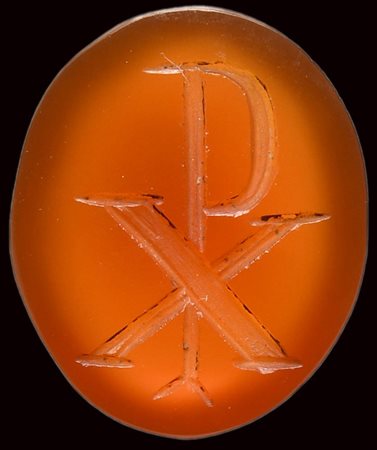
Lotto 233 A late roman carnelian intaglio. Christogram.
4th century A.D.
7,5 x 9 x 3 mm
Christological CHI-RO emblema. Mirror polishing and vivid color of the stone.
U.K private collection -
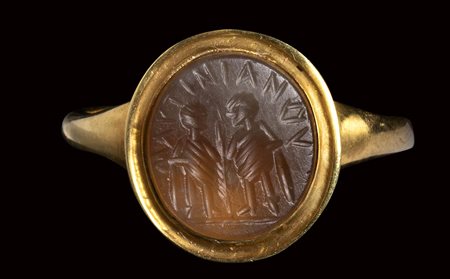
Lotto 234 A christian agate intaglio mounted on a modern gold ring.
4th century A.D.
Intaglio : 11 x 12 mm
Ring : 20 x 18 mm
8,08 g
This rare stone, mounted on a modern gold ring, said to be from Asia minor. Two draped male figures (Christ and another figure?) standing facing each other; one's figure hand is raised; a branch (?) between them. Groundline.
Around, MAPTINIANOY.
The ring is published and described by Jeffrey Spier.
Parallels: J. Spier, Late Antique and Early Christian Gems, Plate 55 Cat. No. 454.
UK private collection, London. -
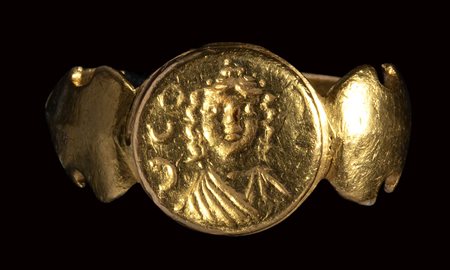
Lotto 235 A late roman gold signet ring, with engraved bezel. Female bust with inscriptions.
3rd – 4th century A.D.
Bezel diam : 11 mm
Ring : 19 x 18 mm
10,23 mm
Flat hoop, slightly rounded without, with either shoulder cut into triangular form. Circular bezel, with engraved design representing the bust of draped woman. Inscriptions on the side (?).
Parallels :
Marshall, F.H., Catalogue of finger rings, 1968, p.187, n°1185
U.K private collection, London. -
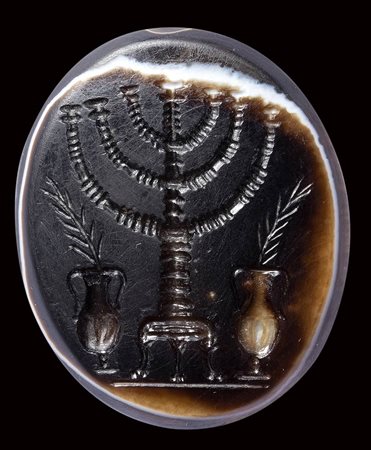
Lotto 236 A rare and large roman sardonyx intaglio. Seven-branched menorah.
1st - 5th century A.D.
30 x 37 x 4 mm
The Second Temple’s seven-branched candelabrum with three animal claws (according to Jewish tradition, the candelabrum was three-footed), with, on each side, a palm branch (lulav) in kantharos. Groundline.
The sense of execution with refined incision to enhance some details of the candelabrum branches, the pedestal and the belly of the kantharos demonstrate a high skilled technic.
This probably indicates a specific command for an important personality.
The seven branched menorah with conical foot appears on the last Hasmonean coinage imagery (40-37 B.C.) and then, not employed during the two Jewish wars against Rome. Although the interdiction of representation was in force at this time, the rabbinical ruling authorized jews to own seals with images even made by pagans as long as it was not meant for worship, but for sealing, or decorative purposes (see. Spier, J. Late Antique and Early Christian Gems, 2013, pp. 159-161).
Hence, the widespread of a certain type of jewish imagery during the Roman Imperial period can be identified in major part with the seven-branched candelabrum, which was the most significant and popular Jewish symbol of the graeco-roman period (one of the most known example is the high relief on Titus Arch in Rome, made in 81 A.D. by Titus’s brother, the emperor Domitian).
A similar iconography with the kantharos on each side and palm branch is represented on one facade of the Magdalena stone discovered in Galilea and dated from the 1st century A.D. The use of animal (lion type) claws for the base of the candelabrum remind one precisely of the Pompeii candelsticks and of the sarcophagus in the Villa Torlonia.
In fact, this particularity begins in the late Hellenistic period, at the time of the Second Temple was erected, the animals representations of the Near-East was exercising a strong influence on Hellenistic art.
Various wear signs on both side. Very attractive stone. Large dimension.
Parallels :
Spier, J., Late Antique and Early Christian gems, pl.121, n°941-943
Strauss, H., The History and Form of the Seven-Branched candlestick of the Hasmonean King, Journal of the Warburg and Courtauld Institutes,Vol. 22, No. 1/2 (Jan. - Jun., 1959), pp. 6-16
U.K., private collection, 70's-80's, London. -
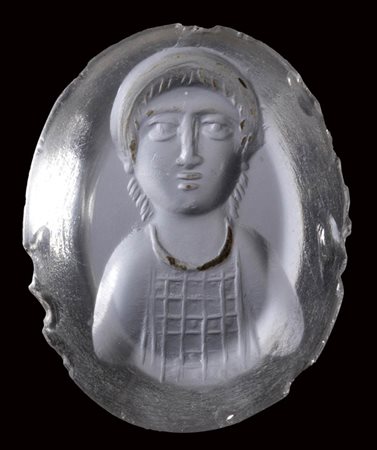
Lotto 237 A rare early byzantine-western gothic rock crystal intaglio. Frontal bust of a man.
5th-6th century A.D.
16 x 20 x 3,5 mm
The young character is depicted frontally. The rounded face is characterized by large eyes, an elongated nose and a small mouth; on the sides you can see the ear lobes. The hair is finely parted and executed with short incised marks, also behind the neck. The head is covered with a headdress. The bust is covered by the typical robe with breastplate-armor in the center, depicted with squares with a small spherical element in the center. The setting of the portrait and the style of clothing derives from late Roman iconography (cf. imperial portraits coined on gold solids). A parallel very close to this interesting effigy is the western gothic portrait of Alaricus II, late fifth century (Vienna, kunstihistorisches Museum, inv. VII B 23). The rock crystal intaglio is part of this barbaric production (Kingdom of the Lombards and Goths, probably a private portrait of an aristocrate or prince). Extraordinary transparency and brightness of the crystal, which lets you see the portrait even from the backside of the bezel. Small chips on the edge. Slight signs of wear. Very rare.
Parallel: J. Spier, Late Antique and Early Christian Gems, p. 27 n. 83.
U.K., private collection, London -
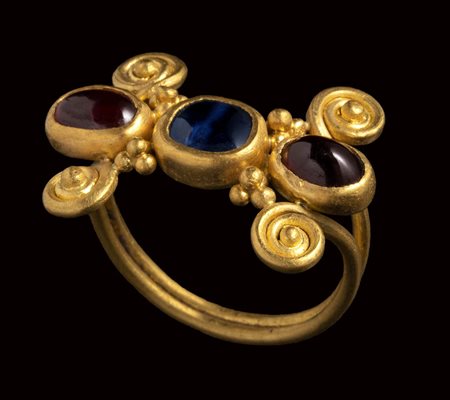
Lotto 238 A late roman gold ring set with a shappire and two garnets.
4th century A.D.
Dim : 21 x 29 mm
ring : 20 x 22 mm
11,20 g
Double rounded hoop, the ends of which forming spirals with a spherical bead in the center and soldered to the central of three box-settings, fastened together with three globule between each. The central setting is oval and has a sapphire. The two other settings have cabochon garnets.
A very similar example is conserved in Palazzo Massimo, Rome, and found in a roman marble sarcophagus.
Parallels :
Marshall, F.H., 1968, n° 853
European private collection 80's. -
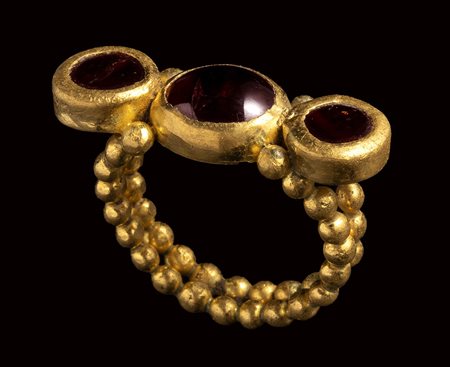
Lotto 239 A late roman gold ring set with three garnets.
4th century A.D.
Dim : 10 x 31 mm
ring diam : 19 mm
15,37 g
Double hoop composed in two series of large beads soldered together. The bezel consists of a central oval setting with a cabochon garnet flanked on either side by a circular setting, also containing garnets.
For a similar hoop typology see Marshall, 1968, n°864
For a similar bezel setting typology see Marshall, 1968, n° 861
European private collection 80's. -
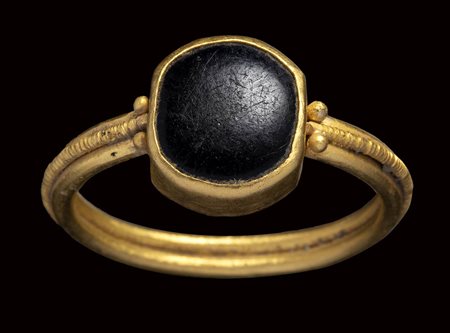
Lotto 240 A late roman gold ring set with an onyx stone.
3rd - 4th century A.D.
Stone : 10 x 10 mm
ring : 21 x 19 mm
7,4 g
With a hoop composed of three wires, the central one ciseled ending with two granules on each terminall. The rounded-shape bezel is set with an oblong onyx.
A similar example is conserved in the Bristish Museum, London, from the Castellani coll.1872.
Parallels :
Marshall, F.H., 1968, n° 781
U.K private collection