
Auction 86 - Glyptics and Ancient Jewelry
-
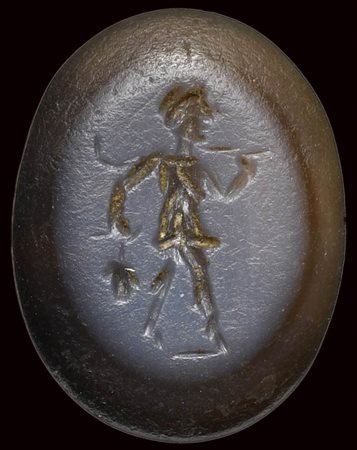
Lotto 145 A roman nicolo intaglio. Faun.
2nd - 3rd century A.D.
9 x 11 x 2,5 mm
The character advances to the right, holding a bunch of grapes and the pedum. Short groundline. Slight wear marks.
U.K private collection -
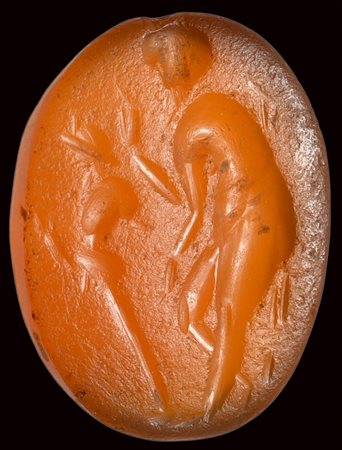
Lotto 146 A roman carnelian intaglio. Priapic scene.
2nd - 3rd century A.D.
9 x 12 x 3 mm
The standing male character is turned to the left and is depicted in the act of worshipping a priapean phallic herm. Apotropaic and votive scene referable to the cult of Priapus. Slight wear marks.
U.K private collection, London. -
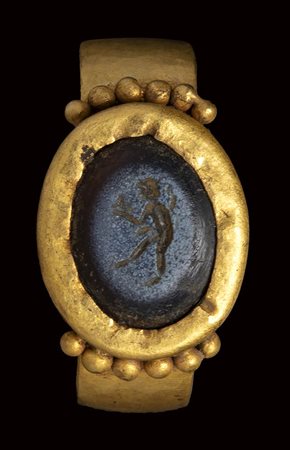
Lotto 147 A roman nicolo intaglio set in an ancient gold ring. Faun.
2nd - 3rd century A.D.
intaglio : 10 x 13 mm
ring : 22 x 19 mm
9,17 g
Turned on the left, holding the pedum and offerings in his left hand. The intaglio is set on a large flatten hoop, ending on an large oval bezel decorated with 6 globules on each side.
U.K. private collection 1985. Formerly in Arthur Sambon (1867-1947) collection. -
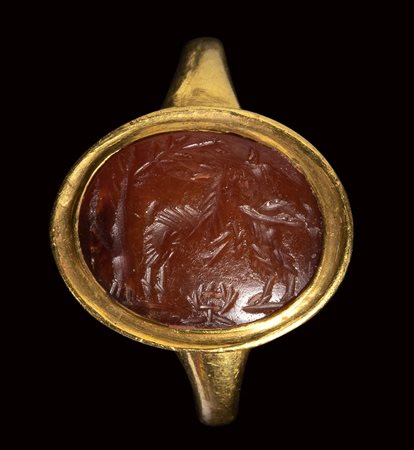
Lotto 148 A roman carnelian intaglio mounted in a modern gold ring. Bucolic fight scene.
2nd-3rd century A.D.
Intaglio : 8 x 11 mm
Ring : 15 x 14 mm
4,74 g
Pan collides with a goat that throws itself against him, raising its anterior legs. A tree in left; below, a laurel wreath (symbol of victory) interrupts the groundline. Interesting work with an allegorical meaning. Slightly convex setting. Wear marks.
U.K private collection, London. -
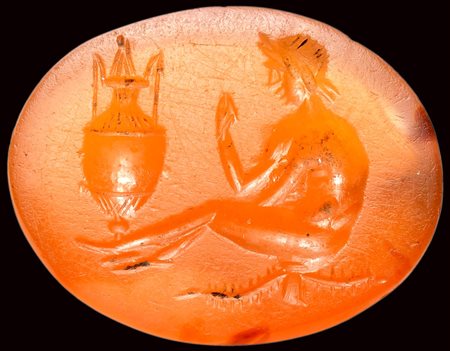
Lotto 149 A romana agate intaglio. Satyr and a vase.
1st century B.C. - 2nd century A.D.
14 x 18 x 4 mm
The young naked figure is seated facing left, raising an arm as in the pose of contemplation. In front of him, an elegant amphora-shaped vase characterized by two handles with an acute angle (similar to the type of trozzella). An unusual double-ended attribute hangs from the satyr's genital area (similar to an insect). Apparently unpublished iconography, to be identified. Wear marks.
U.K private collection -
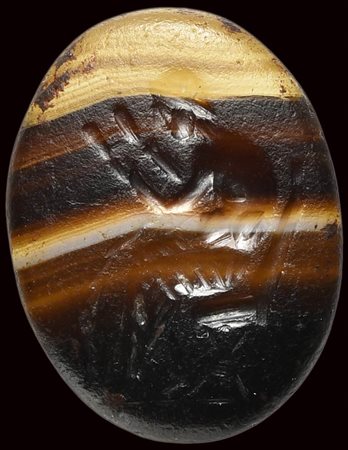
Lotto 150 A roman banded agate intaglio. Seated reader.
2nd century A.D.
10 x 13 x 3 mm
The character is seated on a crossed legs chair. He holds a papyrus near the face, reading it with attention.
Traces of iron mounting. Wear marks. Attractive color of the stone. Rare.
U.K private collection -
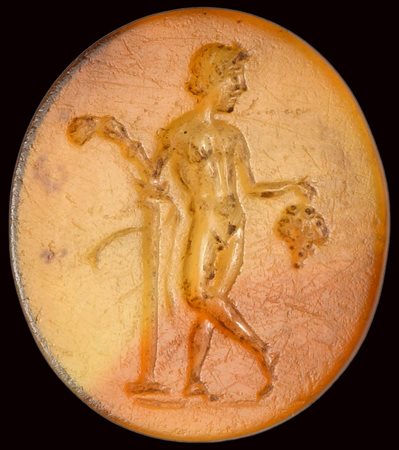
Lotto 151 A fine roman carnelian intaglio. Satyr with attributes.
1st century B.C. - 1st century A.D.
11 x 13 x 1 mm
The young satyr is standing with crossed legs, elegantly leaning against a column. The figure, inspired by the hellenistic models, is slightly three-quarters while the head is in profile. With his right hand he holds ribbons and a very gnarled curved stick (pedum) while with his left a large bunch of grapes. Small groundline. The intaglio is done with great technical and artistic skill. The pose is elegant and soft in the modeling of the anatomy. Attractive variety of stone zoned between light yellow and orange. Wear marks.
U.K private collection, London. -
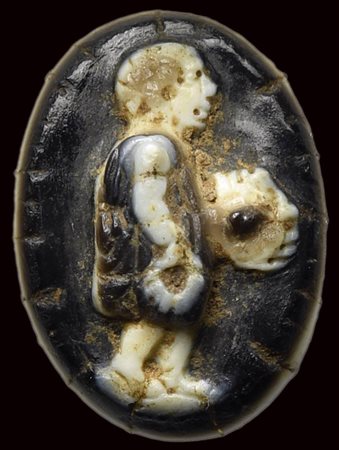
Lotto 152 An unusual roman eight-layers banded agate cameo. Actor with mask and laurel wreath.
1st century B.C. - 1st century A.D.
7 x 9 x 3 mm
The elderly theatrical actor advances to the right, wearing a tunic skillfully engraved in the dark layer of the agate, unlike his body. With his left hand he holds a theatrical mask with the profile facing upwards, while with his left hand he holds a laurel wreath, symbol of victory and agonal triumph. This small cameo, expertly engraved on an unusual eight-layers agate, shows signs of wear and traces of a mounting on the edge. Rare and unpublished.
U.K private collection, London. -
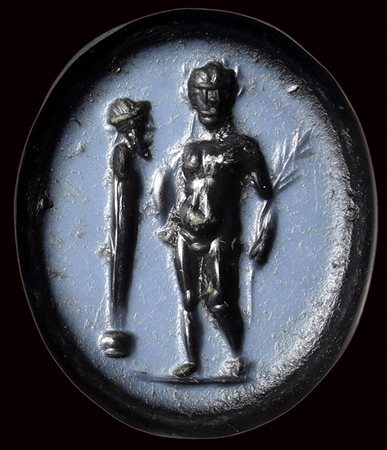
Lotto 153 A roman nicolo intaglio. Athlete with herm.
1st - 2nd century A.D.
10 x 12 x 2 mm
The victorious character is standing, slightly in three quarters, with his right hand on his side and his left hand holding a laurel branch, a symbol of triumph. To his right, a bearded herm. Groundline. The muscular anatomy of the athlete is well engraved, according to a spontaneous sense of volumes. Attractive vivid color of the stone. Slight wear marks.
U.K private collection -
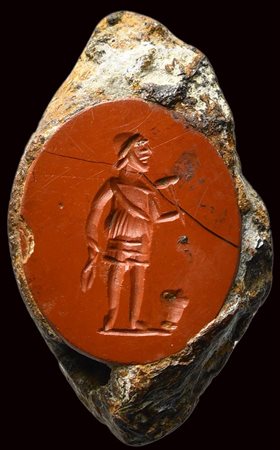
Lotto 154 A roman red jasper intaglio. Hephaestus.
1st - 2nd century A.D.
Intaglio : 9 x 11 mm Mounting : 12 x 18 mm
The character holds the tongs with his right hand, the hammer with his left. At his feet, a basket containing metal planchet-flan for minting coins (?). The figure wears a tunic and is characterized by the aspect of Hephaestus, with a thick beard and pileus headdres (a coin coiner?). Groundline. A black grain runs through the stone. Attractive vivid color of jasper. Fragmentary iron ring mounting. Rare iconography.
European private collection. -
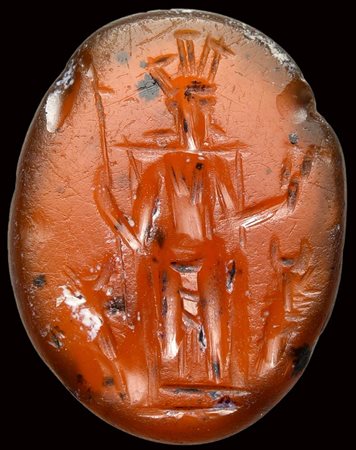
Lotto 155 A roman carnelian intaglio. Cybele.
2nd-3rd century A.D.
12 x 15 x 3 mm
The syncretic figure is seated on the throne, wearing a tunic and a tourreted crown, holding a sceptre with the right hand, an attribute with the left. At her feet, lions. Cybele or Berecyntia, also known as Madre Montagna. Chips on the edge and traces of burns. Wear marks. Very rare.
Parallels:
Penn Museum database, inv. 29-128-908.
U.K private collection -
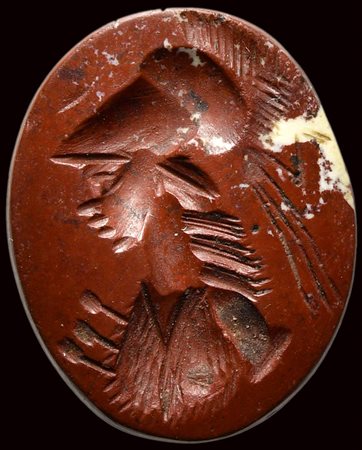
Lotto 156 A roman red jasper intaglio. Bust of Athena.
3rd century A.D.
10 x 13 x 2,5 mm
The helmated deity is turned to the left, wearing the egida. Slight wear marks and little trace of burning on the right.
U.K private collection -
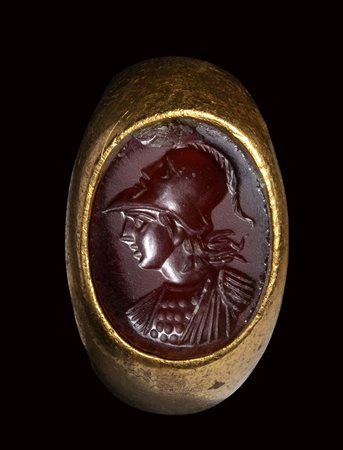
Lotto 157 A large roman carnelian intaglio set in a gold ring. Bust of Athena.
2nd – 3rd century A.D.
Intaglio : 14 x 19 mm
Ring : 21 x 19,5 mm
17,43 g
Large rounded hoop ending with an oval bezel with the carnelian intaglio.
The goddess is turned on the left, represented with an helmet in a form of a mask showing wavy hair which gives a dimension of movement. The egides on her bust. Nice dimension of the stone and nice execution.
Small chip on the edge of the stone.
U.K private collection, London. -
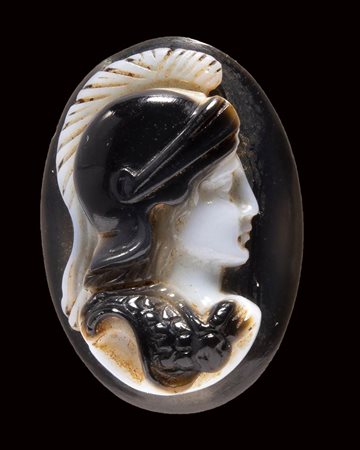
Lotto 158 A roman three-layers onyx cameo. Athena.
2nd – 3rd century A.D.
11 x 16 x 7 mm
Helmeted bust of Athena. The goddess is depicted in profile, with the aegis. The gem is characterized by an high thickness. Very fine condition.
U.K private collection -
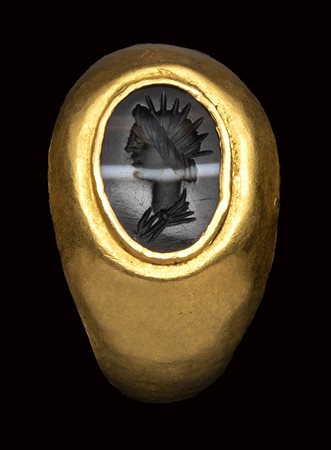
Lotto 159 A roman banded agate intaglio set in ancient gold ring. Bust of Helios.
2nd century A.D.
intaglio : 9 x 13 mm
ring : 20 x 19 mm
8,30 g
The solar god is turned on the left wearing the radiated crown. The intaglio is set in a large hoop, rounded without, flat within.
For the intaglio see parallels :
Antik Gemmen in Deutschen Sammlungen, Band IV, T.211, 1587, inv. K481
U.K. private collection 1985. Formerly in Arthur Sambon (1867-1947) collection. -
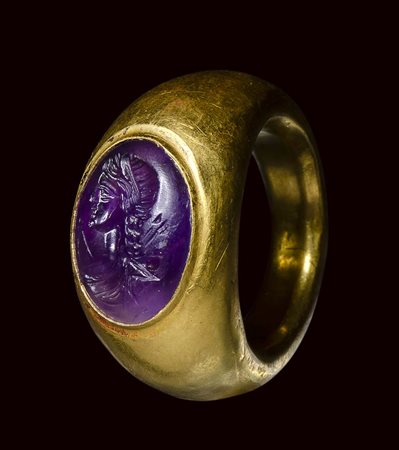
Lotto 160 A roman amethyst intaglio set in a large ancient gold ring. Bust of Artemis.
3rd century A.D.
Stone: 12 x 16 mm; ring diam. 18 mm; 12,22 gr.
With a large hollow hoop rounded without and flatten within, the broad shoulders ending with an oval bezel set with a large amethyst intaglio. The bust depicts the goddess Artemis facing left. She is characterized by a long neck and a rounded face with a proeminent chin. The semi-opened mouth is surmounted by a straight short nose. The large eye is framed with heavy lids and eyebrow and the pupil is incised. The short fronthead is surmounted by long weavy hair ending behind the neck with two large locks. The head adorned with a diadema. The bust is draped with an globular attach (fibula), behind, bow and arrows. The features treatment especially the eyes, nose and chin are characteristics of the near eastern workshops. The intact gold mouting shows traces of deposits and patina. Nice intense color of the stone.
U.K private collection, London. -
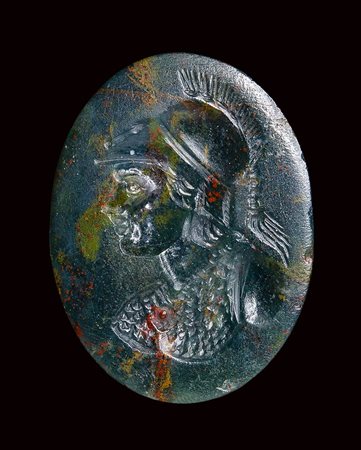
Lotto 161 A large roman eliotrope intaglio. Bust of Athena.
2nd - 4th century A.D.
16 x 22 x 5 mm
The helmeted divinity faces left and is depicted with a well-detailed bust decorated with a gorgoneion. Attractive variety of heliotrope, characterized by multi-colored inclusions. The stone is large in size and shows signs of wear on the entire surface.
U.K. private collection, London. -
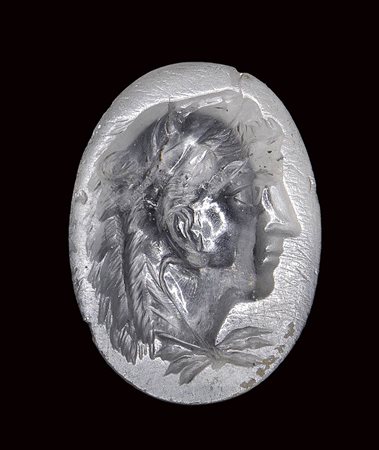
Lotto 162 A roman rock crystal intaglio. Bust of Hercules.
2nd century A.D.
1,3 x 1,7 x 5 mm
The mythological hero is facing right and depicted with young features; plain chick, rounded chin, a long straight nose and a wide-open eye. The short fronthead is surmonted by a range of weavy hair, the rest covered by the head of a lion letting the ears uncovered. The details of the animal skin is well rendered, the crest hairs and the paws binding around the neck of the hero. Very fine execution and beautiful variety of rock crystal, with few inclusions. Wear marks.
U.K private collection, London. -
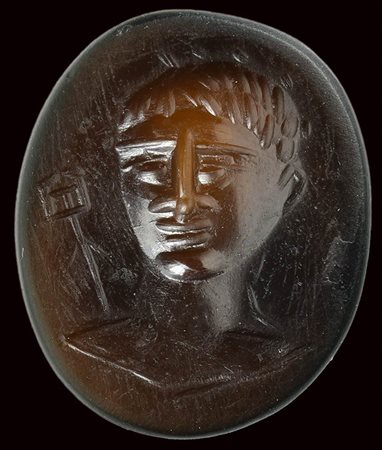
Lotto 163 A roman sard intaglio. Bust of Mercury.
1st B.C. - 1st century A.D.
11 x 13 x 2 mm
The young god face is presented on a light three-quarters. Caduceus behind the shoulder.Marked anatomical features. Slight wear marks.
U.K private collection -
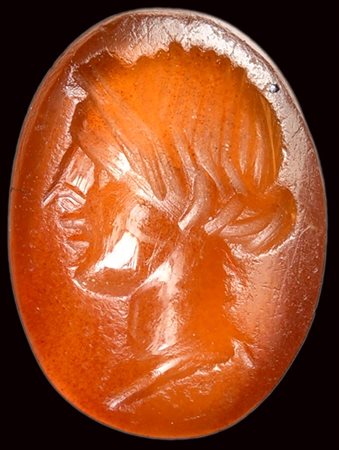
Lotto 164 A roman carnelian intaglio. Female head.
2nd century A.D.
6 x 9 x 2 mm
Portrait of a young woman, turned to the left. Slight wear marks.
U.K private collection -
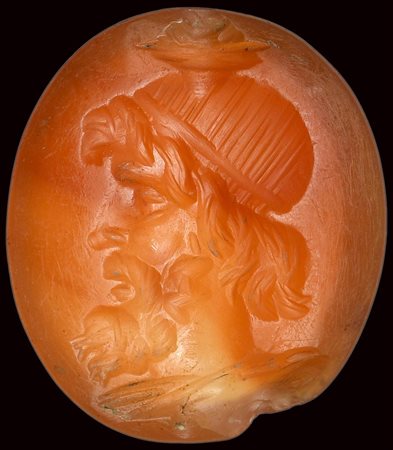
Lotto 165 A roman carnelian intaglio. Zeus Serapis.
1st century A.D.
16 x 17,5 x 4 mm
The bearded god is facing left, with a draped bust and a modius on the head. Slight wear marks and chipping on the edge. Attractive color of the stone.
U.K private collection -
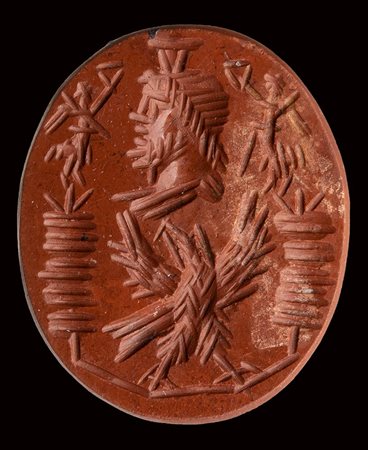
Lotto 166 A roman red jasper intaglio. Allegory of Zeus.
2nd - 3rd century A.D.
13 x 16 x 3 mm
Above, the bust of Zeus Serapis facing left, below the eagle with open wings; on the sides, military banners surmounted by winged victories. Allegory of the military and political power of the Empire. Well composed subject. Slight signs of wear.
Parallel: Antiken Gemmen in Deutschen Sammlungen, Band I, Staatliche Munzsammlung Munchen, Teil 3, p. 86 n. 2667
U.K private collection, London. -
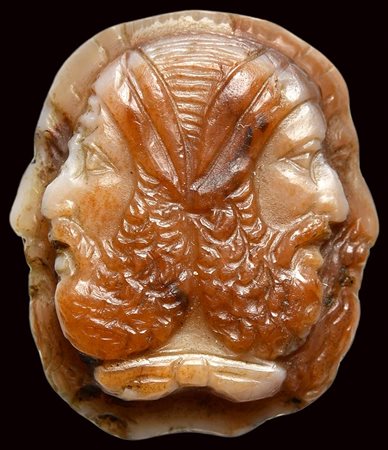
Lotto 167 A roman agate cameo. Four conjoined heads (Janus).
1st century B.C. - 2nd century A.D.
14 x 16 x 5 mm
In the foreground, the typical two-faced bust of Janus characterized by two conjoined bearded heads. In the background there are two other conjoined bearded heads, seen in profile: two overlapping pairs of joint heads. The iconography is inspired by the apotropaic compositions of the gryllos and the carvings with vases covered by conjoined human heads. The model for the double-faced bust of Janus comes from the Roman republican coinage (see : Anonymous. Circa 225-217 BC. Æ Aes Grave As). Wear marks. Large chippings on the backside of the stone. Unusual specimen. Rare iconography.
U.K private collection -
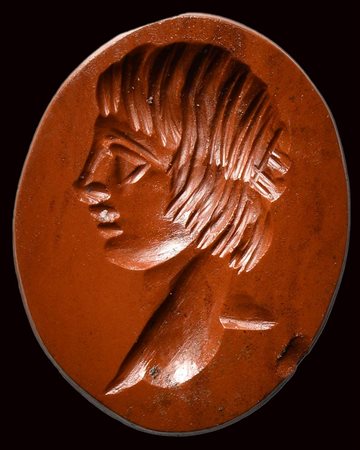
Lotto 168 A roman red jasper intaglio. Bust of ephebus.
2nd century A.D.
10 x 13 x 2 mm
The young man is turned on the left side. The head is characterized with long thick hair covering the ears. Attractive stone color. Little chipping on the edge.
U.K private collection -
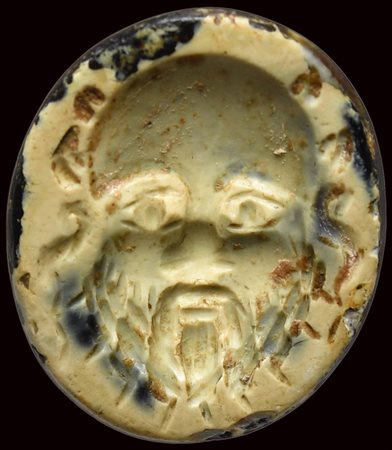
Lotto 169 A roman burnt agate intaglio. Mask of Silenus.
1st - 2nd century A.D.
10 x 12 x 2 mm
Frontal mask of a Silenus, characterized by large eyes, thick beard and bald head. On the head, a crown of ivy leaves. Interesting color of the stone due to burns.
U.K. private collection -
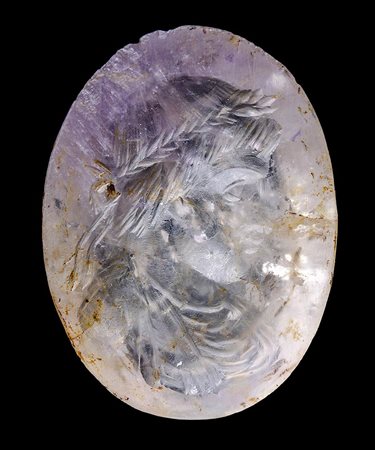
Lotto 170 A roman amethyst intaglio. Bust of a ruler.
1st - 2nd century A.D.
13 x 17 x 3 mm
The young character is facing right and he is characterized by a draped bust and laurel wreath on the head. The head is characterized by thick hair framing the entire facing until the neck. Wear marks, small chips on the edge, and traces of iron mounting. The light amethyst is darker on the upper part and transparent on the lower one. Probably the portrait of an eastern ruler. Nice size and fine execution.
European private collection. -
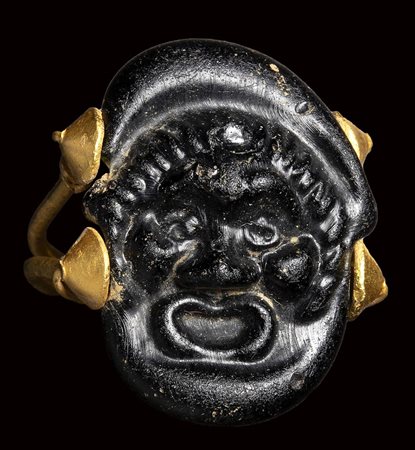
Lotto 171 A rare roman black glass cameo set in an ancient gold ring. Theatrical mask.
1st-2nd century A.D.
Dim : 20 x 27 mm
ring : 21 x 22 mm
9,45 g
This specimen is included into a specific category of Roman rings with a casted glass paste (cf. Wien, Kunsthistrischen Museum inv. XI B 29 ss.). The tragic theatrical mask is melted in a dark glass and perforated with two holes passing through the thickness of the piece. In these two holes pass two filaments of solid gold which join together with the two thicker golden rods which form the ring. Specimen in excellent condition, with patina deposits. Rare.
Parallels: Die Antiken Gemmen des Kunsthistorischen Museums in Wien, Band III, p. 229 n. 2518.
U.K. private collection 1985. Formerly in Arthur Sambon (1867-1947) collection. -
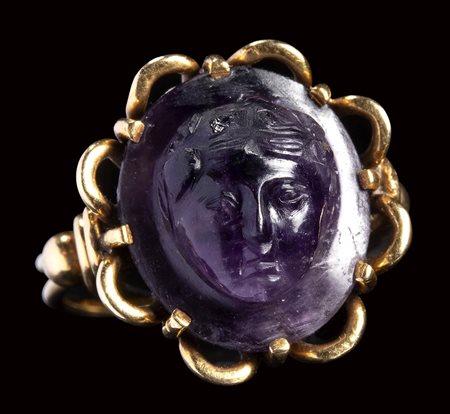
Lotto 172 A fine roman amethyst cameo mounted on a modern gold ring. Mask of Bacchus.
1st century B.C. - 1st century A.D.
Cameo : 13 x 15 x 8 mm
ring diam : 17,5 mm
7,19 g
The face of the young god has a rounded shape, with hair gathered and adorned with ivy leaves. The Bacchic subject fits well with the variety of the stone, a splendid mirror-polished dark purple amethyst. The style feels the influence of the late Hellenistic Greek style. The work is carried out in high relief and is mounted in an elegant modern gold ring with an open work bezel (floral structure). Wear marks. Rare.
European private collection. -
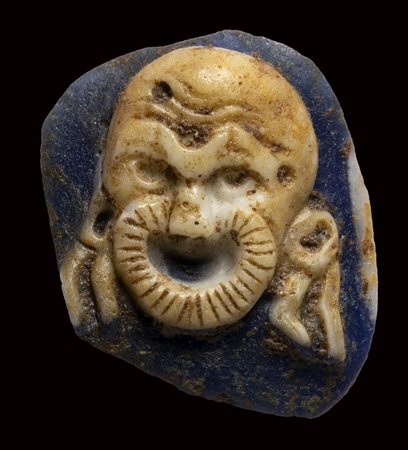
Lotto 173 A roman fragment two-layers blue and white glass cameo. Theatrical mask.
1st - 2nd century A.D.
23 x 27 x 8 mm
The white frontal mask emerges in high relief from a blue background and is characterized by a bold head with deep wrinkles on the fronthead.The eyes and the mouth are wide open emphasizing the caricatured expression. Two long locks fall behind the ears. Ancient patina deposits. Wear marks. Fine condition.
U.K., private collection 70's, in the same family since then. -
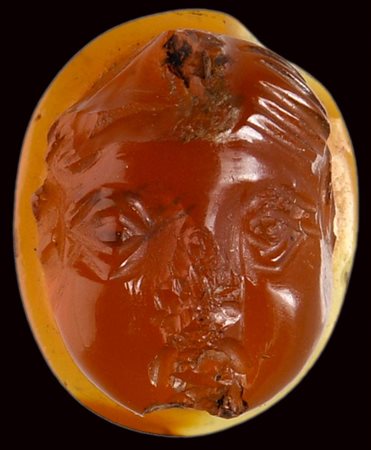
Lotto 174 A roman carnelian cameo. Eros.
1st century B.C. - 1st century A.D.
6,5 x 8,5 x 4 mm
The head of a child/Eros in very high relief; curl topknot in centre of forehead between parted hair. Detailed face features. Broken nose and chin. Chipping on edge. Flat back. Vivid color of the stone.
Parallels: M. Henig, H. Molesworth, The Complete Content Cameos, pp. 177-179 ("Eros head").
U.K private collection -
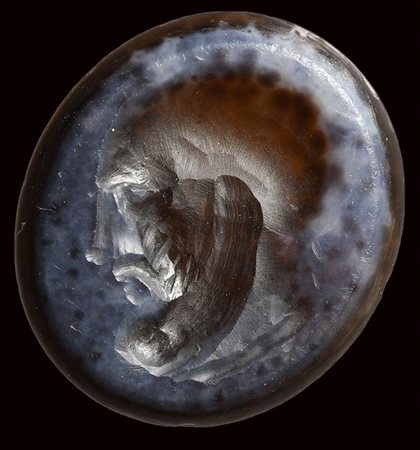
Lotto 175 A roman nicolo intaglio. Male portrait.
2nd - 3rd century A.D.
10,5 x 12 x 2 mm
The male character's face is turned to the left, and has a thick beard. The work is not finished.
Rare example of carving in progress, where traces of engraving tools are visible.
Attractive color of the stone.
U.K private collection -
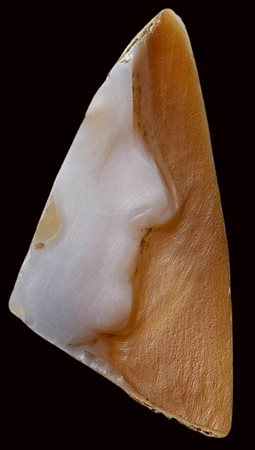
Lotto 176 A rare fragment of an unfinished large roman agate cameo. Imperial portrait.
1st century A.D.
13 x 25 x 4 mm
In this fragment of two-layered agate the traces of the sketch procedures and of the engraver tools for carving a cameo are clearly visible. In this case it had to be a portrait whose physiognomy recalls some profiles of the Jiulio Claudian dynasty. Also on the back there are traces of the wheel instruments. Rare.
U.K private collection -
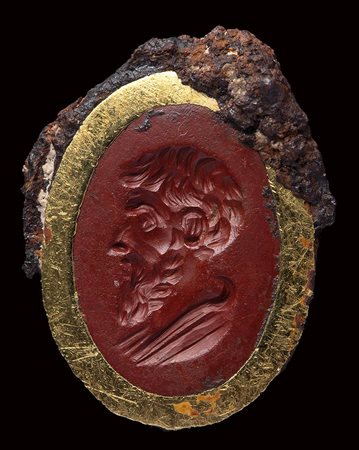
Lotto 177 A roman red jasper intaglio. Philosopher.
2nd - 3rd century A.D.
Intaglio : 11 x 14 mm
The effigy is characterized by a thick hair and a long beard, slightly curved nose, marked cheekbone, tunicate bust. The gem, characterized by an attractive bright red color, is still set in its original metal (fragmentary) setting formed by an iron ring (broken) with a gold frame.
U.K private collection, London. -
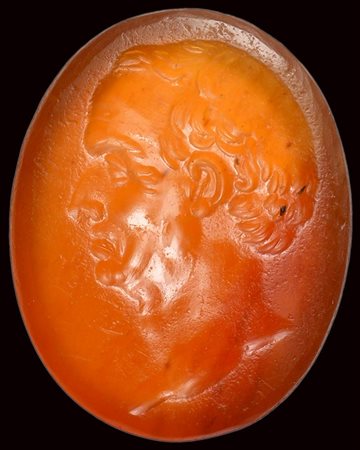
Lotto 178 A fine roman carnelian intaglio. Portrait of Maecenas.
1st century B.C. - 1st century A.D.
9 x 12 x 3 mm
This fine portrait, facing left, is characterized by physiognomic details expertly engraved, referable to known models identifiable as portraits of the famous roman character. The naturalistic and expressive features of the face, which reveal an advanced age, are inspired by the late Republican portraits. Slight wear marks.
See parallels: Boston, Museum of Fine Arts: 99.112; Story-Maskelyne, M.H.: The Marlborough Gems (1870): no. 517
Boardman, J., Scarisbrick, D., Wagner C., Zwierlein-Diehl, E: The Marlborough Gems (2009): no. 209
U.K private collection, London. -
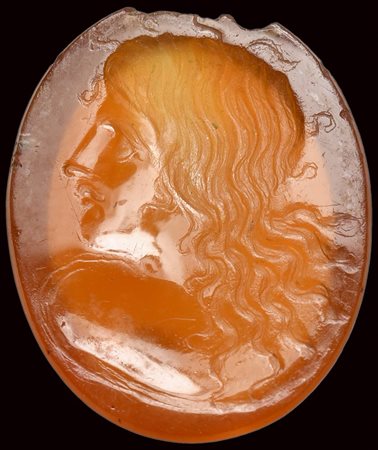
Lotto 179 A fine late hellenistic carnelian intaglio. Bust of Nereid.
1st century B.C.
12,5 x 16 x 3 mm
The young figure is turned to the left, and is characterized by a slightly open mouth, rounded chin, long and thick hair as moved by the wind, with strong inspiration from the Hellenistic models. The face, facing in profile, is characterized by delicate features finely engraved and mirror polished. The left shoulder is seen from behind, as in the typical movement of swimming. The figure is variously interpreted as Nereid or as Leandro crossing the Dardanelles to reach the lover Eros. By some the subject is interpreted as a marine divinity or Selene. The figure expresses beauty and elegance and shows a particularly refined execution. Attractive color of the stone. Slight wear marks. Missing on the edge.
Parallels: A. Giuliano, I cammei dalla Collezione Medicea del Museo Archeologico di Firenze, pp. 216-217; L. P. B. Stefanelli, La collezione Paoletti, vol. 1, tomo 2 n. 218, tomo 3 n. 480; Le Gemme Farnese, 1994, p. 122 n. 184 (225); G.M. A. Richter, Engraved gems. Greek, Etruscan and Roman, The Metropolitan Museum of New York, n. 150; J. Boardman, Greek gems and finger rings, n. 1003.
U.K private collection 80's. -
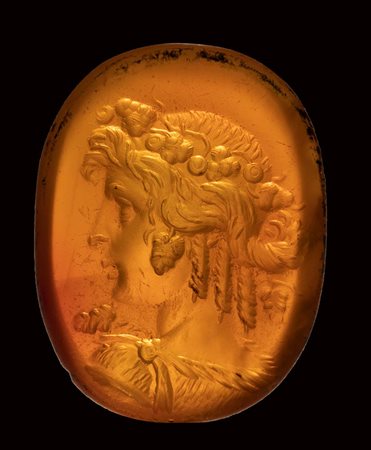
Lotto 180 A very fine late hellenistic carnelian intaglio. Bust of Bacchante.
End of 2nd - Beginning 1st century B.C.
17 x 23 x 3 mm
The figure is turned to the left, with the three-quarters bust seen from behind covered by a goat fur stopped by a round fibula on the shoulder; the head is in profile, with a thick and very detailed hair, decorated with small bunches of grapes and berries; braids descend on the neck. The face is characterized by a slightly sunken eye and a slightly open mouth, in the typical expressive rendering of late Hellenistic works. In this case it is a work referable to the Ptolemaic context and which presents a particularly close parallel with a carnelian intaglio of the Cabinet des Medailles, identified as a portrait of a Ptolemaic princess as a bacchante. Both carvings seem to come exactly from the same atelier. Wear marks.
Parallels: M.L. Vollenweider, Camées et intailles. Tome I. Les Portraits grecs du Cabinet des médailles, p. 146 n. 140.
U.K., private collection 80's. -
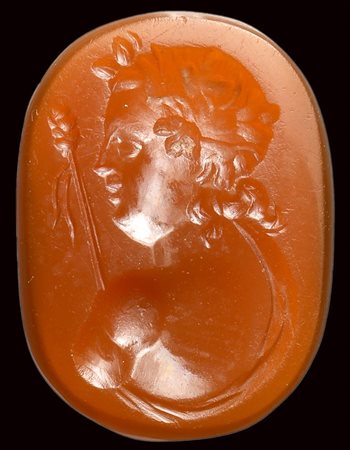
Lotto 181 A roman sard intaglio. Dionysos bust.
1st century B.C. - 2nd century A.D.
10 x 14 x 3 mm
The young god is turned to the left with his head in profile but with a three-quarters bust seen from behind (the right shoulder is covered by the cloak). The head is adorned with an ivy crown. In the background emerges the thyrsus. The shape of the bezel is rectangular with rounded corners. Attractive color of the stone. Slight wear marks.
U.K private collection -
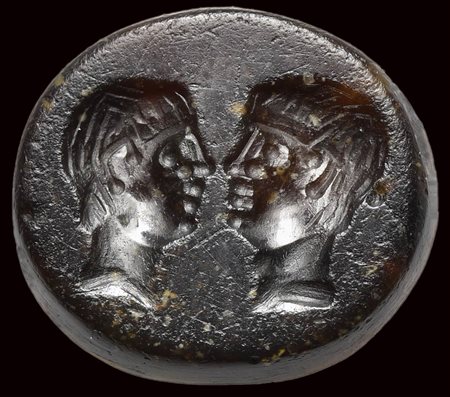
Lotto 182 A roman republican sard intaglio. Two male portraits.
1st century B.C.
12 x 14 x 2,5 mm
Two faced male busts of young characters, with short hair. Use of globular elements for the face's details ( eyes, nose, lips, chin, ears). Wear marks.
U.K private collection -

Lotto 183 A fine roman carnelian intaglio set in a gold frame. Bust of Hercules.
Beginning of the 1st century A.D.
6 x 8 x 2 mm
The young hero is facing right, with the club engraved behind his neck. This intaglio, considering the really small size of the stone, is characterized by an extraordinary engraving quality. In such a small surface the engraver managed to render all the anatomical and physiognomic details of this portrait, even with small almost globular elements for the club, inspired by the Gnaios models. The stone is mounted in a small gold frame with traces of bronze in the backside, probably ancient. Signs of wear. Attractive color of the stone. Slight wear marks.
Parallels: Antike Gemmen in Deutschen Sammlungen, Band IV, Hannover und Hamburg, n. 1057, 1058; Die Antiken Gemmen des Kunsthistorisches Museum in Wien, band I, p. 165 n. 543.
U.K. private collection, London. -
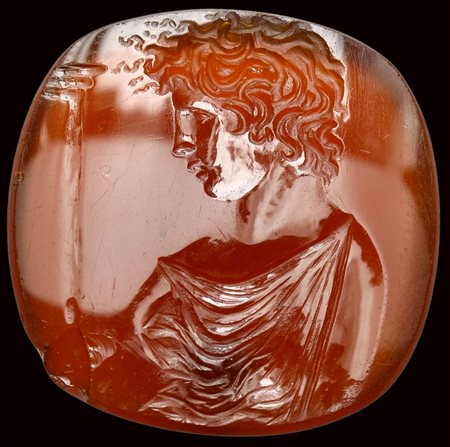
Lotto 184 A very fine and large greek late hellenistic carnelian intaglio. Ptolemaic Female bust.
2nd-1st century B.C.
21 x 21 x 4 mm
The young character is facing left, with the head in profile slightly inclined downwards. The bust is instead depicted in three quarters, with uncovered shoulders and the chest characterized by a delicate breast, covered only by a light, very tight tunic. The character is characterized by thick hair, formed by elegant curvilinear locks that cover the head descending on the nape and forehead, rising slightly at the top. The anatomical volumes of the face and torso are executed with a very low and delicate relief, while the hair and the tunic, almost a wet drapery that sensually reveals the underlying breast, are engraved with more marked and raised lines. In front of the figure, always in very low relief, almost imperceptible, we can see a structure, probably architectural, with a frame (rather than considering it a scepter?). The identification of the character is not clear and multiple, given the absence of safe attributes. The iconography and composition of the scene recall for some details a gem from the Farnese collection, depicting a female bust characterized by the same half-closed mouth and very short hair with wavy, almost masculine locks, in the act of contemplating a mask and identified as Melpomene. Musa is in fact defined as the character depicted half-length with a chiton, in front of a column / architectural structure with a frame on top of a mask, exactly in front of his face framed equally by a wavy and very short hair (Dactyliotheca Capponiana). This iconography is in fact considered as the representation of poetry or of a poet. The ephebic face, young and very delicate, has almost masculine features, similar to the androgynous beauty of Antinous. The small eye, the linear nose, the small fleshy and slightly open mouth, the rounded chin, the hair disordered by curvilinear locks that dominate the head, the delicate and engraved bust with imperceptible relief compared to the dress, the attitude of the face and his languid contemplative expression: all stylistic details referable to the late Greek production of the Hellensitic period, full of pathos and characterized by an extreme and extraordinary executive refinement. In the valuable catalog raisonné concerning the Greek portraits in the Cabinet des Médailles in Paris, the impression of a gem (n. 111) considered as lost and of unknown location, certainly from the De Clecq collection, was taken from a Ptolemaic gem. This piece depicts the portrait of a young princess daughter of Ptolemy VI and Cleopatra II, dressed only in an almost transparent peplum delicately fixed on the bare shoulders; in front of her a spike and a poppy flower: The face, also in this case, is characterized by a sweet melancholy, full of pathos and delicacy, the features of the flight refined, in very low relief, the mouth slight opened, the head in profile slightly inclined downwards, the nose straight ahead. Its physical and stylistic characteristics, the compositional and executive typology are very similar and in part identical to the carnelian bust carving yet to be identified. Apparently both can be traced back to the same cultural and artistic sphere, perhaps to the same engraving workshop. The carnelian intaglio can probably depicts in the same way a prolemaic princess of the Seleucid empir. The gem is masterfully engraved with great art and technical expertise; the stone, chracterized by a pure deep red, is mirror polished. Chip on the edge. Artwork of great rarity.
Parallels: M. L. Vollenweider, Camées et intailles, Tome I, Les Portraits grecs du Cabinet des médailles, n. 111, 123, 124, 209, 217; Le Gemme Farnese, 1994, p. 126 n. 192 (296); M. L. Ubaldelli, Dactyliotheca Capponiana, p. 224.
U.K., private collection 70's, in the same family since then. -
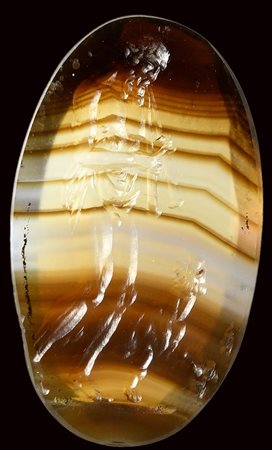
Lotto 185 A fine roman banded agate intaglio. Silenus with panther.
1st century B.C. - 1st century A.D.
10 x 17 x 2 mm
The character is standing, facing right, in the act of playing the double flute. At his feet a panther, referring to Dionysus and the Bacchic processions, who follows him attached to his legs, looking towards the double flute, as if enchanted by the melody. Groundline. The anatomical details of Silenus and the panther's body are rendered with art and skill. Depiction inspired by classical statuary models. Mirror polishing. Slight wear marks. Attractive color of the stone.
U.K private collection -
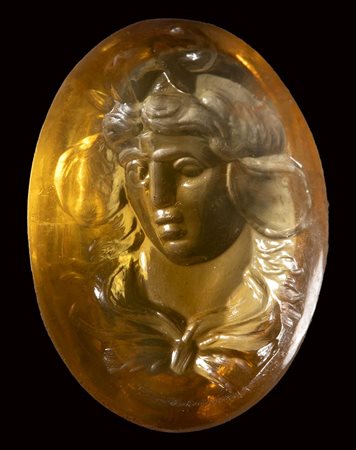
Lotto 186 A fine citrine quartz roman intaglio. Bust of Africa - Lybia.
1st century B.C. - 1st century A.D.
9,5 x 13 x 5 mm
Bust of Lybia - Africa in almost full front view, slightly in three-quarters. She wears an animal skin knotted on the chest and the hide of an elephant's head as a headdress. Long hair descend to her shoulder. An expressive face with almost three-dimensional relief effect , engraved with a very deep intaglio.
Extraordinary vivid color of the stone, of a great purity and brightness. Mirror polishing.
High thickness of the stone with convex back. Rare.
Parallels: G.M.A. Richter, p. 87 n. 383; cf. Furtwangler, Berl. Kat.,nos. 4883 ff. and A.G. pl. XXVI, 20, pl. XLI, 47. The same subject occurs also in coins
U.K., private collection 70's, in the same family since then. -
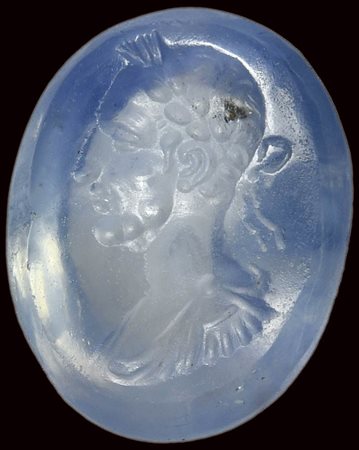
Lotto 187 A roman sapphire intaglio. Bust of Julius Caesar.
End of 1st century B.C.
7 x 9 x 5 mm
The bust of the roman dictator is turned to the left. The character wears the laurel wreath ending with ear of corns (egyptian symbol). He wears the armour under the chlamys. The face is characterized by his typical physiognomic marked traits, well executed considering the very small size and the particular hardness of this precious stone; the style is close to the globular style of the late republican period . Attractive stone color with various shades of blue. Convex surface on both sides of the stone. Wear marks. Rare.
Parallels : M. L. vollenweider, Die Portratgemmen der romischen Republik, 1972, pl. 75-81.
U.K private collection -
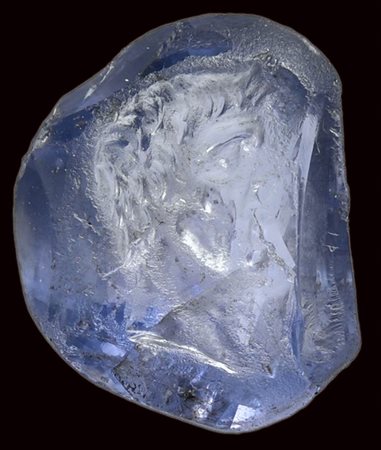
Lotto 188 A roman sapphire intaglio. Bust of male ruler.
End of 1st century B.C.
6 x 8 x 3 mm
The portrait is facing right. The nose and part of the mouth are missing due to the breaking of the stone. However, the physiognomic features are well evident, such as the protruding cheekbone and the spherical chin, the folds on the cheek, the marked orbital arch, the musculature of the neck and above all the typical hair with overlapping strands with a characteristic raised tuft of hair on the front. These anatomical details, referable to the late republican iconography, make it probable that this effigy is identified with Pompey the Great, or a similar and coeval private portrait. The stone was later shaped on the back with facets, probably in the Renaissance period. However, the front side has retained its ancient wear marks. Rare.
Parallels : M. L. vollenweider, Die Portratgemmen der romischen Republik, 1972, pl. 71-75.
U.K private collection -
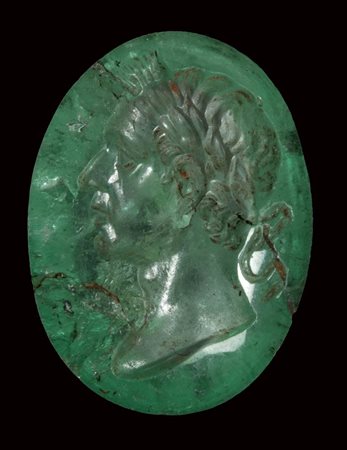
Lotto 189 A very fine roman emerald intaglio. Bust of a ruler.
Late 1st century B.C.
9 x 12 x 5 mm
The precise identification of this refined laureated portrait is not entirely certain. What is certain is that it was engraved on an emerald of extraordinary quality, very precious for that time, characterized by a slightly convex surface frontside, instead very convex in the backside, emphasizing the intense color and the preciousness of the artefact.
The portrait is engraved with great skill, the anatomical details are well rendered and delicately modeled. The nose is protruding, the eye has a lively and strong-willed expression, the mouth slightly open, the cheekbone protruding, the neck has a slight protuberance on the throat. The hair is finely chiseled, held by a laurel wreath ending with ears of wheat.
This detail is an allegorical reference to Egypt, and the same variety of emerald seems to refer to the Alexandrian ateliers. The style of the portrait is comparable to some late republican official or private portraits, including some effigies of the famous Roman dictator Caius Julius Caesar, whose ties to Egypt are very decisive. The physiognomy of this portrait seems to evolve in the later Augustinian portraits of the Julio Claudia dynasty. To be identified. Slight cracking. Wear marks. Rare.
Parallels : M. L. vollenweider, Die Portratgemmen der romischen Republik, 1972, pl. 75-81.
U.K., private collection 70's, in the same family since then. -
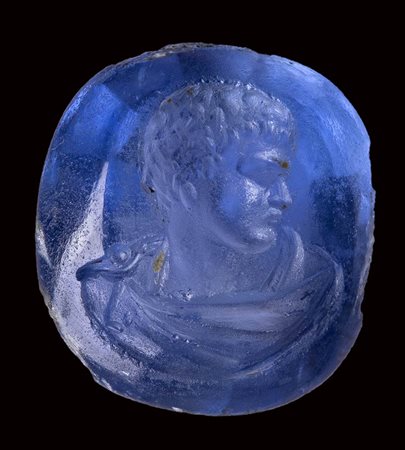
Lotto 190 A roman sapphire intaglio. Bust of the emperor Caracalla.
Early 3rd century A.D. (circa)
9,5 x 9,5 x 5,5 mm
Bust of young Caracalla, Roman emperor (AD 198-217) wearing a cloack with a round fibula. The effigy presents the front bust and the head turned in profile towards the right, in its typical torsion. The physiognomy, the pose and the marked expression are typical of Caracalla: the forehead is wrinkled, the sunken eye, the mouth tightened, the neck in tension, the hair composed of short curls; the absence of the barbula indicates that it is a portrait made at his young age.
The precious intaglio, made on an extraordinary quality sapphire, shows signs of wear and traces of the execution with ancient instruments, executed with natural spontaneity and decision. The structure of the coat folds is inspired by the statuary models; the head also has a high relief which gives it a sculptural sense. The back of the stone must have been reworked in the Renaissance: it has many facets and ends pointed . Attractive vivid color of the stone. Very rare specimen and rare example of technical expertise given the hardness and small size of the piece. Slight chips on the edge. Wear marks.
Parallels: D. Scarisbrick, C. Wagner, J. Boardman, The Beverly collection of gems at Alnwick Castle, p. 227 n. 212; Beazley Archive: Story-Maskelyne, M.H.: The Marlborough Gems (1870): no. 485, Boardman, J., Scarisbrick, D., Wagner C., Zwierlein-Diehl, E: The Marlborough Gems (2009): no. 302 (Walters Art Museum, Baltimore: 42.1061, sapphire intaglio).
European private collection -
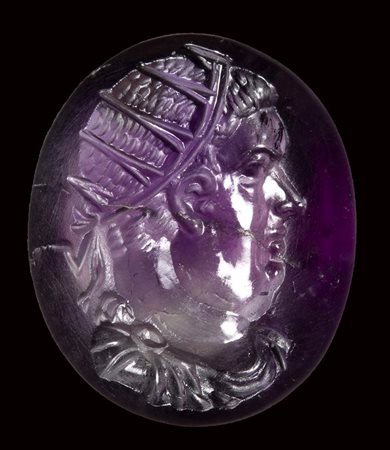
Lotto 191 A fine roman amethyst intaglio. Portrait of the Emperor Balbinus.
3rd century A.D.
11 x 13 x 5 mm
This peculiar effigy can be identified with the portrait of the emperor Decimo Celio Calvino Balbino (178-238), in charge from February to May 238 A.D. In this rare and unpublished effigy of the emperor, he is facing right, with the draped bust and the radiate crown on the head. Two round fibulae are visible on the shoulders. The head is characterized by physiognomic features that well show his peculiar aspect in a naturalistic and expressive sense. The face is characterized by a small expressive eye, a slightly wrinkled forehead, a broad and generous beardless cheek. The lips are small, the globular chin engraved as small sphere that is grafted onto the large double chin; the neck is massive. The hair is short and tight, finely dotted according to the typical late style also present on the official coinage
portraits. The style of the bandages hanging on the nape is the same as that present on the coins; it can be assumed that the engraver of this portrait was probably an engraver of cones. The highly realistic traits of the character are expressed according to the “late style” rendering that fits well with the artistic taste of the time. This rare portrait is engraved on a beautiful mirror polished amethyst (slightly convex on the front side, more convex on the backside) characterized by a purple vivid color with a fine transparency on the bust. Small crack in the stone. Wear marks.
U.K., private collection 80's. -
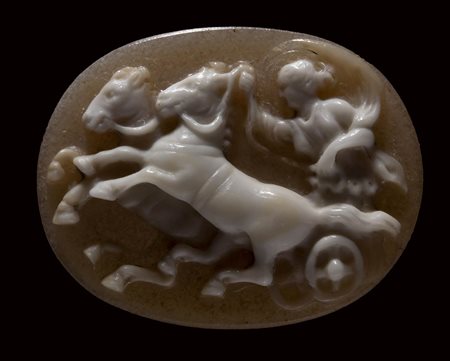
Lotto 192 A large roman two-layers agate cameo. Eos on the chariot.
1st - 2nd century A.D.
21 x 27 x 4 mm
The figures are facing left. The goddess of Dawn wears a chiton with overfold, and an himation which is blown out behind her by the wind. She is driving a chariot with two galopping horses. She holds the bridles that hold the two horses in two hands. The two mighty animals raise their front legs. The figures are engraved on the white layer tending to the shade of ivory, on a honey-colored background with small brown inclusions. The cameo, of generous dimensions, is sculpted with fine skill in high relief. Slight wear marks. Rare.
Parallels: U. Pannuti, La collezione glittica - Museo Archeologico Nazionale di Napoli, vol. 2, p. 182 n. 149-150; pp. 191-192 n. 159-160.
G. M. A. Richter, Catalogue of the engraved gems. Greek, etruscan and roman, The Metropolitan Museum of New York, Pl. LXIX n. 624-625.
Furtwangler, A.G., pls. LVII, 5, LXIII, 49.
Babelon, Cat. des Camées, n. 37, 38.
Walters, B.M. Cat. n. 3528.
European private collection 80's