
Auction 86 - Glyptics and Ancient Jewelry
-
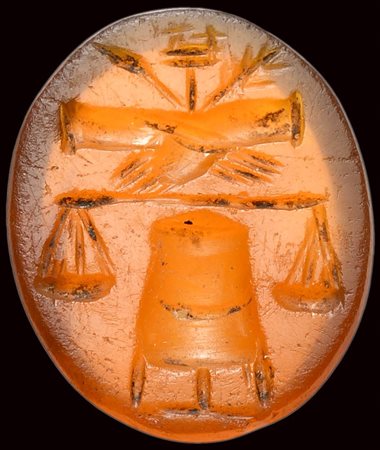
Lotto 97 A roman carnelian intaglio. Allegorical emblema.
2nd century A.D.
9 x 12 x 2 mm
A modius is surmounted by a balance; above: two clasped hands holding an ear of corn, a palm branch and a caduceus (dextrarum junctio). Allegorical emblema referred to abundance, luck and union. Slight wear marks.
U.K private collection -
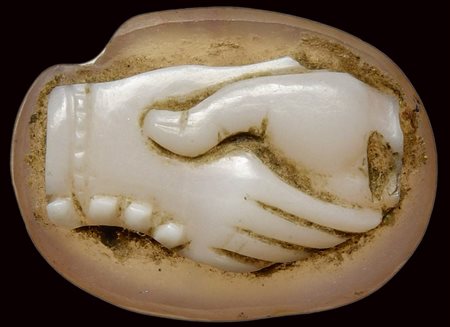
Lotto 98 A late roman two-layers agate cameo. Dextrarum junctio.
3rd - 4th century A.D.
8 x 11 x 3,5 mm
Two clasped hands. Allegorical depiction of the military and political alliance, as for a marriage. Wear marks. Chipping on the edge.
U.K. private collection -
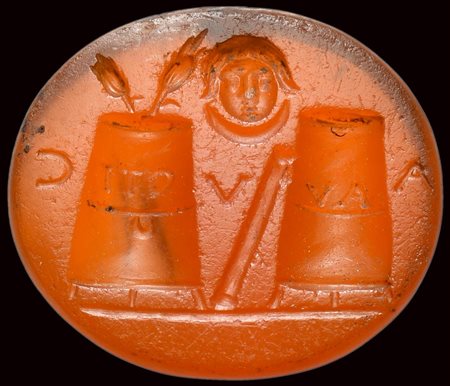
Lotto 99 A roman carnelian intaglio. Allegorical emblema with two inscribed modius and mask.
1st century A.D.
11,5 x 13 x 3 mm
The emblematic representation is composed of two Modii, separated in the center by an instrument resting on the container on the right. Above the right container: AV; on the left container, which contains two ears of wheat: OTI.
In the field, the letters: A-V-C. Above, a frontal mask on crescent moon. Groundline.
Unusual allegorical emblem, executed with great skill and compositional symmetry. The subject is probably referred to a corporation. Attractive color of stone. Slight wear marks. Rare.
U.K private collection, London. -
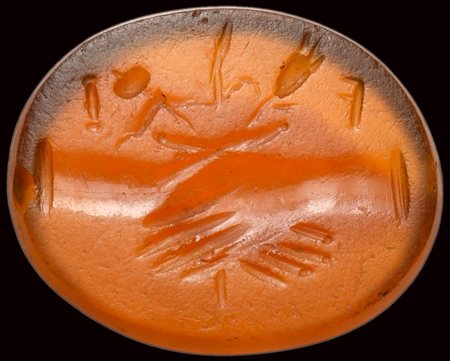
Lotto 100 A roman carnelian intaglio. Dextrarum junctio with letters.
1st century B.C. - 2nd century A.D.
9 x 12 x 2 mm
Two clasped hands, holding one ear of corn, a poppy flower and a branch; above the hands, the letter F-I (probably, FIDELITAS). Allegorical emblema referable to a marriage with auspicious of abundance and good luck. Slight wear marks.
U.K private collection -
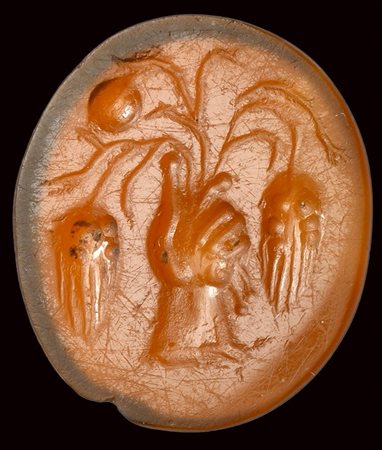
Lotto 101 A roman republican sard intaglio. Allegorical emblem.
1st century B.C.
12 x 14 x 2 mm
In a vertical position, one hand is holding a poppy flower and two ears of wheat which elegantly hang downwards. Use of globular elements. Allegorical emblema referred to good luck, abundance and prosperity. Wear marks.
U.K. private collection -
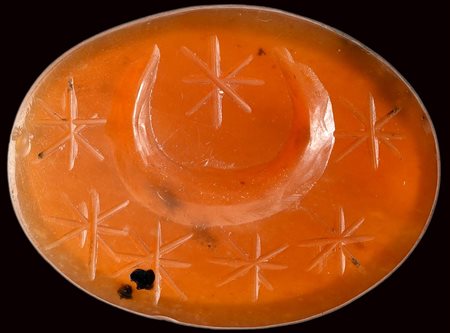
Lotto 102 A large roman carnelian intaglio. Crescent moon with seven stars.
2nd century A.D.
13 x 17 x 3 mm
Allegorical emblema with astrological references . Slight wear marks.
Parallels: U. Pannuti, Catalogo della collezione glittica, vol. II, p. 294.
U.K private collection -
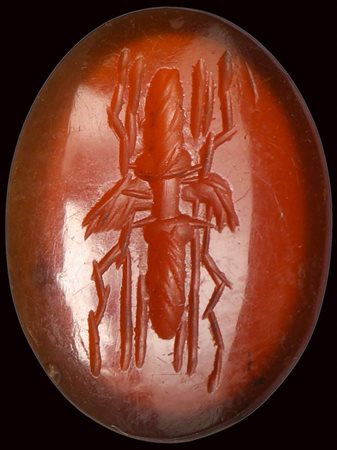
Lotto 103 A roman deep red carnelian intaglio. Winged thunderbolt.
1st - 2nd century A.D.
10 x 13 x 3 mm
The emblematic depiction is inspired by coin issues (Divus Augustus Pater, AE dupondius - winged thunderbolts). Mirror polishing. Attractive color of the stone.
U.K private collection -
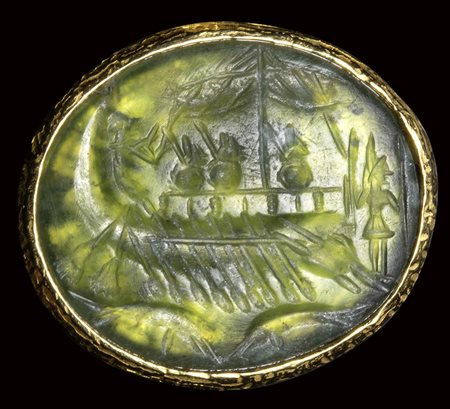
Lotto 104 Gold cufflinks with silver gem-impression. A roman green chalcedony intaglio. Warship with dolphins.
1st-3rd century A.D.
intaglio : 17 x 21 mm
Weight (cufflinks) : 16,92 g
The warship sails to the right and is characterized by a wild boar-headed rostrum, a high aplustre, oars at sea and a large, partially open sail; on board, 3 helmeted soldiers armed with spears and shields. On the rostrum there is an armed soldier (presumably the leader highlighted in a certain allegorical sense ?). At the bottom of the ship: the helmsman. At sea, two dolphins. This specimen, engraved on a precious large green chalcedony, finds a very similar comparison with a specimen preserved at The Hermitage Museum. Slight wear marks. The stone is set in a gold mounting as a cufflink. The lot include a nice toned silver impression.
Parallels: The sails of Hellas. Seafaring in the ancient world. The State Hermitage Museum (Exhibition Catalogue), St; Petesburg 2010, p. 186 n. 101 inv. ΓP 22776.
European private collection. -
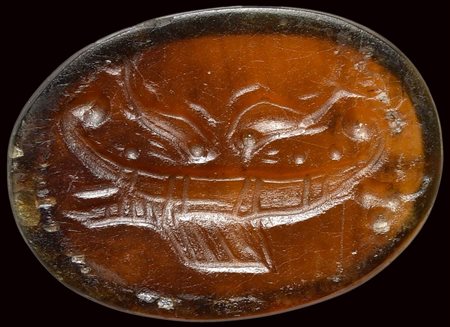
Lotto 105 A roman italic sard intaglio. Two dolphins above a ship.
2nd-1st century B.C.
10 x 14 x 2 mm
The two sea creatures are depicted on a military ship as an allegorical emblem. The ship is characterized by rostrum. Use of globular elements. Attractive color of the stone. Slight wear marks.
U.K private collection, London. -
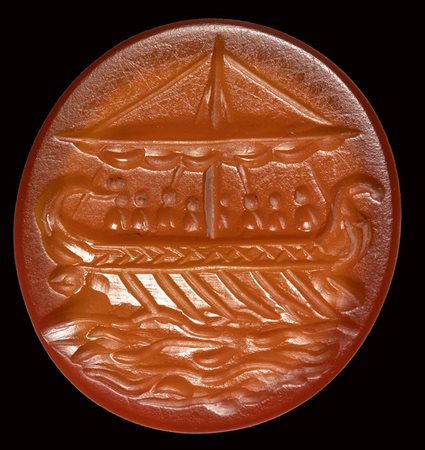
Lotto 106 A roman carnelian intaglio. Galley with figures.
1st century B.C. - 1st century A.D.
12 x 13 x 2,5 mm
A galley with eight figures holding round shields; the warship has the rostrum and the aplustre, the sail closed and the ropes pulled. Below, the waves of the sea (for a similar representation of the boat see the carnelian intaglio, Berlin, inv. FG6880). Interesting detailed work. Attractive color of the stone. Wear marks. Rare.
Parallels: Antike Gemmen in Deutschen Sammlungen, Band II, Staatliche Museen Preubischer Kultubesitz Antikenabteilung- Berlin, p. 176 n. 476.
U.K., private collection 80's, London. -
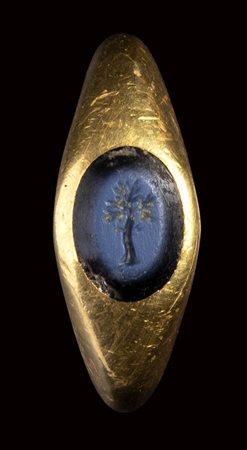
Lotto 107 A roman nicolo intaglio set in a massive gold ring. Tree.
1st-3rd century A.D.
intaglio : 6 x 9 mm
ring diam : 12 x 16 mm
8,86 g
In a central position, a tree, a symbol of strength and prosperity. The small stone is finely engraved and shows slight signs of wear.
U.K private collection, London. -
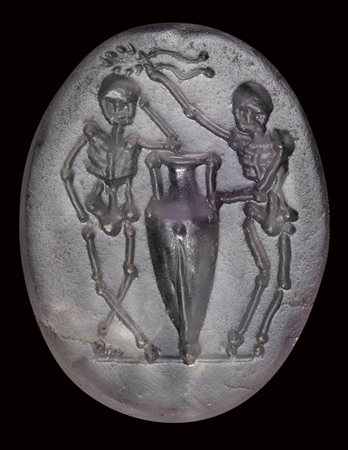
Lotto 108 A roman republican amethyst intaglio. Two skeletons with amphora.
1st century B.C.
16 x 21 x 3,5 mm
The two skeletons are standing and symmetrically flank a large wine amphora, depicted in a central position.
The skeleton on the right is held in the amphora with one hand and with the other crowns with a laurel wreath his companion, who leans peacefully against the oblong container. Groundline. The highly allegorical scene refers to death and the pleasures of life, between the memento mori and a hymn to the triumph of life that continues even after death.
This representation is attested in the late roman republican repertoire and is probably inspired by similar representations present on the mosaics.
Presence of globular elements. Wear marks and slight small crack.
Intaglio engraved with great skill (without excluding a certain sense of irony) on a very clear variety of amethyst, which well alludes to the wine and the Dionysian sphere. Very rare.
Parallels: Antike Gemmen in Deutschen Sammlungen, Band IV, Hannover und Hamburg, n. 468; Antike Gemmen in Deutschen Sammlungen, Band II, Staatliche Museen Preubischer Kultubesitz Antikenabteilung- Berlin, n. 421 inv. FG6518.
U.K., private collection 70's, London. -
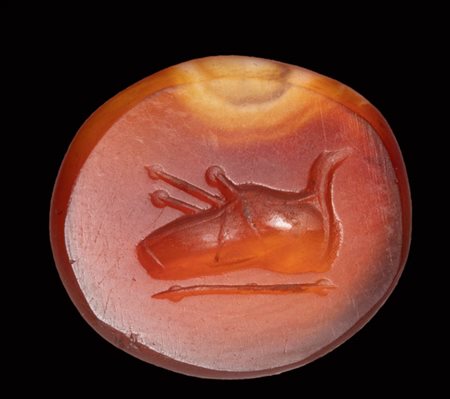
Lotto 109 A roman republican carnelian intaglio. Shoe of a haruspex.
1st century B.C.
9 x 10 x 2 mm
The Aruspice was a priest whi predicted the future analyzing animals viscera. His attributes and distinctive signs were the ituus and the typical shoe with curved raised point/rear termination. In this gem the shoe is facing left. Groundline. Use of globular elements. Attractive color of the stone. Rare.
Parallels: Antike Gemmen in Deutschen Sammlungen, Band IV, Hannover und Hamburg, n. 237 p. 65.
Monte-Carlo private collection, Mr. P.L, 1982 -
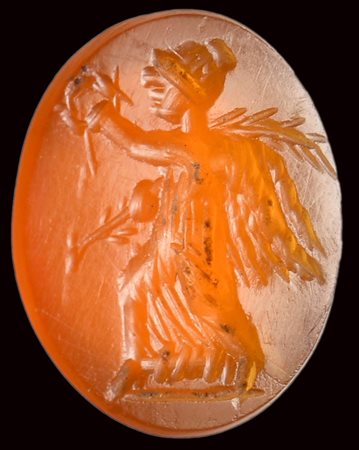
Lotto 110 A roman carnelian intaglio. Winged victory.
2nd - 3rd century A.D.
7 x 9 x 3 mm
The figure, facing left, holds a laurel wreath with the left hand and a palm branch with the right. Groundline.
U.K. private collection -
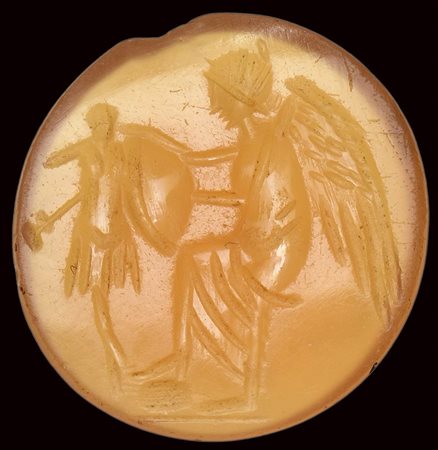
Lotto 111 A roman carnelian intaglio. Victory with a trophy.
2nd - 3rd century A.D.
14 x 15 x 2 mm
The winged personification of the victory is turned on the left side, with draped legs, putting a shield on a military trophy (in the same position, the victory is usually depicted also writing on the shield). Slight wear marks.
U.K. private collection -
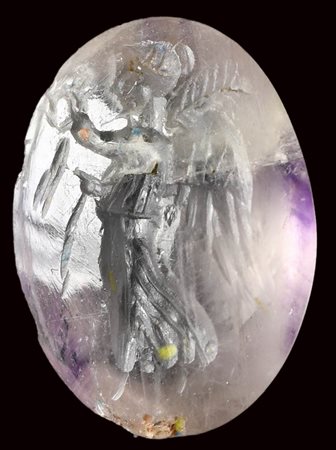
Lotto 112 A roman late republican amethyst intaglio. Victory with attributes.
1st century B.C.
8 x 11 x 4 mm
The draped and winged figure is turned to the left, holding the palm branch with the right hand and the laurel wreath with the left one. Use of globular elements. Light crack in the stone. Attractive variety of light colored amethyst with darker purple hues.
U.K. private collection -
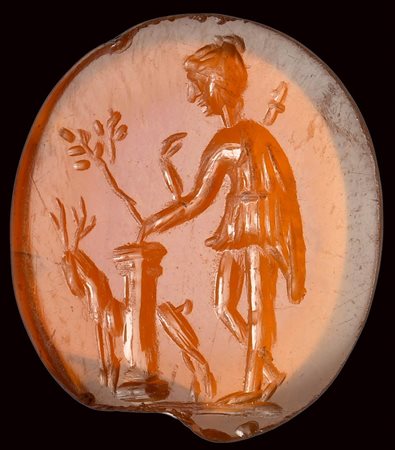
Lotto 113 A large roman carnelian intaglio. Artemis.
2nd century A.D.
13 x 15 x 3 mm
The goddess of the hunt faces left, and wears a short tunic with a cloak; the quiver can be seen on the shoulders. The figure holds a frond with her left hand just above a column, while she brings her right hand towards her face. Behind the small column is the deer, her sacred animal. Votive and devotional representation referable to the cult of Artemis. Beautiful composition. Attractive color of the stone. Chipping on the edge.
U.K private collection, London. -
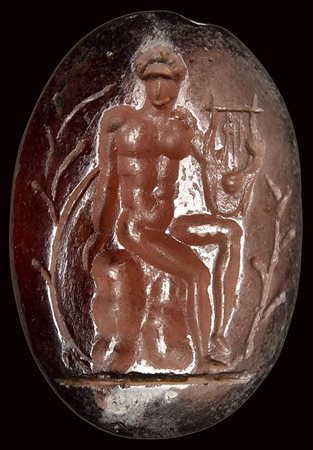
Lotto 114 A roman late republican garnet intaglio. Apollo citharedus.
1st century B.C.
9 x 13 x 3 mm
The naked deity is seated on top of the rocks, surrounded by plants. The figure is depicted with the front torso and legs slightly turned to the right. The body is characterized by a well accentuated musculature. With his left hand he holds the lyre in its typical pose inspired by classical Greek models. Ground line. Use of globular elements. Wear marks. Chipping on the edge. Attractive color of the stone.
U.K private collection, London. -
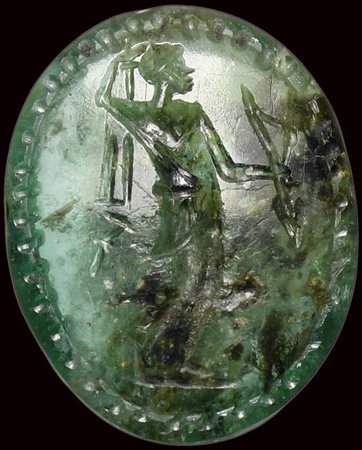
Lotto 115 A rare roman emerald intaglio. Artemis with a magical inscription.
1st - 2nd century A.D.
8 x 10 x 3 mm
The divinity of hunting is turned to the right. With his right hand she takes an arrow from the quiver, with his left hand she holds the bow. The young figure wears a short tunic. Dotted frame with ovoid elements around the goddess. Groundline. In the backside, magical inscription- symbols. Magical amulet with protective and votive function. Attractive precious stone. Slight wear marks. Very rare.
Parallel: U. Pannuti, Catalogo della collezione glittica, vol. I, p. 45 n. 63 (probably, from the same atelier).
U.K., private collection 70's, London. -
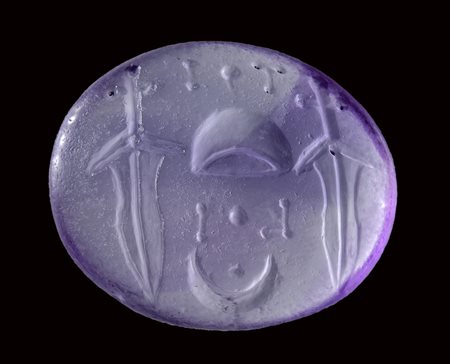
Lotto 116 A roman late republican amethyst intaglio. Emblema.
End of 1st century B.C.
14 x 17 x 5 mm
In the center, a Pileus between two daggers; in the field, the letters TI-LI and a crescent moon.The emblem is apparently inspired by the well known representation found on some rare coins minted under M. Brutus (for example, se the extraoronary Q. Servilius Caepio (M. Junius) Brutus AV Aureus.
Military mint travelling with Brutus in the East, late summer-autumn, 42 B.C. L. Plaetorius Cestianus, moneyer. Bare head of Brutus to right; BRVT above, IMP before, L • PLAET • CEST behind / Pileus between two daggers of differing design, their points downwards; below, EID • MAR. A. Campana, Eidibus Martiis (forthcoming), 13 (O1/R6) and pl. 1,13 (this coin); Crawford; Sydenham; BMCRR - etc.). However, the gem seems to have different references and names, to be identified (“TILI” as an abbreviation of Atili?).
Since there is no written reference to the Ides of March as in the coins, but an unidentified name, the meaning of this emblem is not entirely identifiable, probably referable to Brutus and his tyrannicide, perhaps by one of his political follower. The presence of the moon refers to an augural, magical but also commemorative value of the stone.This intaglio is characterized by stylistic details typical of the late Roman republican style, such as the globular elements, the rendering of the letters and daggers (as in the coins), in the composition and in the shape / choice of the stone variety (a very clear amethyst, almost transparent, with dark purple shades). The gem is expertly engraved and polished (the blades of the daggers take on a sharp and deadly aspect). The stone is characterized by signs of wear on the entire surface. Rare.
U.K., private collection A.L., 70's-80's, London. -
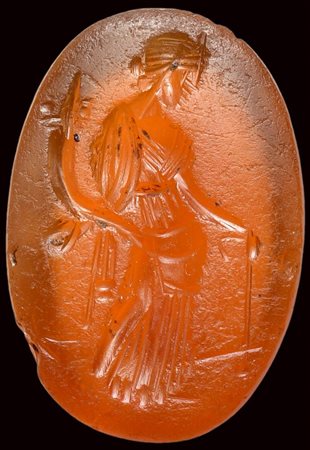
Lotto 117 A roman carnelian intaglio. Fortuna-Tyche.
2nd - 3rd century A.D.
9 x 13 x 4 mm
The personification of the abundance is standing, draped and turned to the right.
In the left hand: the rudder; in the right hand: cornucopia. Slight wear marks.
U.K private collection -
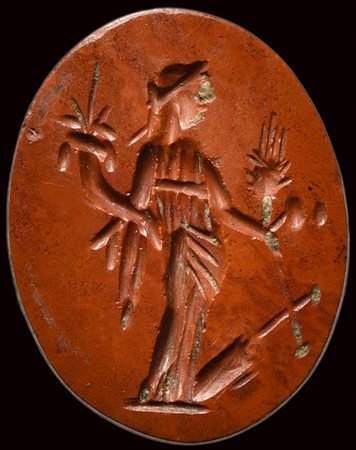
Lotto 118 A roman red jasper intaglio. Tyche-Fortuna.
2nd - 3rd century A.D.
8,5 x 11 x 2,5 mm
The personification of abundance is standing, and she holds the cornucopia with a drapery in his right hand, the rudder, a poppy flower and a ear of corn in her left hand. Groundline.
U.K private collection -
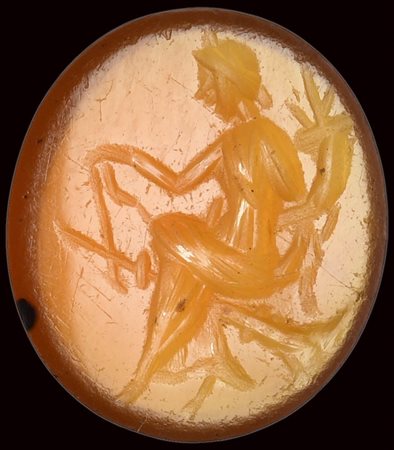
Lotto 119 A roman carnelian intaglio. Fortuna-Tyche.
2nd - 3rd century A.D.
10 x 12 x 2 mm
The personification of the abundance is seated on the rudder, facing left; with the right hand she holds the rudder, with the left she holds the cornucopia. Rare and unusual allegorical depiction. Slight wear marks.
U.K private collection -
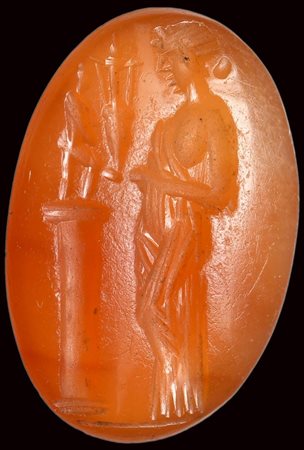
Lotto 120 A roman carnelian intaglio. Offerer.
2nd - 3rd century A.D.
10 x 15 x 4 mm
The standing and draped female figure is turned to the left. With both hands, she offers a small amphora to an idol on top of a column. Votive scene. Slight wear marks.
U.K private collection, London. -
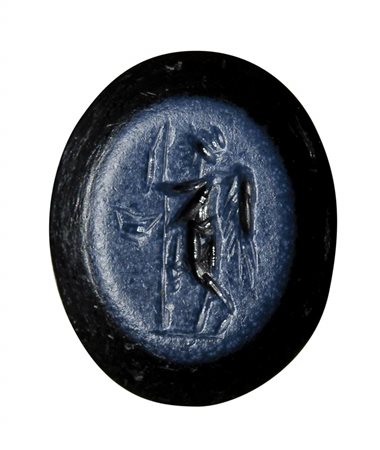
Lotto 121 A roman nicolo intaglio. Funerary winged genius.
2nd - 3rd century A.D.
8 x 10 x 3 mm
The character, identifiable with Pothos, is standing with crossed legs facing left. He holds a scepter in the right hand and a cup in the left one. Attractive color of the stone.
Parallels: Erika Zwierlein-Diehl, Die Gemmen und Kameen des Dreikonigenschreines, p. 309 n. 206 (for the same subject on the same stone).
European private collection. -
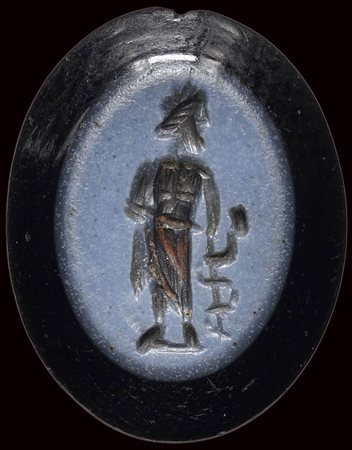
Lotto 122 A roman nicolo intaglio. Asclepius.
2nd - 3rd century A.D.
10,5 x 14 x 3 mm
The divinity is standing, seen from the front but with the head turned to the right. The figure holds the scepter with the snake entertwined; gem related to the protection of good health and the power of medicine.
U.K private collection -
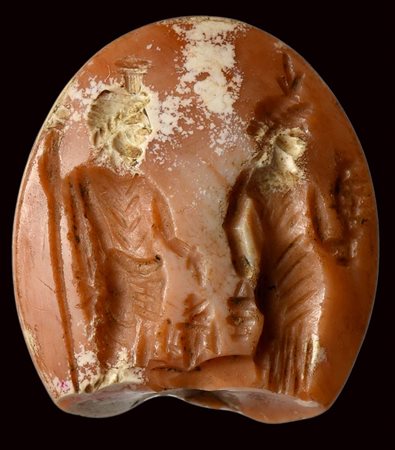
Lotto 123 A roman agate intaglio. Zeus Sarapis, Isis and Harpokrates.
2nd - 3rd century A.D.
15 x 17 x 5 mm
The three characters are standing turned on the right side. The goddess Isis holds a sistrum in her left hand and a jug in her right, Harpokrates holds a horn of abundance in his right; Sarapis holds a scepter in his right. Isis wears plants on her head, and Sarapis the modius. Interesting iconography in reference of the egyptian osiriac triad. Stone is broken on the lower part. Nice color of the stone. Slight wear marks and little traces of burns.
Parallels : A cast of the Cornell Gem Impressions Collection, Cornell University, 01.1.0101
U.K private collection -
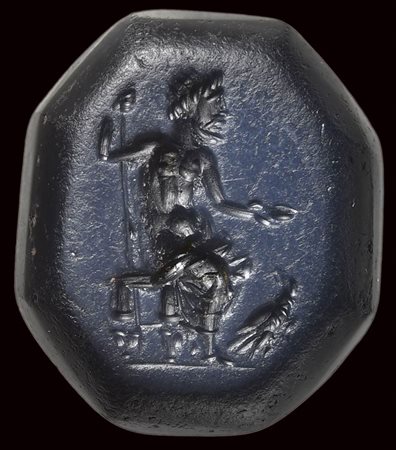
Lotto 124 A roman nicolo intaglio. Zeus with the eagle.
2nd - 3rd century A.D.
10 x 12 x 3 mm
The deity is seated on a throne. With his right hand he holds the scepter, with his left he holds a patera. At his feet, the eagle. Groundline. Votive gem dedicated to the cult of Zeus, supreme ruler of Olympus. Interesting octagonal shape of the bezel. Wear marks.
U.K. private collection -
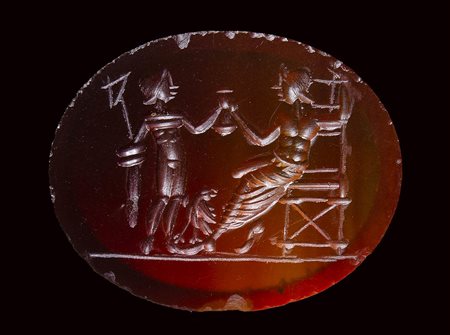
Lotto 125 A large roman carnelian intaglio. Mythological scene.
2nd - 3rd century A.D.
21,5 x 27 x 3 mm
On the left side, the standing figure of Hermes is holding the caduceus and facing Zeus seated on his throne. The young god is offering a purse of money to the supreme god ( at his feet an eagle).Groundline. Probably from an eastern workshop. Small chips on the edge. Very large size. Beautiful deep red and orange color.
Monte-Carlo private collection, Mr. P.L, 1982 -
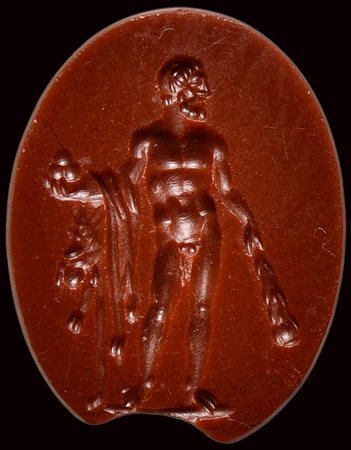
Lotto 126 A fine roman red jasper intaglio. Hercules with the apples of Hesperides.
1st - 2nd century A.D.
10 x 13 x 3 mm
The hero, facing right, is holding the club with the left hand, three apples of the Hesperides and the lion skin with the right one. Groundline. The scene refers to the famous twelve labors of Hercules. In this case, the heroic figure is standing, with the body finely sculpted in its anatomical details, seen from the front but with the head turned in profile to the right, in a glorious pose showing the fruit of the eleventh labor. Subject that symbolizes strength, courage, astuteness and virtue. Attractive color of the stone. Rare. Slight wear marks. Large chipping on the edge below.
U.K., private collection 80's, London. -
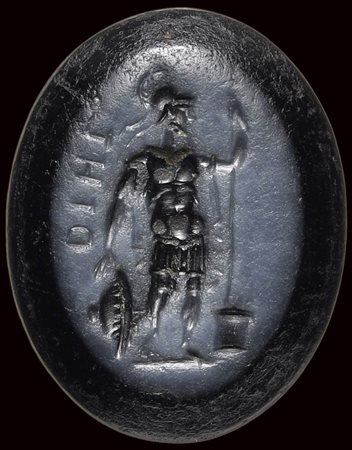
Lotto 127 A fine roman nicolo intaglio. Standing Mars.
2nd century A.D.
11 x 14 x 3 mm
The divinity is standing, with the helmeted head turned to the right. He wears the cloack and the armor; he holds the spear with his left hand and the shield with his right. At his feet, a small cylindrical altar. On the left side, the inscription THIO.
Votive gem consecrated to the military supremacy and to the victory in war.
Intaglio executed with technical skill and with great attention to the rendering of anatomical details. Wear marks.
U.K private collection -
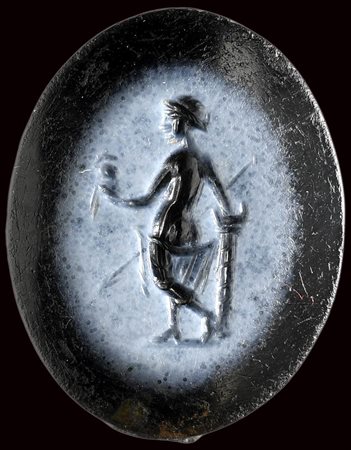
Lotto 128 A large roman nicolo intaglio. Venus victrix.
2nd century A.D.
12,5 x 16 x 3 mm
The goddess, facing left, is partially draped and leaning on a column. She holds the helmet in the left hand and the spear in the right one. Slight wear marks.
U.K private collection -
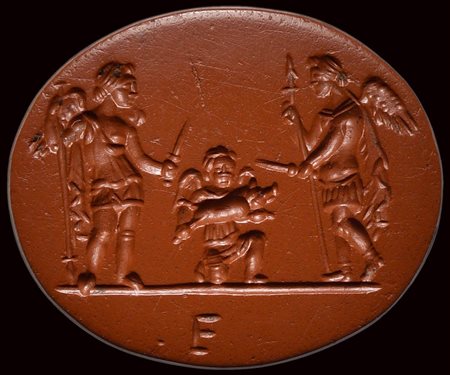
Lotto 129 A fine roman red jasper intaglio. Votive scene.
1st - 2nd century A.D.
11 x 14 x 3 mm
The scene of sacrifice is composed in the center by a winged erote who rests his right knee on the ground, in a votive attitude, in the act of offering a small boar as a sacrificial victim. On the sides, two winged armed geniuses, facing the center of the scene. A figure wears the cloak armor and holds a spear and a sword, which he brings closer to the animal; the other figure, in a tunic and cloak, holds one spear but with the tip pointing downwards and still wields a sword. Groundline. Below, the letter F. Interesting allegorical representation. Attractive color of the stone. Slight wear marks. Rare.
U.K., private collection 70's, London. -
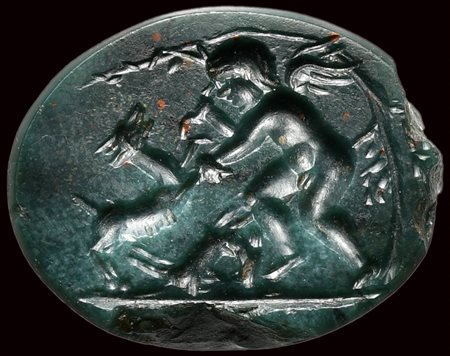
Lotto 130 A roman bloodstone intaglio. Eros hunter.
1st - 2nd century A.D.
9 x 12 x 3 mm
The winged child is depicted in the act of hitting a goat with a weapon, holding it by a paw. At his feet, the body of a dying prey. In the background, a tree. On the back of the bezel: the initial letter of the owner's name (in the style of the seals), presumably engraved during the 18th century. Unusual piece. Attractive vivid color of the stone. Light chipping on the edge. Wear marks.
U.K private collection -
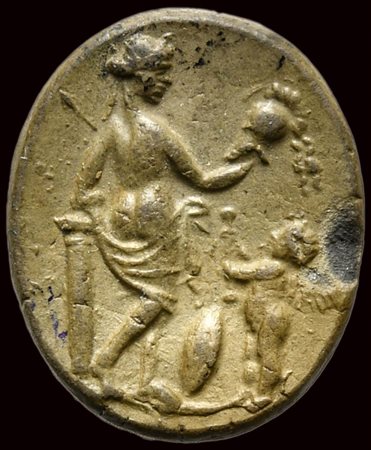
Lotto 131 A roman burnt silver impression from an intaglio. Venus victrix with eros.
1st - 2nd century A.D.
9 x 11 x 2 mm
The divinity is facing right, offering the helmet to Eros with her right hand; with her left she holds a spear. The partially draped figure leans on a column. Below, a shield and winged eros holding a sword. Scene referring to the eternal victory of love and to its great power on the human beings. Interesting specimen. Chipping on th edge.
U.K private collection -
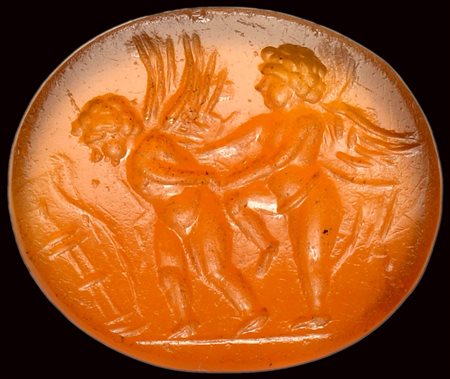
Lotto 132 A roman carnelian intaglio. Eros and Anteros.
1st century A.D.
10 x 12 x 3 mm
The two winged creatures, intent in the struggle, are naked and are both characterized by thick hair. An erote attacks from behind his opponent, blocking his hands on his back and making him his prisoner. Anteros, taken prisoner, appears defeated and with his head tilted forward. Below, a bow and a quiver, the reason for the dispute: the arms of Love. Groundline. Delicious scene composed with grace and irony. Interesting stylistic rendering. Wear marks.
Parallels: U. Pannuti, p. 26 n. 36
U.K private collection -
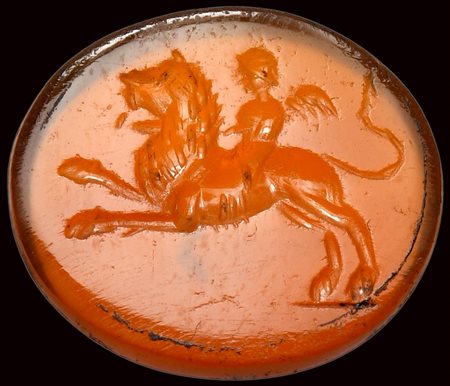
Lotto 133 A roman carnelian intaglio. Eros on a lion.
2nd century A.D.
11 x 13 x 2 mm
The winged erote is seating on the back of a rampant lion. Depiction referred to the power love and to the strenght. Groudline. Slight wear marks. Attractive color of the stone.
U.K private collection -
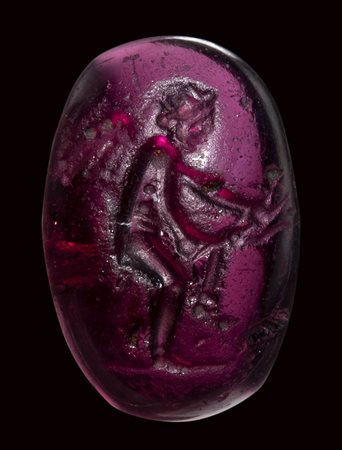
Lotto 134 A roman republican garnet intaglio. Eros with a bow.
1st century B.C.
7 x 11 x 4 mm
The graceful winged figure is in the act of making a bow, his invincible weapon of love. Use of globular elements. Attractive color of the stone. Slight wear marks.
U.K. private collection, London. Property of a East London gentleman. -
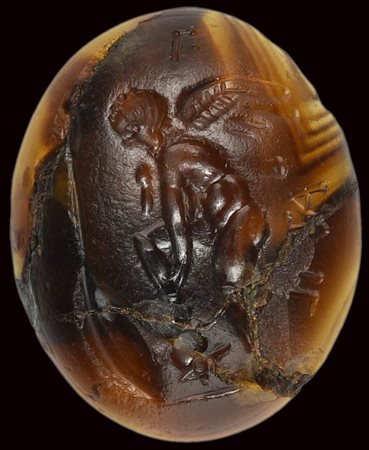
Lotto 135 A roman republican agate intaglio. Eros with panoplia.
1st century B.C.
12 x 15 x 4 mm
The winged erote is depicted in the act of wearing a military sandal, next to the weapons of Mars: helmet, shield and spear. Letters around the winged figure. The carving, made on a beautiful variety of brown-colored zoned agate with honey tones, is broken into fragments and recomposed. Allegory of the Love preparing himself to the battle. Wear marks.
U.K private collection -
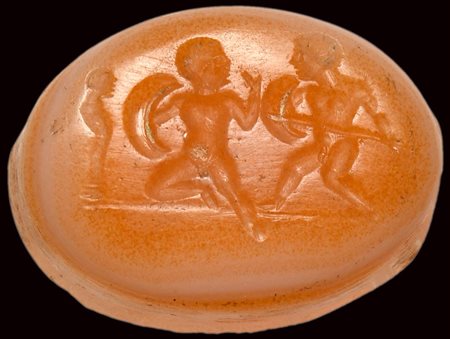
Lotto 136 A roman agate intaglio. Two armed pygmies near herm.
1st century A.D.
10 x 14 x 4,5 mm
A pygmy armed with a spear and a shield advances to the left, towards a seated companion, armed only with a shield, near a herm. Ground line. The two little characters seem to dialog. Scene probably inspired by a Nilotic iconography (mosaic).
U.K private collection -
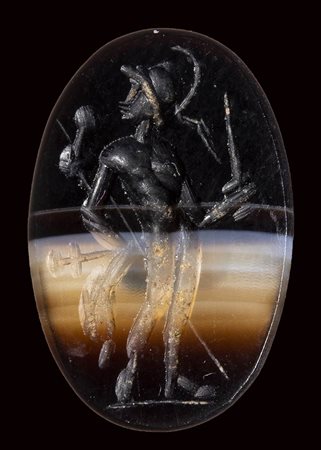
Lotto 137 A roman banded agate intaglio. Warrior.
2nd - 3rd century A.D.
11 x 16 x 3 mm
The standing figure is turned with the body to the right side, facing left withe the head in profile. The warrior is holding a sword with the left hand, a scabbard, a spear and a drapery with the right. Groundline. Attractive color of the stone. Slight wear marks.
U.K private collection -
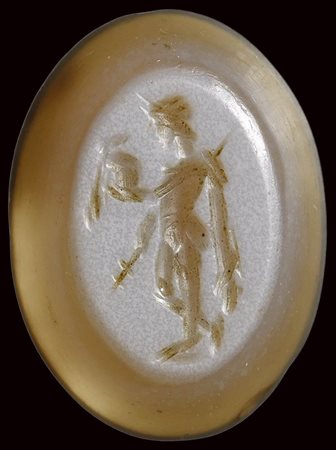
Lotto 138 A roman nicolo agate intaglio. Warrior.
2nd - 3rd century A.D.
12 x 17 x 4 mm
The figure facing left is wearing a cloak, holding the spear with his right hand, the helmet with his left. Groundline. Nice size and tone of the stone.
U.K private collection -
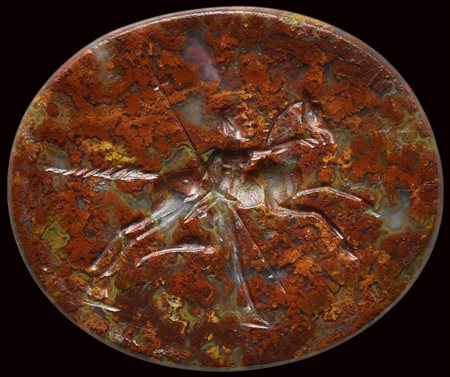
Lotto 139 A fine roman red jasper with green, yellow and transparent inclusions. A running figure with a galopping horse.
1st century B.C.
14 x 17 x 3,5 mm
The running male figure is naked and holds a spear with a small cloth in his right hand, the horse with his left (even though the bridle has not been shown). Next to him is a galloping horse with raised front legs. The scene, very interesting, is identifiable by a glass impression from a lost intaglio, that represents the same scene: a rider who gets on the horse while running with the help of the pole ("Un soldato solito di salire a cavallo coll'ajuto dell'Asta"). Extraordinary variety of the stone. Large size. Rare subject.
See parallels: L.P.B. Stefanelli, La collezione Paoletti, vol. 1, p. 154 n. 528.
U.K private collection -
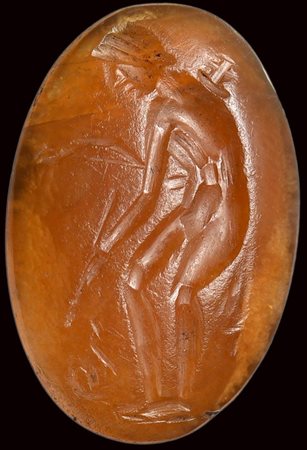
Lotto 140 A roman agate intaglio. Apollo with a snake.
2nd century A.D.
10 x 14 x 3 mm
The god is standing, facing left, slightly bent forward. With his right hand he holds the bow, while with his left he holds an arrow (the quiver on his shoulders). At his feet, a snake. Small groundline. Slight wear marks.
U.K private collection -

Lotto 141 A roman green chalcedony intaglio. Biga.
2nd century A.D.
5 x 7 x 1,5 mm
The racing chariot is pulled by two horses moving left. The charioteer shakes the whip with her right hand. Interesting specimen of small dimensions but rich in details. Slight wear marks. Groundline. Attractive vivid green color of the stone with chromium inclusions.
U.K private collection -
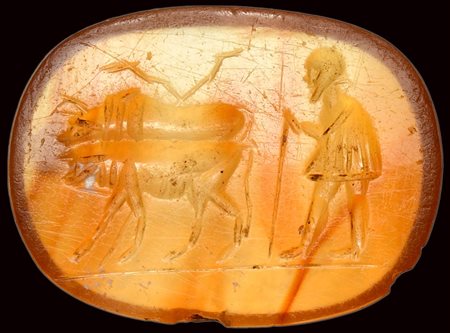
Lotto 142 A roman carnelian intaglio. Bucolic scene.
2nd century A.D.
14 x 10 x 2 mm
An old shepherd watches over two grazing cows advancing to the left. In the background, a plant. Light chipping on the edge. Bucolic scene. Slight wear marks.
U.K private collection -
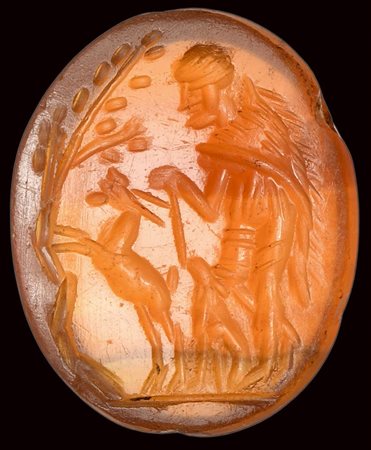
Lotto 143 A roman agate intaglio. Bucolic scene.
2nd century A.D.
10 x 12 x 2,5 mm
A shepherd, covered with a fur coat, is looking at his goat while she is climbing toward a little tree, eating a leaf. Groundline. Slight wear marks.
U.K private collection -
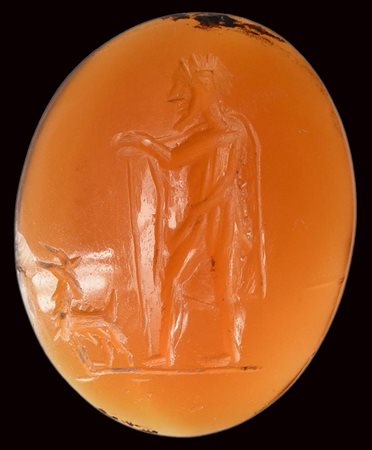
Lotto 144 A roman carnelian. Shepherd with a goat.
2nd - 3rd century A.D.
12 x 15 x 3 mm
The character, facing left, wears a cloak and leans on a stick. At his feet, a goat. Bucolic scene. Ground line. Attractive color of the stone.
U.K. private collection