
Auction 86 - Glyptics and Ancient Jewelry
-
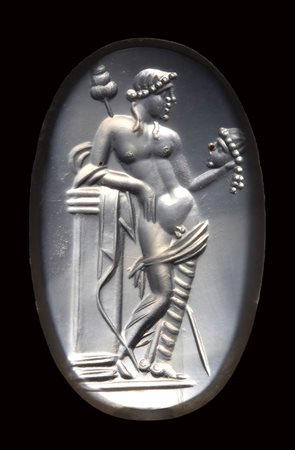
Lotto 49 A large roman italic chalcedony intaglio. Dionysos with mask.
2nd-1st century B.C.
13 x 21 x 3 mm
The young god is elegantly leaning against a column, in the act of contemplating a theatrical mask. Behind his shoulders, the thyrsus. His body is partially naked (only the legs are draped) and has a well-engraved musculature with delicate anatomical volumes. Numerous details are rendered with globular elements. Groundline. The elegant depiction is inspired by hellenistic models. Attractive size and color of the stone. Slight wear marks.
U.K. private collection, Surrey. -
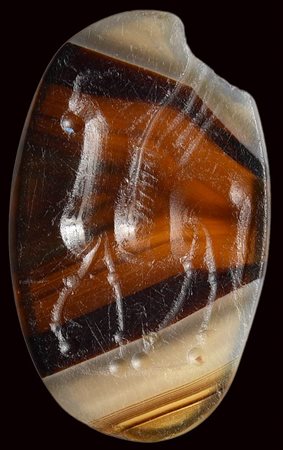
Lotto 50 A roman italic banded agate intaglio. Pegasus.
2nd century B.C.
10 x 17 x 2 mm
The mythological winged creature is facing left. Use of globular elements. Wear marks. Chipping on the edge. Attractive vivid color of the stone.
U.K. private collection, London. -
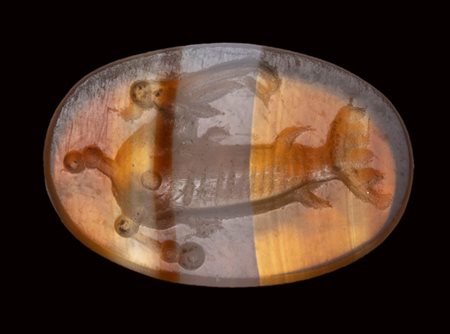
Lotto 51 A roman italic banded agate intaglio. Seagoat.
2nd-1st century B.C.
7 x 10,5 x 1,5 mm
The marine creature is turned on the left side and characterized by a goat protome ending with a fish tail. Use of globular elements. Attractive color of the stone. Slight wear marks.
U.K. private collection, London. -
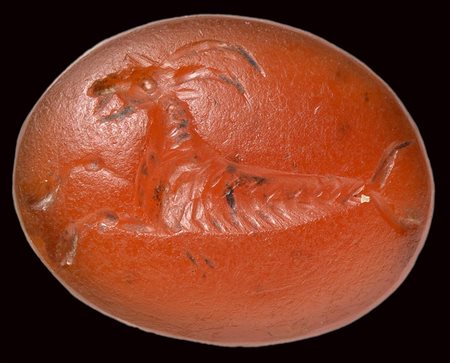
Lotto 52 A roman carnelian intaglio. Sea-goat.
1st century B.C. - 1st century A.D.
10 x 13 x 4 mm
The creature is facing left. Slight wear marks. Attractive color of the stone.
U.K. private collection, London. -
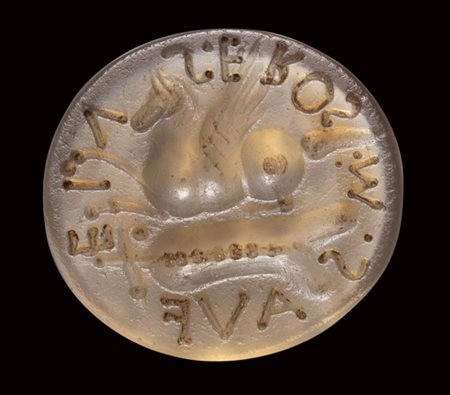
Lotto 53 A roman italic chalcedony intaglio. Pegasus with inscription and allegorical attributes.
1st century B.C.
12 x 13 x 2 mm
Pegasus facing left, above a rudder. Around: SAVFEIVS - EROS - M.
Allegorical emblema referred to the abundance and to the prosperity.
Use of globular elements. Slight wear marks.
U.K., private collection 70's, in the same family since then. -
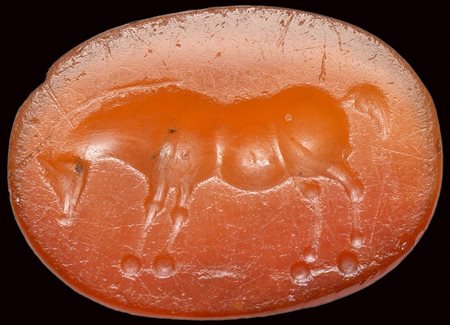
Lotto 54 A roman italic carnelian intaglio. Horse.
2nd century B.C.
11 x 15 x 3 mm
The animal is turned towards the left side. The anatomical details engraved with globular elements. Slight wear marks.
U.K private collection, London. -
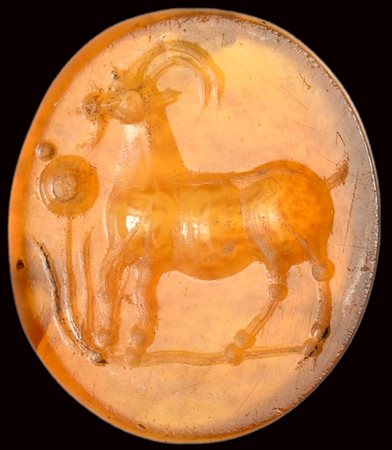
Lotto 55 A roman italic carnelian intaglio. Antelope with poppy flower.
2nd-1st century B.C.
11 x 12 x 2 mm
The quadruped is facing left, near a large poppy flower. Groundline. Use of globular elements. Slight wear marks.
U.K private collection, London. -
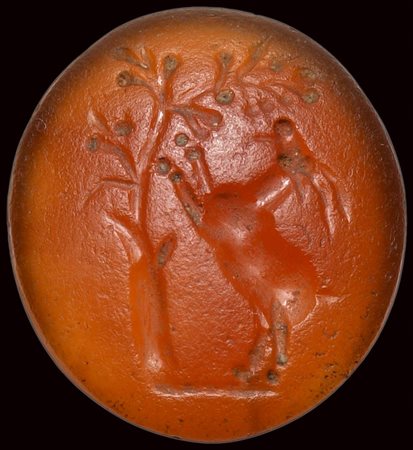
Lotto 56 A roman carnelian intaglio. A goat under a tree.
1st century B.C.
12 x 13 x 4 mm
The animal lifts its front legs to lean on a trunk of a tree and eats its leaves. Groundline. Bucolic scene. Use of globular elements. Wear marks.
U.K private collection, London. -
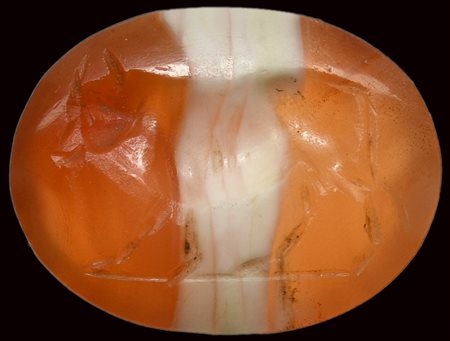
Lotto 57 A roman banded agate intaglio. Bull.
1st-2nd century A.D.
9 x 12 x 3,5 mm
The animal is turned on the left and characterized by a heavy body with the musculature in evidence. Groundline. Convex surface.
U.K private collection, London. -
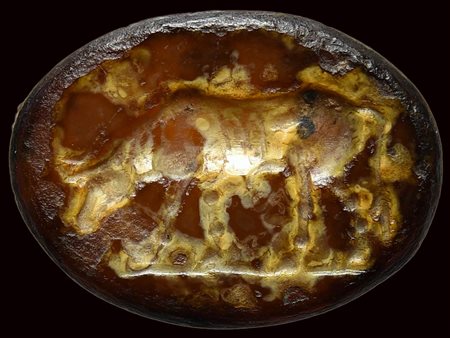
Lotto 58 A roman italic burnt sard intaglio. Bull.
2nd century A.D.
9 x 12 x 2 mm
The animal is turned on the left. Anatomical details engraved with globular elements. Groundline. The stone is partially burnt with missing material on the surface.
U.K private collection, London. -
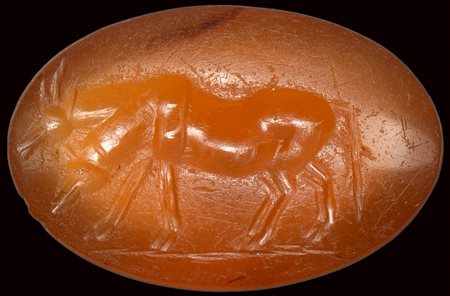
Lotto 59 A roman carnelian intaglio. Two heifers.
2nd century A.D.
8 x 13 x 4 mm
The two quadrupeds, grazing and sticked to each other (one on the first ground, the other in background). Groundline. Slight wear marks.
U.K private collection, London. -
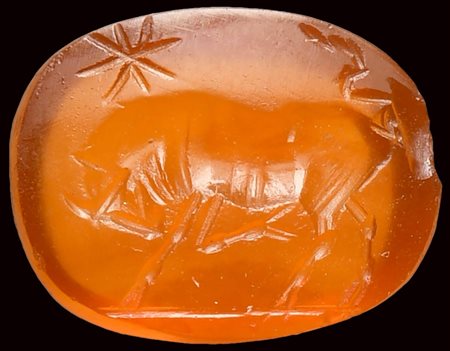
Lotto 60 A roman carnelian intaglio. Bull with a star.
2nd-3rd century A.D.
6 x 7,5 x 2 mm
The charging bull is depicted under a star. Astrological allegory. Groundline. Chipping on the edge.
U.K private collection, London. -
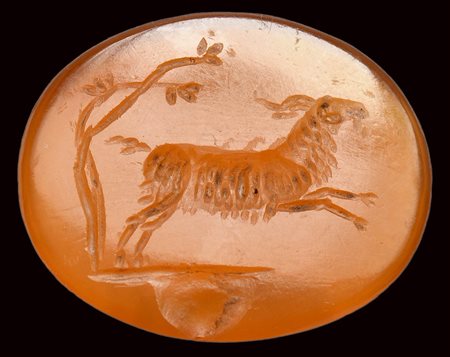
Lotto 61 A roman carnelian intaglio. Goat.
1st-2nd century A.D.
13 x 16 x 2 mm
The animal, under a bush, is running towards the right side. Bucolic scene. Chipping under the groundline.
U.K private collection, London. -
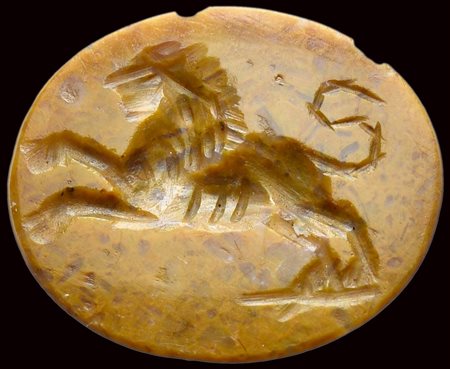
Lotto 62 A roman yellow jasper intaglio. Lion.
2nd-3rd century A.D.
11 x 13 x 2 mm
The animal is turned on the left side, rising his front legs. Groundline. Little chipping s on the edge. Slight wear marks.
U.K private collection, London. -
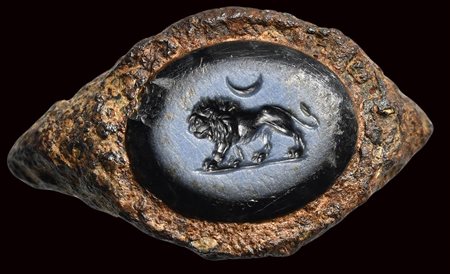
Lotto 63 A roman nicolo intaglio set in an ancient iron fragmentary ring. Lion with crescent moon.
2nd - 3rd century A.D.
Intaglio : 9 x 12 Mounting : 13 x 22 mm
The powerful feline is turned on the left side. Above, a crescent moon. Groundline. Allegorical depiction with astrological and magical meaning. Wear marks. Fragmentary iron mounting.
U.K private collection, London. -
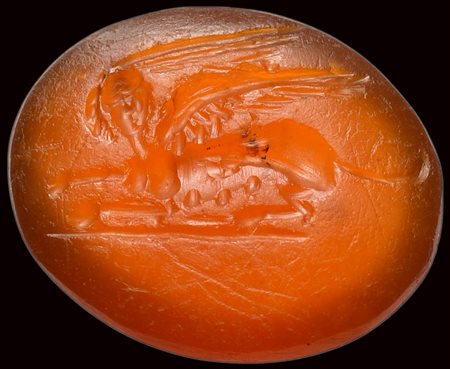
Lotto 64 A roman carnelian intaglio. Sphinx.
2nd century A.D.
10 x 12 x 4 mm
The winged creature is turned on the left side with the body, turning back the head in three-quarters. Groundline. Unusual pose. Slight wear marks. Vivid color of the stone.
U.K private collection, London. -
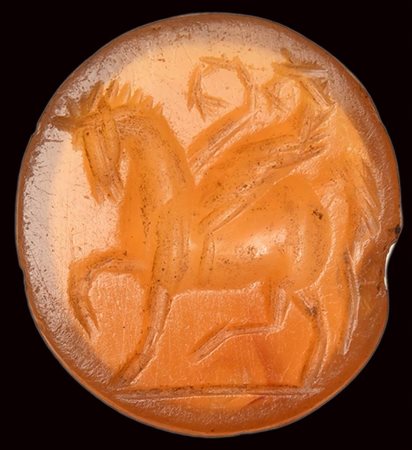
Lotto 65 A roman carnelian intaglio. Pegasus.
2nd century A.D.
9 x 10,5 x 2 mm
The winged creature is turned to the left side, raising the front right leg. Groundline. Slight wear marks. Light chipping on the edge.
U.K. private collection, London. -
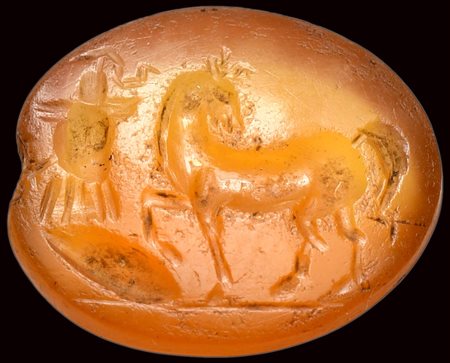
Lotto 66 A roman carnelian intaglio. Horse with military trophy.
2nd - 3rd century A.D.
11 x 13 x 4 mm
The mighty animal heads to the left, turning its head back; in front of him a military trophy composed of lorica surmounted by a helmet and below a shield. Groundline. Wear marks. Chipping on the edge.
U.K. private collection, London -
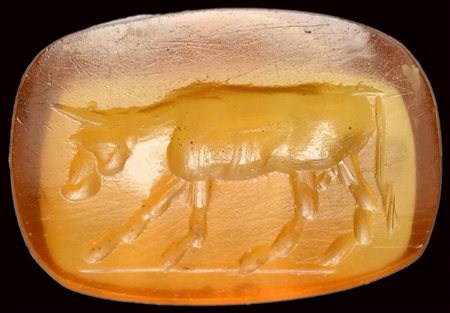
Lotto 67 A roman carnelian intaglio. Bull.
2nd-3rd century A.D.
8 x 11 x 2 mm
The animal is turned on the left. Groundline. Slight wear marks.
U.K private collection, London. -
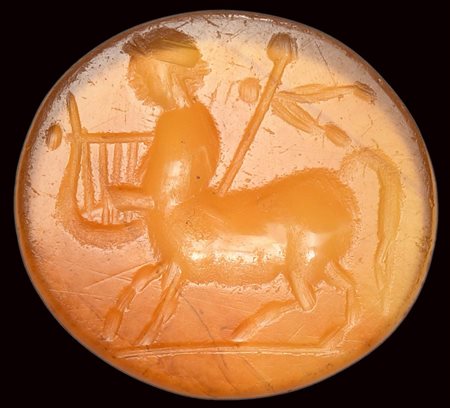
Lotto 68 A roman carnelian intaglio. Centaur with attributes.
2nd - 3rd century A.D.
11 x 12 x 2 mm
The mythological creature is turned to the left, in the act of playing the lyre. Behind it appears a thyrsus as a reference to the Dionysian processions. Groundline.
U.K. private collection, London -
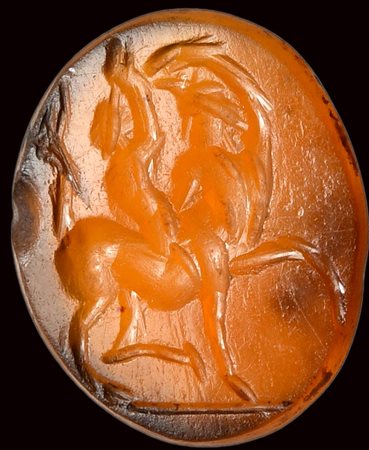
Lotto 69 A roman carnelian intaglio. Centaur with a child.
2nd century A.D.
8 x 10 x 2 mm
The mythological scene is probably related to the childhood of Achilles, who was raised by the centaur Chiron. A small boy is in fact depicted here on the back of a centaur, who turns back to him offering an object. Interesting subject. Slight wear marks. Chipping on the edge.
U.K. private collection, London. -
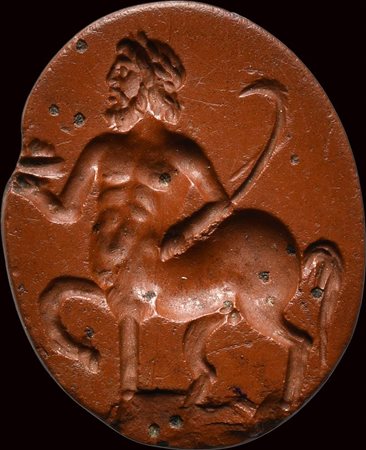
Lotto 70 A fine roman red jasper intaglio. Centaur with attributes.
1st - 2nd century A.D.
12 x 15 x 2,5 mm
The mythological creature is facing left, with one leg raised, showing the horse's body in profile and the human torso almost frontally. With his right hand he holds a plate with offerings (votive scene), while with his left he holds the pedum.The head is in profile and is characterized by a thick beard and hair. Fine execution for the anatomical details, after the classical greek models. A chip on the edge. Slight wear marks.
U.K., private collection 80's, London. -
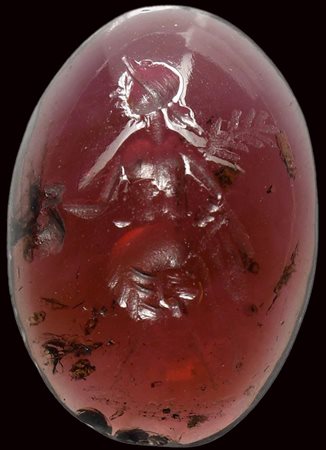
Lotto 71 A rare roman garnet intaglio. Hybrid female creature.
2nd - 3rd century A.D.
9 x 12 x 3 mm
The monstrous creature is formed by a human body with bird legs, similar to the harpies (which are usually winged). The figure advances to the left, holding a purse for money with her right hand and a palm frond with her left. Apotropaic depiction referable to good luck. Attractive vivid color of the convex stone. Mirror polishing. Rare and unusual iconography.
U.K. private collection, London. -
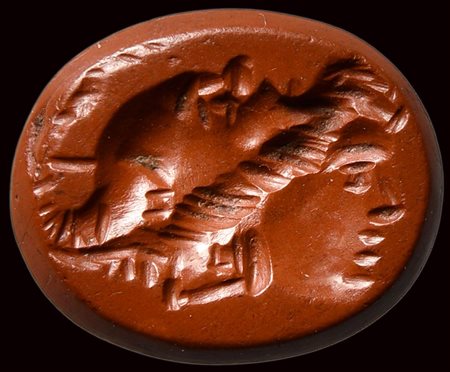
Lotto 72 A roman red jasper intaglio. Gryllos.
2nd century A.D.
8 x 10 x 2 mm
The hybrid composition is formed by a silenus mask with an elephant head terminal on the top (referred to the Africa); a young satyr mask and a bearded man mask. Apotropaic gem. Attractive vivid color of the stone.
U.K. private collection -
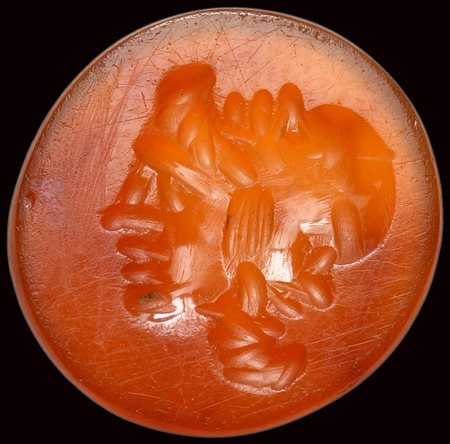
Lotto 73 A roman carnelian intaglio. Gryllos.
1st century B.C. - 1st century A.D.
12 x 13 x 2 mm
The hybrid representation is composed with the masks of two elderly Sileni and of a young satyr. Apotropaic and magical depiction. Wear marks. Vivid color of the stone.
U.K. private collection -
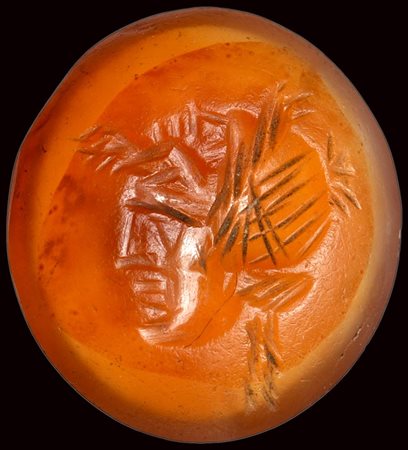
Lotto 74 A roman late republian agate intaglio. Actor with mask.
1st century B.C. - 1st century A.D.
11 x 12 x 3 mm
The juvenile face, turned to the left, has on his head (still partially worn over his face) the mask of an old character. The composition can be referred to the gryllos typology, without excluding a certain apotropaic component.
U.K. private collection -
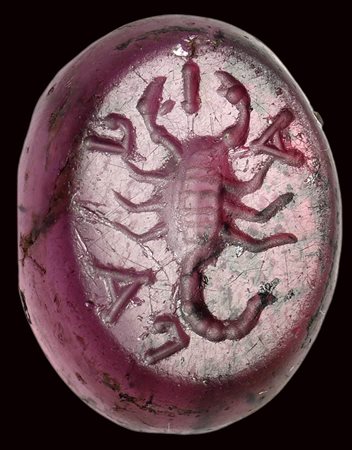
Lotto 75 A roman republican garnet intaglio. Scorpio with letters.
1st century B.C.
11 x 14 x 13,5 mm
The insect is surrounded by letters: PA - P- I -A . Emblema. The backside of the stone is concave. Use of globular elements. Slight wear marks. Attractive color of the stone.
U.K. private collection -
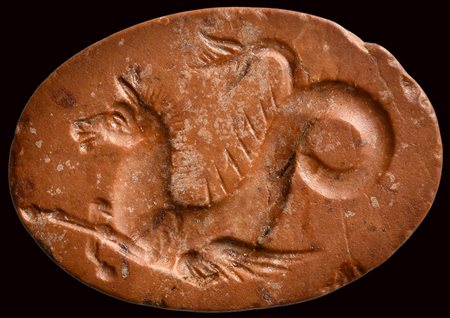
Lotto 76 A roman red jasper intaglio. Winged sea horse.
2nd - 3rd century A.D..
18 x 26 x 5 mm
Sea horse turned on the left, forelegs moving. The left wing visible, the right wing hidden by the body of the animal. The hindquarters wound in a spiral, ending in a fishtail. Large size of the stone. Chips on the edge and traces of burns. Slight wear marks. Probably produced by an eastern atelier inspired by graeco persian models.
Parallels : Penn Museum, inv. 29-224-410; Cabinet des Médailles, Paris, Seyrig.1973.1.525.2.
U.K., private collection 70's, in the same family since then. -
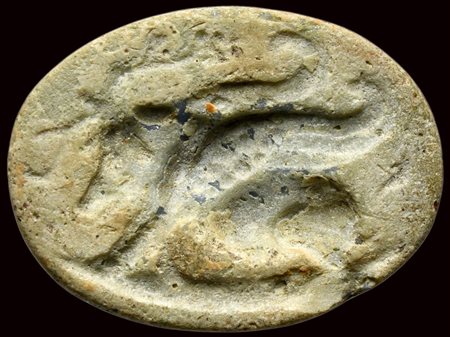
Lotto 77 A roman glass paste intaglio. Winged sow.
1st - 2nd century A.D.
11 x 15 x 3 mm
The winged animal is turned on the left, near a tree. The long wings have curved endings. Groundline. Rare subject.
U.K., private collection 70's, in the same family since then. -
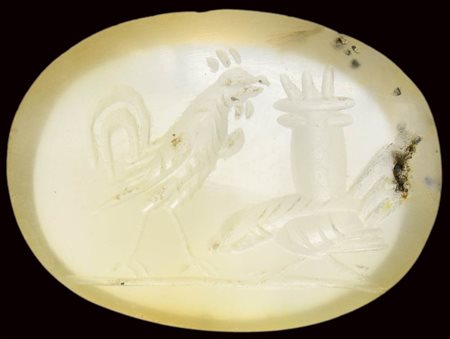
Lotto 78 A roman chalcedony intaglio. Two cocks.
2nd century A.D.
11 x 15 x 3 mm
One cock, facing left pecking on the ground, while the other next, facing right, keeping the head raised; in the background, an altar. Groundline. Interesting votive scene, well composed. Nice size of the stone.
U.K. private collection -
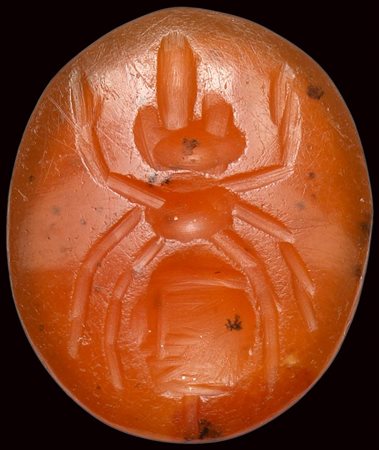
Lotto 79 A roman carnelian intaglio. Ant.
2nd-3rd century A.D.
11 x 13 x 3 mm
The insect is holding a wheat seed. Slight wear marks.
U.K. private collection -
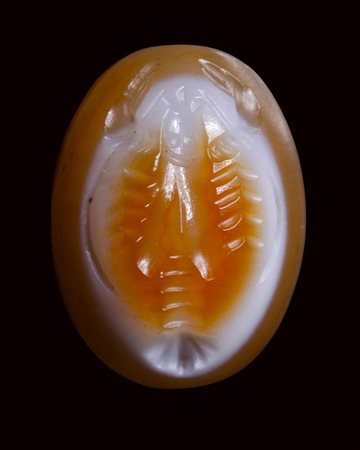
Lotto 80 A roman three-layers agate intaglio. Lobster.
1st century B.C. - 1st century A.D.
10 x 13 x 5 mm
The shellfish is depicted with very detailed naturalistic style. The stone is highly polished in the engraved part. The representation is executed with great skills. Rare.
U.K. private collection, London. -
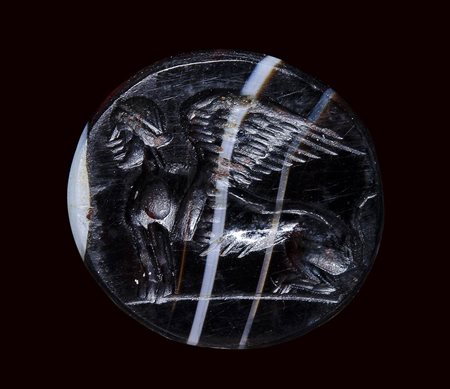
Lotto 81 A roman banded agate intaglio. Sphinx.
2nd century A.D.
10 x 11 x 2 mm
The mythological creature is facing left and characterized by a human head and a lion body with wings on its back. Presented, the lower body bent toward the floor, the sphinx shows an elegant posture that refering to the traditional classical greek representations. The wing feathers, the nose and the mouth details are rendered by short engraved lines. Groundline. Attractive variety of the stone.
U.K. private collection, London. -
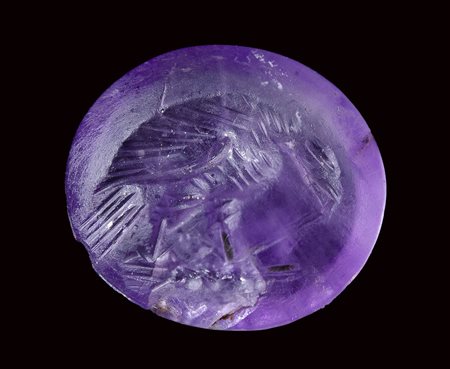
Lotto 82 A roman amethyst intaglio. Eagle with prey.
1st - 2nd century A.D.
9 x 9 x 3 mm
The animal is facing right eviscerating a prey: with the claws he holds the hare and with his beak he removes the bowels. The depiction is finely engraved on a bright light purple amethyst. Allegorical scene referring to the strenght and the victory.Little crack on the edge and slight wear marks.
European private collection. -
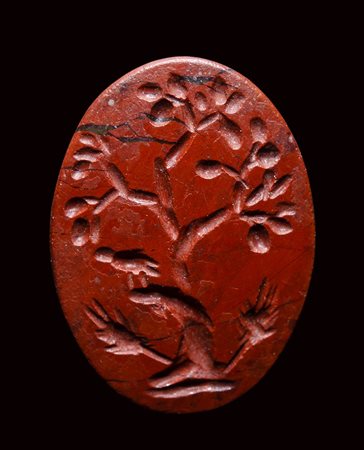
Lotto 83 A roman red jasper. Bucolic scene.
2nd - 3rd century A.D.
6,5 x 9 x 1,5 mm
The scene is composed with a tree in the center with a bird on branch. On the ground, two ear of corns. Groundline. Wear marks. On the reverse, lack of polishing due to the separation from the iron mounting.
U.K private collection -
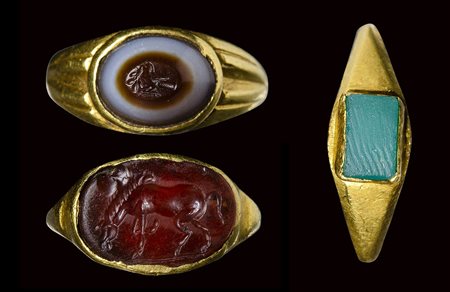
Lotto 84 A lot of three roman gold rings with stones intaglio and glass.
2nd - 4th century A.D.
Carnelian intaglio: 11 x 16 mm; ring diam: 18 mm; 10,26 gr. Banded agate intaglio: 8 x 10mm; ring diam 15 mm; 6,53 gr. Glass paste: 4 x 8 mm; ring 14 x 17 mm; 5,7 gr
From left to right: With an oval-shaped hoop, rounded without and flatten within. The broad shoulders are supporting a flared bezel set with a large carnelian intaglio. The scene is figuring a horse turned to the left and bending toward the ground with open-mouth to grasp something. The upper right leg raised. Groundline. The horse’s mane and the general body volume are well rendered; With rounded hoop and angular-shaped shoulders, respectively set with an oval three-layers agate intaglio depicting a bird turned to left eating a branch.Groundline. And a rectangular green glass paste stone. Very good condition.
UK private collection, London. -
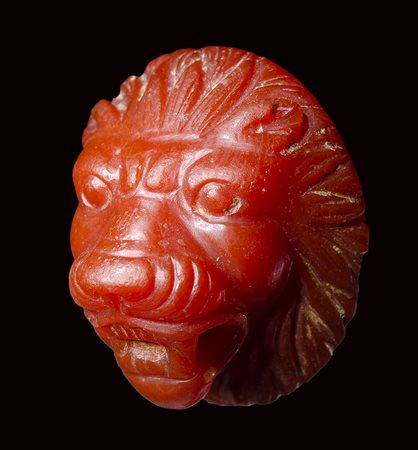
Lotto 85 A fine roman carnelian applique-cameo. Frontal head of a lion.
2nd - 3rd century A.D.
18 x 20 x 12 mm
Lion’s head in frontal position, slightly open jaws; and visible teeth. The snout is marked by carved lines for the lips hair and the center of the fronthead presents wrinkles. The eyes are wide-open and globular, emphasizing the ferocity of the animal. The mane is arranged neatly in a radial pattern around the snout, short locks divided by curvilinear incisions. The ears are rounded in a regular hollow. The artifact is carved in high relief with great skill and reminds the hardstone phaleras with lion’s head. The back is concave, and dug deep. Even the half-open mouth has a through-hole between the teeth. However, this carnelian specimen cannot be considered as a phalera, as it is very delicate and small in size, with no fixing holes. The iconographic typology, however, recalls the bronze phaleras or masks fixed on the doors. Its function could therefore be ornamental, perhaps for a jewel, boxe or a precious clothing, being also particularly light and emptied and therefore easy to wear. The stone shows signs of wear. For the not common phalera with lion’s head in frontal position, the model must be identified, in addition to the already known bronze lion’s head phaleras, both in the sculptural production (lion’s masks set on marble sarcophagis of the late imperial production-oriental workshops), and in the bronze studs that held the rings to knock on the doors (so-called “roman lion head door knocker”). An interesting comparison also comes from the glyptic collections of the Kunsthistorisches Museum of Vienna: chalcedony phalera-cameo, frontal lion’s head, n. inv. X 11, light blue chalcedony with opalescent tones, dated II-III century A.D. (from Coll. Joseph de France - Baroness K. von Hess 1808).
UK private collection, London. -
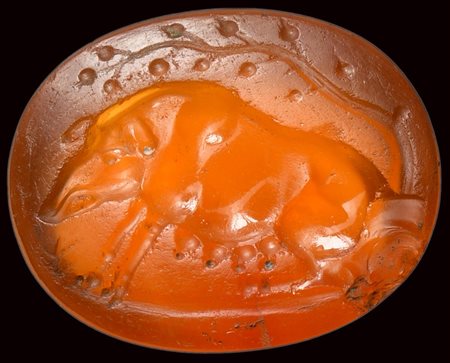
Lotto 86 A fine roman carnelian intaglio. Sow.
1st century B.C. - 1st century A.D.
10 x 12 x 5 mm
The heavy seated sow with four teats, facing left. At right, a tree with globular- style leaves. Motif situated on a curved ground line that connects to the trunk of the tree-branch. Use of globular elements. Intaglio executed with art and great skill. Attractive color of the stone. Slight wear marks. Chipping on the edge.
See: Museum of Fine Art, Boston, inv. 98.739
U.K., private collection 80's, London. -
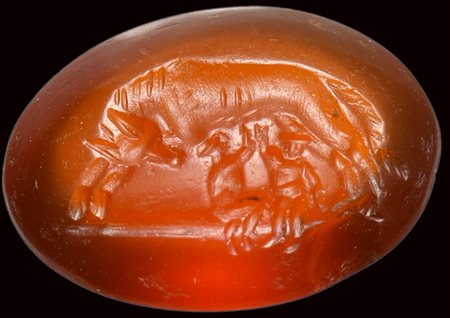
Lotto 87 A roman carnelian intaglio. The she-wolf with the twins.
1st-2nd century A.D.
8 x 10 x 5 mm
The allegorical scene is referred to the founding myths of the ancient Rome, one of the most emblematic. The twins Romolus and Remus are feeding on the animal’s breasts; she is facing left but with her head turned to the right to protect the two infants. Groundline. According to tradition, Rome was founded in 753 B.C. by the twins Romulus and Remus. Sons of Mars and a mortal woman named Rhea Silvia, the twins were abandoned by their uncle in the Tibur river. A she-wolf discovered them on the banks of the river and feeded them until they were taken in by a passing sheperd, Faustulus. The representation of the wolf feeding the twins became a popular subject in Roman Republican and Imperial art. Slight wear marks. Chipping on the edge. Attractive color of the stone.
Parallels: The Metropolitan Museum of New York Database, inv. 41.160.693.
U.K. private collection -
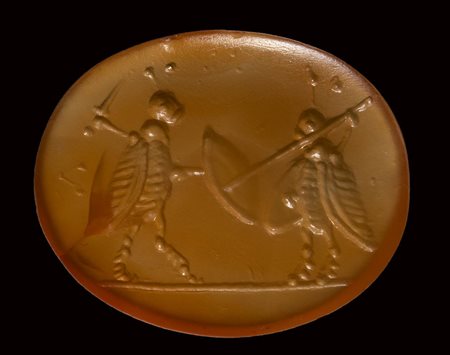
Lotto 88 A roman republican carnelian intaglio. Two cicadas fighting as gladiators.
1st century B.C.
17 x 21 x 3,5 mm
The two insects fight vigorously using gladiators weapons. The cicada on the left protects itself with a shield and raises the sword to hit its opponent, who fights with a spear and a shield. Both insects are finely engraved in detail, with the use of the typical mirror-polished globular elements. Groundline. Traces of letters in the field, partly erased due to the ancient wear marks of the stone surface. Attractive size and color of the stone. Slight crack in the lower left corner of the stone.
Rare subject referable to the late republican repertoire of insects that perform human actions.
Parallels: Antike Gemmen in Deutschen Sammlungen, Band II, Staatliche Museen Preubischer Kultubesitz Antikenabteilung- Berlin, n. 424-425, inv. FG6525- 24.
U.K., private collection 80's, London. -
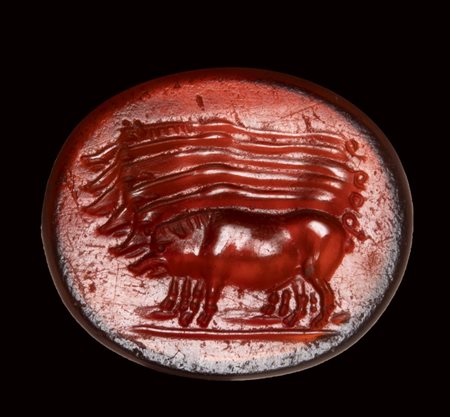
Lotto 89 An unusual roman carnelian intaglio. Six boars.
1st century B.C. - 1st century A.D.
9,5 x 11 x 1,5 mm
An extraordinary representation of six wild boars seen in profile, facing left, one behind the other in perspective. It is possible to see the whole body in foreground, and just the snout, back and curled tail for the others. Groundline. The intaglio is performed with great skill considering also the size of the stone. Use of globular elements. Mirror polishing. Attractive vivid color of the stone. Slight wear marks. Rare.
U.K., private collection 80's. -
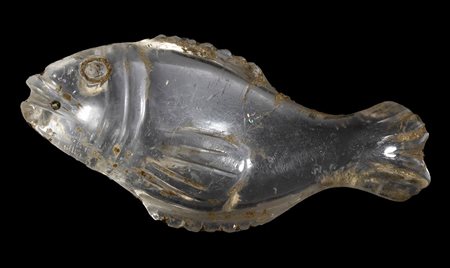
Lotto 90 A roman rock crystal microsculpture. Fish.
1st-3rd century A.D.
L : 48 mm
The animal with flat back, elongated body, a short serrated tail, and engraved fin; a rounded eye, a slightly open-mouth with a little through hole. Colorless crystal, with internal inclusions and patina deposits on the surface. Wear marks. Probably a game-counter or an amulet.
Parallels : U. Pannuti, Catalogo della collezione glittica, Museo Archeologico Nazionale di Napoli, vol. 1, p. 154 n. 283, 284, 285 ss.; British Museum database: inv. 1814,0704.1132 ss.
European private collection. -
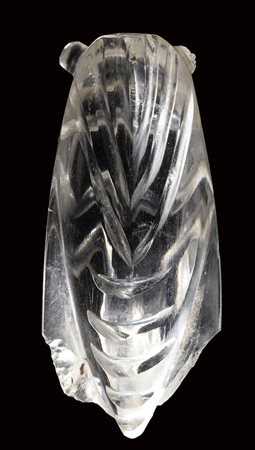
Lotto 91 A roman rock crystal microsculpture. Cicada.
1st-3rd century A.D.
Dim : 40 x 17 mm
The insect has an elongated body, with parallel or crossed grooves engraved for both body segments and wings. Big bulging eyes. Lack on one wing. Wear marks. Extremely clear and bright stone.
U.K. private collection, London. -
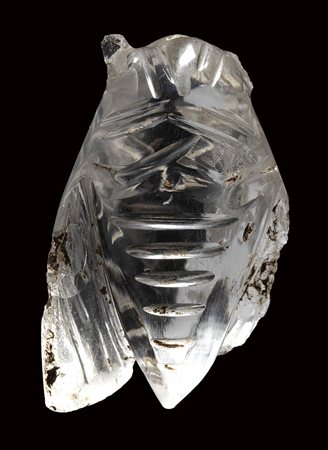
Lotto 92 A roman rock crystal microsculpture. Cicada.
1st-3rd century A.D.
L : 36 mm
The insect has a large and stocky body, with parallel or crossed grooves engraved for both the body segments and the wings. Big bulging eyes (one is missing). Lack on one wing. Signs of wear. Extremely clear and bright stone.
Parallels : U. Pannuti, Catalogo della collezione glittica, Museo Archeologico Nazionale di Napoli, vol. 1, p. 162 n. 300 ss.
European private collection. -
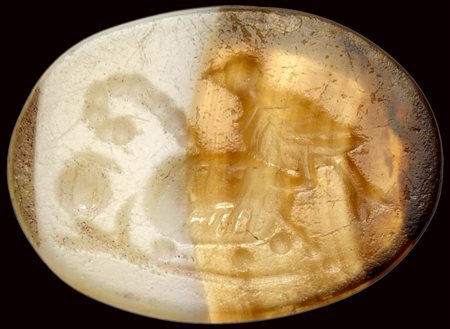
Lotto 93 A roman italic banded agate intaglio. Bird with attributes.
2nd-1st century B.C.
9 x 13 x 2 mm
The animal is seated on the top of a case, near a poppy flower and a pedum. Allegorical emblema composed by funerary and bucolic attributes. Use of globular elements. Wear marks.
U.K. private collection -
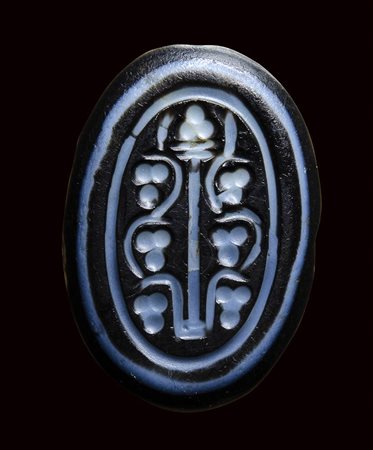
Lotto 94 A rare eastern roman onyx intaglio. Allegorical emblema.
1st - 3rd century A.D.
12 x 17 x 3 mm
The representation is characterized by a stylized and symmetrical emblem structure, depicting racemes of grapes with bunches; in the center, probably a thyrsus or a scepter referable to the Dionysiac sphere. The unusual composition is known from some rare specimens, probably referable to eastern regions. Attractive variety of stone, finely engraved. The back has a chipped surface.
Parallels: Antiken Gemmen in deutschen sammlungen, band I, Staatliche Munzsammlung Munchen, teil 3, p. 116 n. 2879.
European private collection. -
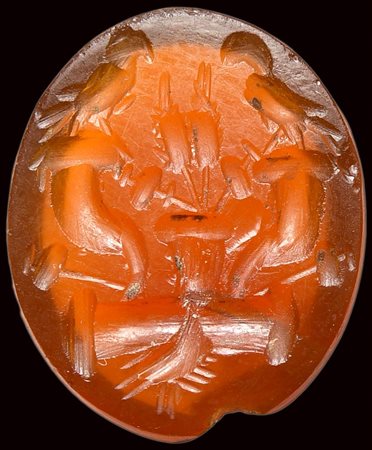
Lotto 95 A roman carnelian intaglio. Allegorical emblema.
2nd - 3rd century A.D.
10 x 12 x 3 mm
In the center, two clasped hands in the dextrarum junctio, holding a kalathos containing two ears of corn and two poppy flowers. On the sides, two cornucopias each surmounted by a parrot with poppy flower. Allegorical emblem referring to good luck and abundance. Slight wear marks. Chipping on the edge.
U.K. private collection -
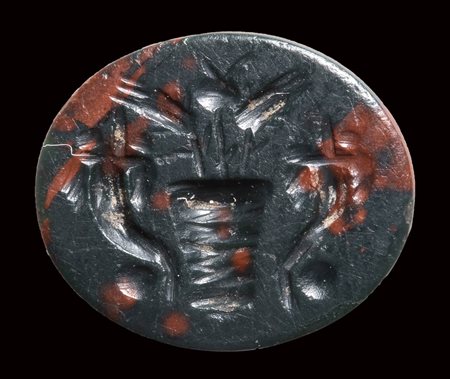
Lotto 96 A roman heliotrope intaglio. Allegorical emblema.
2nd century A.D.
9 x 11 x 2 mm
In the center, a basket (kalathos) containing two ears of corn and a poppy flower. On the sides, according to a symmetrical composition, two cornucopias with globe. Allegory of abundance and prosperity. Beautiful variety of stone with vivid red inclusions. Slight wear marks.
U.K., private collection 80's, London.