
Auction 86 - Glyptics and Ancient Jewelry
-
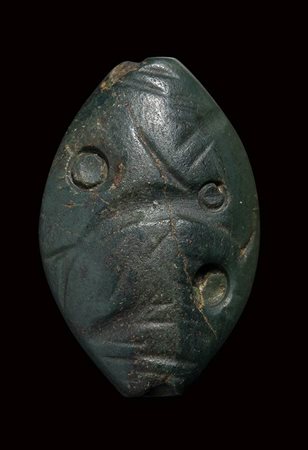
Lotto 1 A minoan amygdaloid green jasper engraved seal.Fish with talismanic symbols .
First half of the 2nd millenium B.C.
13 x 19 x 7 mm
The animal is facing right. Drilled details. The stone is drilled lenghtwise.
Slight crack on the surface. Wear marks. Rare.
Parallels :
J. Paul Getty Museum, inv. 2001.14.24; J; Boardman, Greek gems and finger rings, Early Bronze Age to Late Classical, 1970, Ch.II, pl. 73; See parallels: Antiken Gemmen, band II, Berlin, n. 12.
U.K., private collection 70's, in the same family since then. -
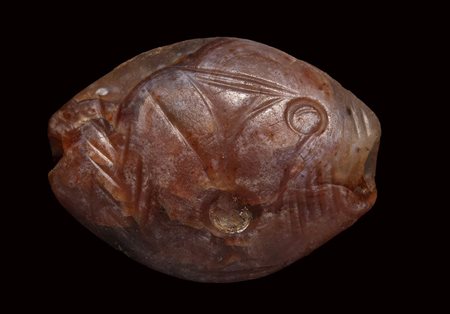
Lotto 2 A minoan amygdaloid agate engraved seal. Talismanic jug.
First half of the 2nd millenium B.C.
15 x 21 x 8 mm
Talismanic jug with floral and cross-hatching.
This symbol is a common pattern for this type of seals.
Drilled lenghtwise. Wear marks. Rare.
Parallels :
J. Paul Getty Museum, inv. 2001.14.24; J. Boardman, Greek gems and finger rings, Early Bronze Age to Late Classical, 1970, Ch.II, pl. 72; See parallels: Antiken Gemmen, band II, Berlin, n. 17.
U.K., private collection 70's, in the same family since then. -

Lotto 3 A minoan hematite engraved seal. Two swans.
2nd millenium B.C.
16 x 17 x 6 mm
A lentoid-shape seal with two swans turned on the left. Wings spread. Groundline. Wear marks.
The seal is drilled lenghtwise. Rare.
Parallels : Siegel CMS I 273b; J. Boardman, Greek gems and finger rings, Early Bronze Age to Late Classical, 1970, Ch.II, pl. 94
U.K., private collection 70's, in the same family since then. -
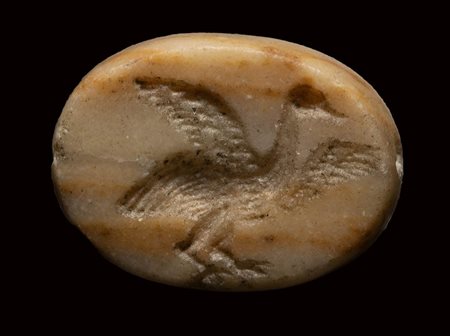
Lotto 4 An early greek alabaster seal. Swan.
2nd millenium B.C.
13 x 18 x 8 mm
The bird is turned on the right, wings spread. Convex backside. Wear marks. Rare.
Parallels : Athens, National Museum, inv. 1793; Siegel CMS I 258.
U.K., private collection 70's, in the same family since then. -
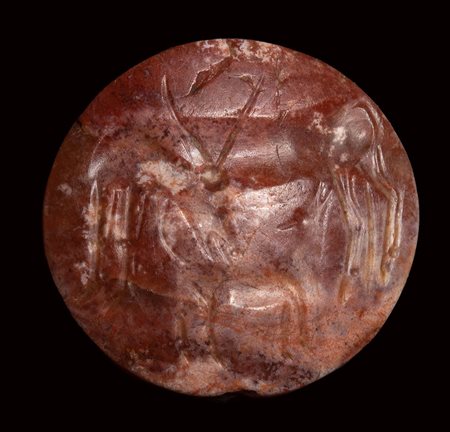
Lotto 5 A mycenaean agate engraved seal. Antilope with her cub.
2nd millenium B.C.
Diam. 18 x 7 mm
A fine lentoid-shape seal with antilope turned on the left and leaning toward her cub facing right. The seal is drilled lenghtwise. Attractive color of the stone. Small crack on top. Wear marks. Rare.
Parallels : J. Boardman, Greek gems and finger rings, Early Bronze Age to Late Classical, 1970, Ch.II, fig. 133; See parallels: Antiken Gemmen, band I, Munchen, n. 74; Athen, National museum, inv. 3178; Siegel CMS I 125
U.K., private collection 70's, in the same family since then. -
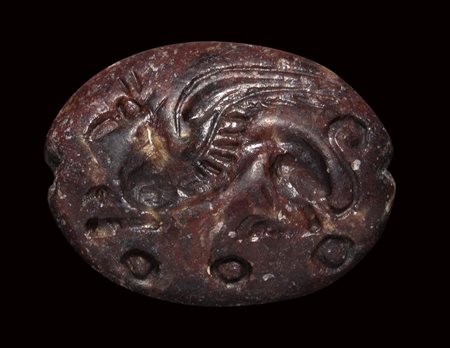
Lotto 6 A mycenaean red jasper engraved seal. Griffin.
2nd millenium B.C.
12 x 16 x 6 mm
The creature is turned left and characterized by large wings, the feathers marked by large incisions. The tip of the tail is curved. Below, three circles. The stone is drilled
lenghtwise. Wear marks. Rare.
U.K., private collection 70's, in the same family since then. -
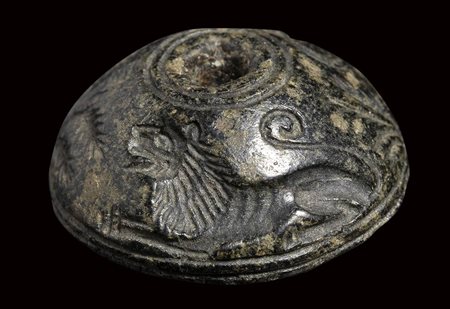
Lotto 7 An early greek serpentine engraved seal. Hunting scene.
Beginning of 1st millenium B.C.
Diam. 30 x 12 mm
The large tronconic seal is drilled highwise. The surface is engraved with a hunt scene; a lion facing left and a deer. The two animals are separated by two trees. Use of globular elements. Fine execution. Slight wear marks. Rare.
U.K., private collection 70's, in the same family since then. -
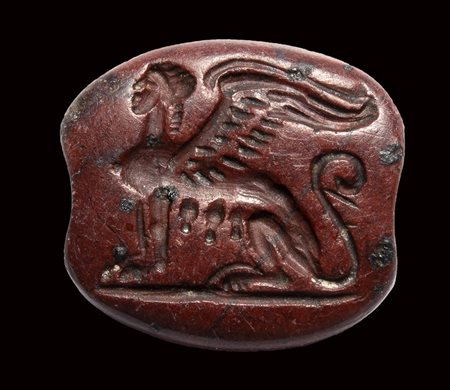
Lotto 8 An archaic greek red jasper engraved seal. Seated sphinx.
Beginning 1st millenium B.C.
14 x 16 x 5 mm
The ovoid seal is drilled lenghtwise. The sphinx is turned on the left, with large wings and three udders pending below her belly. Groundline. Wear marks. Rare.
U.K., private collection 70's, in the same family since then. -
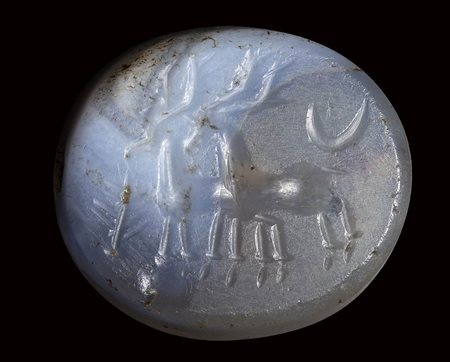
Lotto 9 A graeco persian chalcedony engraved seal. Two stags.
6th century B.C.
17 x 19 x 9 mm
The two animals are facing left and characterized by large horns. On the right, crescent moon, a branch on the left. The seal is drilled lenghtwise.
Parallels for the style: J. Boardman, Greek gems and finger rings, p. 355, pl. 942
UK private collection, London. -
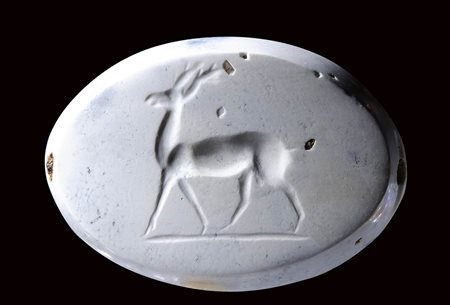
Lotto 10 A large eastern greek burnt chalcedony seal intaglio. Deer.
5th-4th century B.C.
22 x 31 x 17 mm
The walking animal is facing left, and characterized by a well-marked anatomy. Groundline. The seal is drilled lengthwise, the back side in ovoid-shape and the entire surface is still well polished but burnt, with very slight lacks. Rare.
Parallels: G.M.A. Richter, Catalogue of engraved gems, The Metropolitan Museum, New York, p. 28 n. 109-113; J. Boardman, Greek Gems and Finger Rings, p. 355 n. 940 ss.
UK private collection, London. -
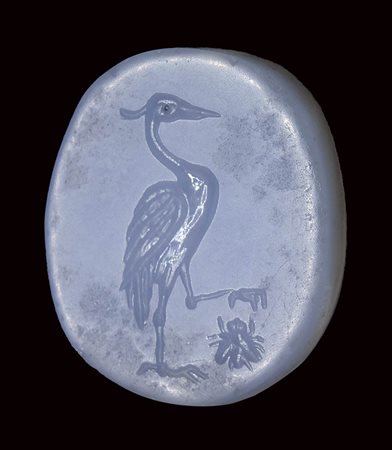
Lotto 11 A fine greek blue chalcedony double sided seal intaglio. Heron hunting an insect / hazelnut.
5th century B.C.
15 x 18 x 7 mm
The animal is facing right and grabbing a flying insect (fly or bee), an idyllic naturalistic repertoire of classical Greek glyptics. The scene is composed with elegance and engraved with great skill: the sharp beak is still clenched; the paw ready to grab the insect; the other paw on the ground to ensure balance to the bird. The reverse of this refined blue chalcedony seal presents a partially peeled hazelnut, engraved with realistic sense and great technical expertise. The carving is expertly polished, while the surface of the stone shows signs of wear and very slight corrosion in front. Backside, a large whitish spot to be considered as a characteristic of the stone itself (layer or burnt?). The artifact, drilled lengthwise, is to be considered of great rarity and beauty.
Parallels: Antike Gemmen in Deutschen Sammlungen, band II, Berlin n. 180, inv. FG311; J. Boardman, Greek Gems and Finger Rings, p. 288 n. 469; p. 289 n. 490, p. 287 n. 514, 518-519.
U.K., private collection 70's, in the same family since then. -
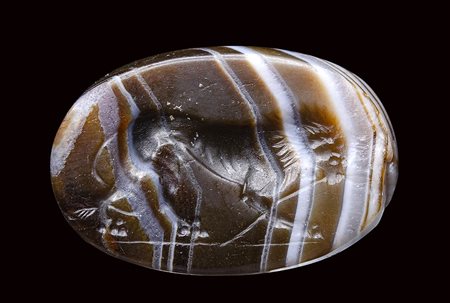
Lotto 12 A fine greek banded agate scaraboid seal intaglio. Lion.
5th century B.C.
17 x 25 x 13 mm
The scene depicts a lion facing right with a branch (?) in his mouth. The animal is characterized by realistic anatomic details; the body musculature and the coasts with rendering volumes. The crest and tail hair are depicting by thin engraved lines meanwhile the eyes, the articulations and the terminals of the feet by globular elements. Groundline. Scaraboid shape and pierced lengthwise. This large stone is masterfully engraved with refined details and artisitc sense of composition. The style of this engraving is referable to classical Greek production, probably identifiable in that transition phase between the archaic and early classical age. Some of these stylistic and executive details are also in the Graeco-Persian production, with numerous stylistic similarities both in the iconography and in the engraving technique. Beautiful colors and fine variety of banded agate. Sligth wear marks. Very rare.
Parallels: J. Boardman, Greek Gems and Finger Rings, p. 185 n. 388 ss.; p. 290 n. 520, p. 292 n. 575; p. 352 n. 866 (greco-persian, "Court Style"). J. Boardman, Archaic Greek Gems, plate XXXI. G.M.A. Richter, Catalogue of engraved gems, The Metropolitan Museum, New York, p. 15 n. 55, n. 101.
UK private collection, London. -
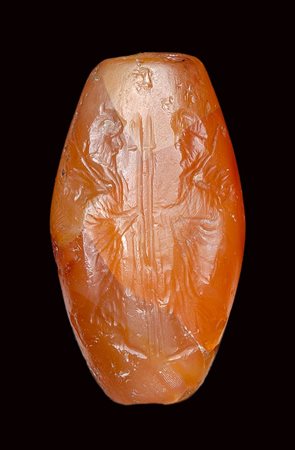
Lotto 13 A rare eastern greek carnelian seal intaglio. Emblema with Zeus Labraundos for thr Satrapy of Caria.
4th century B.C.
H: 32 mm
This rare representation is composed with two bearded and draped male figures, each holding a spear/sceptre in the left hand and a double axe in the right. The two figures are facing each other, in the same attitude and both show a mature face. The left hand holding the spear also holds a part of the himation, each raising a foot slightly in the same move. This emblematic scene, very rare and of historical interest, refers to the satrapy of Caria, and in particular the coinage of Idrieus. Idrieus, or Hidrieos was a ruler of Caria under the Achaemenid Empire, nominally a Satrap from the House of Hecatomnus (the Hecatomnids) created when they succeeded the assassinated Persian Satrap Tissaphernes in the Carian satrapy.
An exact comparison is identifiable with the drachm: Head of Apollo wearing laurel wreath, drapery at neck. Rev: legend (“IDRIEOS”), Zeus Labraundos standing. Circa 351/0 to 344/3 BCE or Satraps of Karia, Pixodaros AR Didrachm. Halikarnassos, circa 341/0-336/5 BC. Laureate head of Apollo facing, turned slightly to right / Zeus Labraundos standing to right, holding double-axe (labrys) over shoulder and and lotus-tipped sceptre; SNG Copenhagen 597; SNG Kayhan 891; SNG Von Aulock 2375-6; Pixodarus -. 6.90g, 20mm. On Greek coins of the classical period (e. g. Pixodauros) a type of Zeus venerated at Labraunda in Caria that numismatists call Zeus Labrandeus stands with a sceptre upright in his left hand and the double-headed axe over his shoulder.
This carnelian cylinder seal is drilled lengthwise, multiple internal cracks and a worn surface. Wear marks and little missing on the surface.
UK private collection, London. -
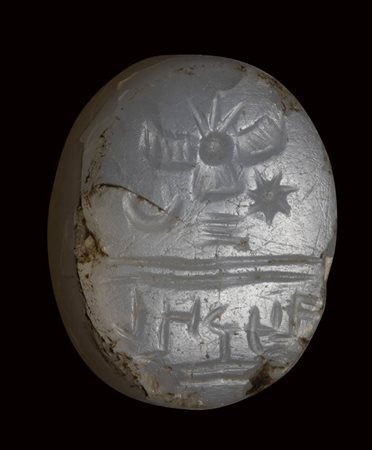
Lotto 14 A semitic (paleo-hebrew) chalcedony scaraboid stamp-seal. Winged solar-disc and inscriptions.
7th century B.C.
11 x 14 x 6 mm
Scaraboid shaped stamp-seal with a slightly domed back. On the base, two registers separated by two horizontal lines: on top, the winged solar-disc with crescent moon; three lines and sun. The second register is a paleo-hebrew or phoenician inscription. Chips on the edge.
U.K., private collection 70's, in the same family since then. -
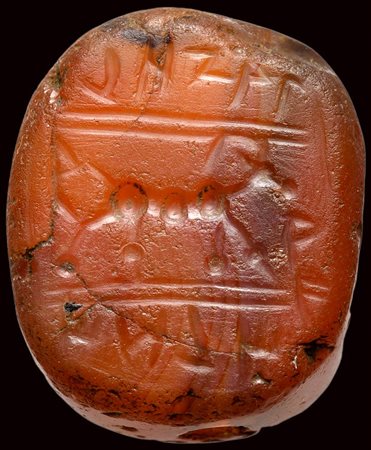
Lotto 15 A semitic (paleo-hebrew) carnelian scaraboid stamp-seal. Deer and inscriptions.
7th century B.C.
14 x 16 x 8 mm
Scaraboid shaped stamp-seal with a slightly domed back and pierced lengthwise. On the base, a deer (ibex type) turned to the right and framed at the top and bottom by two horizontal lines; phoenician or aramaic inscriptions. Drill technique for the animal. Wear marks.
Parallel : British Museum, London, inv. 02971.
U.K., private collection 70's, in the same family since then. -
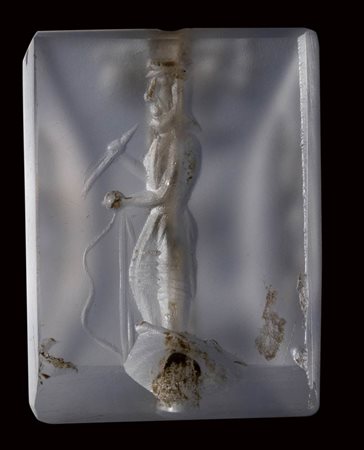
Lotto 16 A rare greco persian chalcedony six-faced tabloid engraved seal. Hunter with animals.
Second half of the 5th century B.C.
10 x 14 x 6 mm
Rectangular stone, with one side flat, the other cut into five facets. Each of the six sides have an engraved figure. The stone is perforated horizontally. Slight chips. The smaller face is engraved with a dog, facing right. The two lateral smaller faces with respectively a hunting dog and a stag. The two larger lateral faces with an ostrich and a fox. The reverse, with a hunter, standing, facing left, putting an arrow to his bow. Very fine quality and rare type. This specific shape and iconography is referred to the graeco-persian period.
See parallels: J. Boardman, Greek gems and finger rings, pp. 313-317, pl. 893, 906 ss. ; Boardman, Intaglios and rings from a private collection, n. 89; G. M. A. Richter, The engraved gems of the greek, etruscan and romans, part I, n. 517-518. Antiken Gemmen, Band II, Berlin, n. 189-190.
U.K., private collection 70's, in the same family since then. -
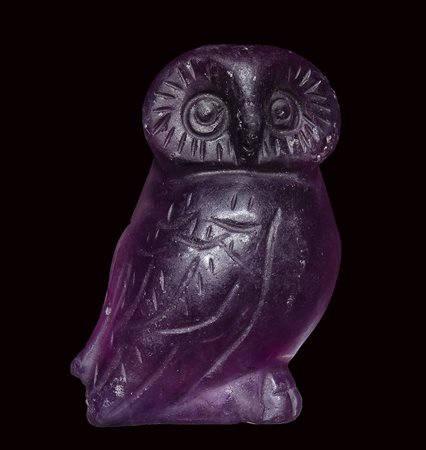
Lotto 17 A rare eastern greek fluorite carved idol. Owl.
4th - 3rd century B.C.
H: 48 mm
The tridimensional sculpture is depicting the famous owl of Athens or Athens noctua. The mythological animal is characterized by an horizontal elongated head with big rounded open-eyes. The head feathers and the pupils are deeply carved. The face is frontal meanwhile the body is turned to the left. The wings, and some other feathers are represented by the same carved-lines. The posture of the bird and the general appearance are referring to the mythological owl of the goddess Athena, symbol of the city of Athens (see coinage production). This sculpture can be seen as a votive idol or a very precious protective amulet empowered by the image linked to the goddess of wisdom and strategy. This ancient micro-sculpture is carved in an extraordinary deep purple bicolor fluorite.
The use of this mineral, from the eastern regions, is very ancient and can be also related to this function as Pline the Elder (H.N XXXVII). During the Antiquity, the amulets, sculpted figures and vessels productions in fluorite are attested in ancient Greece and Rome as a precious stone. Wellknown for the crystals wonderful colors and the perfect cleavage. According to current studies, fluorite is referrable to the ancient and precious Murra, used to produce cups and table vases. The oldest mention is from Sesto Properzio. The most complete description is by Caius Pliny the Second, who considers it a gem, although it was not considered as such, for example, by the jurist Cassio Longino around 50 A.D.
In the luxury of the Roman canteens, murrine were preferably used for hot drinks (Marco Valerio Marziale). Murra cups and vases were not lacking at the court of the Ptolemies (Gaio Svetonio Tranquillo). The first seems to have arrived in Rome with Pompey with the treasures of Mithridates. Pliny describes the particular aroma that this tableware emanated. The nature of murra is not yet well understood, Corsi, in 1845, hypothesizes it is a type of fluorite and C. E. N. Bromehead (1949) summarizes all the previous discussions, insisting on identifying murra with fluorite. Pliny describes “the murra vases come from the East. There they are found in several localities, not even famous, especially in the Parthian kingdom, but the most beautiful, however, are in Carmania. It is thought to be a liquid substance that solidifies under the ground by heat. […] Their splendor is without intensity and more than splendor it is properly luster. But what makes their value is the variety of colors, due to the repeated turning of the veins to purple red or pure white or a third shade between the two, when, as for a passage of color, the purple red becomes flaming or the milky white turns red. There are those who especially appreciate the edges and certain shades reissued, as seen in the inner part of the rainbow. Others like dense veins - any transparency or fading is a defect for them - as well as granules and spots that are not outgrowth, but, as also happens in the human body, mostly flat. Even the smell of the substance is a reason for value. The crystal is the result of a cause contrary to the one exposed, of a very intense solidification by freezing […]”.
See the Kantharos or Crawford Cup, British Museum, London, 1st-2nd A.D, found on the border between Syria and Turkey, or The Barber Cup, British Museum, London, 1st-2nd A.D, found on the border between Syria and Turkey (However, other research establishes that the “murra” should instead be identified with several specimens of banded agate and not with the fluorite).
This unique specimen is a beautiful exemple of the ancient craftsmanship from the choice of the bicolor fluorite and its artisitc treatment, combining both the stone and the mythic animal characteristics to emphasize the power of the symbolic hence the protective function of the sculpture. Wear marks. No missing parts. Extremely rare.
Enrico Butini Enigma dei vasi murrini. Leggende, storia, letteratura, indagine archeogemmologica. L'ERMA di BRETSCHNEIDER 2019; Dario Del Bufalo, Murrina Vasa: a luxury of imperial Rome, Roma 2016.
U.K. private colletion. Property of East London gentleman; formerly acquired by R. Ancient Art from Rabi Gallery (Mount street, London) in the 80's -
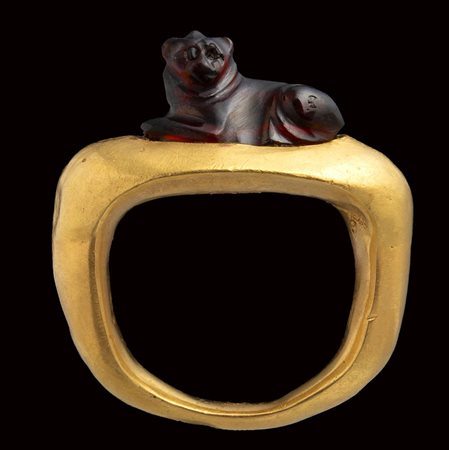
Lotto 18 A fine greek garnet microsculpture mounted on a modern gold ring. Lioness.
5th-4th century B.C.
Stone: 16 mm Ring: 16 x 18 mm 12.80 gr
The feline is lying down, with the body in profile and the head raised facing frontally. The eyes are round, made of a different stone and set in the garnet microsculpture in two small holes. The style and the execution are typical of this classical Greek production. Attractive vivid color of the stone. The postclassical gold massive ring is inspired by ancient models. Slight wear marks. Very rare.
Parallels: G.M.A. Richter, Catalogue of engraved gems. Greek, etruscan and roman. The Metropolitan Museum of New York, p. 15 n. 55; Antiken Gemmen in Deutschen Sammlungen, Band I, Staatliche Munzsammlung Munchen, p. 70 n. 358.
European private collection. -
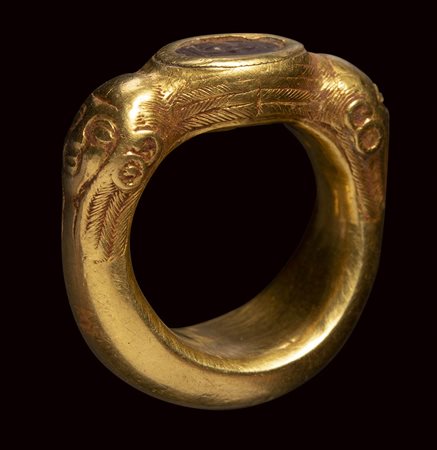
Lotto 19 A rare etruscan agate intaglio set in an ancient massive gold ring. Silenus.
5th century B.C.
intaglio : 6 x 9 mm
ring : 15 x 14 mm
16, 02 gr.
The figure is in the “Knielauf” position and turned on the left. Groundline.Cable border. The mounting is a plain broad hoop, rounded without, flat within and ending on either side with female head characaterized by
an archaic style with large almond eyes. The heads are supporting the almond-shaped bezel set with the agate intaglio and decorated with incised short braided lines. This ring typology is typical archaic greek
(Boardman, 1967) yet the style and production of this example is etruscan as well as the intaglio execution. The form of the ring is referrable to the “lion ring” type conserved in the British Museum, London.
The use of the ring with “cartridge” or with engraved stone as stamp-seal, becomes very widespread in the middle of the 6th century B.C., and often represents single figures; real or fantastic animals, or complex scenes.
Very fine and rare specimen.
Parallels : F. Marshall, 1968, pl. VIII, n° 300; Metropolitan Museum, NY, inv.40.11.16; Cristofani,Martelli, L'Oro degli Etruschi, 1985, p.56, fig. 10.
U.K. private collection 1985. Formerly in Arthur Sambon (1867-1947) collection. -
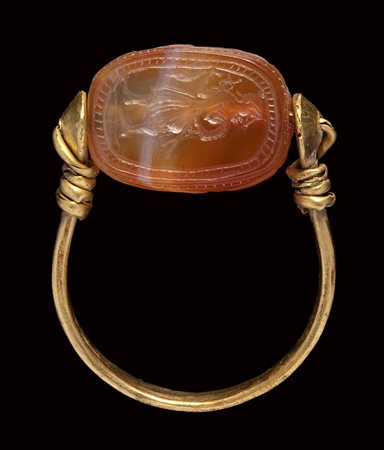
Lotto 20 An etruscan agate scarab intaglio, mounted on an ancient gold ring. Hermes.
5th century B.C.
intaglio : 11 x 15 x 9 mm
ring diam_ 20 mm
7,5 gr.
The character can be identified as Hermes. The god is standing, the body turned on the left meanwhile his head is reversed on the right. He holds the caduceus in his left hand, and the purse in the right one. Clothes and hat in oriental style. Groundline. Cable border. For the mounting; hoop angular on the outside ending with small convex discs with agate scarab revolving on a wire swivel passing through the disks and twisted around the ends of the hoop. The stone is drilled lenghtwise and filled with gold.
Parallels : Marshall, F. , 1968, pl. XV, n°314.
U.K., private collection 80's. -
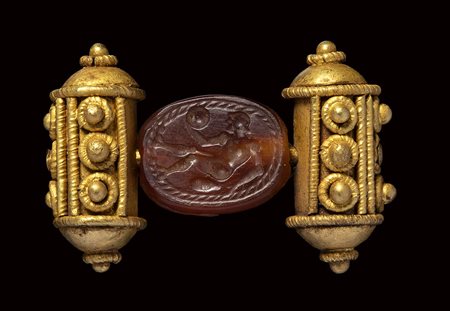
Lotto 21 An etruscan carnelian scarab intaglio, mounted on an ancient gold ring. Athlete.
5th - 4th century B.C.
intaglio : 9 x 11 x 6 mm
ring : 19 x 17 mm
9,27 gr.
The masculine figure is facing left, leaning forward, holding a sphere
(or a disc) with the right hand, while the left arm counterbalances
backward. The very developed musculature is marked by
voluminous shoulders and thighs, as well as the bust cut in “v”. His posture, his anatomy and his hairstyle recalls the figure of the Greek athlete, although the style of the incision is Etruscan.
Globular style. Cable border. The mounting is a thin broad hoop, convex without, concave within, ending in large cylindrical ornaments which are decorated with 2 ranges of 3 granules decorated with spool wires, separated by wires. Very fine conservation.
Parallels : Marshall, F., 1968, pl.X, n° 342; Nicolini, G. , Technique des ors antiques, pl. 221-224; J. Boardman,Greek Gems and Finger rings, 1970, pl.336, p. 183. P. Zazoff, Etruskische Skarabaen n. 294.
U.K. private collection 1985. Formerly in Arthur Sambon (1867-1947) collection. -
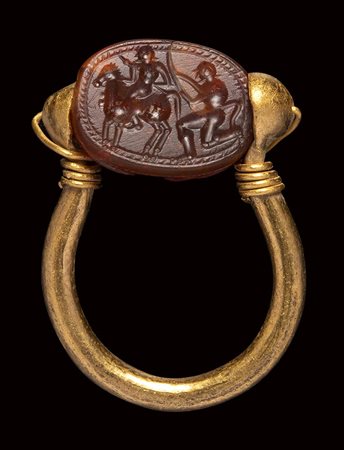
Lotto 22 An etruscan carnelian scarab intaglio, mounted on an ancient gold ring. Warrior and Faun.
4th century B.C.
intaglio : 12 x 16 x 8
ring : 17 x 21 mm
11,12 gr.
The two characters are facing left. The warrior is riding a horse, holding a spear in his left hand. Behind, the faun in “Knielauf” position also carries a weapon toward him. Globular style. Cable border. The mounting is a large broad hoop ending with small convex discs with carnelian scarab; the stone is revolving on a wire swivel passing through the disks and twisted around the ends of the hoop.The scarab is partially damage on the convex backside.
Parallels : J. Boardman, Intaglios and rings : Greek, Etruscan and Eastern,1975, n°188 et 189.
U.K. private collection 1985. Formerly in Arthur Sambon (1867-1947) collection. -
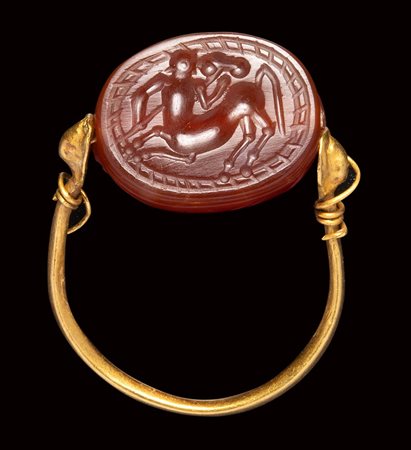
Lotto 23 An etruscan carnelian scarab intaglio mounted on an ancient gold ring. Centaur.
4th century B.C.
intaglio : 11 x 14 x 7 mm
ring diam _ 17 mm circa
3,73 gr.
The creature is turned on the left side, holding a spear. Cable border. Globular style. Attractive color of the stone.
The mounting is a large broad hoop ending with small convex discs with the carnelian scarab; the intagio is revolving on a wire swivel, passing through the disks and twisted around the ends of the hoop. Small chip on the scarab wing case.
Parallel: Aa.Vv., L'Oro degli Etruschi, M. Cristofani and M. Martelli, n. 270 for the setting type.
Property of a gentleman, UK, London.
Ex Christie's, Fine Antiquities, 6 July 1994, lot 339 -
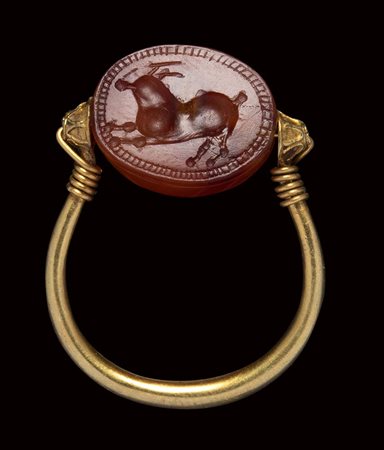
Lotto 24 An etruscan carnelian scarab mounted on an ancient gold ring. Antelope.
4th century B.C.
intaglio : 12 x 16 x 9
ring : 20 x 18 mm
7 g
The animal is running to the left side.
Globular style. Cable border. The mounting is a plain rounded hoop ending with convex terminals. The carnelian scarab revolved on a visible gold pin which passed through the terminals ending and twisted around the ends of the hoop.
Parallels : Museo Archeologico Nazionale di Napoli, inv. 27073/1228
U.K., private collection 80's. -
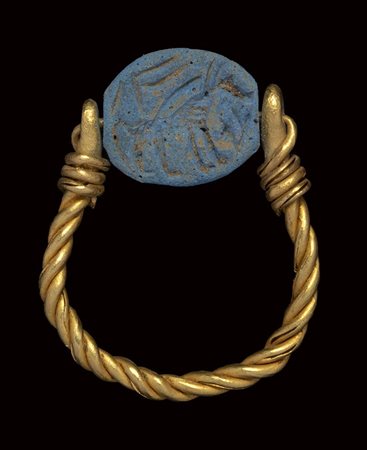
Lotto 25 A phoenician blue glass paste scarab intaglio, mounted on an ancient gold ring. Quadrupede
5th - 4th century B.C.
intaglio : 10 x 12 x 5 mm
ring diam : 17 mm
2,77 g
The animal is facing left. For the mounting, the refined ring-shaped hoop is formed by the interweaving of two thread-like elements of different thickness and ends near the scarab with a spiral twisted pattern. The mounting style reminds etruscan production, which makes this scaraboid ring an example of one of the most develop market in Etruria. Very fine condition.
U.K. private collection 1985. Formerly in Arthur Sambon (1867-1947) collection. -
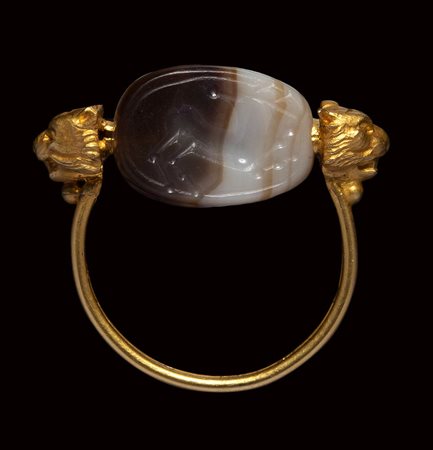
Lotto 26 An etruscan banded agate scarab intaglio mounted on an gold ring. Horned stag running.
4th century B.C.
intaglio : 10 x 14 x 7 mm
ring : 19 x 16 mm
5,84 gr.
The quadrupede is running to the right, his head turned on the left. Globular style. Rope pattern border. The gold mounting, a swivel-ring with lion head terminals is probably postclassical. Very fine condition.
Property of a gentleman, London. Ex Christie's, Fine Antiquities, 6 July 1994, lot 339. -
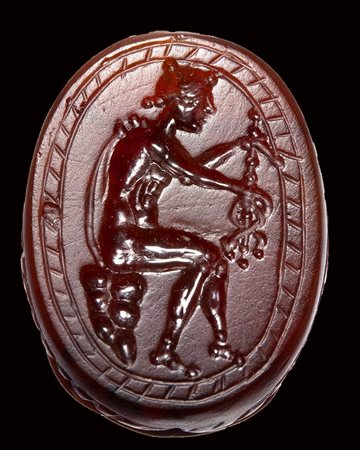
Lotto 27 An etruscan carnelian scarab intaglio. Hermes with caduceus.
4th-3rd century B.C.
11 x 15 x 9,5 mm
The young god is seated on top of the rocks, facing right. His body is naked and has a detailed incised musculature, emphasized by the presence of globular elements. On his head he wears the petasus while on his shoulders a cloak with chlamys. With the left hand he holds the handle of the caduceus, while with the right he seems to touch one of the two snakes entwined with the magic stick, facing downwards. A foot and one hand of the god are engraved over the dotted frame, with a globular termination, according to a style typical of this production (near the socalled “Italic- Etruscanizing group” of the 3rd century B.C., Richter, Pl. XXXIV).The allegorical scene seems to be inspired from a mythicall episode while the pose recalls the scenes of characters who manufacture or create tools-works of art. Around the figure, a dotted frame finely engraved. The figure is executed in a refined way and is characterized by a mirror polish in all its details. Slight superficial crack on the back of the beetle. Wear marks. Rare
U.K., private collection 80's. -
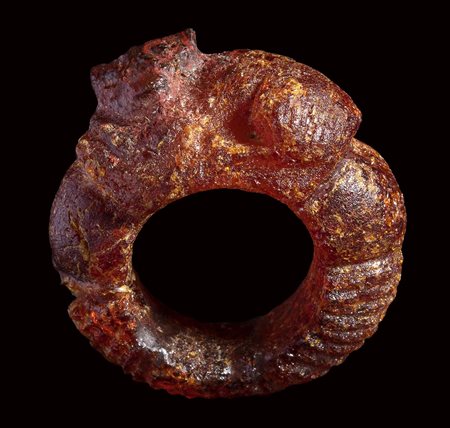
Lotto 28 A roman amber finger ring with lion protome.
1st – 2nd century A.D.
30 x 32 mm
Ring shaped in a fine twist. The bezel in a form of a crouched lion. Nice dark red color, opaque on the surface.
Parallel: Cabinet des Médailles, Paris, inv. Froehner.1138
U.K. private collection, London. -
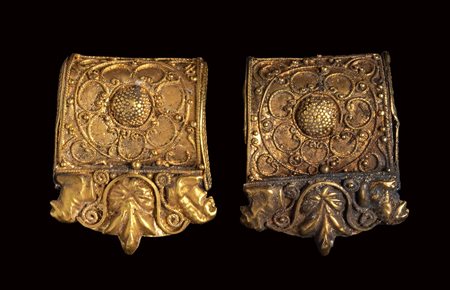
Lotto 29 A pair of etruscan gold bauletto earrings.
6th - 5th century B.C.
H : 18 mm circa
4,01 g
Broad strip of gold bent into three-quarters of a cylinder. The two ends of the strip are joined by a wire or narrow band, which attached the cylinder to the ear.The larger surface of the cylinder is decorated with filigree and granulation. The terminals are embossed with vegetal and lion protome pattern. Very fine work. Traces of oxydation on the back of one earring and on its terminal clasp.
Parallel: Dallas Museum of Art, inv. 1991.75.17.A-B
U.K. private collection -
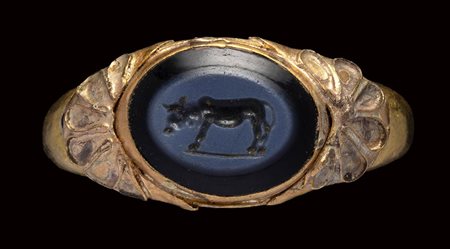
Lotto 30 A roman nicolo intaglio set in an etruscan gold ring. Bull.
intaglio: 1st-2nd century A.D.; ring: 4th-3rd century B.C.
intaglio : 9 x 12 mm
ring diam : 15 x 12 mm
4,02 g
This specimen is an interesting testimony of glyptic reuse. The gold-foil hollow ring is an Etruscan production; the nicolo intaglio is a roman imperial production (a similar case is attested, with the same type of stone, London, British Museum, FR 298). Intact.
Parallel: Aa.Vv., L'Oro degli Etruschi, M. Cristofani and M. Martelli, p. 300 n. 190.
U.K. private collection -
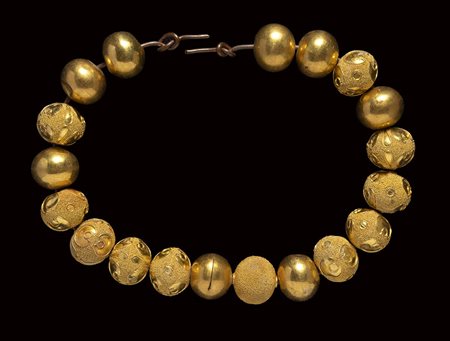
Lotto 31 A group of 19 etruscan gold beads.
6th century B.C.
Bead diam : 10 mm
12,65 g
Spherical gold beads, including 10 of them decorated with granulation of great finesse (one completely decorated with granulation). Very fine condition.
Parallels : Antikenmuseum, Berlin, inv. GI.6; Cristofani, M., Martelli, M. , L'oro degli Etruschi, 1985, p. 172, fig. 154.
Monte-Carlo, private collection of Mr. L, prior to 90’s -
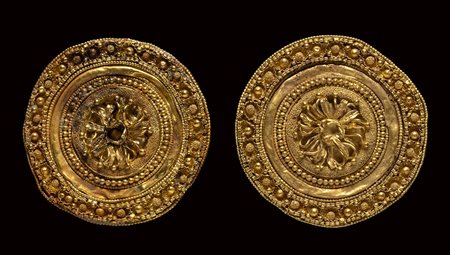
Lotto 32 A pair of etruscan gold disc ear-stud.
2nd half of the 6th century B.C.
Diam : 34 mm
11,18 g
The disks are formed of a circular gold sheet, the outer surface of which has a central floral element composed of radiated leaves of gold, each bearing granules at its top, and background in granulation. Three concentric bands encircle the floral:
The outtern band is composed with 28 flowers made with curl leaves, granulated beads alternated with plain one. The intern band is composed with 57 gold spheres encircled with beaded wire. Backside covered with a plain gold sheet. Hole at the center to attach the ear clip (one partially remained). The central gold bead are missing in each earring.
Originally an East Greek type, striking disk earrings were a fashionable female accessory for several centuries. Complex patterns were made with filigree and granulation, techniques of applying fine gold wires and miniscule granules to create intricate designs.
Parallels : J.-P Getty Museum, Los Angeles, inv. 83.AM.2.2.1; Metropolitan Museum, NY, inv. 13.225.30a,b. Cristofani, M., Martelli, M. , L'oro degli Etruschi, 1985, p. 170, fig. 148-153
Marshall 1911, pp. 136-137, n. 1414 tav. 20.
Monte-Carlo, private collection of Mr. L, prior 90’s -
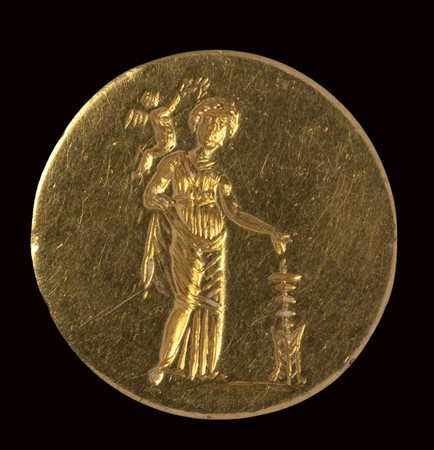
Lotto 33 A very fine early Hellenistic gold ring with engraved bezel. Aphrodite and Eros.
4th - 3rd century B.C.
Bezel diam : 25 mm
ring : 20 x 15 mm
16,12 gr.
The hoop is rounded without, flat within, ending on a flat large circular bezel. The bezel is engraved with the group of Aphrodite and Eros. The goddess is standing in a contrapposto posture, her right leg slighlty bend forward.She wears a chiton with a himation which shows her body shape by transparency. Turned to the right, she's sprinkling incense on to the flame of a three-legged incense-burner. The little winged god is seated on her right shoulder and turns to crown her. Groundline.
Solid gold. Slight wear marks. Very fine condition and rare specimen. For a similar scene and ring see Metropolitan Museum, NY, inv. 06.1125
Parallels :
Chabouillet, Anatole. Catalogue général et raisonné des camées et pierres gravées de la Bibliothèque impériale. Paris : 1858, n°2630.
Marshall, F.H., 1968,n° 83 et 84
Richter, Gisela M. A. 1920. Catalogue of Engraved Gems of the Classical Style. no. 48, pp. 45-46, pl. 20, New York: The Metropolitan Museum of Art.
Lexicon Iconographicum Mythologiae Classicae (LIMC). 1984. Vol. 2: Aphrodisias-Athena. "Aphrodite," p. 41, no. 286, pl. 30, Zürich: Artemis Verlag
Property of a gentleman, London. Acquired at Sotheby's, Antiquities, London, 14th Dec. 1990, lot 93
Ex Guilhou Collection
Ex Harari Collection
Published :
Guilhou (de Ricci), n° 289
Guilhou, n° 132
Boardman, GGFR 421, n° 690
Boardman, Scarisbrick, n° 11. -
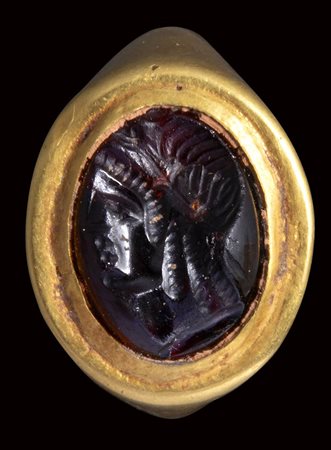
Lotto 34 An fine hellenistic garnet intaglio mounted on an ancient gold ring. Bust of Isis.
2nd-1st century B.C.
Intaglio : 10 x 14 mm
Ring : 17 x 16 mm
7,89 g
With a hollow gold hoop, broad shoulders ending with an oval bezel set with a garnet intaglio. The gem shows the bust of a woman, as Isis, with calamistrated locks, wearing a diadema. Use of globular elements for the eye and the mouth. This is possibly the portrait of a Ptolemaic queen as Isis, perhaps Cleopatra Thea (see Plantzos 52 - 4, pls. 9-11). High convex garnet stone. Mirror polishing. This beautiful intaglio is set on an ancient gold ring. Very fine condition.
Parallels: J. Boardman, C. Wagner, Masterpieces in miniature. Engraved gems from prehistory to the present, p. 131 n. 119; Antiken gemmen in Deutschen sammlungen, band I, Staatliche - Munchen, p. 81 n. 439 (Granat). M.L. Vollenweider, Camées et intaillles, Cabinet des médailles, . 105 n. 92 (Cléopatre I assimilée à Isis).
U.K. private collection, London. -
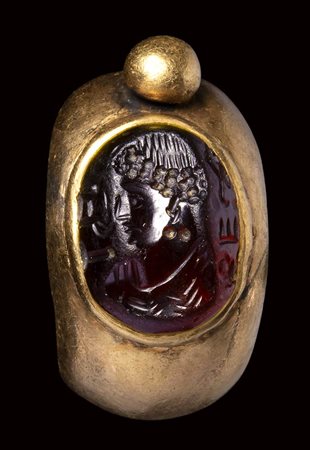
Lotto 35 A North-West Indian gold ring with garnet intaglio. Bust of man with inscriptions.
5th-6th century A.D
Intaglio : 10 x 13 mm
Ring : 16 x 13 mm
11,47 gr
A large hollowed hoop, rounded without, flatten within. The oval bezel set with a nice thick intaglio. Gold sphere on the hoop, to mark the sens of impression. The male bust is turned on the left. Clean-shaved, but has a moustache. He wears an earring with two circular pendants. On the edge, clockwise, Brahmi script. Rare.
Parallels: J. Spier, J. Ogden, Rings of the ancient world, p. 53 n. 16; Henig, M., Classical Gems, 1994, p.216-217, n°484-488.
U.K. private collection, London. -
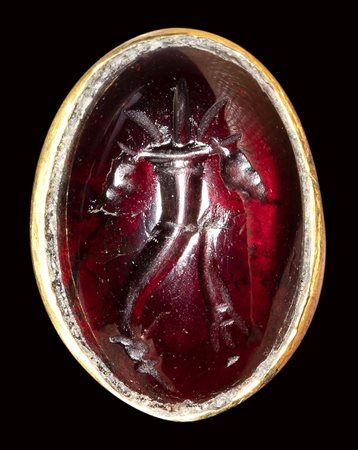
Lotto 36 A ptolemaic garnet intaglio set in a gold ring. Cornucopia.
3rd-2nd century B.C.
Intaglio : 10 x 15 mm
Ring : 17 x 15 mm
9,62 g
This fine convex hellenistic garnet intaglio is set in an ancient gold ring. The cornucopia, engraved in the typical ptolemaic model as in the coins, is characterized by two grape bunches hanging at sides, bound with fillet (see PTOLEMAIC KINGS of EGYPT. Arsinoe II Philadelphos. AV Mnaieion – 'Oktadrachm' Alexandreia mint. Struck under Ptolemy II, circa 252/1-250/49 BC). Attractive color of the stone. Mirror polishing.
U.K. private collection, London. -
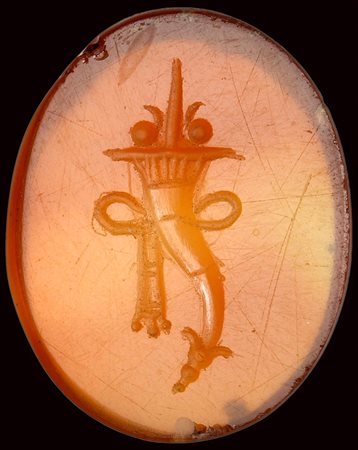
Lotto 37 A large late hellenistic carnelian intaglio. Cornucopia.
2nd century B.C.
14 x 17 x 3,5 mm
This beautiful and well detailed cornucopia with ribbons is inspired by ptolemaic coins issues (see: Ptolemaic Kings of Egypt, Arsinoe II Philadelphos or Ptolemy III Evergetes and posthumus issues, mint of Alexandria). Emblema of good luck and abundance, elegantly composed. Use of globular elements. Slight wear marks. Attractive color of the stone.
U.K. private collection, London. -
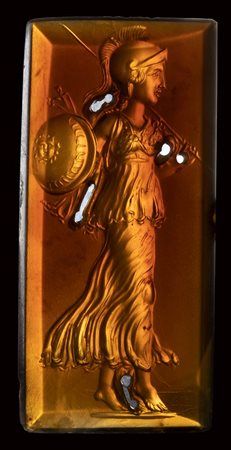
Lotto 38 A very fine Greek late classical rectangular sard intaglio - plaque. Athena.
Late 4th century B.C.
18,5 x 39 x 3 mm
Athena, walking on tiptoe to the left side, holding a spear in the left hand and a round-shield (with Medusa mask in relief) in the right arm. She wears a crested Attic helmet and a long belted chiton, with aegis. Small groundline. The light dancing pose is far removed from the early stately representations of Athena. The elegant transparency of the folds is in line with the late fifth and early fourth century work. An interesting parallel for the iconography and the pose, is a sard intaglio (British Museum, 65.7-12.141, 3rd century B.C., Walters Cat. no. 1144); for the shape of the plaque, a quadrangular chalcedony with back faceted, Maenad (found in the theatre of Dionysos, Athens, now in the Staatliche Museum of Berlin).This remarkable rectangular sard is a rare and precious testimony of Greek glyptic production of the late classical period. The beauty of the engraving, the style perfection and the great rarity of the typology (a large, rectangular plaque, extremely thin) make it more difficult to find close comparisons to this piece, in some aspects apparently unique in its kind.
An interesting detail of this piece is the presence of ancient fixing holes present on the stone, directly on the figure. These are four fixing points each consisting of two circular holes. Only in one case the two holes remain intact and circular (on the right, on the hand of the figure). In the other three cases, however, the small portion that separated the two holes, too thin and fragile, is damaged; however their division is still visible. The destination of this plaque is not entirely certain, but these holes suggest that probably, in a con- text to be defined, it was sewn directly to a precious dress-garment or a simulacrum. The stone is extremely thin, with a faceted back. On the surface, light traces of burning. Slight wear marks. Intact.
Parallels: G.M.A. Richter, The engraved gems of the greeks, etruscans and romans - part one. A History of Greek Art in miniature, Phaidon 1968, p. 84 n. 253-255, p. 143 n. 549.
U.K. private collection, London. Property of a London gentleman; previously from the collection of R.T. formerly acquired on the Antique Hypermarket, M. Cohen (Antiques) in the 70's. -
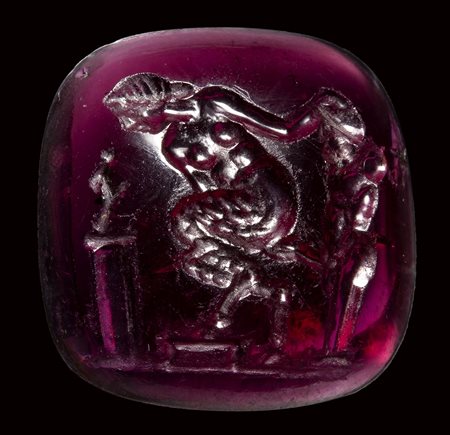
Lotto 39 A fine late hellenistic garnet intaglio. Erotic scene with herm.
2nd - 1st century B.C.
16 x 16 x 4 mm
A female satyr offers herself to a priapic herm on a base, her hand to its head, one foot raised on a low base. In front of her, a column surmounted by a priapic idol. Groundline. This erotic scene is inspired by ancient greek models, executed also in marble relief during the roman era. For a similar composition, see a roman marble sarcophagus carved with scenes of Bacchic revelry, 2nd century A.D. See the detail of a female Pan (and a Pan headed herm), and copied also in other similar variant as for a carnelian intaglio, Marlborough gem collection (a male with short cloak standing on a low column; a bearded satyr playing double pipes; a burning altar; a girl satyr offers herself to a priapic herm on a base, her hand to its head, one foot raised on a low base). Very vivid and attractive color of the stone.
Mirror polishing. Wear marks. Rare.
Parallels: Beazley Archive - Gem Database, cast from the Marlborough gems, n. 336, carnelian intaglio in a gold ring, Story-Maskelyne, M.H.: The Marlborough Gems (1870): no. 637; Boardman, J., Scarisbrick, D., Wagner C., Zwierlein-Diehl, E: The Marlborough Gems (2009): no. 336; Catherine Johns, Sex or Symbol. Erotic images of Greece and Rome, 1989.
U.K., private collection 80's, London. -
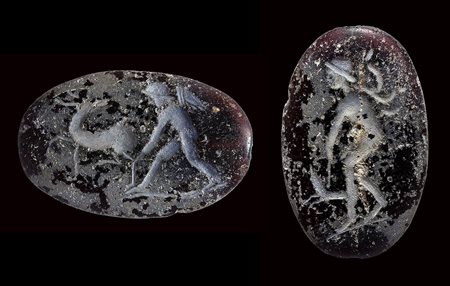
Lotto 40 A late hellenistic two-faced glass intaglio. Eros with stag & Eros with a dog.
2nd-1st century B.C.
20 x 32 x 11 mm
This rare oval shaped glass intaglio presents a scene on each face. On one face, the scene is rendered horizontally with an Eros walking on the left and a stag looking toward him. On the other one, the scene is treated vertically, with Eros and his dog turned on the left. Ground line. The pendant is drilled lenghtwise, with bronze traces inside. Nice iridescent patina.
U.K. private collection, London. -
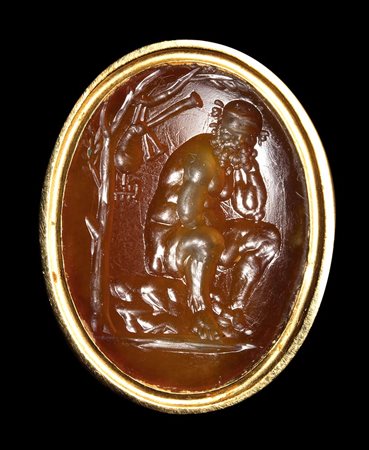
Lotto 41 A very fine hellenistich jacinth intaglio. Seated satyr.
3rd-2nd century B.C.
Intaglio : 15 x 19 mm
Ring : 18 x 17 mm
3,30 g
Formerly in the Ionides Collection, this beautiful intaglio is characterized by convex face and flat back, with the figure of a bald and elderly satyr, seated beside a tree, his bagpipes hung up behind him. The stone is set as a ring in a modern metal mounting. Slight wear marks. Beautiful color of the stone, which becomes lighter where the intaglio is deeper. Sir John Boardman remarks " To judge from the confident and bold cutting of the scene on no. 16 this is another Hellenistic gem. Later treatment of this subject would have rendered the anatomy, features and tree in greater detail but with less sculptural force. The satyr has hung up his pipes and sits tired and somewhat fuddled in a pose long employed in Greek Art for similar, although generally heroic subjects - the bomused, mad Ajax, sulking Achilles, even the sad patient Penelope. Here the comparative triviality of the subject takes nothing from the dignity of the figure. We might recognize here Marsyas, defeated by Apollo who has hung his now useless pipes on the tree to which he will soon be bound, to be flayed for thi presumption. Such representations are seen on gems but it should be the reed pipes (auloi) that he played, and not the bagpipes, as here. However, the Marsyas scenes probably inspired this picture".
Parallels: J. Boardman, Engraved gems. The Ionides collection, pp. 21-22 n. 16; p. 93 fig; 16.
U.K. private collection. Formerly in the Ionides Collection, formed by Constantine Alexander Ionides (1833-1900) and his son, Alexander Constantine (1862-1931). Ex Sotheby's auction, Antiquities, London, december 1990, lot. 94. -
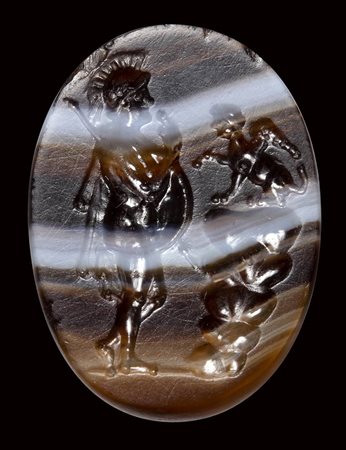
Lotto 42 A fine roman italic banded agate intaglio. Oedipus with the Sphinx.
2nd century B.C.
15 x 21 x 3 mm
The Greek hero is standing, facing right, in front of the sphinx. The character is helmeted and holds a spear with a shield; on his shoulders he wears a cloak while the rest of the body is naked. The winged sphinx is seated on top of the rocks in the act of raising the right paw, while Oedipus brings his right hand towards the face, in a colloquial gesture, typical for this iconography. Groundline. The intaglio is engraved with great skill on an extraordinary variety of banded agate with dark brown bands almost black, honey tones and white with transparencies. Presence of globular elements that emphasize the anatomical details of the figures. Nice size of the stone. Wear marks. Slight chipping on the top edge. Rare.
Parallels: G. Sena Chiesa, Gemme. Dalla corte imperiale alla corte celeste, pp. 56-57; Die Antiken Gemmen des Kunsthistorisches Museum in Wien, band III, p. 52 n. 1638. Die Antiken Gemmen in Deutschen Sammlungen, Band IV, Hannover und Hamburg, n. 1754.
U.K., private collection 80's, London. -
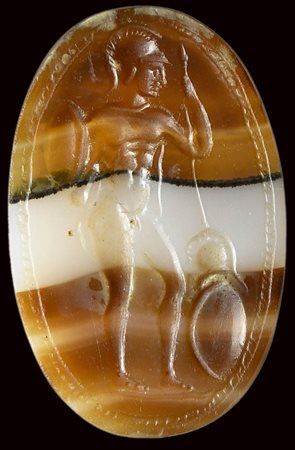
Lotto 43 A fine and large banded agate roman italic intaglio. Warrior.
2nd century B.C.
10 x 16 x 3 mm
The male figure wears a helmet with a crest, and is characterized by a naked, slender and muscular body.
The character, referable to an heroic figure, faces right and holds a small shield with his right hand (under which the sword is seen in the scabbard); with his left hand he holds a spear. At his feet, another larger shield on which a helmet is placed. Groundline.
Around, a dotted frame. The presence of a shield with a helmet at the feet of the warrior is referable to the commemoration and funeral honor of a soldier who died bravely in battle. Specimen executed with great technical skill and artistic finesse. Use of globular elements. Beautiful variety of banded agate with honey and brown tones, and characterized by a slight burn on the edge.
U.K. private collection, London. -
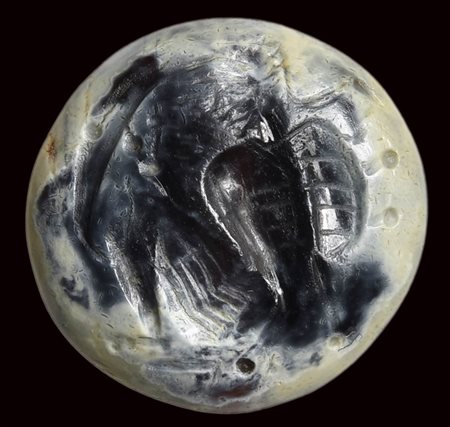
Lotto 44 A roman italic burnt sard. Dying Otriade.
2nd century B.C.
Diam_ 10 x 2 mm
The spartan warrior is seated on the ground, still holding the sword with his left hand and covering himself with the shield held by his right hand. The character wears helmet and armor. Use of globular elements, typical of the Italic style. Attractive and peculiar color of the stone due to burns. Interesting composition.
U.K. private collection, London. -
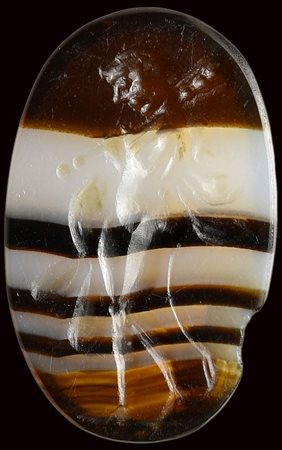
Lotto 45 A fine banded agate roman italic intaglio. Omphale.
2nd century B.C.
11 x 18 x 3 mm
The mythological figure is turned to the left, and supports the heavy club of Hercules on his delicate shoulders. Her naked body, depicted in her typical sensual pose, is partially protected by the leontea. Use of globular elements. Intaglio executed with technical skill and excellent composition.Extraordinary varity of banded agate, characterized by vivid colors. Slight wear marks. Chipping on the edge.
U.K. private collection, London. -
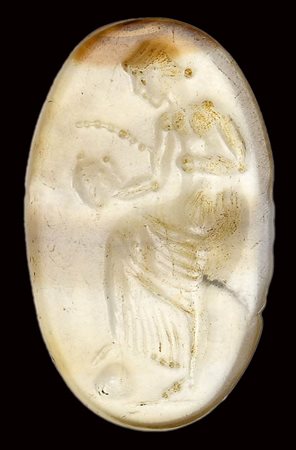
Lotto 46 A roman italic banded agate intaglio. Muse.
2nd century B.C.
9 x 15 x 2 mm
The female figure is turned to the left and wears a long draped dress. With her left hand she holds a frond, with her right hand a theatrical mask. The figure, probably identifiable with Thalia or Melpomene, contemplates the mask and rests a foot on a globe. Use of globular elements. Slight wear mask.
U.K. private collection, London. -
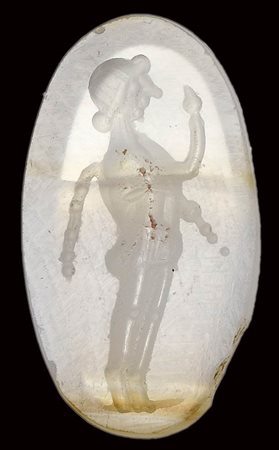
Lotto 47 A roman italic banded agate intaglio. Faun.
2nd century B.C.
8,5 x 15 x 3 mm
The character is facing right on tiptoes; with his left hand he holds a curved stick as he raises the right hand towards his face. Groundline. Use of globular elements. Slight wear marks.
U.K. private collection, London. -
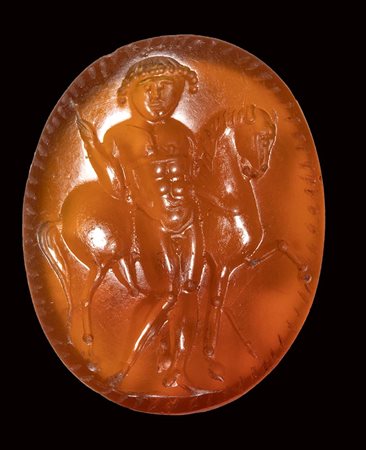
Lotto 48 A roman italic carnelian intaglio. Male figure with a horse.
2nd-1st century B.C.
15 x 19 x 4 mm
The figure is standing, with the front body slightly in three - quarters. Behind, the horse in profile, facing right. The body of the warrior is characterized by a very well-detailed anatomy, with the presence of numerous globular elements that emphasize the musculature and anatomical structure. The facial features are always performed with globules, as well as the thick helmet-shaped hair. Around, a dotted frame. Specimen executed with peculiar style. Very fine work. Rare.
European private collection.