
Auction 86 - Glyptics and Ancient Jewelry
-
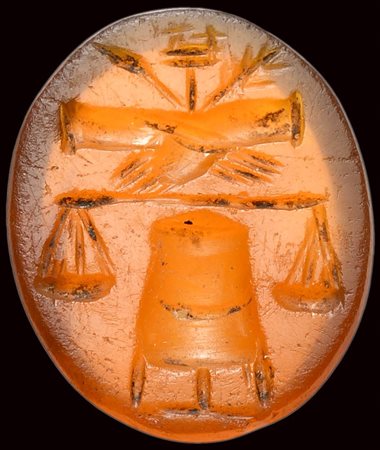
Lotto 97 A roman carnelian intaglio. Allegorical emblema.
2nd century A.D.
9 x 12 x 2 mm
A modius is surmounted by a balance; above: two clasped hands holding an ear of corn, a palm branch and a caduceus (dextrarum junctio). Allegorical emblema referred to abundance, luck and union. Slight wear marks.
U.K private collection -
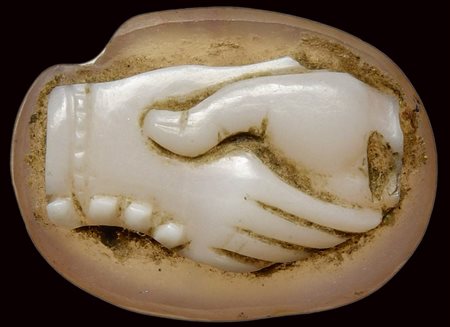
Lotto 98 A late roman two-layers agate cameo. Dextrarum junctio.
3rd - 4th century A.D.
8 x 11 x 3,5 mm
Two clasped hands. Allegorical depiction of the military and political alliance, as for a marriage. Wear marks. Chipping on the edge.
U.K. private collection -
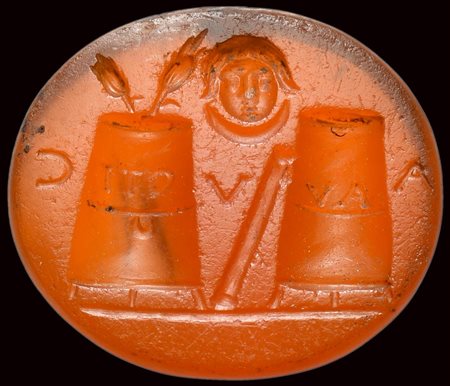
Lotto 99 A roman carnelian intaglio. Allegorical emblema with two inscribed modius and mask.
1st century A.D.
11,5 x 13 x 3 mm
The emblematic representation is composed of two Modii, separated in the center by an instrument resting on the container on the right. Above the right container: AV; on the left container, which contains two ears of wheat: OTI.
In the field, the letters: A-V-C. Above, a frontal mask on crescent moon. Groundline.
Unusual allegorical emblem, executed with great skill and compositional symmetry. The subject is probably referred to a corporation. Attractive color of stone. Slight wear marks. Rare.
U.K private collection, London. -
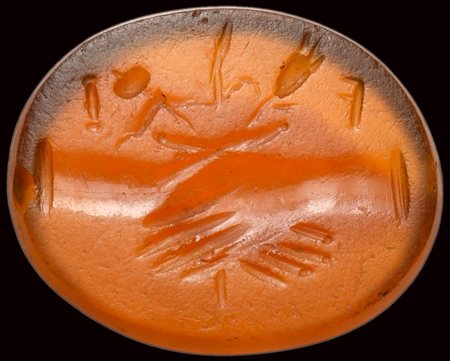
Lotto 100 A roman carnelian intaglio. Dextrarum junctio with letters.
1st century B.C. - 2nd century A.D.
9 x 12 x 2 mm
Two clasped hands, holding one ear of corn, a poppy flower and a branch; above the hands, the letter F-I (probably, FIDELITAS). Allegorical emblema referable to a marriage with auspicious of abundance and good luck. Slight wear marks.
U.K private collection -
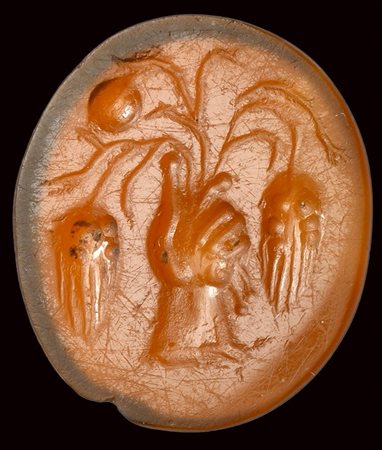
Lotto 101 A roman republican sard intaglio. Allegorical emblem.
1st century B.C.
12 x 14 x 2 mm
In a vertical position, one hand is holding a poppy flower and two ears of wheat which elegantly hang downwards. Use of globular elements. Allegorical emblema referred to good luck, abundance and prosperity. Wear marks.
U.K. private collection -
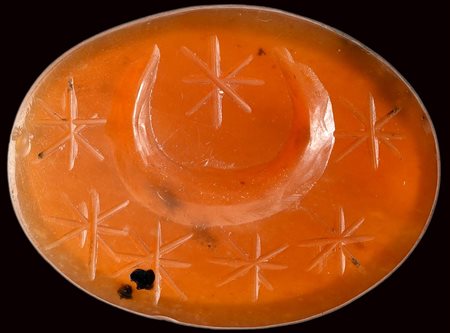
Lotto 102 A large roman carnelian intaglio. Crescent moon with seven stars.
2nd century A.D.
13 x 17 x 3 mm
Allegorical emblema with astrological references . Slight wear marks.
Parallels: U. Pannuti, Catalogo della collezione glittica, vol. II, p. 294.
U.K private collection -
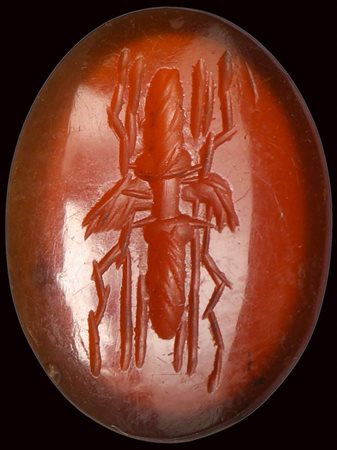
Lotto 103 A roman deep red carnelian intaglio. Winged thunderbolt.
1st - 2nd century A.D.
10 x 13 x 3 mm
The emblematic depiction is inspired by coin issues (Divus Augustus Pater, AE dupondius - winged thunderbolts). Mirror polishing. Attractive color of the stone.
U.K private collection -
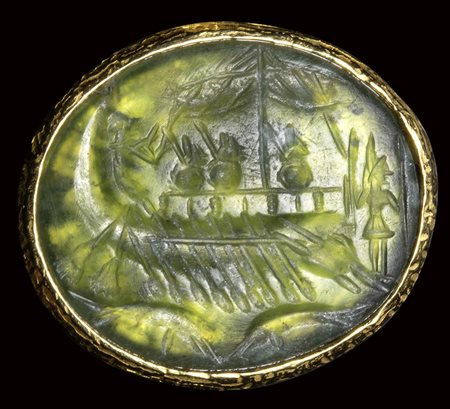
Lotto 104 Gold cufflinks with silver gem-impression. A roman green chalcedony intaglio. Warship with dolphins.
1st-3rd century A.D.
intaglio : 17 x 21 mm
Weight (cufflinks) : 16,92 g
The warship sails to the right and is characterized by a wild boar-headed rostrum, a high aplustre, oars at sea and a large, partially open sail; on board, 3 helmeted soldiers armed with spears and shields. On the rostrum there is an armed soldier (presumably the leader highlighted in a certain allegorical sense ?). At the bottom of the ship: the helmsman. At sea, two dolphins. This specimen, engraved on a precious large green chalcedony, finds a very similar comparison with a specimen preserved at The Hermitage Museum. Slight wear marks. The stone is set in a gold mounting as a cufflink. The lot include a nice toned silver impression.
Parallels: The sails of Hellas. Seafaring in the ancient world. The State Hermitage Museum (Exhibition Catalogue), St; Petesburg 2010, p. 186 n. 101 inv. ΓP 22776.
European private collection. -
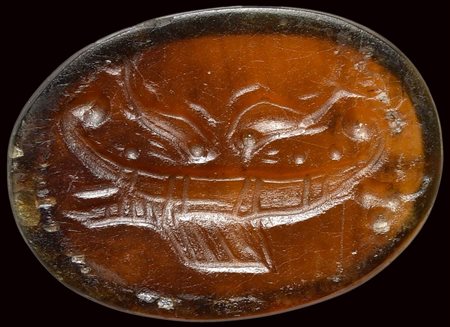
Lotto 105 A roman italic sard intaglio. Two dolphins above a ship.
2nd-1st century B.C.
10 x 14 x 2 mm
The two sea creatures are depicted on a military ship as an allegorical emblem. The ship is characterized by rostrum. Use of globular elements. Attractive color of the stone. Slight wear marks.
U.K private collection, London. -
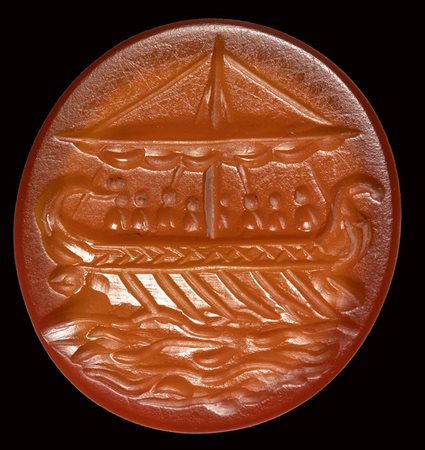
Lotto 106 A roman carnelian intaglio. Galley with figures.
1st century B.C. - 1st century A.D.
12 x 13 x 2,5 mm
A galley with eight figures holding round shields; the warship has the rostrum and the aplustre, the sail closed and the ropes pulled. Below, the waves of the sea (for a similar representation of the boat see the carnelian intaglio, Berlin, inv. FG6880). Interesting detailed work. Attractive color of the stone. Wear marks. Rare.
Parallels: Antike Gemmen in Deutschen Sammlungen, Band II, Staatliche Museen Preubischer Kultubesitz Antikenabteilung- Berlin, p. 176 n. 476.
U.K., private collection 80's, London. -
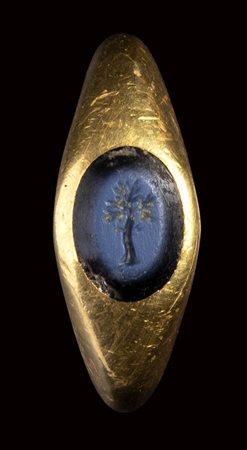
Lotto 107 A roman nicolo intaglio set in a massive gold ring. Tree.
1st-3rd century A.D.
intaglio : 6 x 9 mm
ring diam : 12 x 16 mm
8,86 g
In a central position, a tree, a symbol of strength and prosperity. The small stone is finely engraved and shows slight signs of wear.
U.K private collection, London. -
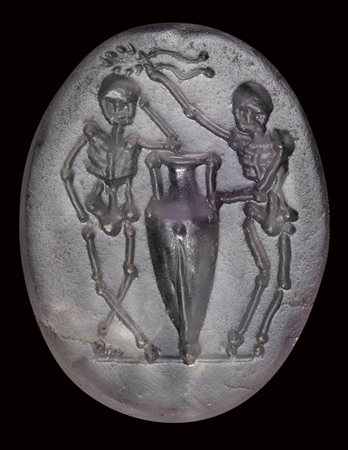
Lotto 108 A roman republican amethyst intaglio. Two skeletons with amphora.
1st century B.C.
16 x 21 x 3,5 mm
The two skeletons are standing and symmetrically flank a large wine amphora, depicted in a central position.
The skeleton on the right is held in the amphora with one hand and with the other crowns with a laurel wreath his companion, who leans peacefully against the oblong container. Groundline. The highly allegorical scene refers to death and the pleasures of life, between the memento mori and a hymn to the triumph of life that continues even after death.
This representation is attested in the late roman republican repertoire and is probably inspired by similar representations present on the mosaics.
Presence of globular elements. Wear marks and slight small crack.
Intaglio engraved with great skill (without excluding a certain sense of irony) on a very clear variety of amethyst, which well alludes to the wine and the Dionysian sphere. Very rare.
Parallels: Antike Gemmen in Deutschen Sammlungen, Band IV, Hannover und Hamburg, n. 468; Antike Gemmen in Deutschen Sammlungen, Band II, Staatliche Museen Preubischer Kultubesitz Antikenabteilung- Berlin, n. 421 inv. FG6518.
U.K., private collection 70's, London.