
Auction 86 - Glyptics and Ancient Jewelry
-
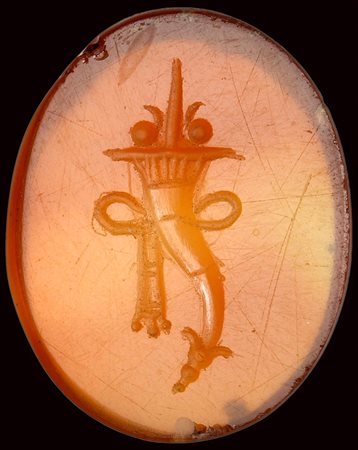
Lotto 37 A large late hellenistic carnelian intaglio. Cornucopia.
2nd century B.C.
14 x 17 x 3,5 mm
This beautiful and well detailed cornucopia with ribbons is inspired by ptolemaic coins issues (see: Ptolemaic Kings of Egypt, Arsinoe II Philadelphos or Ptolemy III Evergetes and posthumus issues, mint of Alexandria). Emblema of good luck and abundance, elegantly composed. Use of globular elements. Slight wear marks. Attractive color of the stone.
U.K. private collection, London. -
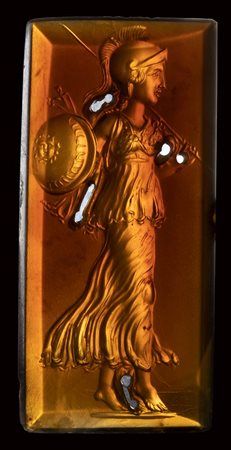
Lotto 38 A very fine Greek late classical rectangular sard intaglio - plaque. Athena.
Late 4th century B.C.
18,5 x 39 x 3 mm
Athena, walking on tiptoe to the left side, holding a spear in the left hand and a round-shield (with Medusa mask in relief) in the right arm. She wears a crested Attic helmet and a long belted chiton, with aegis. Small groundline. The light dancing pose is far removed from the early stately representations of Athena. The elegant transparency of the folds is in line with the late fifth and early fourth century work. An interesting parallel for the iconography and the pose, is a sard intaglio (British Museum, 65.7-12.141, 3rd century B.C., Walters Cat. no. 1144); for the shape of the plaque, a quadrangular chalcedony with back faceted, Maenad (found in the theatre of Dionysos, Athens, now in the Staatliche Museum of Berlin).This remarkable rectangular sard is a rare and precious testimony of Greek glyptic production of the late classical period. The beauty of the engraving, the style perfection and the great rarity of the typology (a large, rectangular plaque, extremely thin) make it more difficult to find close comparisons to this piece, in some aspects apparently unique in its kind.
An interesting detail of this piece is the presence of ancient fixing holes present on the stone, directly on the figure. These are four fixing points each consisting of two circular holes. Only in one case the two holes remain intact and circular (on the right, on the hand of the figure). In the other three cases, however, the small portion that separated the two holes, too thin and fragile, is damaged; however their division is still visible. The destination of this plaque is not entirely certain, but these holes suggest that probably, in a con- text to be defined, it was sewn directly to a precious dress-garment or a simulacrum. The stone is extremely thin, with a faceted back. On the surface, light traces of burning. Slight wear marks. Intact.
Parallels: G.M.A. Richter, The engraved gems of the greeks, etruscans and romans - part one. A History of Greek Art in miniature, Phaidon 1968, p. 84 n. 253-255, p. 143 n. 549.
U.K. private collection, London. Property of a London gentleman; previously from the collection of R.T. formerly acquired on the Antique Hypermarket, M. Cohen (Antiques) in the 70's. -
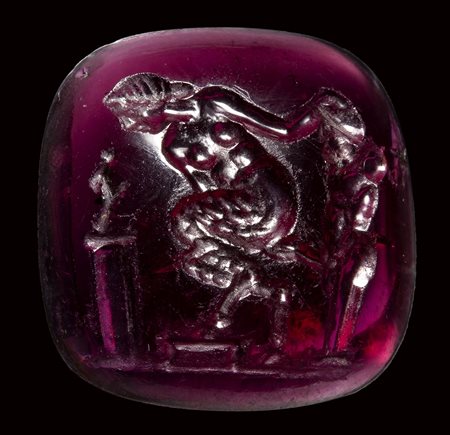
Lotto 39 A fine late hellenistic garnet intaglio. Erotic scene with herm.
2nd - 1st century B.C.
16 x 16 x 4 mm
A female satyr offers herself to a priapic herm on a base, her hand to its head, one foot raised on a low base. In front of her, a column surmounted by a priapic idol. Groundline. This erotic scene is inspired by ancient greek models, executed also in marble relief during the roman era. For a similar composition, see a roman marble sarcophagus carved with scenes of Bacchic revelry, 2nd century A.D. See the detail of a female Pan (and a Pan headed herm), and copied also in other similar variant as for a carnelian intaglio, Marlborough gem collection (a male with short cloak standing on a low column; a bearded satyr playing double pipes; a burning altar; a girl satyr offers herself to a priapic herm on a base, her hand to its head, one foot raised on a low base). Very vivid and attractive color of the stone.
Mirror polishing. Wear marks. Rare.
Parallels: Beazley Archive - Gem Database, cast from the Marlborough gems, n. 336, carnelian intaglio in a gold ring, Story-Maskelyne, M.H.: The Marlborough Gems (1870): no. 637; Boardman, J., Scarisbrick, D., Wagner C., Zwierlein-Diehl, E: The Marlborough Gems (2009): no. 336; Catherine Johns, Sex or Symbol. Erotic images of Greece and Rome, 1989.
U.K., private collection 80's, London. -
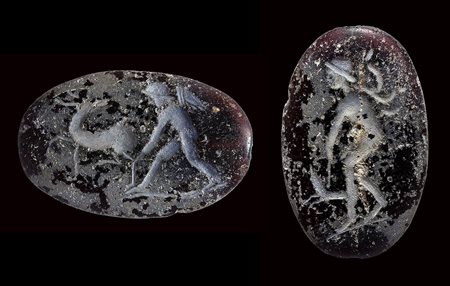
Lotto 40 A late hellenistic two-faced glass intaglio. Eros with stag & Eros with a dog.
2nd-1st century B.C.
20 x 32 x 11 mm
This rare oval shaped glass intaglio presents a scene on each face. On one face, the scene is rendered horizontally with an Eros walking on the left and a stag looking toward him. On the other one, the scene is treated vertically, with Eros and his dog turned on the left. Ground line. The pendant is drilled lenghtwise, with bronze traces inside. Nice iridescent patina.
U.K. private collection, London. -
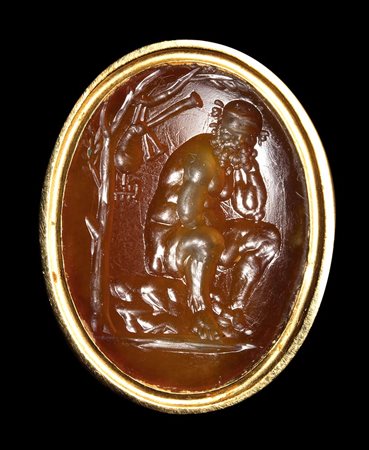
Lotto 41 A very fine hellenistich jacinth intaglio. Seated satyr.
3rd-2nd century B.C.
Intaglio : 15 x 19 mm
Ring : 18 x 17 mm
3,30 g
Formerly in the Ionides Collection, this beautiful intaglio is characterized by convex face and flat back, with the figure of a bald and elderly satyr, seated beside a tree, his bagpipes hung up behind him. The stone is set as a ring in a modern metal mounting. Slight wear marks. Beautiful color of the stone, which becomes lighter where the intaglio is deeper. Sir John Boardman remarks " To judge from the confident and bold cutting of the scene on no. 16 this is another Hellenistic gem. Later treatment of this subject would have rendered the anatomy, features and tree in greater detail but with less sculptural force. The satyr has hung up his pipes and sits tired and somewhat fuddled in a pose long employed in Greek Art for similar, although generally heroic subjects - the bomused, mad Ajax, sulking Achilles, even the sad patient Penelope. Here the comparative triviality of the subject takes nothing from the dignity of the figure. We might recognize here Marsyas, defeated by Apollo who has hung his now useless pipes on the tree to which he will soon be bound, to be flayed for thi presumption. Such representations are seen on gems but it should be the reed pipes (auloi) that he played, and not the bagpipes, as here. However, the Marsyas scenes probably inspired this picture".
Parallels: J. Boardman, Engraved gems. The Ionides collection, pp. 21-22 n. 16; p. 93 fig; 16.
U.K. private collection. Formerly in the Ionides Collection, formed by Constantine Alexander Ionides (1833-1900) and his son, Alexander Constantine (1862-1931). Ex Sotheby's auction, Antiquities, London, december 1990, lot. 94. -
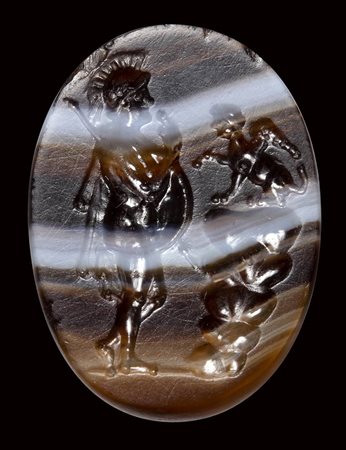
Lotto 42 A fine roman italic banded agate intaglio. Oedipus with the Sphinx.
2nd century B.C.
15 x 21 x 3 mm
The Greek hero is standing, facing right, in front of the sphinx. The character is helmeted and holds a spear with a shield; on his shoulders he wears a cloak while the rest of the body is naked. The winged sphinx is seated on top of the rocks in the act of raising the right paw, while Oedipus brings his right hand towards the face, in a colloquial gesture, typical for this iconography. Groundline. The intaglio is engraved with great skill on an extraordinary variety of banded agate with dark brown bands almost black, honey tones and white with transparencies. Presence of globular elements that emphasize the anatomical details of the figures. Nice size of the stone. Wear marks. Slight chipping on the top edge. Rare.
Parallels: G. Sena Chiesa, Gemme. Dalla corte imperiale alla corte celeste, pp. 56-57; Die Antiken Gemmen des Kunsthistorisches Museum in Wien, band III, p. 52 n. 1638. Die Antiken Gemmen in Deutschen Sammlungen, Band IV, Hannover und Hamburg, n. 1754.
U.K., private collection 80's, London. -
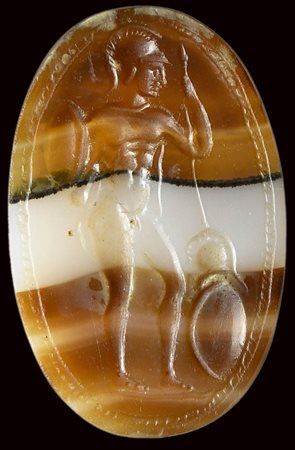
Lotto 43 A fine and large banded agate roman italic intaglio. Warrior.
2nd century B.C.
10 x 16 x 3 mm
The male figure wears a helmet with a crest, and is characterized by a naked, slender and muscular body.
The character, referable to an heroic figure, faces right and holds a small shield with his right hand (under which the sword is seen in the scabbard); with his left hand he holds a spear. At his feet, another larger shield on which a helmet is placed. Groundline.
Around, a dotted frame. The presence of a shield with a helmet at the feet of the warrior is referable to the commemoration and funeral honor of a soldier who died bravely in battle. Specimen executed with great technical skill and artistic finesse. Use of globular elements. Beautiful variety of banded agate with honey and brown tones, and characterized by a slight burn on the edge.
U.K. private collection, London. -
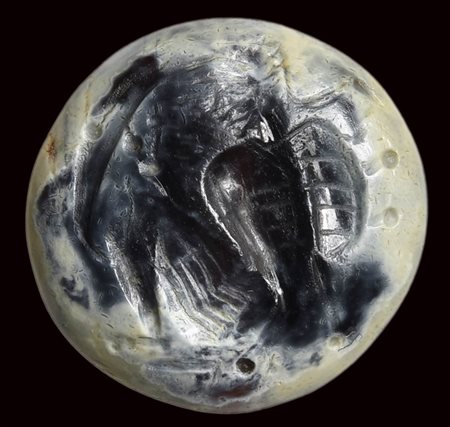
Lotto 44 A roman italic burnt sard. Dying Otriade.
2nd century B.C.
Diam_ 10 x 2 mm
The spartan warrior is seated on the ground, still holding the sword with his left hand and covering himself with the shield held by his right hand. The character wears helmet and armor. Use of globular elements, typical of the Italic style. Attractive and peculiar color of the stone due to burns. Interesting composition.
U.K. private collection, London. -
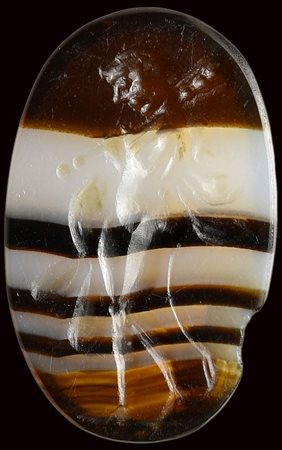
Lotto 45 A fine banded agate roman italic intaglio. Omphale.
2nd century B.C.
11 x 18 x 3 mm
The mythological figure is turned to the left, and supports the heavy club of Hercules on his delicate shoulders. Her naked body, depicted in her typical sensual pose, is partially protected by the leontea. Use of globular elements. Intaglio executed with technical skill and excellent composition.Extraordinary varity of banded agate, characterized by vivid colors. Slight wear marks. Chipping on the edge.
U.K. private collection, London. -
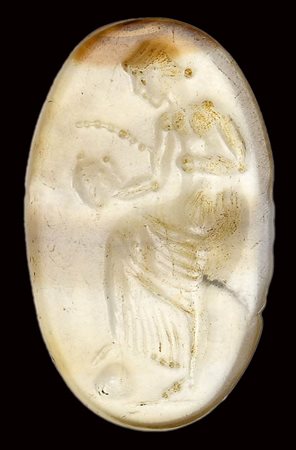
Lotto 46 A roman italic banded agate intaglio. Muse.
2nd century B.C.
9 x 15 x 2 mm
The female figure is turned to the left and wears a long draped dress. With her left hand she holds a frond, with her right hand a theatrical mask. The figure, probably identifiable with Thalia or Melpomene, contemplates the mask and rests a foot on a globe. Use of globular elements. Slight wear mask.
U.K. private collection, London. -
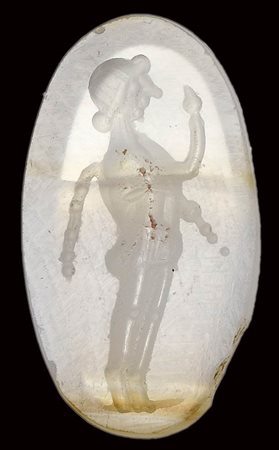
Lotto 47 A roman italic banded agate intaglio. Faun.
2nd century B.C.
8,5 x 15 x 3 mm
The character is facing right on tiptoes; with his left hand he holds a curved stick as he raises the right hand towards his face. Groundline. Use of globular elements. Slight wear marks.
U.K. private collection, London. -
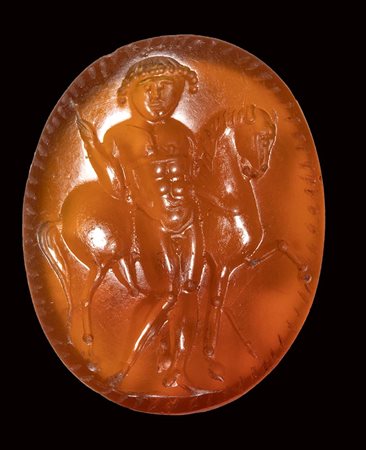
Lotto 48 A roman italic carnelian intaglio. Male figure with a horse.
2nd-1st century B.C.
15 x 19 x 4 mm
The figure is standing, with the front body slightly in three - quarters. Behind, the horse in profile, facing right. The body of the warrior is characterized by a very well-detailed anatomy, with the presence of numerous globular elements that emphasize the musculature and anatomical structure. The facial features are always performed with globules, as well as the thick helmet-shaped hair. Around, a dotted frame. Specimen executed with peculiar style. Very fine work. Rare.
European private collection.