
Auction 86 - Glyptics and Ancient Jewelry
-
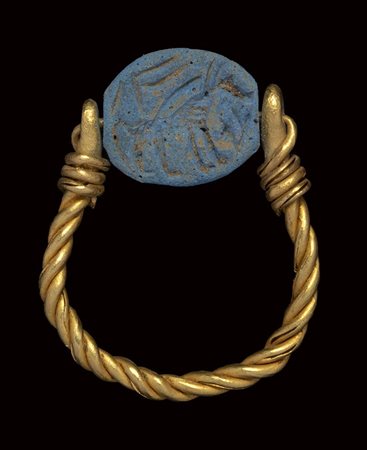
Lotto 25 A phoenician blue glass paste scarab intaglio, mounted on an ancient gold ring. Quadrupede
5th - 4th century B.C.
intaglio : 10 x 12 x 5 mm
ring diam : 17 mm
2,77 g
The animal is facing left. For the mounting, the refined ring-shaped hoop is formed by the interweaving of two thread-like elements of different thickness and ends near the scarab with a spiral twisted pattern. The mounting style reminds etruscan production, which makes this scaraboid ring an example of one of the most develop market in Etruria. Very fine condition.
U.K. private collection 1985. Formerly in Arthur Sambon (1867-1947) collection. -
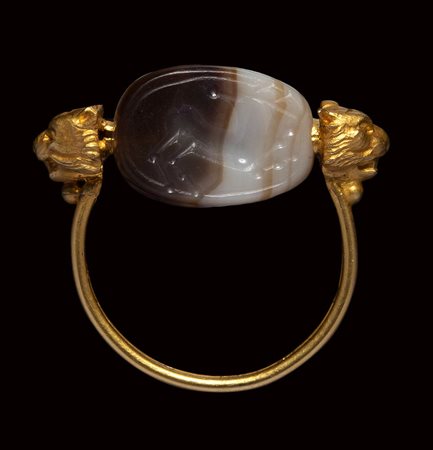
Lotto 26 An etruscan banded agate scarab intaglio mounted on an gold ring. Horned stag running.
4th century B.C.
intaglio : 10 x 14 x 7 mm
ring : 19 x 16 mm
5,84 gr.
The quadrupede is running to the right, his head turned on the left. Globular style. Rope pattern border. The gold mounting, a swivel-ring with lion head terminals is probably postclassical. Very fine condition.
Property of a gentleman, London. Ex Christie's, Fine Antiquities, 6 July 1994, lot 339. -
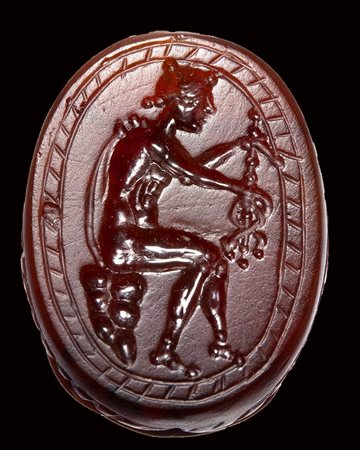
Lotto 27 An etruscan carnelian scarab intaglio. Hermes with caduceus.
4th-3rd century B.C.
11 x 15 x 9,5 mm
The young god is seated on top of the rocks, facing right. His body is naked and has a detailed incised musculature, emphasized by the presence of globular elements. On his head he wears the petasus while on his shoulders a cloak with chlamys. With the left hand he holds the handle of the caduceus, while with the right he seems to touch one of the two snakes entwined with the magic stick, facing downwards. A foot and one hand of the god are engraved over the dotted frame, with a globular termination, according to a style typical of this production (near the socalled “Italic- Etruscanizing group” of the 3rd century B.C., Richter, Pl. XXXIV).The allegorical scene seems to be inspired from a mythicall episode while the pose recalls the scenes of characters who manufacture or create tools-works of art. Around the figure, a dotted frame finely engraved. The figure is executed in a refined way and is characterized by a mirror polish in all its details. Slight superficial crack on the back of the beetle. Wear marks. Rare
U.K., private collection 80's. -
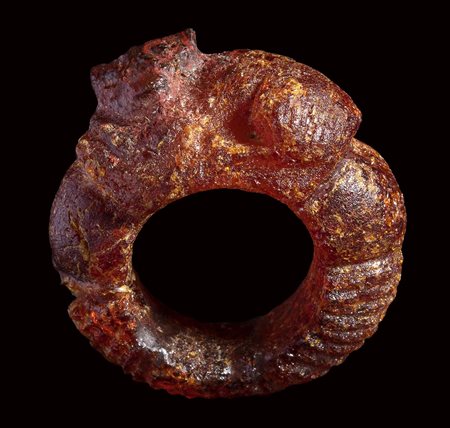
Lotto 28 A roman amber finger ring with lion protome.
1st – 2nd century A.D.
30 x 32 mm
Ring shaped in a fine twist. The bezel in a form of a crouched lion. Nice dark red color, opaque on the surface.
Parallel: Cabinet des Médailles, Paris, inv. Froehner.1138
U.K. private collection, London. -
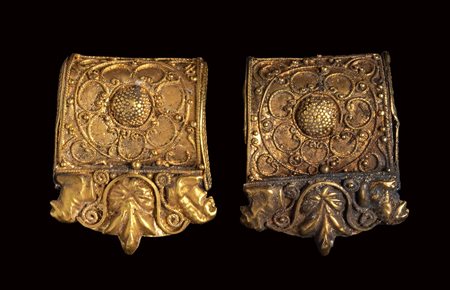
Lotto 29 A pair of etruscan gold bauletto earrings.
6th - 5th century B.C.
H : 18 mm circa
4,01 g
Broad strip of gold bent into three-quarters of a cylinder. The two ends of the strip are joined by a wire or narrow band, which attached the cylinder to the ear.The larger surface of the cylinder is decorated with filigree and granulation. The terminals are embossed with vegetal and lion protome pattern. Very fine work. Traces of oxydation on the back of one earring and on its terminal clasp.
Parallel: Dallas Museum of Art, inv. 1991.75.17.A-B
U.K. private collection -
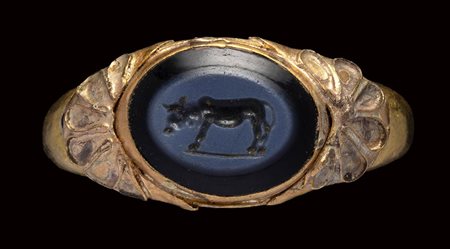
Lotto 30 A roman nicolo intaglio set in an etruscan gold ring. Bull.
intaglio: 1st-2nd century A.D.; ring: 4th-3rd century B.C.
intaglio : 9 x 12 mm
ring diam : 15 x 12 mm
4,02 g
This specimen is an interesting testimony of glyptic reuse. The gold-foil hollow ring is an Etruscan production; the nicolo intaglio is a roman imperial production (a similar case is attested, with the same type of stone, London, British Museum, FR 298). Intact.
Parallel: Aa.Vv., L'Oro degli Etruschi, M. Cristofani and M. Martelli, p. 300 n. 190.
U.K. private collection -
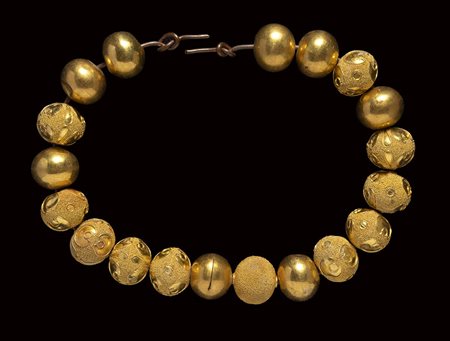
Lotto 31 A group of 19 etruscan gold beads.
6th century B.C.
Bead diam : 10 mm
12,65 g
Spherical gold beads, including 10 of them decorated with granulation of great finesse (one completely decorated with granulation). Very fine condition.
Parallels : Antikenmuseum, Berlin, inv. GI.6; Cristofani, M., Martelli, M. , L'oro degli Etruschi, 1985, p. 172, fig. 154.
Monte-Carlo, private collection of Mr. L, prior to 90’s -
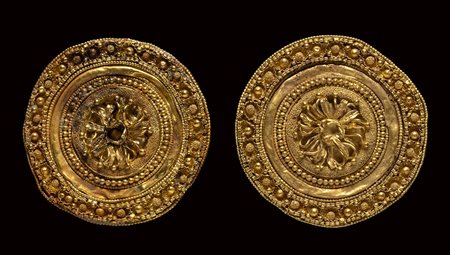
Lotto 32 A pair of etruscan gold disc ear-stud.
2nd half of the 6th century B.C.
Diam : 34 mm
11,18 g
The disks are formed of a circular gold sheet, the outer surface of which has a central floral element composed of radiated leaves of gold, each bearing granules at its top, and background in granulation. Three concentric bands encircle the floral:
The outtern band is composed with 28 flowers made with curl leaves, granulated beads alternated with plain one. The intern band is composed with 57 gold spheres encircled with beaded wire. Backside covered with a plain gold sheet. Hole at the center to attach the ear clip (one partially remained). The central gold bead are missing in each earring.
Originally an East Greek type, striking disk earrings were a fashionable female accessory for several centuries. Complex patterns were made with filigree and granulation, techniques of applying fine gold wires and miniscule granules to create intricate designs.
Parallels : J.-P Getty Museum, Los Angeles, inv. 83.AM.2.2.1; Metropolitan Museum, NY, inv. 13.225.30a,b. Cristofani, M., Martelli, M. , L'oro degli Etruschi, 1985, p. 170, fig. 148-153
Marshall 1911, pp. 136-137, n. 1414 tav. 20.
Monte-Carlo, private collection of Mr. L, prior 90’s -
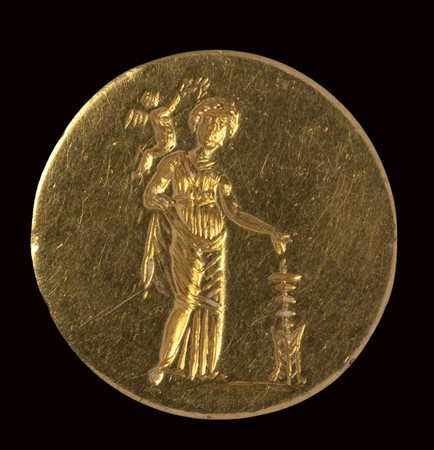
Lotto 33 A very fine early Hellenistic gold ring with engraved bezel. Aphrodite and Eros.
4th - 3rd century B.C.
Bezel diam : 25 mm
ring : 20 x 15 mm
16,12 gr.
The hoop is rounded without, flat within, ending on a flat large circular bezel. The bezel is engraved with the group of Aphrodite and Eros. The goddess is standing in a contrapposto posture, her right leg slighlty bend forward.She wears a chiton with a himation which shows her body shape by transparency. Turned to the right, she's sprinkling incense on to the flame of a three-legged incense-burner. The little winged god is seated on her right shoulder and turns to crown her. Groundline.
Solid gold. Slight wear marks. Very fine condition and rare specimen. For a similar scene and ring see Metropolitan Museum, NY, inv. 06.1125
Parallels :
Chabouillet, Anatole. Catalogue général et raisonné des camées et pierres gravées de la Bibliothèque impériale. Paris : 1858, n°2630.
Marshall, F.H., 1968,n° 83 et 84
Richter, Gisela M. A. 1920. Catalogue of Engraved Gems of the Classical Style. no. 48, pp. 45-46, pl. 20, New York: The Metropolitan Museum of Art.
Lexicon Iconographicum Mythologiae Classicae (LIMC). 1984. Vol. 2: Aphrodisias-Athena. "Aphrodite," p. 41, no. 286, pl. 30, Zürich: Artemis Verlag
Property of a gentleman, London. Acquired at Sotheby's, Antiquities, London, 14th Dec. 1990, lot 93
Ex Guilhou Collection
Ex Harari Collection
Published :
Guilhou (de Ricci), n° 289
Guilhou, n° 132
Boardman, GGFR 421, n° 690
Boardman, Scarisbrick, n° 11. -
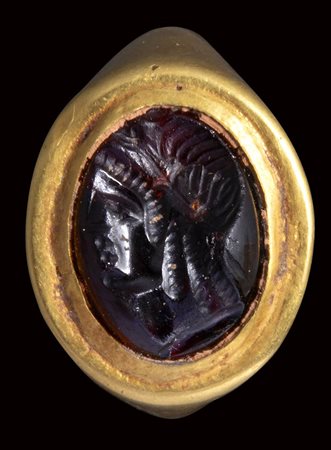
Lotto 34 An fine hellenistic garnet intaglio mounted on an ancient gold ring. Bust of Isis.
2nd-1st century B.C.
Intaglio : 10 x 14 mm
Ring : 17 x 16 mm
7,89 g
With a hollow gold hoop, broad shoulders ending with an oval bezel set with a garnet intaglio. The gem shows the bust of a woman, as Isis, with calamistrated locks, wearing a diadema. Use of globular elements for the eye and the mouth. This is possibly the portrait of a Ptolemaic queen as Isis, perhaps Cleopatra Thea (see Plantzos 52 - 4, pls. 9-11). High convex garnet stone. Mirror polishing. This beautiful intaglio is set on an ancient gold ring. Very fine condition.
Parallels: J. Boardman, C. Wagner, Masterpieces in miniature. Engraved gems from prehistory to the present, p. 131 n. 119; Antiken gemmen in Deutschen sammlungen, band I, Staatliche - Munchen, p. 81 n. 439 (Granat). M.L. Vollenweider, Camées et intaillles, Cabinet des médailles, . 105 n. 92 (Cléopatre I assimilée à Isis).
U.K. private collection, London. -
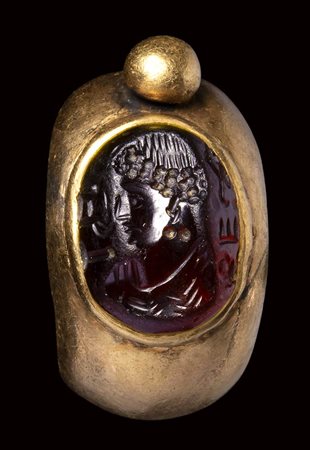
Lotto 35 A North-West Indian gold ring with garnet intaglio. Bust of man with inscriptions.
5th-6th century A.D
Intaglio : 10 x 13 mm
Ring : 16 x 13 mm
11,47 gr
A large hollowed hoop, rounded without, flatten within. The oval bezel set with a nice thick intaglio. Gold sphere on the hoop, to mark the sens of impression. The male bust is turned on the left. Clean-shaved, but has a moustache. He wears an earring with two circular pendants. On the edge, clockwise, Brahmi script. Rare.
Parallels: J. Spier, J. Ogden, Rings of the ancient world, p. 53 n. 16; Henig, M., Classical Gems, 1994, p.216-217, n°484-488.
U.K. private collection, London. -
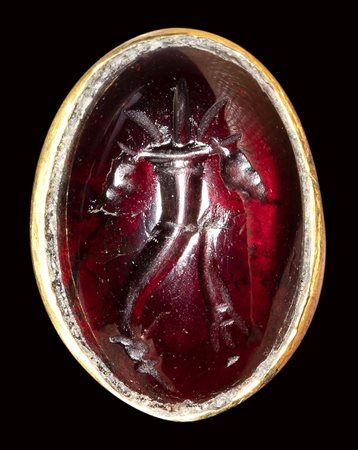
Lotto 36 A ptolemaic garnet intaglio set in a gold ring. Cornucopia.
3rd-2nd century B.C.
Intaglio : 10 x 15 mm
Ring : 17 x 15 mm
9,62 g
This fine convex hellenistic garnet intaglio is set in an ancient gold ring. The cornucopia, engraved in the typical ptolemaic model as in the coins, is characterized by two grape bunches hanging at sides, bound with fillet (see PTOLEMAIC KINGS of EGYPT. Arsinoe II Philadelphos. AV Mnaieion – 'Oktadrachm' Alexandreia mint. Struck under Ptolemy II, circa 252/1-250/49 BC). Attractive color of the stone. Mirror polishing.
U.K. private collection, London.