
Auction 86 - Glyptics and Ancient Jewelry
-
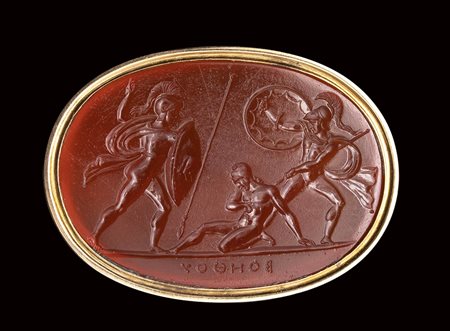
Lotto 313 A fine neoclassic Poniatowski carnelian intaglio mounted on a gold ring. Achilles having killed Pilidorus, attacked by Hector.
19th century A.D.
Intaglio : 20 x 30 mm
Ring : 26 x 17 mm
7,89 g
The intense fighting scene refers to an episode of the Trojan War. The brave Achilles, after killing Polidoro by hitting him with his spear, is attacked by Hector, who faces him without fear. The bodies are naked, sculpted in their youthful beauty, with the muscles tense in combat. Only helmet and shield protect them; the rising drapery is purely ornamental, a neoclassical signature of this splendid stone, mounted in its original ring commissioned by the Polish prince for his legendary collection. The intaglio is signed with greek letters under the groundline: ΒΟΗΘΟΥ (Boethos). Very fine condition.
Parallels: Beazley Archive; Catalogue des pierres graves antiques de S.A. le Prince Stanislas Poniatowski ([1830?]-1833): V.168; Christie's, London: 1839-1159. G. Vangelli de Cresci, Ad Minima Ad Maxima. La raccolta di impronte e matrici di gemme incise e medaglie. Museo dell'Antica zecca di Lucca.
U.K private collection, London. -
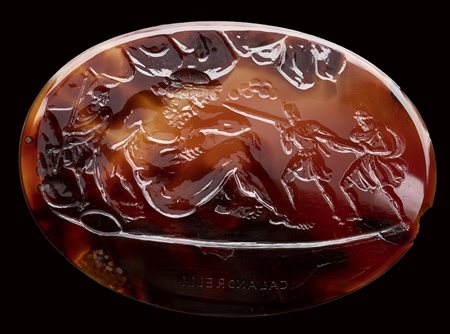
Lotto 314 A very fine neoclassical agate intaglio signed Calandrelli.
Ulysses and his companions blinding the eye of Polyphemus.
1820-1830 circa
42 x 59 x 4 mm
This remarkable large agate intaglio, signed below CALANDRELLI, depicts the famous scene in which
Ulysses and his companions are ready to blind the cyclops in his cave, after falling asleep for drinking wine. On the right Ulysses, recognizable by his typical headdress, pushes the base of the long inflamed wooden pole, directed towards the eye of Polyphemus, helped by his companion; wearing an helmet and a cloack covering an armor. A third character is instead behind the monstrous cyclops, to monitor the action, armed with a spear and always dressed with helmet, armor and cloak. The cyclops, who occupies the most prominent central position, is intoxicated and seated on the ground, with his head bowed over his left arm, resting on the raised knee, as a sign of yielding to sleep; instead his right arm is abandoned towards the ground, near the emptied cup. The scene is set inside the cave, with masterfully rendered rocks.
The same delicacy is used to make the smoke coming out of the tip of the bursting pole.The scene is set according to a well-balanced structure and studied by the artist, as evidenced by one of his drawings (Berlin) which undoubtedly constitutes the faithful preparatory model for this gem: the correspondance between the preparatory drawing and the agate carving it is in fact very strong, almost total, except for some aesthetic variations (as often happened during the execution phase).There is a second variant of the same scene, always attributed to Calandrelli but signed in Greek as Demophilos (ΔΕΜΟΦΙΛΟΣ ΕΠΟΙΕΙ), made for the Prince Poniatowski. The attribution of the drawing to Calandrelli is certain; the attribution to Calandrelli for the Poniatowski intaglio (currently missing and testified by the plaster cast ) may not be so sure.
The style of the intaglio signed Demophilos (propabably Calandrelli ?) appears in fact different, far inferior in skill and style, with anatomical details often artistically weak and the proportions of the characters not always respected.
The agate intaglio signed by the artist, reveals in fact an extraordinary engraving quality completely different, with a masterly rendering of the anatomical details and the expressive physiognomy of the figures very faithful to the drawing. Every detail is mirror-polished with great skill. A very rare and extraordinary agate variety was used to represent this mythological episode: the agate in fact presents very fine variety of colors from red, yellow to brown tones with shades and spots, as if to symbolize the cave, the smoke and the violence of the scene. The stone has slight signs of wear, small cracks and a chipping on the edge, probably caused by removing the stone from its original setting.
A Grand Tour Era plaster cast impression, taken from this work, has been identified in a private collection. Unpublished.
Parallels: Catalogue des pierres graves antiques de S.A. le Prince Stanislas Poniatowski ([1830?]-1833): VI.30
Christie's, London: 1839-538
Prendeville, J.: Explanatory catalogue of the proof-impressions of the antique gems possessed by the late Prince Poniatowski and now in the possession of John Tyrrell, Esq. (1841): 1014
Calandrelli drawing, Antikensammlung Berlin: A.IV.4
Lord Monson
Christie's, London: June 9, 1851, lot 101
Samuel Sharp
Sotheby's, London: 5 April 1883: lot 91
Platz-Horster,G.: L'antica maniera. Zeichnungen und Gemmen des Giovanni Calandrelli in der Antikensammlung Berlin (2005): P.81 G. Vangelli de Cresci, For the Poniatowki collection: A Minima Ad Maxima, La raccolta di impronte ematrici di gemme incise e medaglie, Museo dell'Antica Zecca di Lucca.
U.K., private collection 80's, London. -
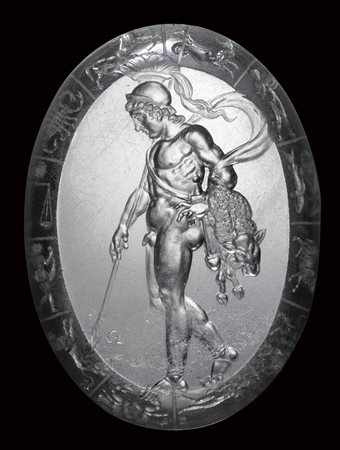
Lotto 315 An extraordinary neoclassical rock crystal intaglio. Jason and zodiac signs.
1820-1830 circa
30 x 42 x 6 mm
Jason, son of the king of Iolco, Aeson, and husband of the sorceress Medea, was at the head of the Argonauts expedition, aimed at the conquest of the golden fleece. Wanting to regain the throne of Iolco usurped from his father Eson by his stepbrother Pelias, Jason will have to go to conquer the Golden Fleece, the skin of the golden ram located in Colchis from King Aetas, at the head of a group of heroes, the Argonauts, who form the crew of the ship Argo. Thanks to Medea, daughter of Eeta, he succeed in his quest and, after many adventures characterizing the whole trip, he will return to Iolco. In this extraordinary rock crystal intaglio, the hero is represented in all his youthful strength and beauty with the attributes of success.
The character is facing left, with the helmeted head in profile and with the chest slightly twisted in three-quarters. The gaze downwards, is contemplative, the left hand resting on the side, while the right holding a spear, the tip pointing downwards. The left leg supports the vigorous body, while the right elegantly lifting the heel. The body is muscular, sculpted with meticulous anatomical details, with great technical skill. On the chest appears the sword sheath leather band, while the feet are protected by sandals whose very thin sole can be seen under the feet. The left arm also carries the mythical fur of the Golden Fleece, emblem of his great enterprise; a flap of cloak rises behind the back, blown by the wind, according to a typical neoclassical iconography. The figure of Jason, perfectly centered in the field of the stone, dominates in all its heroic splendor, in a powerful sculptural pose of classical inspiration, and at the same time intimate and delicate.
A strong allegorical and astrological meaning is present in this precious gem, showing the 12 zodiacal signs masterfully engraved on the edge of the back of the stone. The extraordinary stylistic rendering of the zodiac symbols is emphasized by their executive perfection despite the narrow and complicated space to engrave, since the edge is inclined. Despite of its thickness, the transparency of the stone makes possible the perception of all signs engraved on the back, creating an effect of passing and overlapping of both scenes, united in a single great astral allegory. The celestial signs accompany Jason in his mythical triumph, after many difficulties and fights. His effigy appears thus protected by the gods and the planets, from the beginning to eternity, as revealed by the letters alpha and omega, the seal of this scene.
The compositional structure of the standing (or seated) figure surrounded by the zodiac is known and attested since ancient times also in the glyptic, in rare and valuable specimens; however the stylistic and executive details seem to advance the dating of this gem to the neoclassical Era.
U. Pannuti, La collezione glittica. Museo Archeologico Nazionale di Napoli, vol. 2, p. 164 n. 130 (Apollo-Helios with the zodiac, ancient roman carnelian intaglio); J. Kagan, O. Neverov, 500 pierres gravées du Cabinet de Duc d'Orléans, p. 67 n. 57/29 (16th century carnelian intaglio); p. 145 n. 273/91, p. 165 n. 335/153. L.P.B. Stefanelli, La collezione Paoletti, vol. 1, tomo I n. 125; n. 197; tomo 4 n. 48 and 228; vol. 2: tomo 5 n. 395 (copy of L. Pichler after the famous carnelian intaglio of Paris, Bibliothèque Nationale, Cabinet des Méedailles) and n. 424; tomo 8 n. 288.
U.K., private collection, acquired from M-G., 70's, London. -
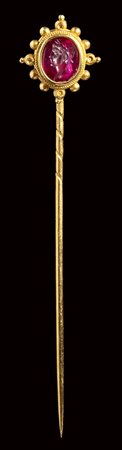
Lotto 316 A fine postclassical ruby intaglio set in a gold stick pin. Bust of a Julio-Claudian emperor.
18th-19th century
Intaglio : 6 x 7,5 mm
Pin : 64 mm
2,50 gr
The laureated emperor, identifiable probably to Augustus or Tiberius, is facing left. This precious intaglio is mounted on a fine gold stick pin characterized by a refined frame worked by spherical elements. Very fine condition. Attractive color of the stone. Rare. -
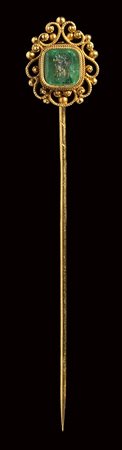
Lotto 317 A postclassical emerald intaglio set in a gold stick pin. Bust of Hercules.
19th century
Intaglio : 8 x 8 mm
Pin : 70 mm
2,80 gr
The hero is facing left, with short hair and the club on the shoulder. This precious intaglio is mounted on a fine gold stick pin characterized by a refined frame worked by intertwined and spherical elements. Very fine condition. -
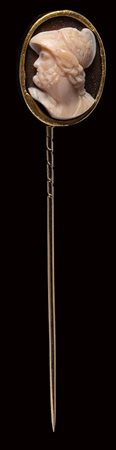
Lotto 318 A neoclassical agate cameo set in a gold stick pin. Ajax.
19th century
Cameo : 15 x 20 mm
Pin : 75 mm
7, 53 g
The bearded hero is wearing the corinthian helmet, facing left with the head in profile and the front bust. The work reproduces a popular and recurring model in neoclassical production, inspired by statuary models. High relief. Fine condition. -
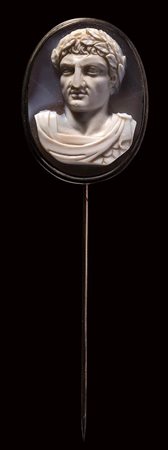
Lotto 319 A modern agate cameo set in a metal stick pin. Bust of an emperor.
18th-19th century
Cameo : 28 x 37 mm
Pin : 92 mm
The effigy of the Roman emperor is carved in high relief, almost frontally, with the face turned slightly three-quarters to the left. Laurel wreath on the head and bust draped with chlamys and armor. Work carried out with marked engravings that well highlight the anatomical volumes of the character, inspired by an ancient model. Fine condition. -

Lotto 320 A modern amethyst intaglio set in a gold stick pin. Female head.
19th century
Intaglio : 8 x 10 mm
Pin : 75 mm
3,0 g
A post classical female head, facing left. Fine gold frame formed by spherical and intertwined elements. Fine condition. -
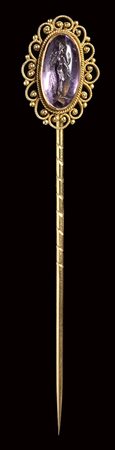
Lotto 321 A modern amethyst intaglio set in a gold stick pin. Winged female figure.
19th century
Intaglio : 7 x 13 mm
Pin : 73 mm
3,59 g
The standing allegorical figure is facing right, holding a branch. This precious intaglio is mounted on a fine gold stick pin characterized by a refined frame worked by intertwined and spherical elements. Very fine condition. -
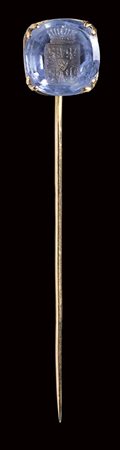
Lotto 322 A modern topaz seal intaglio mounted in a metal stick pin. Coat of arms.
19th century
Intaglio : 12 x 12 mm
Pin : 68 mm
4,34 g
Heraldic coat of arms composed of an ornated shield surmounted by a crown with nine points. To be identified. Attractive color of the stone. Slight wear marks. -
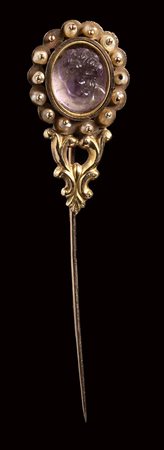
Lotto 323 A postclassical amethyst cameo set in a gold stick pin with pearls. Bust of Cupid.
18th-19th century
Cameo : 10 x 13 mm
Pin : 62 mm
2,93 g
The young head is turned slightly in three-quarters to the right side, engraved in high relief. Fine work. Mirror polished. The stone is mounted on a fine gold Georgian stick pin characterized by a refined frame with pierced pearls (one missing). Very fine condition. -
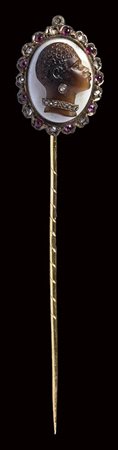
Lotto 324 A fine victorian agate cameo set in a gold stick pin with precious stones. Moor's head.
19th century
Cameo : 11 x 14 mm
Pin : 70 mm
4,0 g
The head is turned to the right and embellished with an earring and a collar made of diamonds masterfully set on the small agate cameo. Rubies and diamonds are set in the frame surrounding the portrait. Very fine condition.