
Auction 86 - Glyptics and Ancient Jewelry
-

Lotto 289 A neoclassical agate cameo. Bust of Maecenas.
End of 18th century - Beginning of 19th century
28 x 40 x 11 mm
The bust portrait of the so called "Maecenas" (Caius Cilnius Maecenas) is facing right. Large stone engraved in high relief, close to "Head of Maecenas" from the Marlborough Collection (Carnelian intaglio, Boston, Museum of Fine Arts: 99.112). -
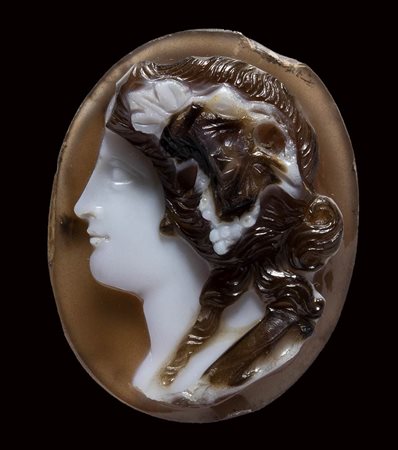
Lotto 290 A neoclassical agate cameo. Bust of a Bacchante.
End of 18th century - Beginning of 19th century
20 x 25 x 6 mm
This fine portrait of a Bacchante is characterized by the typical thick hair adorned with leaves and bunches of grapes. The depiction could be identified also with Dionysos. Attractive use of the layers of the stone. Slight chipping on the edge. -
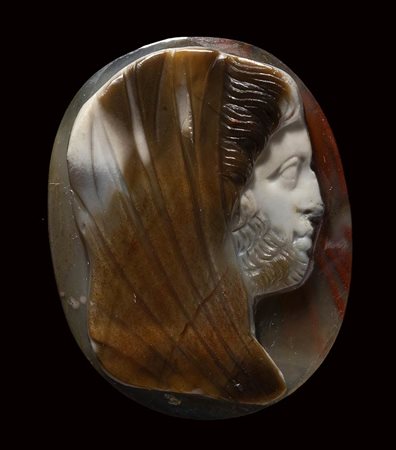
Lotto 291 A neoclassical agate cameo. Bust of a veiled man.
End of 18th century - Beginning of 19th century
16 x 21 x 3 mm
The bearded character is probably the representation of Saturn. The cameo has an unusual concave rather than convex relief, to follow the colored layers and veins of the agate. Attractive colors of the stone. -
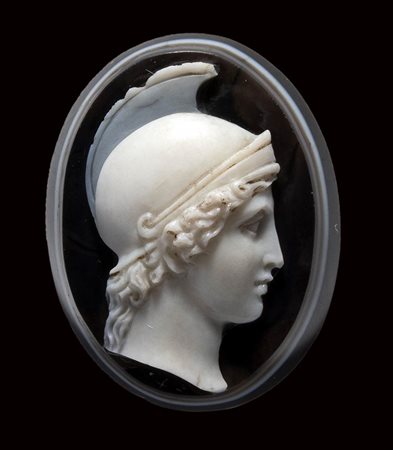
Lotto 292 A fine neoclassical agate cameo. Bust of Athena.
Mid of the 19th century circa.
16 x 20 x 8 mm
The helmated deity is facing right. On the reverse of the stone, an engraved handwritten inscription: “N. 4 - Negroni - 670”. Fine work executed on an attractive six-layers agate. Mirror polishing. Slight chipping on the helmet crest. -
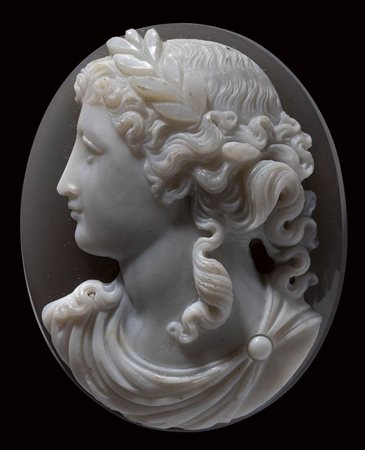
Lotto 293 A neoclassical french two-layers agate cameo. Bust of Apollo.
19th century
37 x 46 x 17 mm
The young god is turned to the left, and is characterized by the draped bust and the head crowned with laurel. The hair is thick and elegantly sculpted with sinuous braids that fall on the neck and shoulder. Work carried out in high relief.
French private collection 80's. Than, UK private collection G. C. , London. -
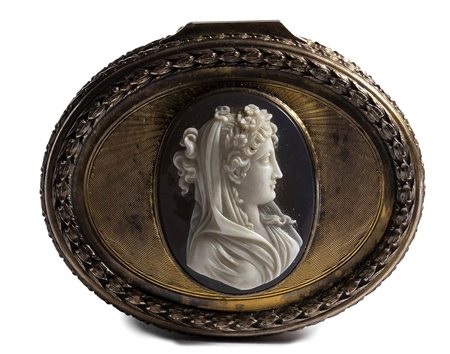
Lotto 294 A large two-layers agate cameo set in a Victorian gilded massive silver snuff box. Veiled bust of Flora.
19th century
Cameo : 32 x 42 mm
Box : 63 x 77 x 37 mm
The female bust is turned to the right side. The figure is characterized by thick hair adorned with a flowers wreath. The head is veiled and the bust is draped. The stone is set in a fine boxe finely engraved, adorned with a garland frame on the edge. Very fine condition. Octagonal mark: Helmeted head of Minerva (1st title), facing right. French manufacture since 1838. -
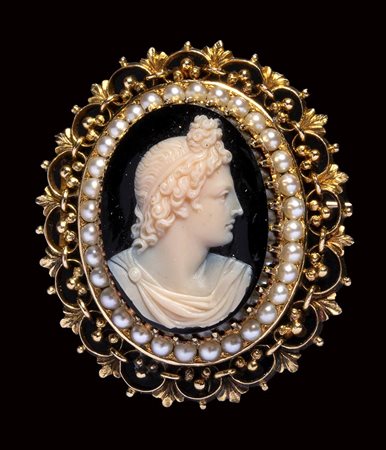
Lotto 295 A neoclassical onyx cameo set in a gold brooch with pearls. Bust of Apollo.
Second half of 19th century
Cameo : 16 x 22 mm
15,0 g
The young god, identifiable with the Apollo Belvedere model, faces right and is wearing a tunique with chlamys. Beautiful victorian gold brooch with pearls.
This prototype has been widely copied and reproduced also on cameos, inspired by the famous statue of the Vatican. For example, the cameo engraved by Saulini in the parure of the Metropoliotan Museum (inv..40.20.55a–c). A very fine exemple of this type comes from the production on Nathaniel Marchant.
Parallels: Catalogue of One Hundred Impressions from Gems engraved by Nathaniel Marchant, J.Edwards, London, 1792, pg. 10, no. XIV, for a listing of a sardonyx intaglio of the Apollo Belvedere, commissioned by the politician J. Cox Hippisley, 1st Baronet (1746-1825). Seidmann, Nathaniel Marchant, Gem Engraver, 1739-1816, The Walpole Society,LIII, 1987, pg.41-2, no.11, mentions that this design of the Apollo Belvedere was particularly popular, and Marchant carved several intaglios of it. -
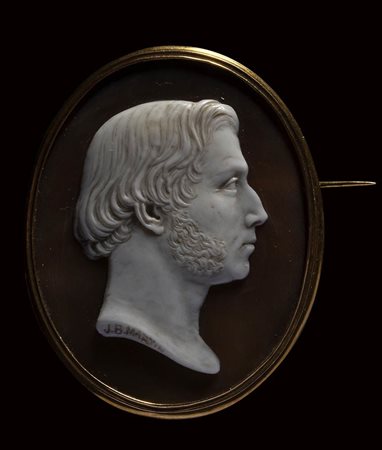
Lotto 296 A 18K gold brooch set with a shell cameo signed JB Martin. Male portrait.
19th century
Cameo : 40 x 50 mm
11,13 gr
The bust portrait, characterized by long and thick hair and beard that ends before the chin, is turned to the right. Private portrait to identify, signed J.B. Martin. -
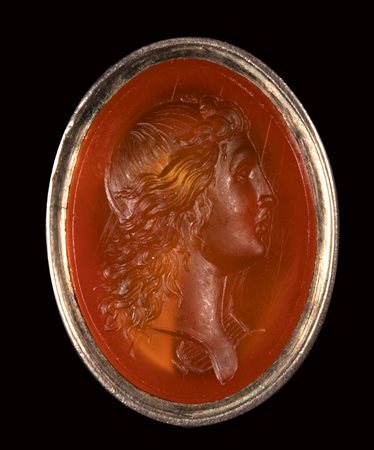
Lotto 297 A neoclassical carnelian intaglio mounted on a seal. Bust of Apollo with lyre.
19th century
Intaglio : 14 x 20 mm
4,34 gr
The young god is facing right. He is characterized by thick and long hair that partially covers the neck. A small lyre appears behind the bust, as an allegory of the arts, poetry and music. Fine work well engraved. Subject inspired by french neoclassical models. Attractive color of the stone. Wear marks on the seal. -
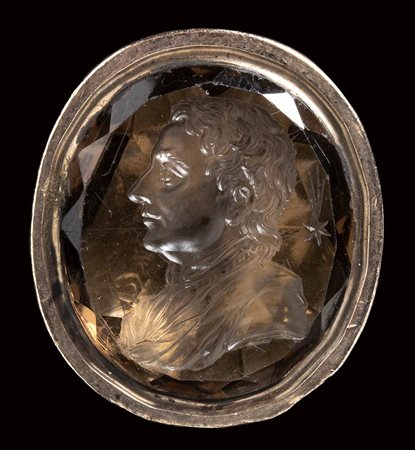
Lotto 298 A quartz fumé intaglio set in a metal seal mounting. Portrait of Isaac Newton.
18th century
intaglio: 20 x 23 mm ; 16.74 gr
Bust of Sir Isaac Newton, bareheaded and wearing a contemporary dress, facing left; a star behind his head. Sir I. Newton (1643-1727) was a favourite subject for English seals and engraved by talented artists as Christopher Seaton, Cave, Wray and Burch. This beautiful work is set in a metal mounting as seal. Attractive brightness of the quartz, faceted on the edge.Very fine condition.
Parallels: M. Henig, Classical gems. Ancient and modern intaglios and cameos in the Fitzwilliam Museum. Cambridge, p. 308 n. 644. -
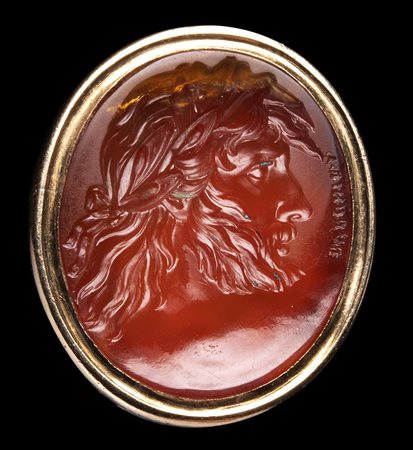
Lotto 299 A fine carnelian intaglio seal engraved by Edward Burch. Zeus wearing a laurel wreath.
Early 19th century
intaglio : 18 x 21 mm; 19, 22 gr
Zeus is facing right and characterized by a thick beard and finely engraved thick hair, with a laurel wreath on the head. The profile is characterized by a protruding nose and a semi-opened mouth. In the foreground, the right shoulder is raised, showing the musculature.
This beautiful intaglio is signed BURCH R.A.: opus of Edward Burch (1730-1814) from Royal Academy. The artist is considered one of the England’s greatest gem-engravers. This stone is mounted as an early 19th century seal engraved with a border of shells, the handle modelled as a stylised lyre composed of foliate scrolls. A very fine intaglio executed with great skill. Light crack on the stone. Extremely fine mirror polishing.
Parallels: G. Seidmann, The diversity of Edward Burch, pp. 17-26 in Le gemme incise nel Settecento e Ottocento. Continuità della tradizione classica, 1998. -
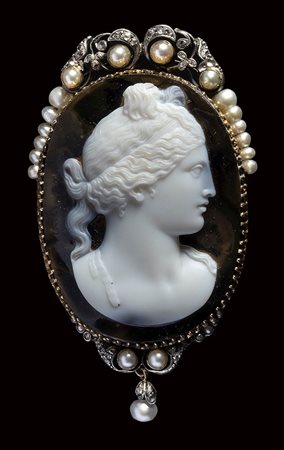
Lotto 300 A neoclassical gold, diamonds and pearls brooch set with an agate cameo signed Pestrini.
Early 19th century
Cameo : 21 x 42 mm
23,74 gr
This fine two-layers agate cameo depicts a female bust in profile, facing right, inspired by the graeco- roman statuary models (probably a Venus).
The stone is signed PESTRINl. Possibly by Clemente Pestrini (Italian, active first half of the 19th century). ca.1810-1820. The brooch is characterized by a split pearl, single and rose-cut diamonds, glazed reverse. Mirror polishing. French assay marks