
Auction 86 - Glyptics and Ancient Jewelry
-
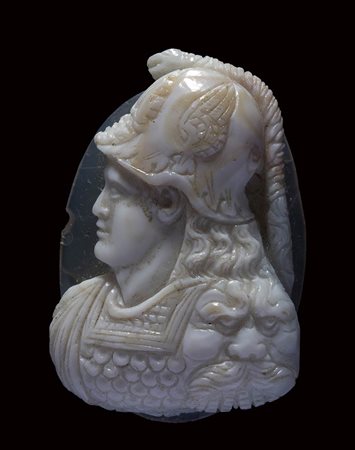
Lotto 277 A renaissance agate cameo. Mars.
16th century A.D.
23 x 34 x 12 mm
Bust of Mars wearing an armor- corselet (egys); a mask on her winged helmet with a feather crest; an expressive grotesque head as epaulette. The character is facing left. This fine cameo is engraved in high relief in the typical renaissance taste. Slight chips and wear marks on the edge.
Parallels: Story-Maskelyne, M.H.: The Marlborough Gems (1870): no. 88
Boardman, J., Scarisbrick, D., Wagner C., Zwierlein-Diehl, E: The Marlborough Gems (2009): no. 320; Le gemme Medici al Museo degli Argenti (Palazzo Pitti), p. 197 n. 107
U.K private collection, London. -
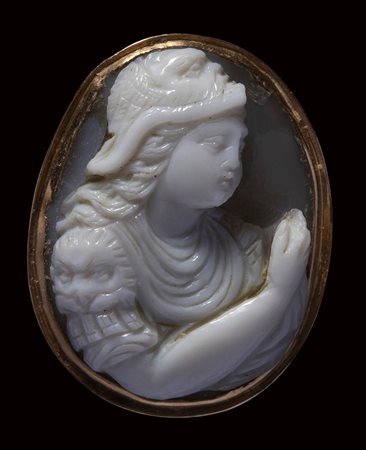
Lotto 278 A renaissance agate cameo mounted on a modern gold ring. Athena
16th century A.D.
Cameo : 17 x 22 mm
Ring : 19 x 16 mm
6,12 g
The goddess is wearing an armor with a cloack; a mask on her helmet; an expressive grotesque - lion head as epaulette. The character is facing right, with a raised arm and with the face turned in three quarter. This fine cameo is engraved in high relief in the typical renaissance taste. Slight chips, cracks and wear marks on the edge. The stone is set in a gold ring.
U.K. private collection, London. -
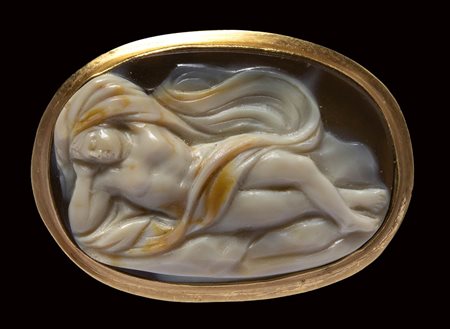
Lotto 279 A renaissance agate cameo mounted on a modern gold ring. Ariadne.
16th - 17th century A.D.
Cameo : 16 x 20 mm
Ring : 17 x 17 mm
9,32 g
The naked sleeping figure is lying to the left above the rocks, with the head turned slightly downwards, supported by his right arm. The eyes are still closed, the legs crossed and the left arm raised in a sign of rest. The figure can be identified with the sleeping Ariadne. In this cameo the figure is elegantly draped with a fold rising in the air and partially cover the figure in his intimate sleep. The scene seems to have been inspired by a relief or a statuary model. The sculptural rendering, the articulated pose of the figure and the peculiar drapery, the executive refinement are all elements that lead this work to the workshop of Alessandro Masnago (active in Milan in c. 1560-1620). The stone is mounted in a gold ring. Very fine condition.
Parallels : Le Gemme dei Medici al Museo degli Argenti. Cammei e Intagli nelle collezioni del Palazzo Pitti, p. 188, n°81-82
U.K private collection, London. -
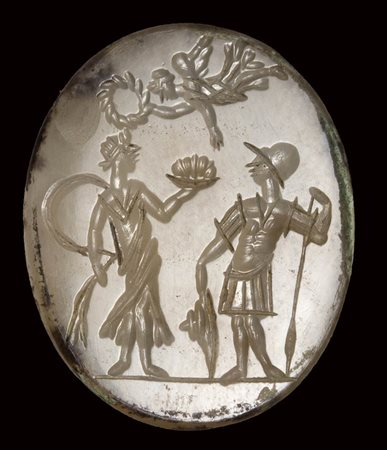
Lotto 280 A late renaissance agate intaglio. Allegorical scene.
17th century
19 x 23 x 5 mm
On the left, a draped female figure in the act of offering a tray with offerings; on the right, an helmeted warrior with spear and shield. Above, a winged victory in the act of crowning the offerer with a laurel wreath. Ground line. Allegorical scene. North Italy-Cisalpine atelier.
Parallel: Le gemme dei Medici al Museo degli Argenti. Cammei e intagli nelle collezioni di Palazzo Pitti, pp. 375 ss.
U.K private collection -
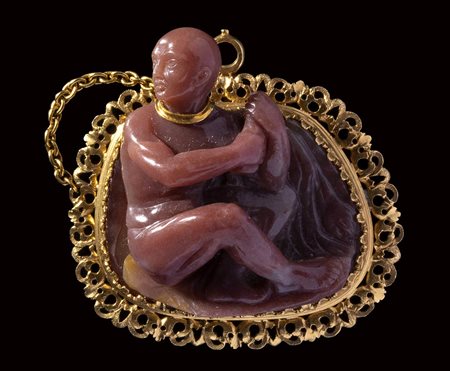
Lotto 281 A very fine high relief rose chalcedony cameo, attribuited to Giovanni Ambrogio Miseroni.
A captive - "The Slave of Love".
End of 16th century A.D.
Cameo : 34 x 37 x 20 mm
25 g
This extremely refined and beautiful jewel is extraordinary for the quality of its composition and execution. Masterfully carved, it represents a chained captive (his bald head indicating that he is of Oriental origin, probably Ottoman or North African). This masterpiece is very close with works by the celebrated hardstone carver Giovanni Ambrogio Miseroni, who worked alongside his brother, the Imperial stone-cutter Ottavio Miseroni. The choice of the stone, the quality of the mirror polishing technique, the facial and the anatomical features of the figure (incised eyes), the composition are all important elements to compare with Miseroni’s works as the Statuette of a Reclining Venus with Cupid in the Kunsthistorisches Museum, Vienna (inv. no. KK 1730). The way the figures emerge from the stone, flanked by flowing drapery, is similar to the present cameo. The gold mount and chain resemble those from a small scent flask from the same circle. The iconography of the shackled prisoner is evident both in Classical and in Renaissance art. Compare, for example, with Giulio Romano’s Chained prisoners, also shackled at the neckfrom the Palazzo Te in Mantua (circa 1527-1528). However this jewel seems to have a meaning that goes beyond technical virtuosity, fashion for certain subjects or political allegory. An allegory rather referred to carnal love.
Perhaps a pledge of love, an intimate message of vigorous passion to wear as a gift and as a bond, unique in its beauty and preciousness.
Parallels: P. Rainer, Splendour and Power: Imperial Treasures from Vienna, exh. cat. Wiener Kunstkammer, Vienna; Schmuckmuseum Pforzheim; Kunstmuseum of Sachsen-Anhalt, Halle; The Fitzwilliam Museum, Cambridge, 2011, pp. 198-203, nos 56-57; D. Scarisbrick, Portrait Jewels, London, 2011, p.33
U.K. private collection, London. The lot was sold at Sotheby's and described as "with a paper note inscribed The Slave in rose agate out of the Wertheimer collection, possibly a reference to Emile Wertheimer Collection of Renaissance Jewels sold Sotheby's London 13 July 1953". -
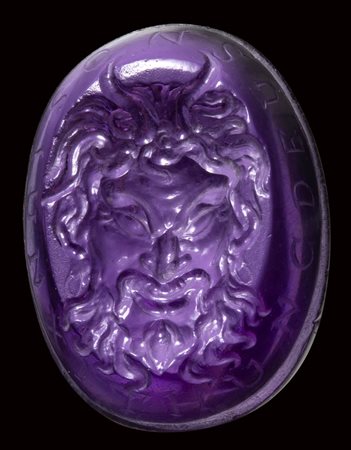
Lotto 282 A fine renaissance amethyst intaglio. Mask of Pan with motto
16th century A.D.
15 x 20 x 7 mm
This impressive frontal effigy of Pan is engraved with a very deep excavation on an amethyst stone of a particularly vivid and bright color. The facial features are typical ones inspired by ancient models (cf. The "Rubens vase", agate, 4th century A.D., Walters Museum inv. 42.562, and the mask of pan sculpted in ancient marble statues and reliefs) but the Michelangelo style seems unequivocal present and particularly strong here. The face is characterized by the typical somatic features of Pan, masterfully engraved with great art and technical skill, with an almost three-dimensional high relief effect. The anatomical details are rendered in an almost virtuosic way, with particular attention to the folds of the face due to the corrugated and almost diabolical expression of the character. The nose is curved, the almond-shaped eyes bent under the corrugated orbital arch, the mouth slightly open in a lascivious smile, the goat horns stand out from the thick hair, the long and finely chiseled beard. Portrait almost alive in its expressiveness. All the details are extremely mirror polished. Around the mask, on the edge: latin motto " HUNC DEUS NOS IUNXIT " ("this god united us"). This inscription, referring to the engraved subject, seems to allude as a pledge of love and passion: this emblem of carnal and feral love, of sexual impetus, unites who gave and who received this erotic seal.
U.K., private collection 70's, London. -
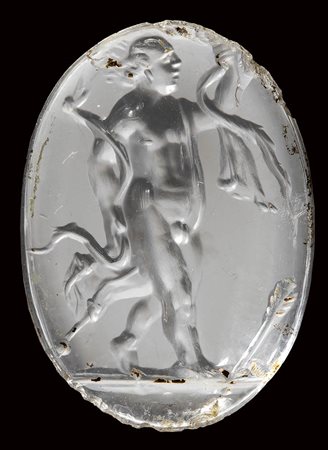
Lotto 283 A postclassical rock crystal intaglio. Allegorical male figure.
17-18th century circa
13 x 18 x 2 mm
A naked male character advances to the right, in the act of holding two snakes (?) with drapes; below, near his feet, an arrow. Groundline. Allegorical scene, to be identified. The stone is particularly thin and of an extraordinary purity and luminosity so as to be able to observe the incision even from the slightly convex back. Slight wear marks. -
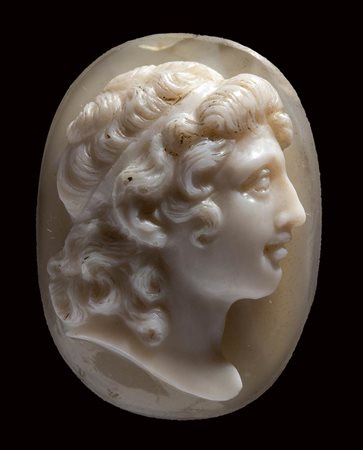
Lotto 284 A neoclassical agate cameo. Bust of Alexander the Great.
End of 18th century - Beginning of 19th century
16 x 21 x 7 mm
The young ruler is turned to the right, and characterized by thick hair held by a band. This beautiful specimen, inspired by the hellenistic models, approaches the works of famous neoclassical engravers such as Pichler and Cerbara for stylistic beauty and executive finesse. -
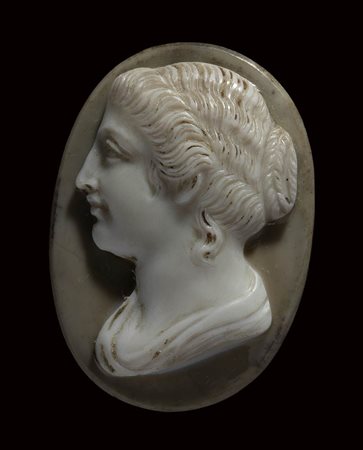
Lotto 285 A neoclassical agate cameo. Female bust.
End of 18th century - Beginning of 19th century
16 x 22 x 6 mm
The draped bust is turned to the left, and characterized by finely engraved gathered hair, inspired by the imperial portraits of the Roman Age. Work with executive finesse. -
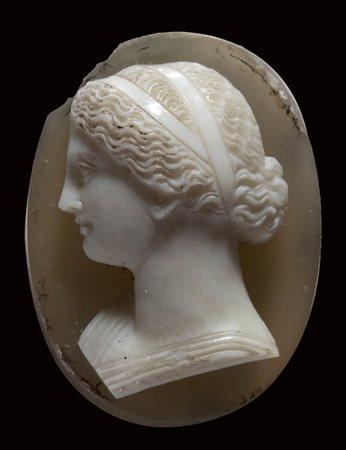
Lotto 286 A neoclassical agate cameo. Bust of a Niobid.
End of 18th century - Beginning of 19th century
16 x 21 x 9 mm
Draped female bust, facing left. The figure is characterized by a hair gathered from two bands. The subject is inspired by a famous marble sculpture (Uffizi, Florence) and it was executed by N. Marchant for a sardonyx intaglio. Small chip on the edge. -
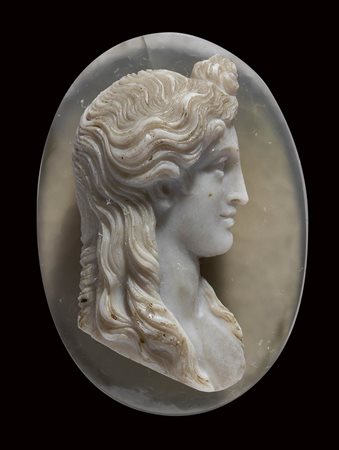
Lotto 287 A neoclassical agate cameo. Bust of Isis.
19th century
26 x 37 x 14 mm
The goddess is facing right, and characterized by thick hair gathered over her forehead aforming a Basileion; three long locks fall from the neck to the shoulder. Beautiful work engraved in high relief. -
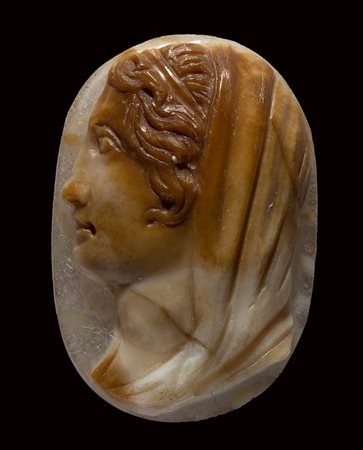
Lotto 288 A neoclassical agate cameo. Bust of a veiled matron.
End of 18th century - Beginning of 19th century
14 x 20 x 6 mm
The female bust is facing left. The figure is characterized by thick hair held by a diadem, under the veil. Interesting stone variety. Slight crack probably due to heat.