
Auction 86 - Glyptics and Ancient Jewelry
-
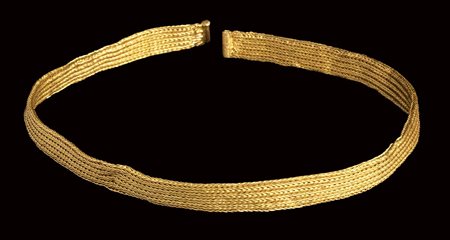
Lotto 253 A roman gold bracelet.
1st century A.D.
L : 200 mm
9,90 g
Consisting of a band of six plated strands ending in a clasp with cylindrical form.
Exceptional state of conservation. This model is inspired by the classical greek jewellery.
Parallel: Marshall, F.H., Jewellery, p.314, n°2719
U.K private collection -
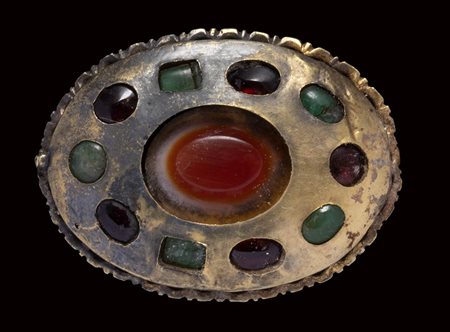
Lotto 254 A late roman large gold brooch set with an agate, garnets and emeralds
4th - 5th century A.D.
33 x 44 mm
15,49 g
The structure of the jewel is in oval-shape, with a hollow and slightly convex body. In the center there is a three-layered agate (which has fallen into the brooch over time and moves slightly in the frame). Around it, five oval garnets and five oval/rectangular emeralds. The brooch is characterized by a finely chiseled frame. The back of the brooch is characterized by a heart-shaped relief ornament. The large-sized jewel is in good general condition, with patina and sediment deposits. Slight damage. Intact.
U.K private collection, London. -
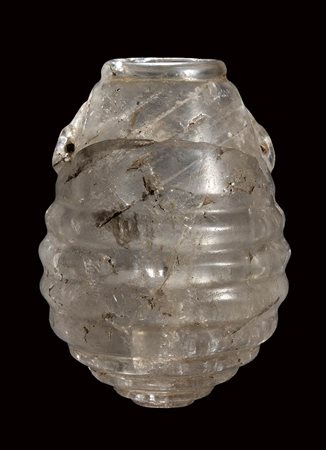
Lotto 255 A roman rock crystal amphoriskos.
1st century B.C.
H_ 54 mm
Diam max : 39 mm
With a piriform-shape, short neck and a rounded rim. The shoulders with twin pierced lug handle. The belly with 7 relief discs. Probably an unguentarium. Cracking and wear marks. Patina deposit. Very rare specimen.
U.K. private collection 1985. Formerly in Arthur Sambon (1867-1947) collection. -
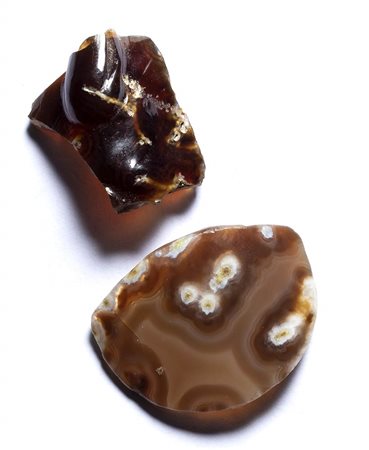
Lotto 256 Two fragments of roman murrina vasa.
1st century B.C. - 2nd century A.D.
22 x 28 mm
18 x 22 mm
The two fragments of cupped vase come from two different artefacts carved in two different beautiful sardonyx varieties.
A fragment has a smooth mirror-polished surface, convex and of fairly uniform thickness, with the presence of typical nodules. The other piece has a cameo carved surface, of uneven thickness and probably decorated with figures. Two precious examples of disappeared artifacts, already from the time of the Romans considered particularly precious and of great luxury. Rare.
Parallel: D. Del Bufalo, Murrina Vasa. A luxury of imperial Rome, 2016.
U.K. private collection -
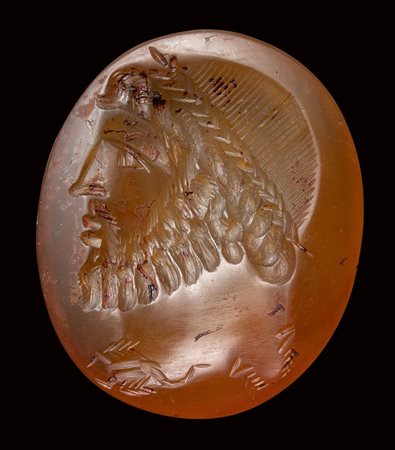
Lotto 257 A large eastern roman carnelian intaglio. Bearded male bust with astrological symbols.
1st - 3rd century A.D.
24 x 29 x 12 mm
The character faces left and is characterized by a thick beard, finely engraved hair with a laurel wreath. The bust ends in front with a scorpion, and behind with a crab, both zodiac symbols. The large stone is characterized by small deposits and traces of iron even inside the carving. Probably a middle-eastern workshop. Very rare astrological iconography.
U.K private collection, London. -
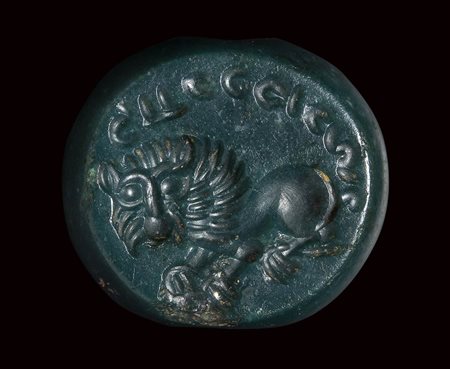
Lotto 258 A sasanian green jasper stamp-seal. Lion and inscriptions.
5th century A.D.
12 x 14 x 11 mm
Ellipsoid shaped stamp-seal with high domed back and hole lenghtwise. On the flat base, a lion running on the left, the head in front. On top, pahlavi inscription "'ys'gzy(?)" For a similar example : MET, NY, inv.81.6.288
Chips on the edge.
Parallel: Brunner, Christoph, Sasanian Stamp Seals in the Metropolitan Museum of Art, p.96
U.K private collection -
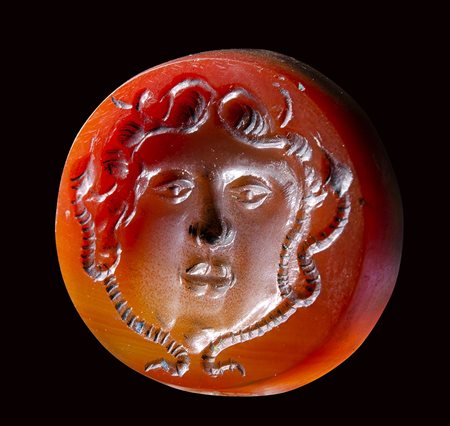
Lotto 259 A large early medieval agate intaglio. Medusa mask.
12th-13th century
24 x 26 x 5 mm
The thick stone is engraved with a Medusa mask characterized by a rounded face with plain chicks, full lips, and a straight little nose. The eyes are framed by heavy lids and the pupils are marked by a globular element. The forehead is surmonted by some curly short locks and snakes surrounding the face until the chin. This unusual stone is characterized by certain stylistic, iconographic and executive details that place it in the glyptic production referable to the court of Frederick II Hohenstaufen. The cameo production is better known, while the intaglio production is still little known and rare. The frontal face of this Medusa certainly emulates the classical models of the Greek-Roman Era, but reveals its evolution through the models of late antiquity with new stylistic features belonging to the early medieval age. The shape, the choice of this variety of agate (slight burnt on the back side) and the type of polishing seem to confirm this dating and the geographical area of its production (southern italian ateliers). The choice of a mythological subject inspired by classical antiquity is in line with the Federician cultural project, always maintaining its apotropaic meaning. The stone was mounted probably in a pendant.
Parallels for the glyptics production of the Federican Court: Aa.Vv. La Glittica Santarelli ai Musei Capitolini, pp. 215 ss with references to Antonio Giuliano researches.
European private collection 80's -
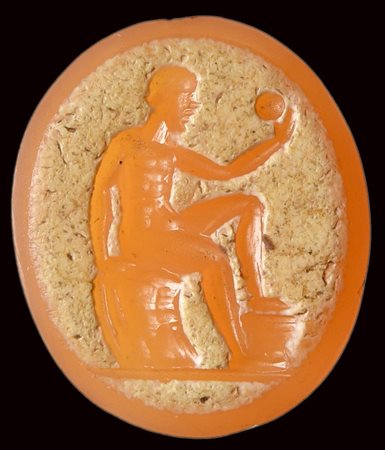
Lotto 260 A postclassical agate intaglio. Seated male figure with a globe.
18th - 19th century
10 x 13 x 3 mm
The character is seated on a rock and rests his left foot on a base on the ground; with his left hand he raises a globe. Groundline. Wear marks. Postclassical work. -
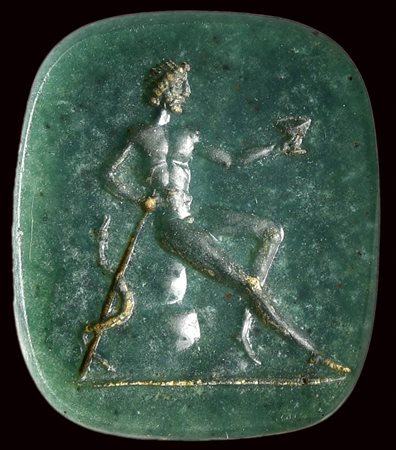
Lotto 261 A postclassical crysoprase intaglio. Asclepius.
18th-19th century
10 x 12 x 2,5 mm
The naked deity is seated on the rocks, holding a cup and the scepter with entertwined snake. Groundline. Attractive color of the stone. Postclassical work. -
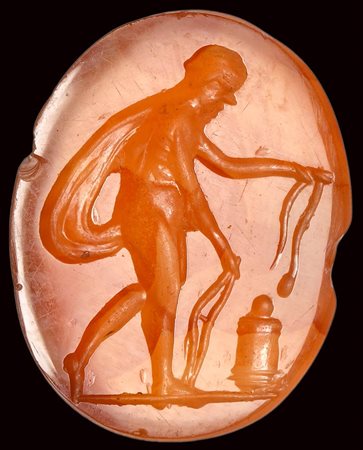
Lotto 262 A post classical agate intaglio. Sacrifice scene.
17th - 18th century
13 x 16 x 3 mm
An old male character with a cloak is in the act of making a sacrifice over a small altar. With both hands he holds offerings. Groundline. Attractive variety of stone. Wear marks. Light chipping on the edge. Postclassical work. -
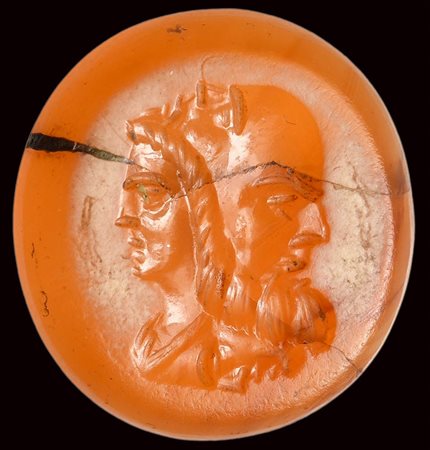
Lotto 263 A postclassical agate intaglio. Gryllos.
18th - 19th century
14 x 16 x 4 mm
The hybrid creature is composed by: mask of an elder Silenus conjoined with a young draped bust; two others male masks are conjoined to the apotropaic depiction. The stone, characterized by a slightly burnt surface, is broken and recomposed in the upper part, and has a crack at the bottom. Wear marks. Postclassical work. -
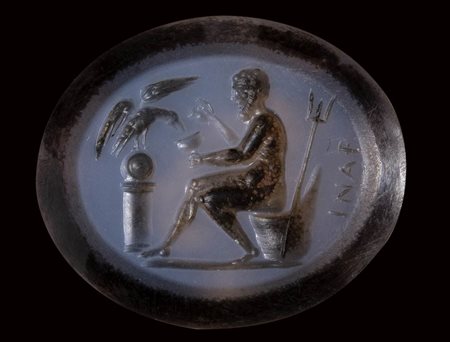
Lotto 264 A postclassical agate-nicolo intaglio. Hades.
18th - 19th century
15 x 18 x 3 mm
The ruler of the Inferos is seated on the throne, facing left, in the act of pouring a drink and quenching a crow's thirst on a column ending in a globe. A trident is leaning against the throne. Behind, the inscription INAP. Groundline. Wear marks.