
Auction 86 - Glyptics and Ancient Jewelry
-
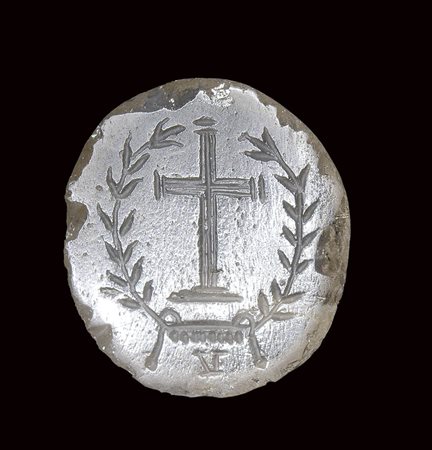
Lotto 229 A rare early byzantine rutilated quartz intaglio. Cross.
6th century A.D.
17 x 19 x 4,5 mm
A cross is surrounded by a laurel wreath, and under the letter V (probably for VOT). The cross is engraved with very thin lines that round its perimeter; the wreath, intricately engraved with pointed leaves, is tied by two ribbons that hang elegantly downwards in the style of coins. Some gems with the depiction of the cross date back to the 5th century, also surrounded by a laurel wreath, very close to the style of the late imperial and early byzantine coinage (Heraclius, with Heraclius Constantine, 610-641. Solidus, Rev. VICTORIA AVGG A / CONOB Cross potent on base and two steps). Crosses as the central subject of the gem therefore appear from the 5th century on carnelian and garnet, in the sixth and seventh century generally on rock crystal, and on Sasanian Christian gems. The rarity and interest of this specimen is also increased by the mineral type of the gem (rutilated quartz, with thin golden thread-like inclusions, similar to rays) and by the large size. Wear marks, abrasions and slight cracks inside the stone.
U.K., private collection 80's. -
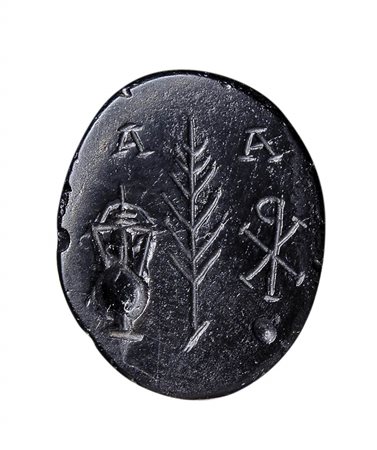
Lotto 230 A late roman black agate intaglio. Martyrium Emblema.
4th-5th century A.D.
14 x 17 x 4 mm.
The gem is engraved on both sides. On the front: a christogram, a palm of victory and martyrdom, a vase (probably a jug). On the back: an anchor with two fish. The gem is characterized by Christological emblems referable to the production of workshops of late Roman antiquity. The black stone is characterized by widespread wear marks over the entire surface. Rare and interesting specimen.
Parallels: J. Spier, Late Antique and Early Christian Gems, Plate 23 Cat. No. 166, plate 33 n. 261-264, pl. 51 n. 434.
U.K., private collection 80's. -
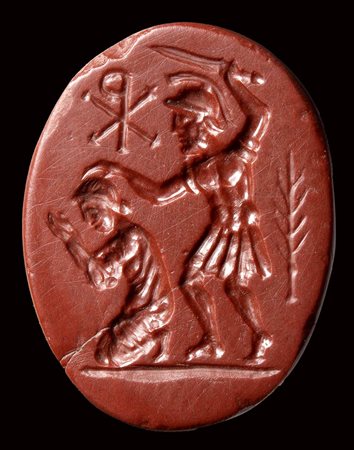
Lotto 231 A late roman red jasper intaglio. Martyrum scene with chi-rho.
3rd-4th century A.D.
15 x 19 x 4 mm
A pagan Roman soldier is in the act of decapitating a female character identifiable with a christian believer. The figure is kneeling on the ground to the left, with her hands folded in a sign of prayer, and she is wearing a long tunic and her hair is gathered. Behind him, a mighty helmeted, bearded and armored soldier. This rests his right hand on the martyr's head, on which the Christogram appears above; with his left hand he raises a sword (gladio) to decapitate. A palm frond in the background, to symbolize the martyrdom and triumph of the resurrection over death. Groundline. Highly symbolic scene, referring to the martyrs of the Christian religion at the time of the Roman Empire. Intaglio executed with skill. Attractive vivid red color of the stone. Wear marks. Slight chipping on the edge. Slight surface cracking of the stone (the stone is whole and does not show any breakages). Rare.
Parallels: Metropolitan Museum of Art Database inv. 81.6.311; King, Charles William. The Johnston Collection of Engraved Gems in the Grand Hall. Hand-book, Vol. no. 9. New York: The Metropolitan Museum of Art, 1881. no. 62, p. 5, 4001/03/2020 Corneille, Pierre, and Paul Allard. "Les procès des Martyrs." In Polyeucte, martyr: Tragedie Chrétienne en Cinq Actes. Tours: Mame, 1889. p. 158. Cabrol, Fernand, Henri Leclercq, and Henri Irénée Marrou. Dictionnaire d'Archéologie Chrétienne et de Liturgie. Vol. 1-15. Paris, 1907-1953. p. 430, fig. 78.
U.K., private collection 70's, London. -
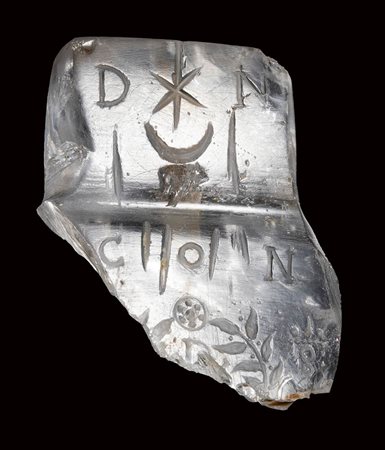
Lotto 232 A late roman rock crystal fragment of a bulla. Constantinian inscriptions with emblema.
4th century A.D.
22 x 28 x 8 mm
On the front of this fragmentary bulla, a crescent moon with a star flanked by the letters D-N is visible at the top. Below, the inscription C-O-N (identifiable with DN CONSTANTIVS PF AVG ) and below: laurel wreath that converges towards a floral corolla; alongside, military insignia and at the center of the crown there must have been the Christogram, as can be seen from the engraved details still visible. This depiction and the inscription are identifiable in some monetary specimens of the Constantinian Era. The precious pendant, carved in a rock crystal of extraordinary transparency and brightness, has a through hole for vertical fastening, signs of wear and residues encrusted in the marks. Rare.
U.K., private collection 70's. -
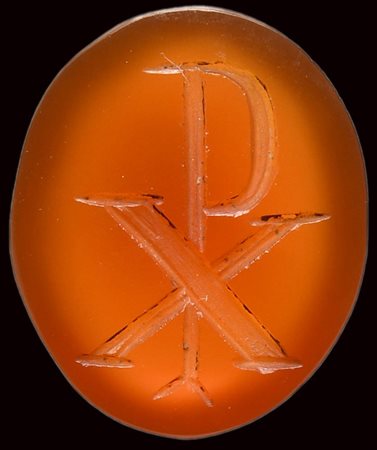
Lotto 233 A late roman carnelian intaglio. Christogram.
4th century A.D.
7,5 x 9 x 3 mm
Christological CHI-RO emblema. Mirror polishing and vivid color of the stone.
U.K private collection -
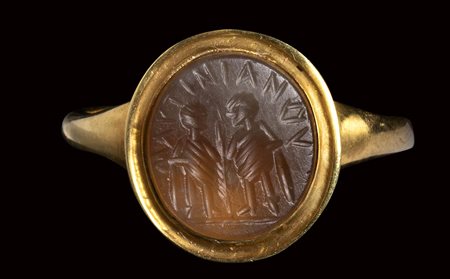
Lotto 234 A christian agate intaglio mounted on a modern gold ring.
4th century A.D.
Intaglio : 11 x 12 mm
Ring : 20 x 18 mm
8,08 g
This rare stone, mounted on a modern gold ring, said to be from Asia minor. Two draped male figures (Christ and another figure?) standing facing each other; one's figure hand is raised; a branch (?) between them. Groundline.
Around, MAPTINIANOY.
The ring is published and described by Jeffrey Spier.
Parallels: J. Spier, Late Antique and Early Christian Gems, Plate 55 Cat. No. 454.
UK private collection, London. -
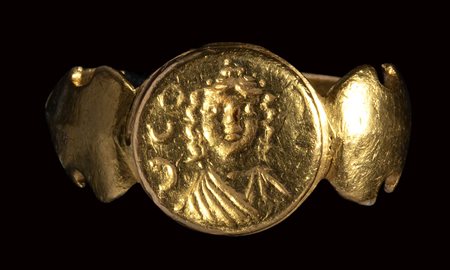
Lotto 235 A late roman gold signet ring, with engraved bezel. Female bust with inscriptions.
3rd – 4th century A.D.
Bezel diam : 11 mm
Ring : 19 x 18 mm
10,23 mm
Flat hoop, slightly rounded without, with either shoulder cut into triangular form. Circular bezel, with engraved design representing the bust of draped woman. Inscriptions on the side (?).
Parallels :
Marshall, F.H., Catalogue of finger rings, 1968, p.187, n°1185
U.K private collection, London. -
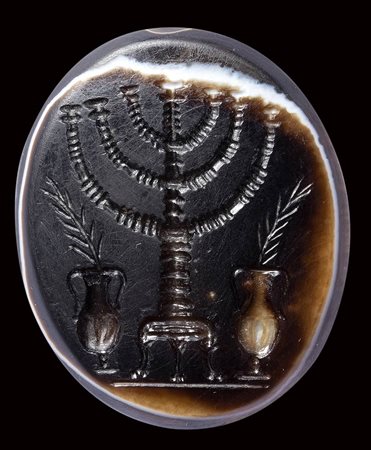
Lotto 236 A rare and large roman sardonyx intaglio. Seven-branched menorah.
1st - 5th century A.D.
30 x 37 x 4 mm
The Second Temple’s seven-branched candelabrum with three animal claws (according to Jewish tradition, the candelabrum was three-footed), with, on each side, a palm branch (lulav) in kantharos. Groundline.
The sense of execution with refined incision to enhance some details of the candelabrum branches, the pedestal and the belly of the kantharos demonstrate a high skilled technic.
This probably indicates a specific command for an important personality.
The seven branched menorah with conical foot appears on the last Hasmonean coinage imagery (40-37 B.C.) and then, not employed during the two Jewish wars against Rome. Although the interdiction of representation was in force at this time, the rabbinical ruling authorized jews to own seals with images even made by pagans as long as it was not meant for worship, but for sealing, or decorative purposes (see. Spier, J. Late Antique and Early Christian Gems, 2013, pp. 159-161).
Hence, the widespread of a certain type of jewish imagery during the Roman Imperial period can be identified in major part with the seven-branched candelabrum, which was the most significant and popular Jewish symbol of the graeco-roman period (one of the most known example is the high relief on Titus Arch in Rome, made in 81 A.D. by Titus’s brother, the emperor Domitian).
A similar iconography with the kantharos on each side and palm branch is represented on one facade of the Magdalena stone discovered in Galilea and dated from the 1st century A.D. The use of animal (lion type) claws for the base of the candelabrum remind one precisely of the Pompeii candelsticks and of the sarcophagus in the Villa Torlonia.
In fact, this particularity begins in the late Hellenistic period, at the time of the Second Temple was erected, the animals representations of the Near-East was exercising a strong influence on Hellenistic art.
Various wear signs on both side. Very attractive stone. Large dimension.
Parallels :
Spier, J., Late Antique and Early Christian gems, pl.121, n°941-943
Strauss, H., The History and Form of the Seven-Branched candlestick of the Hasmonean King, Journal of the Warburg and Courtauld Institutes,Vol. 22, No. 1/2 (Jan. - Jun., 1959), pp. 6-16
U.K., private collection, 70's-80's, London. -
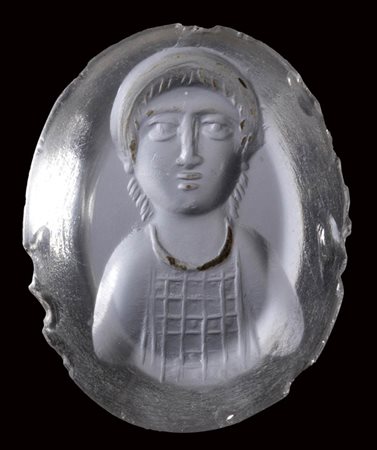
Lotto 237 A rare early byzantine-western gothic rock crystal intaglio. Frontal bust of a man.
5th-6th century A.D.
16 x 20 x 3,5 mm
The young character is depicted frontally. The rounded face is characterized by large eyes, an elongated nose and a small mouth; on the sides you can see the ear lobes. The hair is finely parted and executed with short incised marks, also behind the neck. The head is covered with a headdress. The bust is covered by the typical robe with breastplate-armor in the center, depicted with squares with a small spherical element in the center. The setting of the portrait and the style of clothing derives from late Roman iconography (cf. imperial portraits coined on gold solids). A parallel very close to this interesting effigy is the western gothic portrait of Alaricus II, late fifth century (Vienna, kunstihistorisches Museum, inv. VII B 23). The rock crystal intaglio is part of this barbaric production (Kingdom of the Lombards and Goths, probably a private portrait of an aristocrate or prince). Extraordinary transparency and brightness of the crystal, which lets you see the portrait even from the backside of the bezel. Small chips on the edge. Slight signs of wear. Very rare.
Parallel: J. Spier, Late Antique and Early Christian Gems, p. 27 n. 83.
U.K., private collection, London -
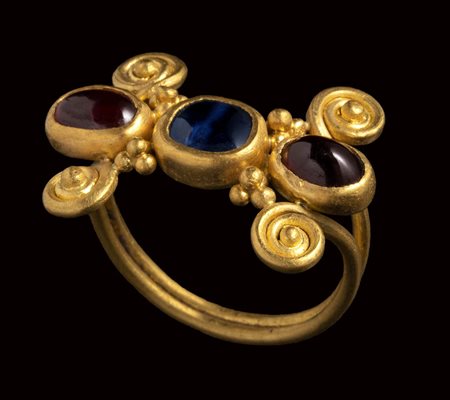
Lotto 238 A late roman gold ring set with a shappire and two garnets.
4th century A.D.
Dim : 21 x 29 mm
ring : 20 x 22 mm
11,20 g
Double rounded hoop, the ends of which forming spirals with a spherical bead in the center and soldered to the central of three box-settings, fastened together with three globule between each. The central setting is oval and has a sapphire. The two other settings have cabochon garnets.
A very similar example is conserved in Palazzo Massimo, Rome, and found in a roman marble sarcophagus.
Parallels :
Marshall, F.H., 1968, n° 853
European private collection 80's. -
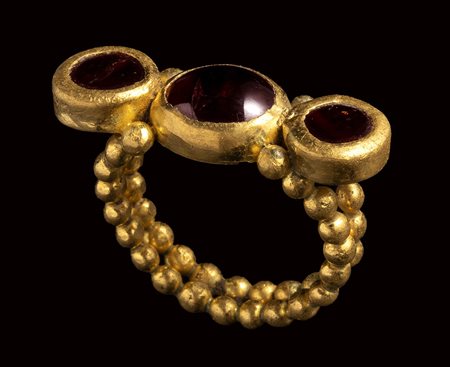
Lotto 239 A late roman gold ring set with three garnets.
4th century A.D.
Dim : 10 x 31 mm
ring diam : 19 mm
15,37 g
Double hoop composed in two series of large beads soldered together. The bezel consists of a central oval setting with a cabochon garnet flanked on either side by a circular setting, also containing garnets.
For a similar hoop typology see Marshall, 1968, n°864
For a similar bezel setting typology see Marshall, 1968, n° 861
European private collection 80's. -
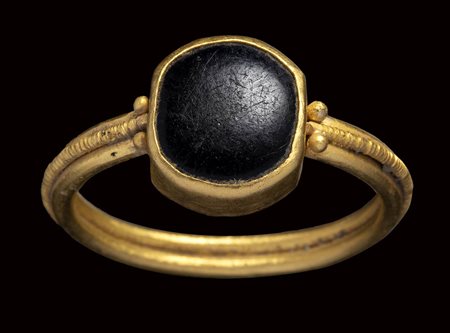
Lotto 240 A late roman gold ring set with an onyx stone.
3rd - 4th century A.D.
Stone : 10 x 10 mm
ring : 21 x 19 mm
7,4 g
With a hoop composed of three wires, the central one ciseled ending with two granules on each terminall. The rounded-shape bezel is set with an oblong onyx.
A similar example is conserved in the Bristish Museum, London, from the Castellani coll.1872.
Parallels :
Marshall, F.H., 1968, n° 781
U.K private collection