
Auction 86 - Glyptics and Ancient Jewelry
-
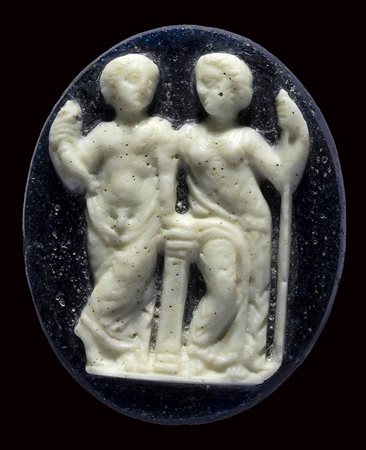
Lotto 193 A large roman blue and white glass cameo. Bacchus and Ariadne
2nd-3rd century A.D.
34 x 42 x 6,5 mm
On the dark blue background, the two figures are standing, engraved on the white layer. They are looking at each other, a little column between them. Ariadne is holding a stick with her left hand, her right arm hidden beside the bust of Bacchus.Her right leg bent is in relief, meanwhile the rendering of the left one well held is more flat, creating a sense of volume. The wine god, is holding a rhyton in his right hand, meanwhile his left hand rests on the column. Legs crossed, with the left on top, also in relief. Very fine condition. Rare.
U.K. private collection, London. -
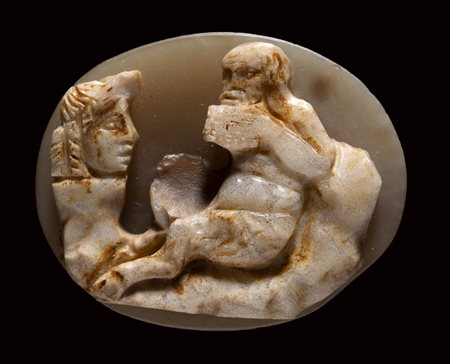
Lotto 194 A roman agate cameo. Satyr and mask.
1st - 3rd century A.D.
20 x 25 x 7 mm
The bucolic scene is well composed and is skillfully carved in high relief on an agate characterized by delicate nuances. On the right side, a satyr sitting on the ground with his back resting on the rocks, in the act of playing the syrinx; in front of him, on the left side, a theatrical mask placed on a rock. The satyr's right thigh (in the background) is chipped. The scene seems inspired by a marble relief. Traces of iron patina. The representation is part of the repertoire of bucolic scenes with references to theater and the musical arts, without excluding allegorical allusions. Rare type.
U.K. private collection, London. -
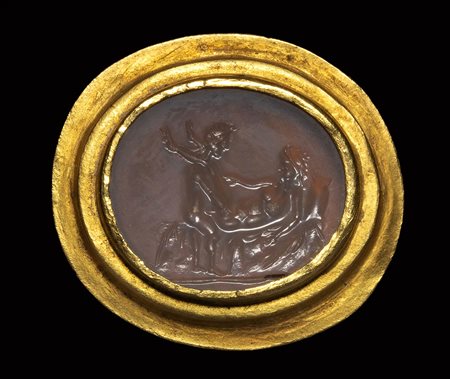
Lotto 195 A roman chalcedony intaglio set in an ancient gold ring. Erotic scene.
2nd - 3rd century A.D.
intaglio : 13 x 17 mm
ring : 21 x 20 mm
13,38 g
Erotic scene, the woman is lying on the bed, her neck resting on a large pillow, meanwhile the man is entering, standing and turned toward her. Groundline. This depiction is referred to the “spintria”, these roman tesserae with various erotic compositions.
Attractive color of the stone. Set on a massive hoop, rounded without, flatten within and broadening upwards. The bezel composed of two bands of gold rising one above the other.
U.K private collection, London. -
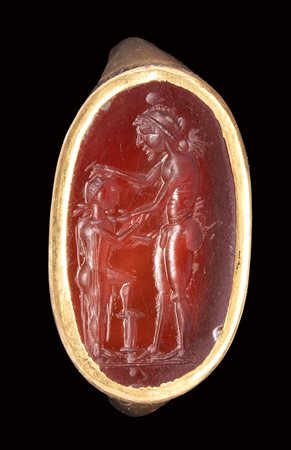
Lotto 196 A roman carnelian intaglio set ina modern gold ring. Homoerotic "paiderastia" scene.
2nd - 3rd century A.D.
intaglio : 9 x 17 mm
ring : 18 x 16 mm
7,86 g
A young boy is depicted in an intimate moment of initiation into the greek paiderastia. The young figure wears a collar and a thin robe that glimpses his shapely naked body (veil) and is faced with an adult male figure, with a diademate head and a naked body. The man brings his hands to the boy's head, who puts his hand up to touch his attributes while keeping his left leg raised above a small altar. Groundline. Probable scene of initiation to homoerotic paideia; the scene seems inspired by the repertoire of Greek black-figured vascular painting. Very rare subject on gems. The ring seems to have a repair in the attack between the rod and the bezel. Wear marks.
U.K private collection 90's -
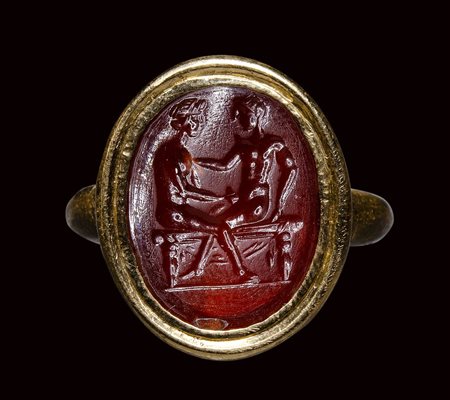
Lotto 197 A roman carnelian intaglio mounted in a modern gold ring. Erotic scene.
2nd century A.D.
stone: 1,4 x 1,8 mm ring diam: 20 mm 12,76 gr.
With a wide hoop rounded without and flatten within surmonted by a large rounded bezel set with a large carnelian intaglio. The scene depicts a man and a woman seated on a bed in front of each other in an act of masturbation. Groundline. The scene is strongly inspired by the depictions of sexual acts coined on the spintriae: the characteristic posture, the style of the figures and of the bed, the composition and the attitudes of the characters. Spintria (plural, spintriae), or more correctly erotic tessera, was the name of a particular category of Roman token, generally used for payments within a brothel. On it, usually, heterosexual erotic scenes are depicted. However, this intaglio is not a copy of spintria as mastrurbation scenes of this type do not seem to recur in the usual repertoire. Another source of inspiration are the frescoes of Pompeii and the terracotta oil lamps.The deep red color of the stone well emphasizes the strong erotic charge of the representation, and presents a small natural inclusion in a nodule exactly on the breast of the female figure, perhaps referable to an intimate auspicious and apotropaic meaning on the health of the owner of the gem. Mirror polishing inside the figures. Wear marks and a minor crack on the edge. Rare.
Parallels: C. Johns, Sex or Symbol. Erotic images of Greece and Rome; T. V. (1973) 'The Spintriae as a Historical Source', The Numismatic Chronicle 13, pp. 52 – 63; A. Campana, A. (2009) 'Le spintriae: tessere Romane con raffigurazione erotiche', La Donna Romana: Immagini E Vita Quotidiana Atti de Convegno. Astina, 7 Marzo 2009. pp. 43 – 96; Jacobelli, L. (2000) Spintriae e ritratti Giulio-Claudii. Bd. 1. Spintriae e scene diverse. L'impianto iconografico. Centro Culturale Numismatico Milanese, Milano; Simonetta, B & Riva R. (1981) Le tessere erotiche romane (spintriae). Quando ed a che scopo sono state coniate. Chiesa, Lugano; Duggan, E. (2016) "Stranger Games: The Life and Times of the spintriae". For a roman cameo with an erotic scene (couple on a bed intituled"spintria"), see U: Pannuti, La Collezione di Glittica, Museo Archeologico Nazionale di Napoli, p. 224 n. 189
U.K., private collection 80's. -
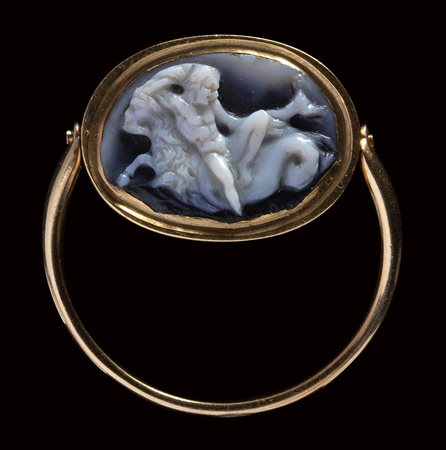
Lotto 198 An roman agate cameo mounted on a modern gold ring. A youth on a seagoat.
2nd - 3rd century A.D.
Cameo : 12 x 18 mm
Ring : 23 x 19 mm
5,60 g
A naked youth riding a capricorn (goat-fish). He claps one of the creature's horns and is fishing with a rod, which curves as it catches a small fish. He is sitting on a hide with a serrated edge. An interesting parallel, very similar, is a refined sardonyx cameo from the Beverly collection (Alnick castle), dated 30 BC and identified as the young Octavian Augustus (whose zodiac sign was Capricorn) in the allegory of the victory of the naval battle of Actium (31 BC). The victory was in fact celebrated on the cameos. However, the figure also seems close to the models of the satyr-pan, as in this case, whose marked features of the face and youthful musculature seem to express. The cameo, mounted in a swivel gold ring, has damaged edges and the figure is missing a foot. The piece clearly shows signs of ancient wear and an ancient execution with marked and spontaneous engraver lines, certainly inspired by a precise model as for the Beverly cameo. Well composed scene. Interesting iconography. Rare.
Parallels: D. Scasbrick, C. Wagner, J. Boardman, The Beverly Collection of gems at Alnick Castle, p. 11 n. 6.
U.K private collection, London -
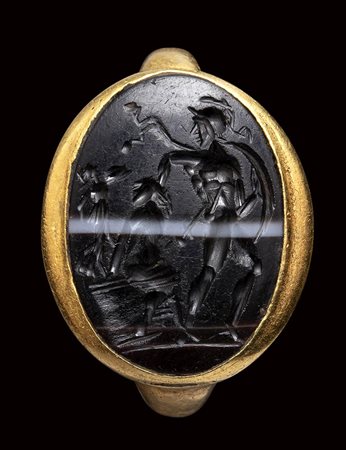
Lotto 199 A roman banded agate intaglio set in a gold ring. Ajax with Cassandra.
2nd-3rd century A.D.
Intaglio : 11 x 16 mm
Ring : 16 x 13 mm
3,56 g
She has fled to the altar and is near to embracing the palladion. Ajax stands beside her in the act of take Kassandra by the hair and holding his shield in the left arm (the sword stuck in his side?). Kassandra is shown in back view, with head and limbs turned in profile; a himation covers the lower part of her body. Ajax, shown in front view, is nude and wears an helmet. The statue of Athena has a girded peplos, with aegis, a helmet and shield, and brandishes her spear. Groundline. Slight wear marks. The stone is set in an ancient gold ring. Very fine condition. Rare.
Parallels: G.M.A. Richter, The engraved gems of the greeks, etruscans and romans, part II, p. 65 n. 300 (British Museum, sard intaglio, from the Blacas collection 445, Walters Cat. No. 1942).
U.K. private collection, London. Ex Schweizer Privatsammlung seit ca. 1930 -
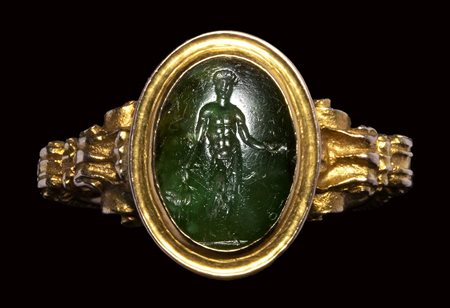
Lotto 200 An early Victorian gold ring, set with a roman intaglio in chromian chalcedony. Bonus Eventus.
intaglio: 1st century A.D. Mounting: 19th century
intaglio : 8 x 12 mm
Diam (ring) : 18 x 19 mm
5, 68 g
The standing and nude figure is holding ears of corn with the right hand and a phiale with the left. Allegorical and votive depiction referred to the abundance and good luck. Slight wear marks. This fine roman green chromium chalcedony is set in an early victorian gold ring, finely chiseled, with a bezel later inscibed: "In memory of William Manson - Ob 19 June ae 1852". Manson was an auctioneer, who joined the firm Christie's in 1831 as partner (at the death of James Christie Jr.) and was replaced by his brother Edward after is death. Very fine condition.
European private collection. -
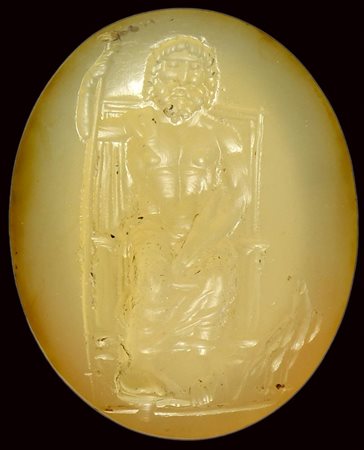
Lotto 201 A very fine roman chacedony intaglio. Zeus enthroned with the eagle.
1st century B.C. - 1st century A.D.
11 x 13 x 5 mm
Zeus is seated on his throne, holding the scepter on his right hand and lightning with the left. The god is characterized by voluminous hair and beard, a muscular body, with the naked torso, and wearing a drapery marked by pleats in relief revealing the framework of his knees and feet. On the left, at his feet, the eagle looking toward him. Groundline. The subject is probably inspired by a sculpture. Very fine execution of the muscular rendering, with an impressive high relief effect, almost three-dimensional. Beautiful work engraved on a fine chalcedony double convex stone with honey tone. Slight wear marks.
Parallels :
Thorvaldsens museum, Copenhague, inv. 189. Cabinet des Médailles, Paris, inv.58.1420.G.M.A. Richter, Catalogue of engraved gem. Greek, etruscan and roman. The Metropolitan Museum of New York, n. 256. Antiken Gemmen in Deutschen Sammlungen, Band I, Staatliche Munzsammlung Munchen, n. 2448.
U.K private collection -
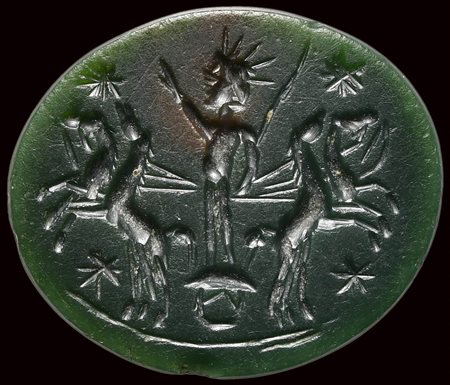
Lotto 202 A roman green jasper astrological intaglio. Helios with solar quadriga.
2nd - 3rd century A.D.
13 x 16 x 3 mm
In the middle of the scene, the standing god is over the chariot, wearing the radiated crown and holding the solar whip/ the bridles with the left hand, rising the right. On his left and right side, the horses. Four stars. Groundline. Fine astrological depiction, well composed. Slight wear marks.
U.K., private collection 70's, in the same family since then. -
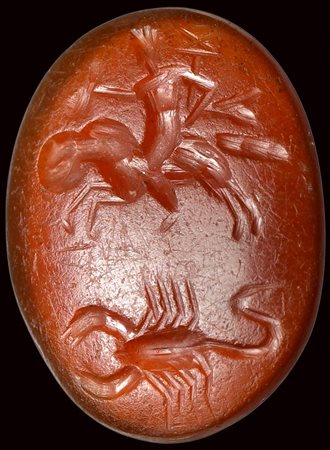
Lotto 203 A roman carnelian intaglio. Mercury on the ram with a scorpion.
2nd - 3rd century A.D.
12 x 15 x 3 mm
The magical and astrological depiction is formed by: on top, Mercury riding a ram and holding a caduceus with the left hand, the purse witht the right; on the lower part, a scorpion. Attractive color of the stone. Wear marks. Rare.
U.K. private collection -
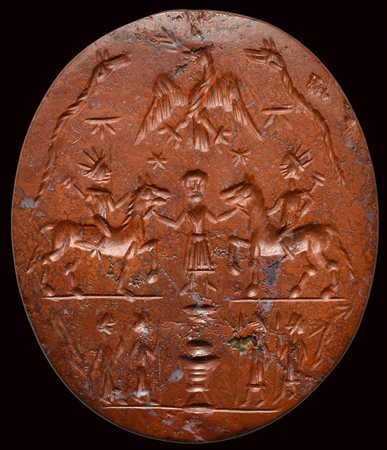
Lotto 204 A large roman magical red jasper intaglio. Allegorical scene referring to the Danubian mystery cults.
2nd-3rd century A.D.
23 x 27 x 3 mm
In some gems and lead plates we find the representation of a goddess standing between the two Dioscuri on horseback. Evenly identifying this character is not simple or certain. According to Chapouthier's interpretation it can be assimilated with the goddess Hekate-Elena; according to Delatte and Derchain it is Nemesis-Hekate; according to Barb, a representation of the mystery cult of Balkan origin. These lead plates derive mainly from the Danubian area. In this jasper intaglio, it is not entirely clear the identification of the central character with tunic and cloak, in the act of spreading his arms; certainly next to it there are two riders with a radiated crown (dioscuri). Above, two stars and above an eagle holding a laurel branch and two snakes in its beak. Below, in the center, a container (crater) and on the sides of the characters armed with spears. In the reverse side of the gem, a crater surmounted by a star, above a vessel and another star; on both sides, two large snakes twisted with two sticks and two arches. Above, crescent moon. Slight wear marks. Very rare.
Parallels: Chapouthier 1935, n. 69, p. 77; fig. 56, p. 287 ss. DELATTE, DERCHAIN, Les Intailles magiques, p. 193 ss, n. 259-260; D. Tudor, Corpus monumentorum religionis Equitum Danuvinorum, II, 1967, n. 228. A. Mastrocinque, Sylloge gemmarum gnosticarum, pp. 354-355.
European private collection.