
Auction 86 - Glyptics and Ancient Jewelry
-
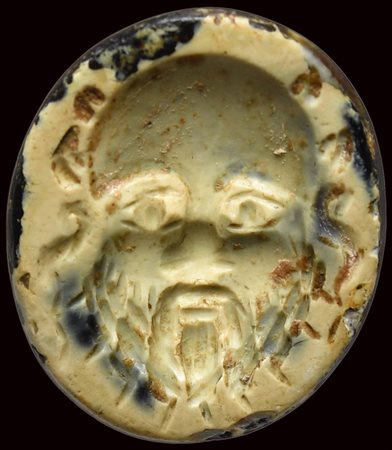
Lotto 169 A roman burnt agate intaglio. Mask of Silenus.
1st - 2nd century A.D.
10 x 12 x 2 mm
Frontal mask of a Silenus, characterized by large eyes, thick beard and bald head. On the head, a crown of ivy leaves. Interesting color of the stone due to burns.
U.K. private collection -
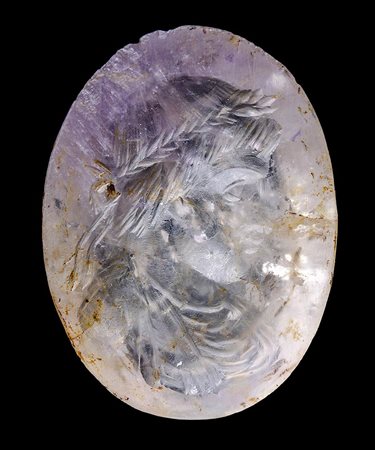
Lotto 170 A roman amethyst intaglio. Bust of a ruler.
1st - 2nd century A.D.
13 x 17 x 3 mm
The young character is facing right and he is characterized by a draped bust and laurel wreath on the head. The head is characterized by thick hair framing the entire facing until the neck. Wear marks, small chips on the edge, and traces of iron mounting. The light amethyst is darker on the upper part and transparent on the lower one. Probably the portrait of an eastern ruler. Nice size and fine execution.
European private collection. -
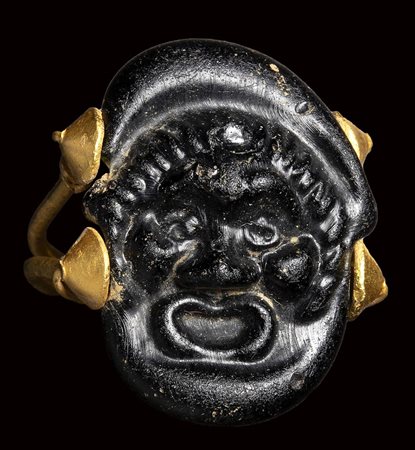
Lotto 171 A rare roman black glass cameo set in an ancient gold ring. Theatrical mask.
1st-2nd century A.D.
Dim : 20 x 27 mm
ring : 21 x 22 mm
9,45 g
This specimen is included into a specific category of Roman rings with a casted glass paste (cf. Wien, Kunsthistrischen Museum inv. XI B 29 ss.). The tragic theatrical mask is melted in a dark glass and perforated with two holes passing through the thickness of the piece. In these two holes pass two filaments of solid gold which join together with the two thicker golden rods which form the ring. Specimen in excellent condition, with patina deposits. Rare.
Parallels: Die Antiken Gemmen des Kunsthistorischen Museums in Wien, Band III, p. 229 n. 2518.
U.K. private collection 1985. Formerly in Arthur Sambon (1867-1947) collection. -
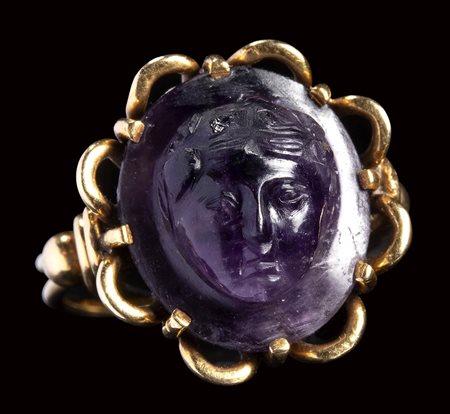
Lotto 172 A fine roman amethyst cameo mounted on a modern gold ring. Mask of Bacchus.
1st century B.C. - 1st century A.D.
Cameo : 13 x 15 x 8 mm
ring diam : 17,5 mm
7,19 g
The face of the young god has a rounded shape, with hair gathered and adorned with ivy leaves. The Bacchic subject fits well with the variety of the stone, a splendid mirror-polished dark purple amethyst. The style feels the influence of the late Hellenistic Greek style. The work is carried out in high relief and is mounted in an elegant modern gold ring with an open work bezel (floral structure). Wear marks. Rare.
European private collection. -
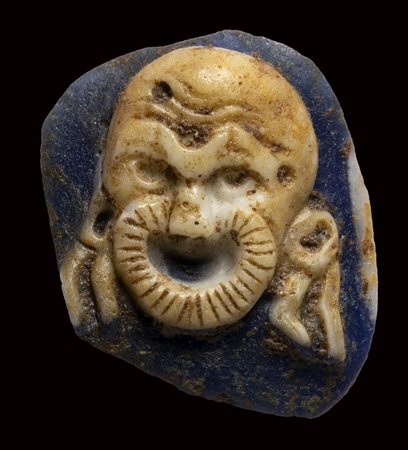
Lotto 173 A roman fragment two-layers blue and white glass cameo. Theatrical mask.
1st - 2nd century A.D.
23 x 27 x 8 mm
The white frontal mask emerges in high relief from a blue background and is characterized by a bold head with deep wrinkles on the fronthead.The eyes and the mouth are wide open emphasizing the caricatured expression. Two long locks fall behind the ears. Ancient patina deposits. Wear marks. Fine condition.
U.K., private collection 70's, in the same family since then. -
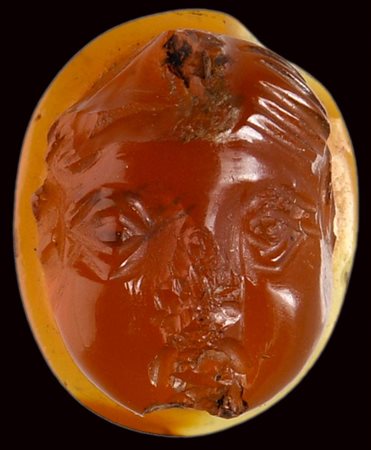
Lotto 174 A roman carnelian cameo. Eros.
1st century B.C. - 1st century A.D.
6,5 x 8,5 x 4 mm
The head of a child/Eros in very high relief; curl topknot in centre of forehead between parted hair. Detailed face features. Broken nose and chin. Chipping on edge. Flat back. Vivid color of the stone.
Parallels: M. Henig, H. Molesworth, The Complete Content Cameos, pp. 177-179 ("Eros head").
U.K private collection -
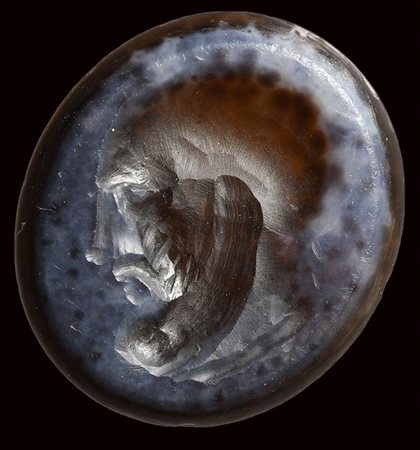
Lotto 175 A roman nicolo intaglio. Male portrait.
2nd - 3rd century A.D.
10,5 x 12 x 2 mm
The male character's face is turned to the left, and has a thick beard. The work is not finished.
Rare example of carving in progress, where traces of engraving tools are visible.
Attractive color of the stone.
U.K private collection -
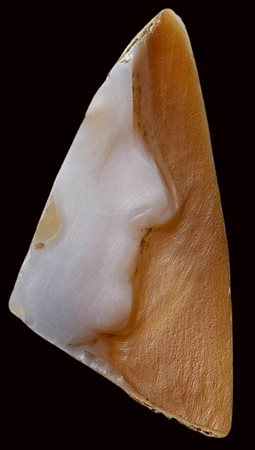
Lotto 176 A rare fragment of an unfinished large roman agate cameo. Imperial portrait.
1st century A.D.
13 x 25 x 4 mm
In this fragment of two-layered agate the traces of the sketch procedures and of the engraver tools for carving a cameo are clearly visible. In this case it had to be a portrait whose physiognomy recalls some profiles of the Jiulio Claudian dynasty. Also on the back there are traces of the wheel instruments. Rare.
U.K private collection -
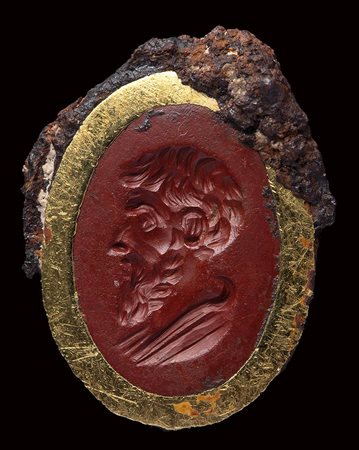
Lotto 177 A roman red jasper intaglio. Philosopher.
2nd - 3rd century A.D.
Intaglio : 11 x 14 mm
The effigy is characterized by a thick hair and a long beard, slightly curved nose, marked cheekbone, tunicate bust. The gem, characterized by an attractive bright red color, is still set in its original metal (fragmentary) setting formed by an iron ring (broken) with a gold frame.
U.K private collection, London. -
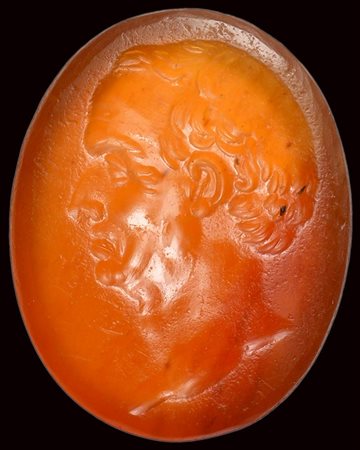
Lotto 178 A fine roman carnelian intaglio. Portrait of Maecenas.
1st century B.C. - 1st century A.D.
9 x 12 x 3 mm
This fine portrait, facing left, is characterized by physiognomic details expertly engraved, referable to known models identifiable as portraits of the famous roman character. The naturalistic and expressive features of the face, which reveal an advanced age, are inspired by the late Republican portraits. Slight wear marks.
See parallels: Boston, Museum of Fine Arts: 99.112; Story-Maskelyne, M.H.: The Marlborough Gems (1870): no. 517
Boardman, J., Scarisbrick, D., Wagner C., Zwierlein-Diehl, E: The Marlborough Gems (2009): no. 209
U.K private collection, London. -
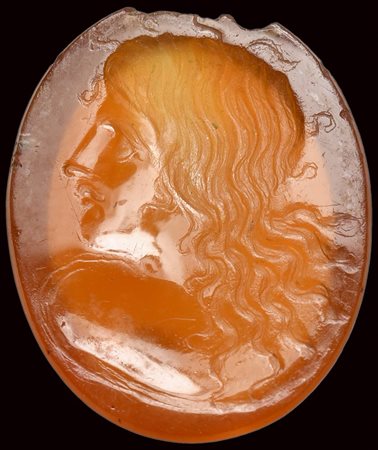
Lotto 179 A fine late hellenistic carnelian intaglio. Bust of Nereid.
1st century B.C.
12,5 x 16 x 3 mm
The young figure is turned to the left, and is characterized by a slightly open mouth, rounded chin, long and thick hair as moved by the wind, with strong inspiration from the Hellenistic models. The face, facing in profile, is characterized by delicate features finely engraved and mirror polished. The left shoulder is seen from behind, as in the typical movement of swimming. The figure is variously interpreted as Nereid or as Leandro crossing the Dardanelles to reach the lover Eros. By some the subject is interpreted as a marine divinity or Selene. The figure expresses beauty and elegance and shows a particularly refined execution. Attractive color of the stone. Slight wear marks. Missing on the edge.
Parallels: A. Giuliano, I cammei dalla Collezione Medicea del Museo Archeologico di Firenze, pp. 216-217; L. P. B. Stefanelli, La collezione Paoletti, vol. 1, tomo 2 n. 218, tomo 3 n. 480; Le Gemme Farnese, 1994, p. 122 n. 184 (225); G.M. A. Richter, Engraved gems. Greek, Etruscan and Roman, The Metropolitan Museum of New York, n. 150; J. Boardman, Greek gems and finger rings, n. 1003.
U.K private collection 80's. -
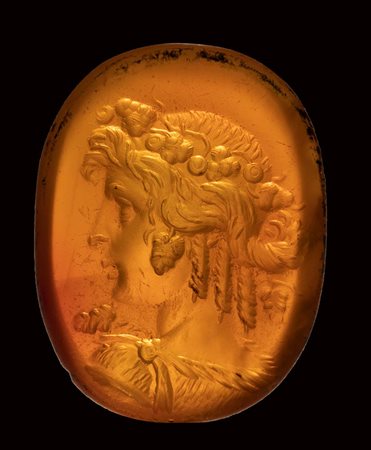
Lotto 180 A very fine late hellenistic carnelian intaglio. Bust of Bacchante.
End of 2nd - Beginning 1st century B.C.
17 x 23 x 3 mm
The figure is turned to the left, with the three-quarters bust seen from behind covered by a goat fur stopped by a round fibula on the shoulder; the head is in profile, with a thick and very detailed hair, decorated with small bunches of grapes and berries; braids descend on the neck. The face is characterized by a slightly sunken eye and a slightly open mouth, in the typical expressive rendering of late Hellenistic works. In this case it is a work referable to the Ptolemaic context and which presents a particularly close parallel with a carnelian intaglio of the Cabinet des Medailles, identified as a portrait of a Ptolemaic princess as a bacchante. Both carvings seem to come exactly from the same atelier. Wear marks.
Parallels: M.L. Vollenweider, Camées et intailles. Tome I. Les Portraits grecs du Cabinet des médailles, p. 146 n. 140.
U.K., private collection 80's.