
Auction 86 - Glyptics and Ancient Jewelry
-
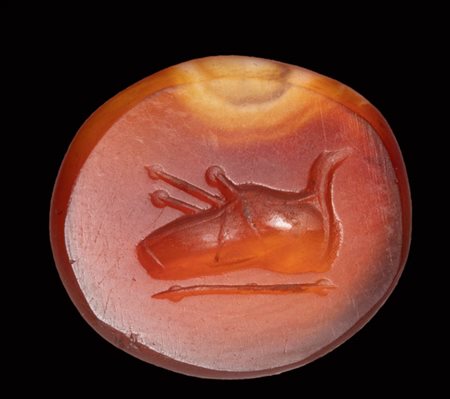
Lotto 109 A roman republican carnelian intaglio. Shoe of a haruspex.
1st century B.C.
9 x 10 x 2 mm
The Aruspice was a priest whi predicted the future analyzing animals viscera. His attributes and distinctive signs were the ituus and the typical shoe with curved raised point/rear termination. In this gem the shoe is facing left. Groundline. Use of globular elements. Attractive color of the stone. Rare.
Parallels: Antike Gemmen in Deutschen Sammlungen, Band IV, Hannover und Hamburg, n. 237 p. 65.
Monte-Carlo private collection, Mr. P.L, 1982 -
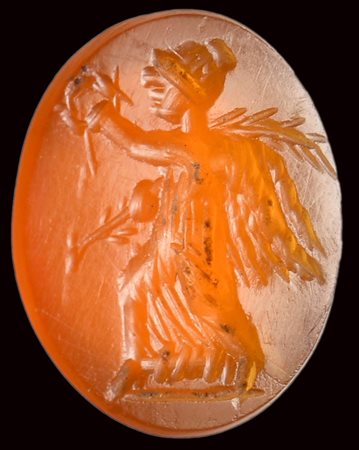
Lotto 110 A roman carnelian intaglio. Winged victory.
2nd - 3rd century A.D.
7 x 9 x 3 mm
The figure, facing left, holds a laurel wreath with the left hand and a palm branch with the right. Groundline.
U.K. private collection -
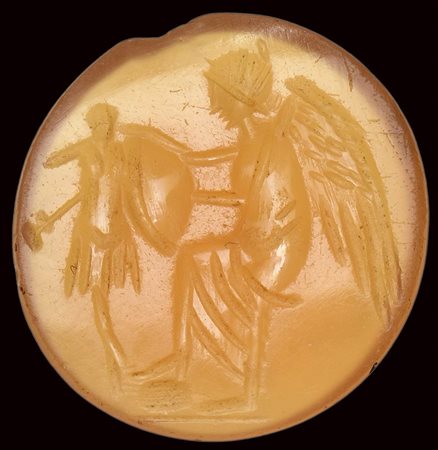
Lotto 111 A roman carnelian intaglio. Victory with a trophy.
2nd - 3rd century A.D.
14 x 15 x 2 mm
The winged personification of the victory is turned on the left side, with draped legs, putting a shield on a military trophy (in the same position, the victory is usually depicted also writing on the shield). Slight wear marks.
U.K. private collection -
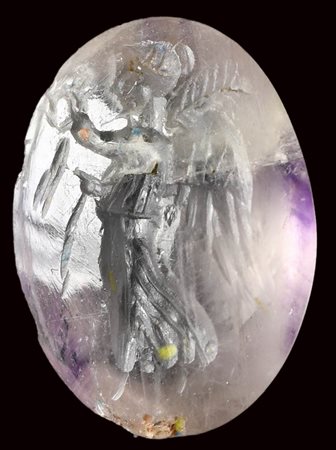
Lotto 112 A roman late republican amethyst intaglio. Victory with attributes.
1st century B.C.
8 x 11 x 4 mm
The draped and winged figure is turned to the left, holding the palm branch with the right hand and the laurel wreath with the left one. Use of globular elements. Light crack in the stone. Attractive variety of light colored amethyst with darker purple hues.
U.K. private collection -
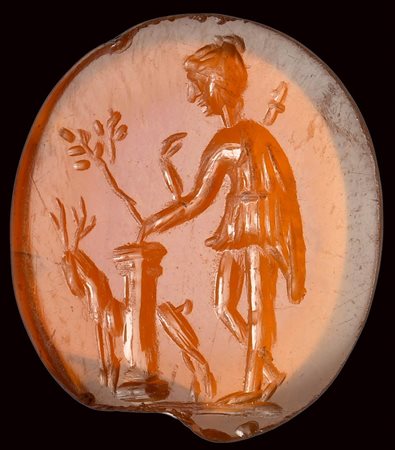
Lotto 113 A large roman carnelian intaglio. Artemis.
2nd century A.D.
13 x 15 x 3 mm
The goddess of the hunt faces left, and wears a short tunic with a cloak; the quiver can be seen on the shoulders. The figure holds a frond with her left hand just above a column, while she brings her right hand towards her face. Behind the small column is the deer, her sacred animal. Votive and devotional representation referable to the cult of Artemis. Beautiful composition. Attractive color of the stone. Chipping on the edge.
U.K private collection, London. -
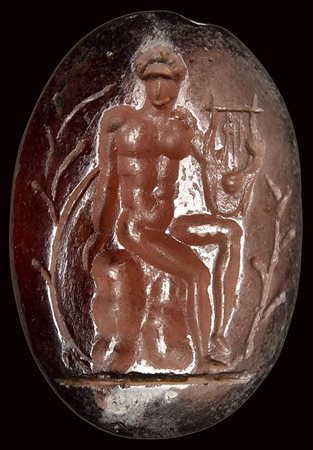
Lotto 114 A roman late republican garnet intaglio. Apollo citharedus.
1st century B.C.
9 x 13 x 3 mm
The naked deity is seated on top of the rocks, surrounded by plants. The figure is depicted with the front torso and legs slightly turned to the right. The body is characterized by a well accentuated musculature. With his left hand he holds the lyre in its typical pose inspired by classical Greek models. Ground line. Use of globular elements. Wear marks. Chipping on the edge. Attractive color of the stone.
U.K private collection, London. -
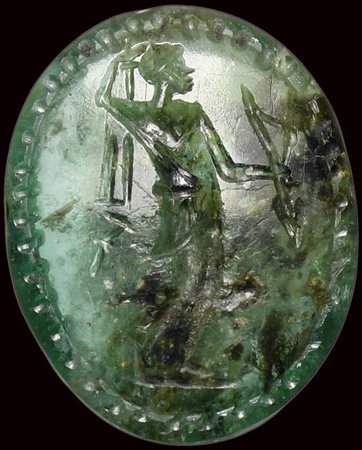
Lotto 115 A rare roman emerald intaglio. Artemis with a magical inscription.
1st - 2nd century A.D.
8 x 10 x 3 mm
The divinity of hunting is turned to the right. With his right hand she takes an arrow from the quiver, with his left hand she holds the bow. The young figure wears a short tunic. Dotted frame with ovoid elements around the goddess. Groundline. In the backside, magical inscription- symbols. Magical amulet with protective and votive function. Attractive precious stone. Slight wear marks. Very rare.
Parallel: U. Pannuti, Catalogo della collezione glittica, vol. I, p. 45 n. 63 (probably, from the same atelier).
U.K., private collection 70's, London. -
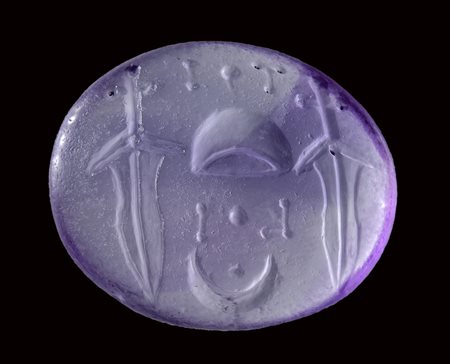
Lotto 116 A roman late republican amethyst intaglio. Emblema.
End of 1st century B.C.
14 x 17 x 5 mm
In the center, a Pileus between two daggers; in the field, the letters TI-LI and a crescent moon.The emblem is apparently inspired by the well known representation found on some rare coins minted under M. Brutus (for example, se the extraoronary Q. Servilius Caepio (M. Junius) Brutus AV Aureus.
Military mint travelling with Brutus in the East, late summer-autumn, 42 B.C. L. Plaetorius Cestianus, moneyer. Bare head of Brutus to right; BRVT above, IMP before, L • PLAET • CEST behind / Pileus between two daggers of differing design, their points downwards; below, EID • MAR. A. Campana, Eidibus Martiis (forthcoming), 13 (O1/R6) and pl. 1,13 (this coin); Crawford; Sydenham; BMCRR - etc.). However, the gem seems to have different references and names, to be identified (“TILI” as an abbreviation of Atili?).
Since there is no written reference to the Ides of March as in the coins, but an unidentified name, the meaning of this emblem is not entirely identifiable, probably referable to Brutus and his tyrannicide, perhaps by one of his political follower. The presence of the moon refers to an augural, magical but also commemorative value of the stone.This intaglio is characterized by stylistic details typical of the late Roman republican style, such as the globular elements, the rendering of the letters and daggers (as in the coins), in the composition and in the shape / choice of the stone variety (a very clear amethyst, almost transparent, with dark purple shades). The gem is expertly engraved and polished (the blades of the daggers take on a sharp and deadly aspect). The stone is characterized by signs of wear on the entire surface. Rare.
U.K., private collection A.L., 70's-80's, London. -
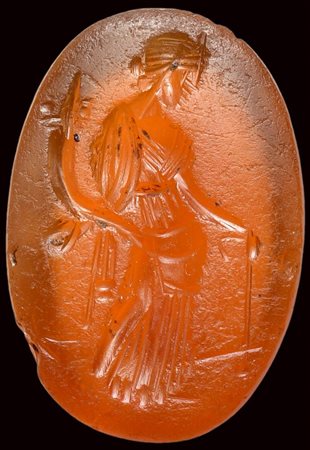
Lotto 117 A roman carnelian intaglio. Fortuna-Tyche.
2nd - 3rd century A.D.
9 x 13 x 4 mm
The personification of the abundance is standing, draped and turned to the right.
In the left hand: the rudder; in the right hand: cornucopia. Slight wear marks.
U.K private collection -
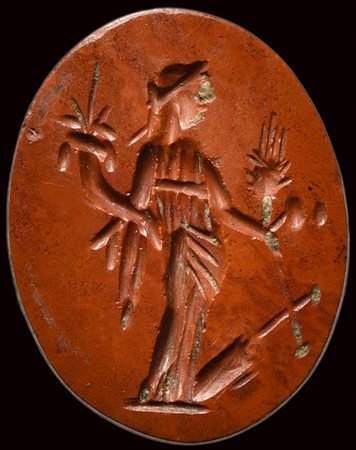
Lotto 118 A roman red jasper intaglio. Tyche-Fortuna.
2nd - 3rd century A.D.
8,5 x 11 x 2,5 mm
The personification of abundance is standing, and she holds the cornucopia with a drapery in his right hand, the rudder, a poppy flower and a ear of corn in her left hand. Groundline.
U.K private collection -
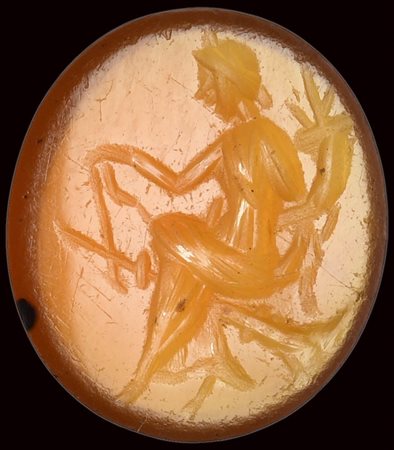
Lotto 119 A roman carnelian intaglio. Fortuna-Tyche.
2nd - 3rd century A.D.
10 x 12 x 2 mm
The personification of the abundance is seated on the rudder, facing left; with the right hand she holds the rudder, with the left she holds the cornucopia. Rare and unusual allegorical depiction. Slight wear marks.
U.K private collection -
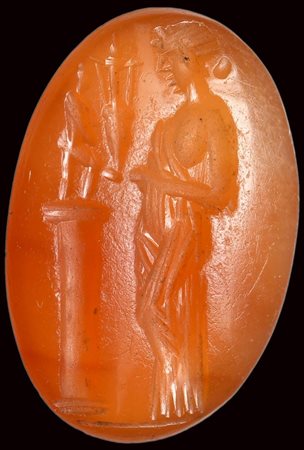
Lotto 120 A roman carnelian intaglio. Offerer.
2nd - 3rd century A.D.
10 x 15 x 4 mm
The standing and draped female figure is turned to the left. With both hands, she offers a small amphora to an idol on top of a column. Votive scene. Slight wear marks.
U.K private collection, London.