
Auction 86 - Glyptics and Ancient Jewelry
-
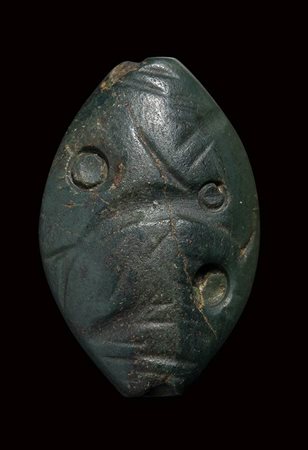
Lotto 1 A minoan amygdaloid green jasper engraved seal.Fish with talismanic symbols .
First half of the 2nd millenium B.C.
13 x 19 x 7 mm
The animal is facing right. Drilled details. The stone is drilled lenghtwise.
Slight crack on the surface. Wear marks. Rare.
Parallels :
J. Paul Getty Museum, inv. 2001.14.24; J; Boardman, Greek gems and finger rings, Early Bronze Age to Late Classical, 1970, Ch.II, pl. 73; See parallels: Antiken Gemmen, band II, Berlin, n. 12.
U.K., private collection 70's, in the same family since then. -
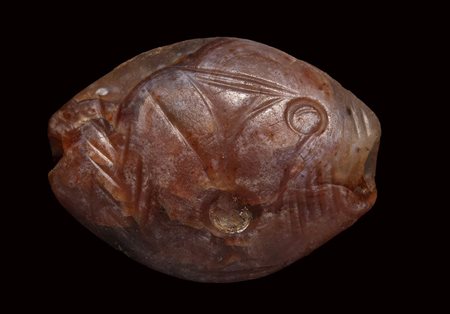
Lotto 2 A minoan amygdaloid agate engraved seal. Talismanic jug.
First half of the 2nd millenium B.C.
15 x 21 x 8 mm
Talismanic jug with floral and cross-hatching.
This symbol is a common pattern for this type of seals.
Drilled lenghtwise. Wear marks. Rare.
Parallels :
J. Paul Getty Museum, inv. 2001.14.24; J. Boardman, Greek gems and finger rings, Early Bronze Age to Late Classical, 1970, Ch.II, pl. 72; See parallels: Antiken Gemmen, band II, Berlin, n. 17.
U.K., private collection 70's, in the same family since then. -

Lotto 3 A minoan hematite engraved seal. Two swans.
2nd millenium B.C.
16 x 17 x 6 mm
A lentoid-shape seal with two swans turned on the left. Wings spread. Groundline. Wear marks.
The seal is drilled lenghtwise. Rare.
Parallels : Siegel CMS I 273b; J. Boardman, Greek gems and finger rings, Early Bronze Age to Late Classical, 1970, Ch.II, pl. 94
U.K., private collection 70's, in the same family since then. -
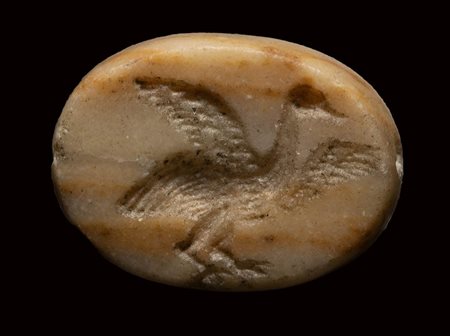
Lotto 4 An early greek alabaster seal. Swan.
2nd millenium B.C.
13 x 18 x 8 mm
The bird is turned on the right, wings spread. Convex backside. Wear marks. Rare.
Parallels : Athens, National Museum, inv. 1793; Siegel CMS I 258.
U.K., private collection 70's, in the same family since then. -
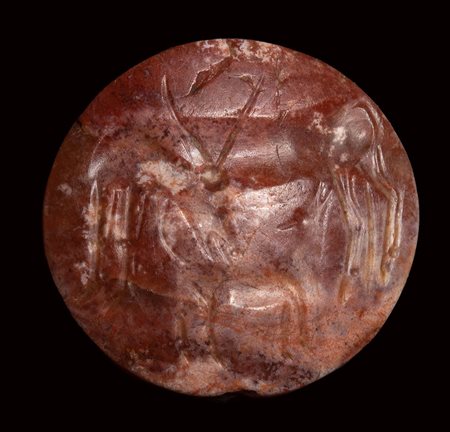
Lotto 5 A mycenaean agate engraved seal. Antilope with her cub.
2nd millenium B.C.
Diam. 18 x 7 mm
A fine lentoid-shape seal with antilope turned on the left and leaning toward her cub facing right. The seal is drilled lenghtwise. Attractive color of the stone. Small crack on top. Wear marks. Rare.
Parallels : J. Boardman, Greek gems and finger rings, Early Bronze Age to Late Classical, 1970, Ch.II, fig. 133; See parallels: Antiken Gemmen, band I, Munchen, n. 74; Athen, National museum, inv. 3178; Siegel CMS I 125
U.K., private collection 70's, in the same family since then. -
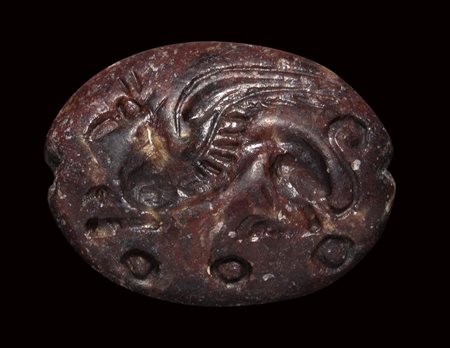
Lotto 6 A mycenaean red jasper engraved seal. Griffin.
2nd millenium B.C.
12 x 16 x 6 mm
The creature is turned left and characterized by large wings, the feathers marked by large incisions. The tip of the tail is curved. Below, three circles. The stone is drilled
lenghtwise. Wear marks. Rare.
U.K., private collection 70's, in the same family since then. -
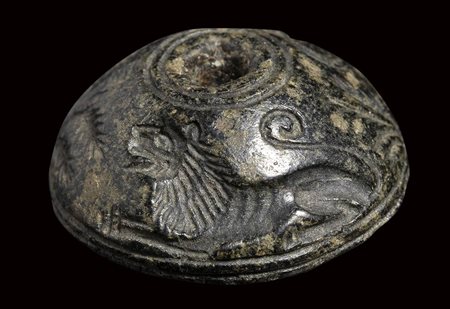
Lotto 7 An early greek serpentine engraved seal. Hunting scene.
Beginning of 1st millenium B.C.
Diam. 30 x 12 mm
The large tronconic seal is drilled highwise. The surface is engraved with a hunt scene; a lion facing left and a deer. The two animals are separated by two trees. Use of globular elements. Fine execution. Slight wear marks. Rare.
U.K., private collection 70's, in the same family since then. -
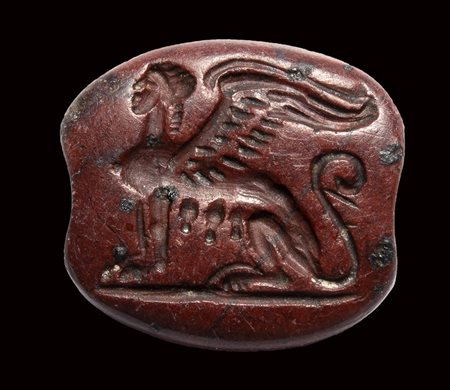
Lotto 8 An archaic greek red jasper engraved seal. Seated sphinx.
Beginning 1st millenium B.C.
14 x 16 x 5 mm
The ovoid seal is drilled lenghtwise. The sphinx is turned on the left, with large wings and three udders pending below her belly. Groundline. Wear marks. Rare.
U.K., private collection 70's, in the same family since then. -
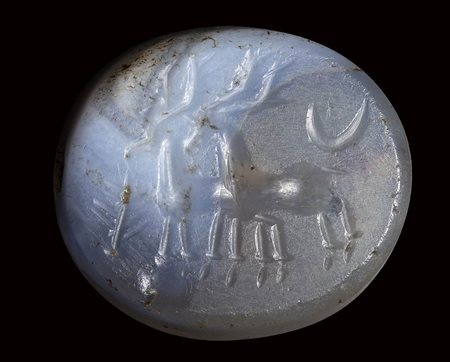
Lotto 9 A graeco persian chalcedony engraved seal. Two stags.
6th century B.C.
17 x 19 x 9 mm
The two animals are facing left and characterized by large horns. On the right, crescent moon, a branch on the left. The seal is drilled lenghtwise.
Parallels for the style: J. Boardman, Greek gems and finger rings, p. 355, pl. 942
UK private collection, London. -
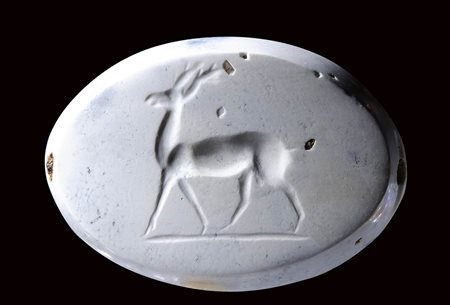
Lotto 10 A large eastern greek burnt chalcedony seal intaglio. Deer.
5th-4th century B.C.
22 x 31 x 17 mm
The walking animal is facing left, and characterized by a well-marked anatomy. Groundline. The seal is drilled lengthwise, the back side in ovoid-shape and the entire surface is still well polished but burnt, with very slight lacks. Rare.
Parallels: G.M.A. Richter, Catalogue of engraved gems, The Metropolitan Museum, New York, p. 28 n. 109-113; J. Boardman, Greek Gems and Finger Rings, p. 355 n. 940 ss.
UK private collection, London. -
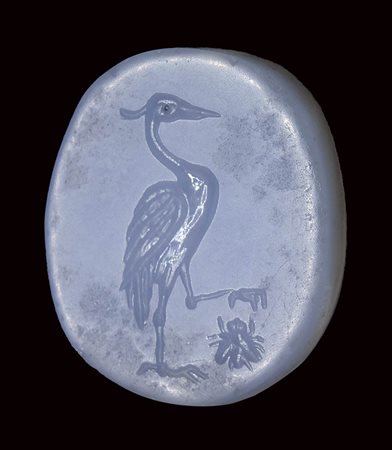
Lotto 11 A fine greek blue chalcedony double sided seal intaglio. Heron hunting an insect / hazelnut.
5th century B.C.
15 x 18 x 7 mm
The animal is facing right and grabbing a flying insect (fly or bee), an idyllic naturalistic repertoire of classical Greek glyptics. The scene is composed with elegance and engraved with great skill: the sharp beak is still clenched; the paw ready to grab the insect; the other paw on the ground to ensure balance to the bird. The reverse of this refined blue chalcedony seal presents a partially peeled hazelnut, engraved with realistic sense and great technical expertise. The carving is expertly polished, while the surface of the stone shows signs of wear and very slight corrosion in front. Backside, a large whitish spot to be considered as a characteristic of the stone itself (layer or burnt?). The artifact, drilled lengthwise, is to be considered of great rarity and beauty.
Parallels: Antike Gemmen in Deutschen Sammlungen, band II, Berlin n. 180, inv. FG311; J. Boardman, Greek Gems and Finger Rings, p. 288 n. 469; p. 289 n. 490, p. 287 n. 514, 518-519.
U.K., private collection 70's, in the same family since then. -
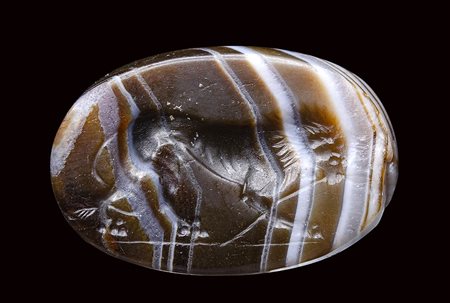
Lotto 12 A fine greek banded agate scaraboid seal intaglio. Lion.
5th century B.C.
17 x 25 x 13 mm
The scene depicts a lion facing right with a branch (?) in his mouth. The animal is characterized by realistic anatomic details; the body musculature and the coasts with rendering volumes. The crest and tail hair are depicting by thin engraved lines meanwhile the eyes, the articulations and the terminals of the feet by globular elements. Groundline. Scaraboid shape and pierced lengthwise. This large stone is masterfully engraved with refined details and artisitc sense of composition. The style of this engraving is referable to classical Greek production, probably identifiable in that transition phase between the archaic and early classical age. Some of these stylistic and executive details are also in the Graeco-Persian production, with numerous stylistic similarities both in the iconography and in the engraving technique. Beautiful colors and fine variety of banded agate. Sligth wear marks. Very rare.
Parallels: J. Boardman, Greek Gems and Finger Rings, p. 185 n. 388 ss.; p. 290 n. 520, p. 292 n. 575; p. 352 n. 866 (greco-persian, "Court Style"). J. Boardman, Archaic Greek Gems, plate XXXI. G.M.A. Richter, Catalogue of engraved gems, The Metropolitan Museum, New York, p. 15 n. 55, n. 101.
UK private collection, London.